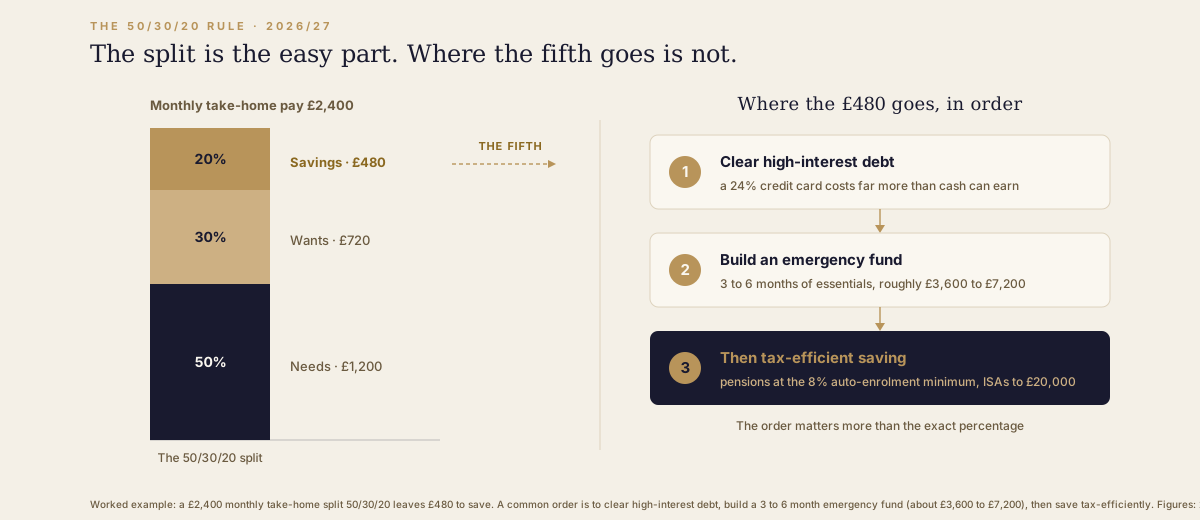
The 50/30/20 rule divides take-home income into three portions: fifty percent for essential living costs, thirty percent for discretionary spending, and twenty percent for savings and debt repayment. Treat the split as a flexible starting point rather than a fixed rule: the value lies in giving every pound a job, not in hitting the exact percentages. In the UK, housing costs and auto-enrolment deductions frequently push all three bands out of shape before a penny is consciously allocated. What matters most is not the exact split, but where you direct the savings.
Few budgeting methods have travelled as far as the 50/30/20 rule. It promises to turn the awkward business of managing money into three clean slices: half of your take-home pay for needs, just under a third for wants, and a fifth set aside. The appeal is obvious, and for a lot of people it is a perfectly sensible place to start. The more useful question, and the one that gets far less attention, is what happens to that final fifth once you have it, because that is the part that quietly decides the shape of everything that follows. All figures in this article reflect the 2026/27 tax year.
Does the 50/30/20 rule work in the UK?
The 50/30/20 rule works as a starting framework in the UK, but housing costs routinely push essential spending past 50% of take-home pay for many households. Auto-enrolment pension contributions and student loan deductions reduce your net pay before you see it, further tightening the split. Treat it as a calibration point to adjust, not a fixed target to hit.
Contents
- What is the 50/30/20 rule?
- Does the 50/30/20 rule work in the UK?
- Does auto-enrolment count towards the 20%?
- Why does the 20% matter more than the split?
- Where your savings go matters more than the split
- How does the rule fit into a longer plan?
- Should you adjust the percentages?
What is the 50/30/20 rule?
The 50/30/20 rule is a budgeting method that divides your take-home pay into three parts: 50% for needs, 30% for wants, and 20% for saving and repaying debt. It was popularised by the US senator Elizabeth Warren in her book All Your Worth, and its strength is that anyone can apply it in about five minutes without a spreadsheet.
Two details are easy to miss. First, the rule works on net pay, the money that actually lands in your account after tax, National Insurance and any deductions, not your headline salary. Second, it asks you to be honest about the difference between a need and a want. Rent, council tax, the weekly food shop and getting to work are needs. The streaming bundle, the takeaway and the weekend away are wants, however much they feel like essentials by Friday.
Does the 50/30/20 rule work in the UK?
The 50/30/20 rule works in the UK as a rough guide, but several British realities tend to push the percentages out of shape before you have even started. The biggest is housing. In large parts of the country, rent or a mortgage alone can swallow a third or more of take-home pay, and once bills and travel are added, essential spending routinely climbs past the 50% mark. When that happens, the rule does not fail at the savings line, it fails at the needs line.
Then there are the deductions that happen before your pay ever reaches you. If you are enrolled into a workplace pension and retirement planning arrangement, and most employees now are, a slice of your income is redirected into saving before you ever see it. Student loan repayments come out at source too. The clean net figure the rule assumes is, for many UK workers, already carved up in ways the original model never accounted for.
None of this makes the rule useless. It makes it a starting calibration rather than a verdict. If your needs genuinely cost 60% of your pay, the honest response is to adjust the other two figures with your eyes open, not to pretend the gap is not there.
Risk warnings
Your home may be repossessed if you do not keep up repayments on your mortgage. Think carefully before securing debts against your home.
Not all mortgage contracts are regulated by the Financial Conduct Authority.
Does auto-enrolment count towards the 20%?
Usually not, because auto-enrolment contributions are typically taken out before your take-home pay is even worked out, which means they sit outside the net figure the rule asks you to divide. Most workplace pensions set up under auto-enrolment deduct your contribution from your salary before income tax, so the money never lands in your account. When you split your take-home pay 50/30/20, you are dividing income that has already had pension saving stripped out of it. The 20% you consciously set aside is on top of a contribution you may barely notice. The exception is a relief at source scheme, where the contribution does come out of your pay after tax, in which case it genuinely is part of the money you are dividing.
This cuts two ways, and both are worth sitting with. The encouraging part is that your true savings rate is higher than the visible fifth, because the pension is quietly working away above the line, with an employer contribution and tax relief attached to it. The less comfortable part is that your take-home figure is smaller than your gross pay, so fixed essentials such as rent claim a larger share of what is left, which is part of why the 50% needs band feels so tight for so many people. The minimum total contribution under auto-enrolment is 8% for 2026/27, charged on the slice of pay inside the qualifying earnings band rather than on all of it, and opting out forfeits your employer’s share entirely. The practical question is whether to treat your conscious 20% as genuinely additional long-term saving, or to count the workplace pension towards your overall saving target and direct the remainder with that in mind. There is no single right answer. It depends on whether your total rate, pension included, is enough for the future you are actually planning for.
How does auto-enrolment affect the 50/30/20 rule?
Auto-enrolment contributions are usually deducted from salary before take-home pay is calculated, so they sit outside the net figure the rule divides. Your visible 20% is therefore on top of the pension contribution already leaving your pay. On qualifying earnings, the minimum total contribution is 8% for 2026/27, split between employee and employer.
Risk warning
Levels and bases of, and reliefs from, taxation are subject to change and their value will depend upon personal circumstances. Taxation and pension legislation may change in the future.
Why does the 20% matter more than the split?
The 20% matters more than the split because each pound within it can do fundamentally different work: clearing a 24% credit card balance, sitting in a rainy-day account, and compounding inside a pension for thirty years produce entirely different outcomes. Most discussion of the rule gets stuck on a different question: is 20% enough? It is an understandable thing to ask and almost always the wrong place to start. The more revealing question is what job each pound of that 20% is actually doing.
This is the same trap as asking how much pension is enough before you have looked at what really drives the number. In both cases the figure feels like the important part, when in fact the structure beneath it does most of the work. A fifth of your income saved badly can quietly underperform a tenth saved well.
A budget does not build wealth. What you point the savings at does.
Where your savings go matters more than the split
Two people can follow the rule identically and end up in completely different financial positions, because the rule tells you how much to save, not where to put it. The account or investment wrapper you use often does as much heavy lifting as the amount itself, through tax treatment, employer contributions and the simple matter of whether the money is invested or left as cash.
Understanding the main types of investment and how they differ from cash is part of this. Cash is certain and instantly available, which makes it the right home for an emergency fund. Over long periods, however, money left entirely in cash has historically struggled to keep pace with rising prices, while money that is invested has had the chance to grow. Investing carries risk and values can fall as well as rise, so the choice is really about matching the money to its purpose, not chasing returns.
Two budgets that look identical on paper, pointed entirely at cash.
Aisha, 31, take-home pay of £2,400 a month
Aisha follows the rule to the letter. Half of her pay covers rent, bills and travel, just under a third goes on the things she enjoys, and the remaining 20%, around £480 a month, goes straight into an easy-access savings account.
She is consistent and never dips into it. Once her emergency fund feels comfortable, she keeps adding to the same account, because the rule told her to save and the money feels safe where it is.
After several years she has a healthy cash balance. But the interest, once rising prices are taken into account, has barely kept her money standing still. Every pound she saved is still, in real terms, close to a pound.
The same 20%, pointed somewhere different.
Sam, 31, take-home pay of £2,400 a month
Sam saves exactly the same 20%, around £480 a month, and keeps a cash buffer for emergencies just as Aisha does. The difference is what happens to the rest of it.
Sam increases their workplace pension by £150 a month to capture the full employer match. Many employers match additional contributions up to a set level, so that £150 from Sam’s pay is met by roughly £150 from the employer, with tax relief added on top. The remainder goes into a Stocks and Shares ISA.
Before a penny of investment growth, the matched portion has already roughly doubled: £150 has become around £300 and more. The same £150 in Aisha’s account is still £150. Over a working lifetime, that gap compounds into a difference measured in many thousands of pounds, and often well beyond.
On paper, the two budgets are indistinguishable. Both save 20%, both keep an emergency buffer, both show the same admirable discipline. What separates their futures is not how much they saved but where it landed. This is also why a detail that is easy to overlook can reshape a plan: from 6 April 2027, savers under 65 will be able to hold in a cash ISA a maximum of £12,000, with the balance of their annual ISA allowance of £20,000 a year for 2026/27 needing to go into stocks and shares or another non-cash ISA. The question of where your savings sit is only becoming harder to avoid.
Risk warnings
ISAs
The favourable tax treatment of ISAs may be subject to changes in legislation in the future.
An investment in a Stocks & Shares ISA will not provide the same security of capital associated with a Cash ISA.
Pensions
A pension is a long-term investment, the value of your investment and the income from it may go down as well as up. Your eventual income may depend upon the size of the fund at retirement, future interest rates and tax legislation.
How does the rule fit into a longer plan?
The rule provides a spending structure for now; a financial plan maps whether that structure is on course for the future you are actually aiming at. The split that suits you at 25, when a deposit and any expensive debt dominate, rarely suits you at 40, when childcare can consume the entire 30% and more, or at 58, when the mortgage is gone and you may be able to save far more than a fifth. Holding the same three percentages across all of those stages would be a strange thing to do.
The real value of any budgeting rule is the habit it builds, not the precision of its numbers. Once the habit of saving is in place, the more important work is checking whether the split is actually pointing you towards the life you want. That is the job of lifetime cashflow modelling, which maps what you save today against the future you are planning for and shows whether the two are on speaking terms.
Should you adjust the percentages?
Yes, adjusting the percentages is not breaking the rule, it is using it properly. The framework was always meant to be a default to refine, not a law to obey. A few considerations tend to matter more than the exact figures:
- If essential costs already exceed 50%, protect the saving line first and look hard at the wants, rather than abandoning the structure entirely.
- If you are carrying expensive debt, the savings portion often does more good clearing that debt than sitting in an account earning less than the debt costs.
- A budget should also account for what happens if your income suddenly stops, which is where protection planning belongs in the picture.
- If you are a higher earner, 20% may be far too modest. For those with the capacity, the more useful target is to save what the plan requires, not what a rule of thumb suggests.
Is the 50/30/20 rule enough on its own?
The 50/30/20 rule earns its popularity by being simple enough that people actually use it, which is no small achievement in personal finance. But the percentages are the scaffolding, not the building. Two people can follow the rule to the letter and arrive in entirely different places, because deciding to save is only the first decision. Where that money goes, and whether the split still serves the life you are planning for, is where the real work begins.
Frequently asked questions
What is the 50/30/20 rule?
The 50/30/20 rule is a budgeting method that splits your take-home pay into 50% for needs, 30% for wants, and 20% for savings and debt repayment. It was popularised by the US senator Elizabeth Warren and is applied to net income, after tax and pension deductions. It is designed as a simple starting structure rather than a precise prescription.
Does the 50/30/20 rule work in the UK?
The 50/30/20 rule works in the UK as a general guide, but UK housing costs, student loan deductions and workplace pension contributions often push the percentages out of shape. In higher-cost areas, essential spending alone can exceed 50% of take-home pay. The percentages are best treated as a starting point to adjust, not a fixed target.
Is the 50/30/20 rule based on gross or net pay?
The rule is based on net pay, meaning your take-home income after income tax, National Insurance and any pension or student loan deductions. Using gross pay would overstate what you actually have available to allocate. For employees auto-enrolled in a workplace pension, some saving is already happening before the 20% is calculated.
What counts as a need versus a want?
A need is spending you cannot reasonably avoid, such as rent or mortgage payments, utility bills, food and essential travel. A want is discretionary spending that improves your life but is not essential, such as dining out, subscriptions and holidays. The line is not always clean, and being honest about which is which is the hardest part of the rule.
What should the 20% savings go towards first?
As a general order of priority, the 20% typically goes towards clearing high-interest debt and building an emergency fund before any longer-term saving. Once a cash buffer is in place, attention usually turns to tax-efficient saving such as workplace pensions and ISAs. The right order depends on your circumstances, so this is general information rather than personal advice.
Is saving 20% of your income enough?
For most people saving from their twenties, 20% directed into matched pension contributions and invested over decades builds a meaningful foundation. For later starters or higher earners, 20% is rarely enough, and the destination of the savings matters as much as the percentage. Whether it is sufficient depends on your goals, your age, and what the money is working hard to do.
How does auto-enrolment affect the 50/30/20 rule?
Auto-enrolment contributions are usually deducted before you receive your take-home pay, so they sit outside the net figure the 50/30/20 rule divides rather than inside the 20%. This means your true savings rate is higher than the fifth you consciously set aside, but your take-home base is also smaller. The minimum total contribution is 8% for 2026/27, charged on qualifying earnings rather than the whole of your pay, and opting out forfeits your employer's share.