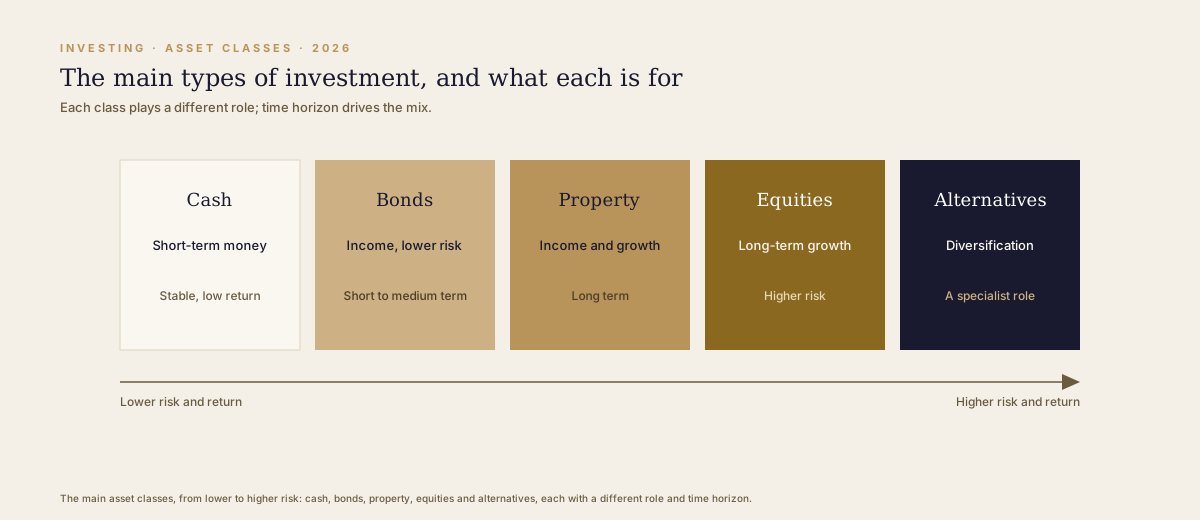
The main types of investments are broad asset classes including cash, bonds, equities, property and alternatives, each with different risk, return and diversification characteristics. Which mix suits you depends mainly on your time horizon rather than risk appetite alone. Each class plays a different role inside a financial plan: short-term money belongs in cash and bonds, long-term money in equities and property. Small changes to the allocation, such as separating near-term spending from the longer-term pot, can have a larger effect on retirement outcomes than which funds are selected.
The five main types of investment in the UK are cash, bonds, equities, property and alternatives. Each behaves differently, carries different risk and return characteristics, and serves a distinct purpose in a well-structured financial plan. Knowing what each type of investment is for tells you far more about whether your money is working for you than any ranking of last year’s best-performing funds. All figures and calculations in this article reflect the 2026/27 tax year.
What is the difference between an asset class and a tax wrapper?
An asset class describes the underlying investment, such as equities, bonds or property, while a tax wrapper is the legal structure holding it. In the UK, the same fund can sit inside an ISA, pension or general account and face very different tax treatment despite identical investment performance.
- Why is choosing investments first a mistake?
- What are the main types of investments?
- What is each investment type actually for?
- How does the same risk look different at different ages?
- How can a small change reshape an investment plan?
- Why does the investment wrapper matter as much as the investment?
- What does real diversification look like?
- Which types of investment suit your situation?
- What questions should a financial plan answer first?
Why is choosing investments first a mistake?
Choosing investments first is a mistake because there is no way to test whether they are right without a goal to measure them against. It is a failure mode in personal investing that no amount of reading about funds will fix: choosing investments first, and asking later whether they fit the plan. The plan has to come first. Without it, the question “what should I invest in?” has no answer, because there is no test for what a good answer looks like.
A 30 year old saving for a deposit in three years, a 50 year old building a pension pot, and a 70 year old drawing income are three different problems. They share the same vocabulary of investment types, but the right mix in each case is almost completely different. Same toolkit, different jobs.
This is why a clear understanding of what each main investment type is, and what it brings to a plan, is more useful than a ranked list of options.
What are the main types of investments?
There are five main types of investment: cash, bonds, equities, property and alternatives. Investors and economists group them by what they call asset classes, categories of holding that tend to behave in similar ways. The four traditional asset classes, plus a fifth grouping for everything that does not fit neatly, are described below.
Cash and cash equivalents
This covers bank deposits, savings accounts, fixed-rate bonds offered by banks, National Savings products, and money market funds. The defining feature is capital security in nominal terms: a pound deposited will return as a pound, plus interest.
What cash does not protect against is the slow erosion of purchasing power. Inflation at 2.5% halves the real value of a sum of money in roughly 28 years. At 4%, it does so in 18. Cash sitting still loses ground in real terms whenever the interest rate after tax is below the rate of inflation.
Bonds and gilts
Bonds are loans. When an investor buys a UK government bond, called a gilt, they are lending money to the Treasury in exchange for a fixed coupon and the return of capital at maturity. Corporate bonds work the same way, with a company as the borrower.
Bonds have historically been used in portfolios for two purposes: to generate income and to dampen the volatility of equity holdings. Both of those uses have looked less reliable in recent years. The 2022 fall in bond prices, as interest rates rose sharply, reminded investors that bonds and safety are not synonyms. Understanding how gilt yields move explains the mechanics behind that relationship.
Equities
Equities are shares in companies. Holding a share means holding a small claim on the future profits of a business. Returns come from two sources: dividends paid out of profits, and capital growth when the share price rises.
Over long periods, equities have delivered the highest real returns of the main asset classes. Over short periods, they have also delivered the most violent falls. The willingness, and the ability, to leave equity money invested through significant drawdowns is what allows the long-term return to be earned. Most of the gap between investor returns and fund returns comes from selling at the wrong moment.
Property
Property is held as an investment in two main ways. Direct ownership of physical buildings, residential or commercial, and indirect ownership through Real Estate Investment Trusts (REITs) or property funds.
Direct property is illiquid, concentrated in single assets, and operationally demanding. Indirect property is more diversified and tradeable, but during stressed markets some property funds have suspended redemptions because the underlying assets cannot be sold quickly enough to meet outflows. This is a feature of the asset, not a flaw in the fund.
Alternatives
This is a catch-all bucket for investments that do not fit the four classes above. It includes commodities and gold, infrastructure, private equity, hedge funds, and increasingly things like venture-stage company investments held through structures such as Enterprise Investment Schemes.
The case for alternatives is that they behave differently to equities and bonds, so adding a small allocation can improve the smoothness of a portfolio’s path. The reality is that the costs, complexity and access requirements vary enormously, and the diversification benefit can disappear in the periods when it would be most useful. The FCA’s InvestSmart campaign sets out how to assess higher-risk investments and the protections that apply to regulated and unregulated products.
Risk warnings
Pension drawdown
Drawdown pension plans (unsecured income) are complex and are not suitable for everyone. Pension decisions can affect your income for the rest of your life (and that of any partner and other dependants). Where benefits are accessed on a flexible basis, these are not fixed or safeguarded for life. If security of income is important to you then you should consider purchasing an annuity or taking a scheme pension to provide a secured level of income.
Cash and deposits
While cash provides security of capital, it may not keep pace with inflation. Over time, the real value of your savings could fall.
Interest rates are not guaranteed to remain at current levels. Rates available when your fixed/notice account matures may be lower, and any reinvestment could earn less.
If your circumstances change, breaking a fixed-term arrangement early may reduce the interest you receive.
EIS, SEIS and VCTs
EIS and SEIS investments should be viewed as high risk and not suitable for everyone.
EIS and SEIS’s by their nature are illiquid and invest in small unlisted companies, which are not traded on a stock market exchange and tend to fluctuate more in value.
Loss of investment capital, in part or full, must be considered prior to investing in an EIS or SEIS.
What is each investment type actually for?
Each investment type serves a distinct job inside a financial plan, determined by when the money will be needed and what a loss at that point would cost. A useful way to think about it is to assign each type a clear purpose.
Cash is for spending soon and for emergencies. Money that will be needed inside roughly three to five years, or that supports an unplanned expense, sits here because the cost of being wrong about the market is higher than the cost of missing some return.
Bonds are for medium-term stability and, in a drawdown portfolio, for the part of the pot that will fund spending in the next several years. They reduce the risk that a market fall forces the sale of equities at a bad price.
Equities are for long-term real growth. Money that will not be touched for ten years or more is the money that can best absorb short-term volatility in exchange for the higher expected long-term return.
Property and alternatives are for diversification and, in some cases, for specific tax or estate planning roles. They are rarely the foundation of a plan, but they can be a useful part of one.
Risk is more than the chance that an investment falls in value. It is the chance that it falls in value at the moment you need it.
That distinction is what makes the planning question come before the portfolio question.
Risk warning
The Financial Conduct Authority does not regulate some aspects of Trust, Tax and Estate Planning.
How does the same risk look different at different ages?
The same market fall represents a completely different risk depending on whether the money will be needed in two years or twenty, because the time available to recover changes everything. For a 35 year old contributing to a pension every month, the biggest risk is not market volatility. It is inflation eroding the real value of their savings over the next three decades, and the opportunity cost of holding too much in cash for too long. For them, an equity-heavy allocation is often the better fit, because it gives the money a chance to outgrow inflation over that time, at the price of a bumpier path.
For a 60 year old five years from retirement, the picture changes. Sequence of returns risk, the risk that a poor market run in the years immediately around retirement leaves a much smaller pot to draw from, becomes the dominant consideration. The right answer is not to abandon equities, but to think about which part of the pot is for spending in the next few years, and to hold that part differently.
For someone already drawing income, the structure of the portfolio drives how durable that income is. A pot that is fully invested in equities can be devastated by a fall in year two of retirement, because each withdrawal locks in a loss that compounds against any future recovery.
The same person, holding the same broad investments, can be exposed to very different risks depending on where they are in their plan. Modelling those risks over a realistic time horizon is one of the things lifetime cashflow planning is designed to do.
Risk warning
The Financial Conduct Authority does not regulate Cashflow Planning.
How can a small change reshape an investment plan?
A single change, such as carving off a cash buffer to cover near-term spending, can reduce how much lasting damage a market fall does to a retirement income plan. The two cases below are illustrative, with the figures simplified for clarity. They are not predictions, and they do not represent any specific individual or recommendation.
Case one: the two year cash buffer
Take a couple who retire at 65 with a pension pot of £500,000, planning to draw £25,000 per year (rising with inflation) to top up their state pensions. They have a portfolio of 80% global equities and 20% bonds.
In version A, they hold the entire pot in that allocation, with no separate cash buffer. In version B, they make one change: they carve off £50,000 into a cash and short-dated bond bucket, leaving the remaining £450,000 invested. Each year, they spend from the cash bucket and refill it from the investment pot when markets are above their starting level.
Imagine that the equity market falls 30% in the second year of their retirement and takes four years to recover.
In version A, both years’ withdrawals come straight out of an already-falling pot. Selling £25,000 of equities when they are 30% down is the equivalent of selling roughly £36,000 worth at the previous level. By the time the market has recovered, the pot has been hollowed out enough that the same level of income now represents a much higher withdrawal rate, and the plan is genuinely fragile.
In version B, the same fall happens, but roughly the first two years of spending after it come from the buffer, so nothing is sold at the bottom. The buffer runs out before the market is fully back, and the rest of the recovery is still funded from the invested pot, though at prices that have had two years to come back. In this illustration the couple ends up with a more durable plan than in version A, though not an untouched one, and the longer a fall outlasts the buffer, the smaller that difference becomes.
Across a thirty year retirement the cumulative effect can be very significant.
Case two: the cash bias
A 45 year old has £80,000 in a savings account because markets “feel uncertain.” They are also paying into a workplace pension, but their additional savings have sat in cash for several years.
Cash is not doing nothing here. It is doing something specific: preserving the nominal value of the £80,000 while inflation slowly reduces what that £80,000 can buy.
Why does money held in cash lose value over time?
Cash loses real value whenever the interest rate after tax is lower than inflation, because the pound amount stays the same while prices rise around it. Over 20 years at 2.5% average inflation, £80,000 held in cash retains only around £49,000 of real purchasing power, even though the account balance never falls. This loss is invisible on a bank statement but reduces what the money can actually buy.
Real value of £80,000 held in cash over 20 years
A 45 year old holds £80,000 in a savings account for 20 years as inflation erodes its purchasing power.
| Input | Value |
|---|---|
| Sum held | £80,000 |
| Time period | 20 years |
| Inflation scenario A | 2.5% per year |
| Inflation scenario B | 3.5% per year |
- At 2.5%: £80,000 ÷ (1.025)^20 = £80,000 ÷ 1.64 = approximately £48,800 in real terms
- At 3.5%: £80,000 ÷ (1.035)^20 = £80,000 ÷ 1.99 = approximately £40,200 in real terms
Result: At 2.5% average inflation, the £80,000 retains real spending power of roughly £49,000. At 3.5%, that falls to around £40,000: a loss of roughly £40,000 in purchasing power with no investment loss.
Now suppose the same person phases the same sum into a diversified portfolio over the next two years, inside a stocks and shares ISA and additional pension contributions where appropriate. The point of the example is not to project an investment return. It is that the cash position is itself a decision, with its own expected outcome, which is loss of purchasing power.
The plan that results, twenty years on, looks substantially different. Whether the result is enough is a separate question, and a personal one. The point is that the choice of investment type, even where it feels like the safe default, is shaping the plan.
Risk warnings
ISAs
The favourable tax treatment of ISAs may be subject to changes in legislation in the future.
An investment in a Stocks & Shares ISA will not provide the same security of capital associated with a Cash ISA.
Pensions
A pension is a long-term investment, the value of your investment and the income from it may go down as well as up. Your eventual income may depend upon the size of the fund at retirement, future interest rates and tax legislation.
Why does the investment wrapper matter as much as the investment?
The investment wrapper matters because the same fund can deliver very different after-tax outcomes depending on whether it sits inside an ISA, pension, or general investment account. The investment wrapper is the legal structure around the investment itself, and the choice of wrapper shapes how money is taxed, when it can be accessed, and how it is eventually drawn or passed on.
The same equity fund can sit inside any of these wrappers and behave identically in terms of investment performance. What changes is the tax treatment, the access rules, and how the money is eventually drawn or passed on. Two people with the same investments and the same total wealth can end up with very different net outcomes purely on the basis of which wrappers they used and in which order they drew from them. The ISA rules, annual allowances and eligible investments are maintained by HMRC and published on gov.uk.
This is one reason broad statements about which investments are “best” are not very useful. Best for what, in which wrapper, drawn down in which order, is the real question. It is also why investment selection sits inside a broader process of planning, rather than being the starting point. The interaction of investment choice and wrapper choice is at the heart of pension and retirement planning.
Risk warnings
Investments
The taxation of the investment is dependent on the individual circumstance of each investor, and may be subject to change in the future.
Past performance is used as a guide only; it is no guarantee of future performance.
Pensions
Levels and bases of, and reliefs from, taxation are subject to change and their value will depend upon personal circumstances. Taxation and pension legislation may change in the future.
Tax, trusts and estate planning
HM Revenue and Customs practice and the law relating to taxation are complex and subject to individual circumstances and changes which cannot be foreseen.
What does real diversification look like?
A truly diversified portfolio holds equities across regions, sectors, and company sizes, alongside bonds of varying duration, and a cash allocation sized to near-term spending needs. A portfolio holding ten different funds that all invest in large US technology companies is not diversified, regardless of how many funds it contains.
Diversification is not about the number of holdings. It is about the number of distinct things they are exposed to. The test is what happens when one of those things has a bad year. If everything moves together, the diversification was nominal rather than real.
This matters more in retirement than in accumulation, because the consequences of correlated falls are sharper when withdrawals are happening at the same time. This dynamic is explored in depth in how shares and bonds interact.
Which types of investment suit your situation?
The right investment mix depends almost entirely on when the money will be needed and what disruption a loss would cause. For money with more than ten years to run, a predominantly equity-based allocation is generally appropriate: the long-term expected return justifies the short-term volatility, and holding too much in cash or bonds over that horizon represents a meaningful drag on real growth.
For money within five years of being needed, the balance shifts toward lower-volatility assets. The cost of a significant market fall in that window is no longer recoverable in time, so protecting the nominal value matters more than chasing further growth.
For someone already drawing income, structure matters as much as allocation. Holding two to three years of spending in cash or short-dated bonds means that equity drawdowns do not force withdrawals from a falling pot. The trade-off throughout is the same: higher expected long-term return against near-term predictability. Most plans require both, with the proportions shifting as the time horizon shortens.
The wrapper those investments sit in shapes how much of the eventual outcome you keep. Decisions about investment type and wrapper are best made together, which is one reason investment advice typically starts with the plan rather than the products.
What questions should a financial plan answer first?
A plan should first establish when the money will be needed and over what period, what role this particular pot plays inside the wider picture, what other resources already exist, and how much of a fall could be absorbed without disrupting the goal. Other resources include state and workplace pensions, employment income, and property, all of which sit alongside this pot and shape how much risk it needs to carry.
Only with those answers in place does the asset class question become tractable. The mix of cash, bonds, equities, property and alternatives is then a means to an end, rather than the end in itself.
This is the part of the work that does not show up in a fund factsheet. It is also where most of the difference between a portfolio and a plan actually lives.
Where should you start?
The best starting point is not choosing investments at all, but defining the job each part of your money needs to do. The main types of investments are easy to list and surprisingly hard to use well. Most of the value comes not from picking the cleverest fund, but from giving each part of the portfolio a clear job, and making sure those jobs add up to the plan you actually have.
Knowing what cash, bonds, equities, property and alternatives are is the first step. Knowing what each is for, inside your own plan, is the one that changes the outcome.
Frequently asked questions
What are the main types of investments in the UK?
The main types are cash and cash equivalents, bonds (including UK government gilts and corporate bonds), equities (shares in companies), property (direct ownership or via REITs and property funds), and a broad group of alternatives that covers commodities, infrastructure and private investments. Each type behaves differently and plays a distinct role inside a financial plan, rather than one being universally better than another.
What is the difference between an asset class and a tax wrapper?
An asset class is the kind of underlying investment, such as equities or bonds. A tax wrapper is the legal structure that holds the investment, such as a pension, ISA, or general investment account. The same fund can sit inside different wrappers and perform identically as an investment, while delivering very different net outcomes because of the tax treatment, access rules, and how the money is eventually drawn or passed on.
Is cash a safe investment?
Cash is safe in nominal terms, meaning a pound deposited returns as a pound plus interest. It is not safe in real terms, because inflation steadily reduces what that pound can buy. Over a long period, money held in cash typically loses purchasing power whenever the interest rate after tax is below the rate of inflation, which is why cash works better as a short-term holding than as a long-term investment.
Why do bonds not always reduce portfolio risk?
Bonds reduce risk when their prices move differently from equities, which has historically been common but is not guaranteed. In 2022, both equities and bonds fell together as interest rates rose sharply, which surprised investors who assumed bonds would always cushion equity losses. The role bonds play in a portfolio depends on the type of bond, its duration, and the prevailing interest rate environment.
How much of a portfolio should be in equities?
There is no universal answer, because the right equity allocation depends on the time horizon for the money, the role of that particular pot inside a wider plan, other resources the individual already has, and how much volatility can be absorbed without disrupting their goals. A 35 year old saving for retirement and a 70 year old drawing income from the same pot would typically arrive at very different answers, even though the question looks identical.
What is sequencing risk?
Sequencing risk is the risk that a poor run of market returns in the years immediately around retirement causes lasting damage to a portfolio that is being drawn from. Because withdrawals lock in losses, a market fall early in retirement has a much larger effect than the same fall later on. Holding a cash and short-dated bond buffer to fund near-term spending is one way to reduce this risk, at the cost of keeping part of the pot in assets with lower expected growth.
Should you hold all five types of investment?
No, not necessarily. Most portfolios are built mainly from cash, bonds and equities, with property and alternatives added only where they serve a specific purpose, such as diversification or a particular tax or estate planning role. Holding alternatives can smooth a portfolio's path, but it adds cost and complexity that is not justified for every investor. The right mix depends on the size of the portfolio, the time horizon, and how much extra complexity is worth tolerating for the diversification benefit.