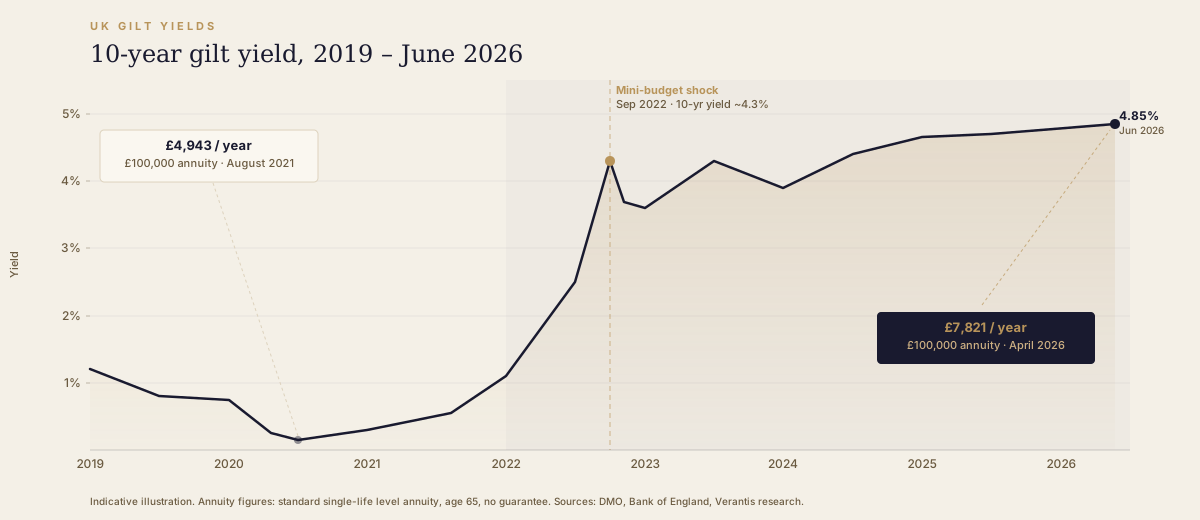
A gilt yield is the annual return an investor earns on a UK government bond relative to its current market price, expressed as a percentage. Gilt yields set the benchmark for long-term interest rates in the UK, feeding directly into annuity income, fixed mortgage pricing, and bond returns. They are the interest rates the UK government pays to borrow, so a move in yields also ripples through to the value of bond holdings and the cost of government debt. For most people the effect is indirect, but it is rarely small.
A gilt yield is the interest rate the UK government pays to borrow money, and it doubles as the reference price for long-term borrowing and lending across the whole economy. That single number quietly shapes the income an annuity can offer, the rate on a new fixed mortgage, the value of the safer holdings in a pension, and how much the government has to spend servicing its debt. Gilt yields matter to you, in other words, even if you have never knowingly owned a gilt. This article explains what gilt yields are, why they move, and the specific ways a shift in yields reaches your own money.
All figures and yield levels in this article reflect market conditions in June 2026.
How do gilt yields affect annuity rates?
Gilt yields drive annuity rates because insurers buy government bonds to fund the guaranteed income they promise. When yields are high, insurers earn more and can offer a larger income for the same pot. A £100,000 pension bought around £4,943 a year in 2021, when yields were near historic lows, and around £7,821 in 2026.
Contents
- What is a gilt yield, and why does it move?
- Why do gilt yields matter to you?
- How do gilt yields drive annuity rates?
- How do gilt yields affect mortgages and the cost of borrowing?
- What do rising gilt yields mean for your pension and investments?
- Why do gilt yields matter even if you never buy a gilt?
- Should you pay attention to gilt yields?
- What counts as a high or low gilt yield?
What is a gilt yield, and why does it move?
A gilt is a bond issued by the UK government, and the gilt yield is the annual return an investor earns on it relative to its current market price. Each conventional gilt pays a fixed amount of cash every year, so its yield and its price move in opposite directions: when the price falls, the yield rises, and when the price rises, the yield falls. A rising gilt yield is really the market saying it will only hold government debt at a lower price.
Yields move with the supply of and demand for gilts, which in turn reflects three things above all: expectations for the Bank of England base rate, expectations for inflation, and confidence in the government’s finances. When investors expect higher inflation or interest rates, or doubt the path of public borrowing, they demand a higher yield to compensate for lending their money. Gilts are issued by the Debt Management Office, the agency that raises money for the government, and they make up the large majority of UK government debt.
Gilts sit at the cautious end of the main types of investment, valued for the predictability of their income and the very low chance the UK government fails to repay. The biggest holders are UK pension funds, insurers, banks and overseas investors, which is one reason a move in the gilt market ripples so widely through everyday finances.
Risk warning
A pension is a long-term investment, the value of your investment and the income from it may go down as well as up. Your eventual income may depend upon the size of the fund at retirement, future interest rates and tax legislation.
Why do gilt yields matter to you?
Gilt yields matter to you because they are the anchor for almost every long-term interest rate you encounter, from the income on an annuity to the rate on a fixed mortgage. When the yield on government debt rises, the cost of borrowing and the reward for lending tend to rise alongside it, because lenders and insurers price their own products off that benchmark.
A higher gilt yield therefore usually means more generous annuity rates and savings returns, but also pricier fixed-rate mortgages and lower prices for bonds you already hold. The same number works in your favour in one part of your finances and against you in another, which is why context matters more than the headline direction.
There are four channels worth following in turn: the income available from annuities, the cost of fixed-rate borrowing, the value of the safer part of an investment portfolio, and the knock-on effect on government finances and the wider pension system. The rest of this article takes each in turn.
How do gilt yields drive annuity rates?
Annuity rates are driven mainly by long-dated gilt yields, because insurers buy gilts to back the guaranteed income they promise you for life. An annuity converts a pension pot into a secure income, and the provider funds that income largely from the interest it earns on government bonds. When gilt yields are high, the insurer earns more on your money and can offer a higher income for the same pot; when yields are low, annuity rates fall with them. That is why turning a pension pot into retirement income looks so different depending on when you do it.
Brian and Susan: two £100,000 pots, five years apart
Brian and Susan are both healthy 65-year-olds, each with a £100,000 pension pot, and each buys the same product: a single-life annuity with level payments and no guarantee. The only thing that differs is the year they buy, and with it the level of gilt yields.
Brian buys in August 2021, when gilt yields sat close to historic lows. His pot secures an income of roughly £4,943 a year for life. Susan buys in April 2026, after yields had climbed to their highest in well over a decade, and the same £100,000 buys her about £7,821 a year.
That is a difference of nearly £2,900 every year, for the rest of their lives, from an identical pot. Across a 25-year retirement it adds up to around £72,000 of extra guaranteed income. Neither of them did anything cleverer than the other; the gilt market simply offered very different terms on the day they signed.
The lesson is not that you should rush to buy or wait, which depends entirely on personal circumstances, but that the gilt market sets the terms on offer at any given moment. When you buy an annuity, the rate environment at the point of purchase locks in your income for life. Building that reality into your pension and retirement planning tends to matter far more than trying to predict the next move in yields.
How do gilt yields affect mortgages and the cost of borrowing?
Fixed mortgage rates are set far more by market interest-rate expectations than by the Bank of England base rate, and gilt yields are one of the clearest signals of those expectations. Lenders fund fixed-rate deals using instruments called swap rates, which move closely with gilt yields because both reflect where the market thinks interest rates are heading over the coming years.
When gilt yields climb, swap rates tend to follow, and fixed mortgage pricing usually edges up even if the Bank of England base rate (held at 3.75% in spring 2026) has not moved at all. The reverse is also true: falling gilt yields can pull fixed rates down ahead of any cut from the Bank.
This is why a remortgage quote can change between one month and the next despite no change in the headline base rate. The gilt market has effectively repriced the cost of borrowing in advance, and lenders have passed that on.
What do rising gilt yields mean for your pension and investments?
Rising gilt yields cut the value of bonds you already hold while raising the income available on new ones, a trade-off that sits at the heart of every balanced portfolio. The safer portion of most pensions and portfolios is held in bonds, including gilts, for stability. Because prices fall as yields rise, a sharp jump in yields can produce a real, if often temporary, capital loss on those holdings, as many cautious investors discovered when bond values fell sharply in 2022.
What do rising gilt yields mean for bond investors?
Rising gilt yields reduce the market value of bonds you already hold, because prices and yields move in opposite directions. A gilt fund or bond ETF will fall in unit price when yields rise. Gilt yields climbed from around 1% in 2021 to over 4% by late 2022, pushing bond fund values sharply lower. New money invested at the higher yields available in 2026 starts from a higher income, though a bond fund can still fall if yields rise again.
The flip side is that money invested in bonds today earns a far higher yield than it would have a few years ago, which improves the long-term outlook for the same asset. How that balance plays out for any individual depends on how their investments are structured and how long they have to ride out short-term moves.
Gilt yields also drive defined benefit pension transfer values. A transfer value is calculated by working out what lump sum, invested today, would be needed to fund a promised future income, and higher gilt yields mean a smaller sum is required. As yields rose from 2022 onwards, transfer values fell sharply, in some cases by a third or more, changing the arithmetic for anyone weighing whether to move a guaranteed pension.
Important information
We do not currently provide advice on transferring out of defined benefit (final salary) pension schemes. If you require this advice, we will provide details of a suitably qualified adviser at a firm with the necessary regulatory permissions who can assist you.
Why do gilt yields matter even if you never buy a gilt?
Gilt yields reach you indirectly through the pension system and the public finances, even if you never buy a government bond yourself. Most UK pension funds and insurers are large holders of gilts, so the gilt market is woven into the retirement income of millions of people. In September 2022, a sudden surge in yields after the so-called mini-budget triggered emergency selling by defined benefit pension funds, and the Bank of England later said a number of schemes came within hours of failing before it stepped in to buy gilts and steady the market. That episode showed how quickly a move in yields can threaten the plumbing behind ordinary pension and retirement planning.
Gilt yields are also the rate at which the government borrows, so higher yields raise the cost of servicing the national debt. With UK public debt close to the size of the whole economy, every rise in yields diverts more tax revenue toward interest payments and less toward services, which feeds into the tax and spending decisions that affect everyone. The House of Commons Library sets out how government debt and debt interest work in more detail.
Risk warnings
Investments
The taxation of the investment is dependent on the individual circumstance of each investor, and may be subject to change in the future.
Pensions
Levels and bases of, and reliefs from, taxation are subject to change and their value will depend upon personal circumstances. Taxation and pension legislation may change in the future.
Should you pay attention to gilt yields?
For most people, the honest answer is that you do not need to follow gilt yields day to day, but you should understand them at the moments they touch a decision. Watching the market daily tends to encourage poor timing and anxiety, and gilt yields are notoriously hard to forecast even for professionals.
Gilt yields are the rate environment in which every yield-sensitive decision is made: locking an annuity, fixing a mortgage, or judging a defined benefit transfer. Understanding the direction of travel matters far more than tracking the daily number.
What is far more useful is recognising the handful of points where the rate environment genuinely changes the maths: setting an annuity, fixing or remortgaging a loan, or deciding how much of a portfolio belongs in bonds. At those moments, the prevailing level of yields is part of the decision, not background noise. A well-built lifetime cashflow plan does the heavy lifting here, because it models how different rate environments affect your income over decades rather than reacting to a single day’s headline.
The trade-off is real. Paying close attention can help you act decisively at the right moment, but it also tempts you into trying to time a market that punishes most attempts to do so.
What counts as a high or low gilt yield?
There is no fixed level that counts as high or low, because the right yield depends on inflation and interest-rate expectations at the time. Through much of the 2010s, 10-year gilt yields sat close to 1% or below, held down by ultra-low interest rates and central bank bond-buying.
By 2026 they have spent most of the year in the region of 4% to 5%, with the 10-year benchmark close to 4.85% in late May and longer-dated yields higher still. By the standards of recent memory that looks elevated, but against a longer historical backdrop it is fairly ordinary. The unusually low yields of the 2010s were the anomaly, not the rule. What matters for you is the direction of travel relative to the decision in front of you, not whether a number looks high in isolation.
The number behind your annuity and your mortgage
Gilt yields are easy to dismiss as a concern for City traders, but they are one of the most quietly powerful numbers in personal finance. They set the income an annuity will pay, nudge the cost of a fixed mortgage, move the value of the cautious half of a portfolio, and shape the public finances that sit behind tax and spending. None of that means you should track them obsessively. It means that when a yield-sensitive decision arrives, the level of the gilt market is part of the picture, and understanding why deserves a place in any serious financial plan.
Frequently asked questions
What is a gilt yield?
A gilt yield is the annual return you earn on a UK government bond, measured against its current market price. Because gilts pay a fixed amount of cash each year, the yield rises when the bond's price falls and drops when its price rises. It is the most widely used benchmark for long-term interest rates in the UK.
Why do gilt yields rise and fall?
Gilt yields move with supply and demand for government bonds, driven mainly by interest-rate expectations, inflation, and confidence in the public finances. When investors expect higher inflation or rates, or worry about government borrowing, they demand a higher yield to hold gilts. The Bank of England base rate and large buyers such as pension funds also pull yields around.
How do gilt yields affect annuity rates?
Annuity rates are largely set by long-dated gilt yields, because insurers buy gilts to fund the income they guarantee. When gilt yields rise, providers can offer a higher income for the same pension pot, and when yields fall, annuity rates usually fall too. This is why annuity income in 2026 has been far higher than during the low-yield years around 2020 and 2021.
Should I watch gilt yields when planning my finances?
For most people there is no need to track gilt yields day to day, but the trend matters at specific decision points. They are most relevant when you are about to buy an annuity, fix a mortgage, or judge the value of a defined benefit transfer. A sound financial plan accounts for the rate environment rather than reacting to every daily move.
Are gilts a risk-free investment?
Gilts carry very little credit risk because the UK government is highly unlikely to default, but they are not risk-free. Their market price falls when yields rise, so an investor who sells before maturity can lose money, as 2022 demonstrated. The fixed income they pay can also be eroded by inflation unless the gilt is index-linked.
What is a good gilt yield?
There is no single good gilt yield, because the right level depends on inflation and interest-rate expectations at the time. A higher yield means cheaper-to-buy gilts and more income for new buyers, but lower prices for anyone already holding them. Through 2026, 10-year gilt yields have mostly sat in the region of 4% to 5%, well above the near 1% levels common in the 2010s.