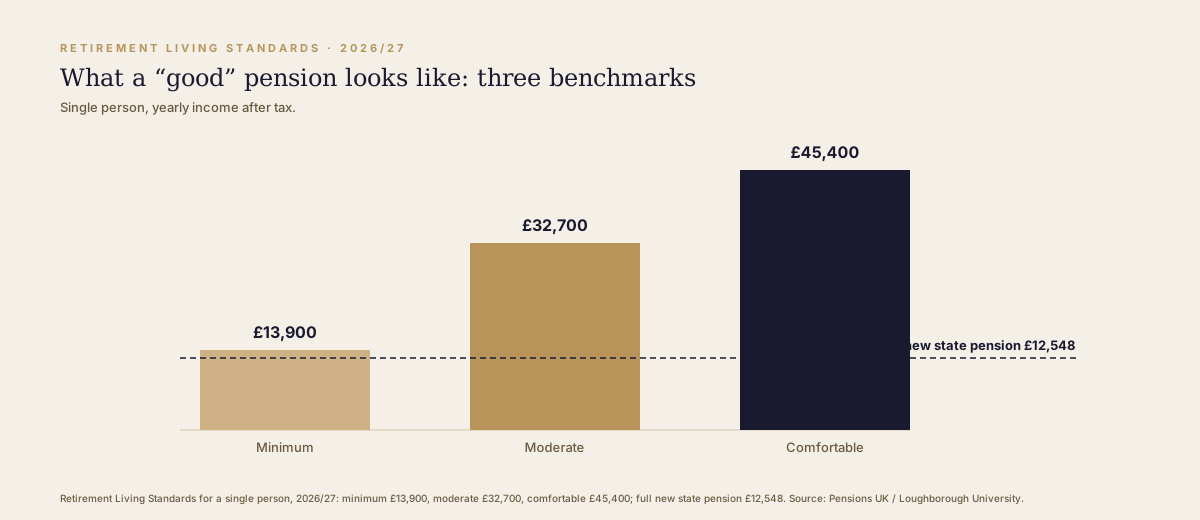
A good pension is the retirement income needed to fund a chosen standard of living, from a chosen retirement age, for the rest of a person's life. Whether a pension is 'good' depends on whether it can sustain the retirement you actually want to live, not on hitting a particular total. The Pensions UK/Loughborough University Retirement Living Standards put a single person's minimum lifestyle at £13,900 a year and a comfortable one at £45,400 in 2026/27, against a full new state pension of about £12,548. Retiring before state pension age means funding that gap entirely from private savings, often the single biggest factor in the final number.
The honest answer to “what is a good pension to retire on in the UK” is that the question is incomplete. A good pension is one that comfortably funds the life you actually want, from the age you want to stop working, for as long as the plan needs to last. Two retirees can ask the same question and arrive at very different numbers. Both can be right. The number on its own is not the answer. The plan behind the number is. The figures and thresholds in this article reflect the 2026/27 tax year.
How much pension income do I need a year in retirement?
The Retirement Living Standards put a single person’s minimum lifestyle at £13,900 a year, a moderate lifestyle at £32,700, and a comfortable lifestyle at £45,400 in 2026/27. The full new state pension covers about £12,548 of that, so the rest must come from workplace and personal pensions.
Contents
- Why is “how much is enough?” the wrong question to start with?
- What are the Retirement Living Standards?
- How much is the state pension worth today?
- What is a good pension to retire on for two very different retirees?
- What moves the number more than anything else?
- Should you aim for a specific pension number?
- How does a cashflow plan answer the question?
Why is “how much is enough?” the wrong question to start with?
It’s the wrong question first because almost every article on this topic leads with a target figure, and the figure on its own tells you almost nothing. A pot of half a million. A pot of a million. An income of thirty thousand a year. The numbers vary because they are answers to a question that has not yet been properly asked.
Three variables shape a retirement income requirement more than any savings rate, fund choice, or product ever will:
- The lifestyle you actually want to live, expressed as annual spending
- The age at which you want to stop working
- The number of years the plan must support
Until those three are pinned down, no figure is meaningful. Working out what good looks like for you is not a calculation. It is a conversation about how you would like to spend your time, with the maths attached to it afterwards.
Risk warning
A pension is a long-term investment, the value of your investment and the income from it may go down as well as up. Your eventual income may depend upon the size of the fund at retirement, future interest rates and tax legislation.
What are the Retirement Living Standards?
The Pensions UK/Loughborough University Retirement Living Standards, usually shortened to the Retirement Living Standards, are an annual set of benchmarks published by Pensions UK (formerly the Pensions and Lifetime Savings Association) and researched by the Centre for Research in Social Policy at Loughborough University. They describe what a Minimum, Moderate, and Comfortable retirement actually costs.
The standards describe three retirement lifestyles by the actual baskets of goods and services they include, rather than by abstract income targets. The latest figures, updated in 2026, are:
What the Retirement Living Standards cost per year (2026/27)
| Standard | One-person household | Two-person household |
|---|---|---|
| Minimum | £13,900 | £22,500 |
| Moderate | £32,700 | £45,400 |
| Comfortable | £45,400 | £62,700 |
Each tier reflects a tangible standard of living, not a percentage of pre-retirement income:
- Minimum covers basic needs. Around £95 a week on groceries for a single person, a one-week UK holiday, eating out about once a month, and no car (a bus pass is assumed). It is enough to live on without hardship, but with no real discretion.
- Moderate introduces material flexibility. A three-year-old car kept for ten years, a fortnight at a three-star all-inclusive in the Mediterranean plus a UK break, and a more generous food and clothing budget.
- Comfortable allows for genuine financial freedom rather than luxury. A four-star fortnight in Europe with spending money, several UK weekends, regular restaurant meals, and replacing the car every five years.
A pattern worth noticing: two people sharing a home reach each tier far more cheaply than two single people. Two state pensioners with full entitlement already exceed the two-person Minimum standard between them. A single retiree with the same state pension does not.
How much is the state pension worth today?
For the 2026/27 tax year, the full new state pension is £241.30 a week, about £12,548 a year. It rose by 4.8% in April 2026 under the triple lock. Receiving the full amount requires 35 years of qualifying National Insurance, and at least 10 years are needed to receive any new state pension at all.
State pension age is currently 66, rising to 67 in stages between April 2026 and April 2028, with further increases legislated thereafter.
Two facts follow from those numbers, and they explain why a “good” pension figure is so personal. First, the full new state pension (about £12,548) sits just below the Minimum Retirement Living Standard for a single person (£13,900). For someone living alone with no other income, the state pension on its own funds something slightly under the public’s idea of a basic retirement.
Second, the state pension is only payable from state pension age. Anyone retiring earlier needs private resources to bridge the gap, and the bridge gets longer the earlier they stop work.
Risk warning
Levels and bases of, and reliefs from, taxation are subject to change and their value will depend upon personal circumstances. Taxation and pension legislation may change in the future.
What is a good pension to retire on for two very different retirees?
Consider two people asking exactly the same question.
Retiree A is 67 today, lives alone, owns his home outright, and spends £12,000 a year. He has a full National Insurance record and is about to claim the state pension. He wants to stop working now.
His position is simple. The £12,548 state pension already covers his spending, with a small annual surplus. He needs no private pension income to retire on the lifestyle he actually lives. His planning questions are mostly about resilience: how to handle a boiler replacement, a new roof, dental work, or care costs in later life. Income, in his case, is the easy part. Even staying just below the Minimum RLS figure, his standard of living is what he is used to, and the state pension funds it.
Retiree B earns and spends £80,000 a year. She is 60, wants to retire now, and is in good health. She has no defined benefit pension.
Her position is fundamentally different. The state pension does not begin for seven years, so she needs to fund the full £80,000 entirely from private resources during that period. That is roughly £560,000 of gross spending before her state pension contributes anything, and before inflation is added. After 67, the state pension covers around £12,500 of her annual spending, leaving £67,500 a year to come from her own capital. If she lives to 95, the plan must last another 35 years from the day she stops working, making the question of a sustainable withdrawal rate from her portfolio as important as the size of the pot itself.
Both retirees have asked “what is a good pension to retire on?” Retiree A’s answer is essentially the state pension. Retiree B’s answer is a multiple of the Comfortable benchmark, sustained over three and a half decades, in real terms, through markets that will go down as well as up, and where sequence of returns risk, the extra damage a fall does when it comes in the first years of drawing, can permanently shape how far the pot stretches.
The question is the same. The answer is not even in the same order of magnitude.
Risk warning
Pensions
Your pension income could also be affected by the interest rates at the time you take your benefits. The tax implications of pension withdrawals will be based on your individual circumstances, tax legislation and regulation which are subject to change in the future.
Defined benefit transfers
We do not currently provide advice on transferring out of defined benefit (final salary) pension schemes. If you require this advice, we will provide details of a suitably qualified adviser at a firm with the necessary regulatory permissions who can assist you.
What moves the number more than anything else?
Across these two examples, and almost every plan in between, the same handful of variables do most of the work:
- Target lifestyle. The gap between Minimum, Moderate, and Comfortable is wide, and the gap between Comfortable and an existing £80,000 lifestyle is wider still.
- Retirement age. Each year earlier roughly subtracts a year of compounding and adds a year of withdrawals. Retiring at 60 instead of 67 is, in capital terms, a significant decision.
- Plan length. Planning to age 90 and planning to age 100 are materially different exercises, and life expectancy at 60 is already well into the 80s for most people in good health.
- Other sources of income. Defined benefit pensions, rental income, ISAs, general investment accounts and other wrappers, a partner’s pension, downsizing, or an expected inheritance all change the shape of the gap.
- Inflation. A £40,000 income today buys roughly half as much in 25 years at 3% inflation. Real-terms planning matters more than headline figures.
- Tax. Net spending power is what funds the lifestyle, not gross income. Drawdown structure, tax-free cash, ISA usage, and allowances all affect what reaches the bank account.
How much does inflation reduce the value of a fixed pension income over time?
Inflation steadily erodes the purchasing power of a fixed pension income. At an average UK inflation rate of 3%, a £40,000 annual income today would need to roughly double to around £80,000 in 25 years to buy the same goods and services, which is why most retirement plans build in annual increases rather than a flat income.
A good retirement plan is not the answer to “how much do I need?” It is the answer to “what do I want, and what does it take to get there and stay there?”
Risk warnings
ISAs
The favourable tax treatment of ISAs may be subject to changes in legislation in the future.
Pension drawdown
Drawdown pension plans (unsecured income) are complex and are not suitable for everyone. Pension decisions can affect your income for the rest of your life (and that of any partner and other dependants). Where benefits are accessed on a flexible basis, these are not fixed or safeguarded for life. If security of income is important to you then you should consider purchasing an annuity or taking a scheme pension to provide a secured level of income.
Should you aim for a specific pension number?
No. Fixating on a single headline figure, whether it is £300,000 or £1 million, usually distorts the plan more than it helps. A round number borrowed from a newspaper article has no relationship to your own spending, your own retirement age, or your own life expectancy, so it can just as easily lead to working longer than necessary as to running out of money too soon.
The trade-off cuts both ways. Retiree A, above, would gain nothing from chasing a generic “£500,000 pot” target: his actual spending is already covered, and working towards an arbitrary figure would mean working years longer than he needs to. Retiree B would be put at real risk by the opposite mistake: assuming a headline figure that sounds large is automatically “enough” for a 35-year retirement at £80,000 a year, when it may fall well short.
A specific number is still useful, but only once it is derived from your own lifestyle, retirement age, and plan length rather than borrowed from someone else’s.
How does a cashflow plan answer the question?
A lifetime cashflow plan answers it by setting out, year by year, the income required to fund a chosen lifestyle, the assets and pensions available to provide it, the order in which they are drawn, and the assumptions made about returns, inflation, and longevity. It then stress-tests the result against poor markets, higher inflation, and longer lifespans than expected.
What that does, in practice, is move the conversation away from a meaningless universal number towards three specific questions:
- What does the life I want actually cost, year by year, in today’s money?
- What do I already have in place, and what is the projected gap?
- What combination of saving more, working longer, spending differently, or investing differently closes that gap with an acceptable margin of safety?
Retiree A’s plan is short and his margin is wide. Retiree B’s plan is longer, more complex, and more sensitive to assumptions. Neither plan is better or worse than the other. They simply belong to different people with different lives.
There is no good pension in the abstract
There is no good pension to retire on in the UK in the abstract. There is only a good pension for the retirement you intend to live. The Retirement Living Standards give a useful frame of reference, and the state pension provides a floor for many households, but the answer to “is it enough?” is always downstream of “enough for what?”
The most valuable work in retirement planning is rarely product selection. It is the patient process of describing the life you want clearly enough that the numbers can be made to fit around it, which is exactly what ongoing pensions and retirement planning advice is for.
The Retirement Living Standards are the property of Pensions UK and Loughborough University, provided by them and reproduced here for information only. The figures are a research-based guide, not a personalised recommendation or financial advice.
Frequently asked questions
What is a good pension to retire on in the UK?
There is no single figure. A pension is 'good' if it can sustain the retirement lifestyle you actually want to live, not because it hits a particular total. Pensions UK (formerly the Pensions and Lifetime Savings Association) publishes three reference points for a single person: £13,900 a year for a minimum lifestyle, £32,700 for a moderate one, and £45,400 for a comfortable one. The right number for any individual depends on the gap between those benchmarks and the life they actually want to live.
How much is the full UK state pension in 2026/27?
The full new state pension is £241.30 a week, about £12,548 a year, for the 2026/27 tax year. This figure increased by 4.8% in April 2026 under the triple lock. Receiving the full amount requires 35 years of qualifying National Insurance contributions; 10 years are needed to receive any new state pension at all.
What is the state pension age in the UK?
State pension age is currently 66 and is rising to 67, with the increase phased in between April 2026 and April 2028. A further increase to 68 is currently legislated for 2044 to 2046, though a government review may propose bringing it forward. The state pension is only payable from state pension age, so anyone retiring earlier needs other income to bridge the gap.
Is the UK state pension enough to live on?
For 2026/27, the full new state pension of about £12,548 a year sits just below the Minimum Retirement Living Standard for a single person, which is £13,900. For a two-person household, two full state pensions of £25,096 comfortably exceed the £22,500 minimum benchmark. Whether the state pension is 'enough' depends entirely on the lifestyle being funded; it covers basic needs for many couples and falls well short for anyone targeting a moderate or comfortable standard.
What are the Retirement Living Standards?
The Retirement Living Standards are an annual benchmark published by Pensions UK (formerly the Pensions and Lifetime Savings Association), with figures calculated by the Centre for Research in Social Policy at Loughborough University. They describe the annual cost of three retirement lifestyles, called Minimum, Moderate, and Comfortable, for both one-person and two-person households. The standards are intended as a reference, not a recommendation, and the lifestyles are defined by real spending baskets rather than abstract targets.
How much do I need to retire at 60 in the UK?
Retiring at 60 means funding the years before state pension age entirely from private resources. Someone targeting a £40,000 spending level for seven years needs roughly £280,000 of bridging income before state pension begins (before tax and inflation), and that is on top of whatever capital is required to sustain spending from 67 onwards. The earlier the retirement, the longer the plan must last and the more compounding time is lost.
How much do I need to retire comfortably in the UK?
The Comfortable Retirement Living Standard is £45,400 a year for a single person and £62,700 for a two-person household, both net of income tax. This level supports a fortnight in Europe at a four-star hotel, several UK breaks, regular dining out, and replacing a car every five years. The capital needed to generate that income depends on the retirement age, other income sources, and the assumed plan length.
Is it worth aiming for a specific pension pot size?
Not on its own. A round figure such as £500,000 or £1 million has no relationship to your spending, retirement age, or life expectancy, so it can lead to working longer than necessary or retiring with too little. A specific number becomes useful only once it is derived from your own lifestyle, retirement age, and plan length through a proper cashflow plan.