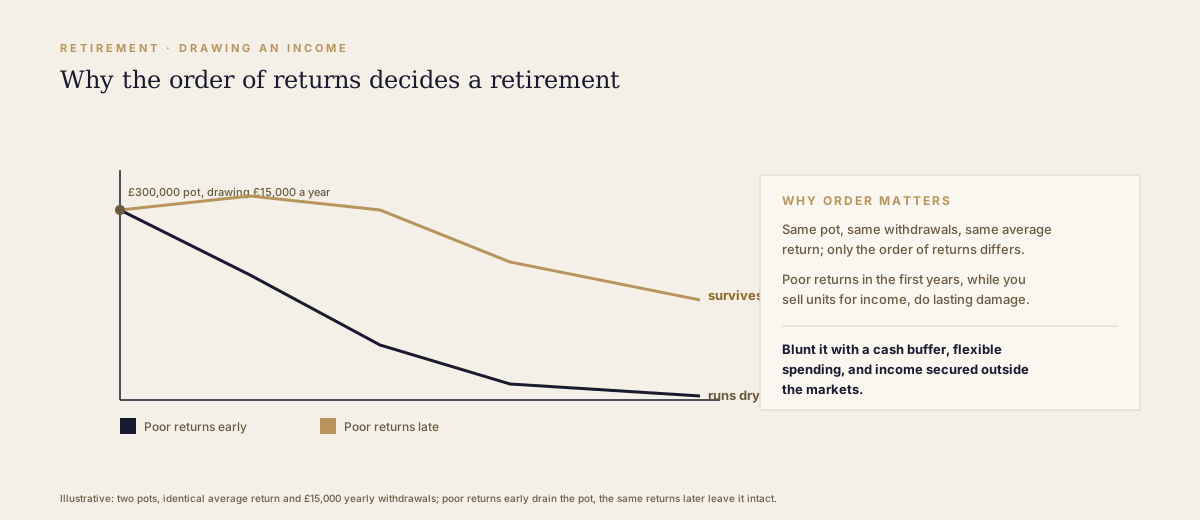
Sequence of returns risk is the danger that the order in which investment returns occur, not just their average, determines how much income a portfolio can sustain over time. When you are drawing an income, a poor run of investment returns in the early years can do far more damage to a pension than the same losses arriving later, even when the long-run average is identical. This is why the years either side of retirement are the most dangerous in an investor's life: you are selling units to fund income at the very moment prices are depressed. The risk cannot be removed, but it can be blunted by holding a cash buffer, keeping spending flexible, and securing part of your income outside the markets.
Sequence of returns risk is the danger that the order in which your investment returns arrive, not simply their average, decides how long a pension lasts once you start drawing an income from it. While you are still saving, a bad year followed by a good one lands in much the same place as the reverse. Once you are withdrawing, it does not. The order of the returns, not the average, is what does the damage. The figures in this article reflect the 2026/27 tax year.
Why does sequence of returns risk matter most in early retirement?
Because you are withdrawing income at the same time markets may be falling, so you sell more units at depressed prices and crystallise the loss. A pot that drops 20% in year one while paying out 5% income can fail to recover even if later returns are strong, because there is less left invested to rebound.
Contents
- What sequence of returns risk is
- Why does the order of returns matter more than the average?
- Why it barely matters while saving
- How to reduce the risk
- Is it worth worrying about?
- What does sequence risk change in your wider plan?
What is sequence of returns risk?
Sequence of returns risk is the chance that a poor order of investment returns, rather than a poor average, leaves a pension unable to support the income drawn from it. The idea grew out of the US planner William Bengen’s 1994 research into sustainable withdrawal rates, which showed that two people retiring with the same portfolio and the same average return could end up in very different places depending on when their bad years arrived. In the UK it is sometimes called pound cost ravaging, the mirror image of pound cost averaging: instead of buying more units when prices are low, you are forced to sell more units when prices are low.
This is different from simply worrying about market falls. A fall matters far more in some years than in others, and the years around retirement are when it matters most. The same volatility that quietly helps you while you are paying into a pension turns into a genuine threat the moment you start taking money out.
Risk warning
Your pension income could also be affected by the interest rates at the time you take your benefits. The tax implications of pension withdrawals will be based on your individual circumstances, tax legislation and regulation which are subject to change in the future.
Why does the order of returns matter more than the average?
The order of returns matters because withdrawals break the symmetry that exists when a pot is left untouched: every pound taken out during a downturn is a pound that can never recover when the market turns, so the same set of returns produces very different results depending on the order they arrive in. If you never touched the money, the order would not matter at all. A pot left untouched that falls 20% and then rises 25% finishes in exactly the same place whichever year each happens, because percentages applied to a fixed sum can be multiplied in any order. This is why the risk lives almost entirely in the withdrawal phase, and why it bites hardest for someone drawing a regular income from an invested pension through flexi-access drawdown.
Consider Diane and Patricia, both 65, both retiring with £500,000 and both planning to draw £25,000 a year. They invest identically and, over their first decade, they earn exactly the same ten annual returns. The only difference is the order. Diane retires straight into a downturn, with two sharp falls in her first two years; Patricia retires into a strong run, and those same two falls arrive at the end of her decade instead. After ten years of identical returns and identical withdrawals, Diane is left with about £328,000 and Patricia with about £509,000, a gap of more than £180,000.
Neither has run out of money. But Diane is now drawing the same £25,000 from a pot nearly £180,000 smaller, and she has another twenty or thirty years to fund. That is how a poor sequence early on quietly raises the odds of running out later, even when markets eventually behave. Two investors can earn an identical average return and still finish a decade six figures apart, purely because of the order those returns arrived in.
How much can sequence of returns risk cost a retiree?
On two identical £500,000 pensions each drawing £25,000 a year for ten years, a retiree who hits two sharp market falls early can end up around £180,000 worse off than one who hits the same falls a decade later, even though both earned the same average return.
Risk warning
Drawdown pension plans (unsecured income) are complex and are not suitable for everyone. Pension decisions can affect your income for the rest of your life (and that of any partner and other dependants). Where benefits are accessed on a flexible basis, these are not fixed or safeguarded for life. If security of income is important to you then you should consider purchasing an annuity or taking a scheme pension to provide a secured level of income.
Why does sequence risk barely matter while you are saving?
While you are saving, sequence risk barely registers, and can even help you. A market fall when you are still paying in lets you buy units cheaply, so a poor early run followed by a recovery often leaves a saver better off than a steady path would. The damage only appears once the cash flow reverses and you are selling units rather than buying them.
The regulator treats the two phases as genuinely different. The Financial Conduct Authority’s 2024 review of retirement income advice pressed firms to stop applying accumulation-era thinking to people who are drawing down, and to test whether the income being taken is actually sustainable.
What decides that sustainability is less the average return over a thirty-year retirement and more the returns in the handful of years on either side of the day you stop work. It is also why the honest answer to what makes a good pension to retire on depends as much on timing and sequence as it does on the size of the pot.
Risk warning
A pension is a long-term investment, the value of your investment and the income from it may go down as well as up. Your eventual income may depend upon the size of the fund at retirement, future interest rates and tax legislation.
How do you reduce sequence of returns risk?
You cannot remove sequence risk, because you cannot control when markets fall, but you can make it less likely that a bad sequence forces your hand. The aim is simple: avoid being forced to sell investments after they have fallen in order to pay yourself. Five defences do most of the work.
- Hold a cash and bond buffer. Keep one to three years of planned income in cash and short-dated bonds, so a stock market fall that is shorter than the buffer does not force you to sell shares at a loss to fund the next payment.
- Keep your spending flexible. Income that can flex down in poor years and up in good ones is the single most powerful protection. A fixed, inflation-linked withdrawal is the most exposed of all.
- Secure a floor of guaranteed income. Covering essential spending with the state pension and, where appropriate, an annuity means a market fall hits only your discretionary spending, never the basics.
- Mind the order you draw from. Spending from cash or from holdings that have held their value, while leaving fallen assets untouched, gives them time to recover.
- Plan against the bad sequence, not the average. Set the starting income at a level the plan survives if the first decade goes badly, rather than one that only works on a smooth average return.
The buffer is the foundation. Holding one to three years of income in cash and shorter-dated bonds gives the equity part of the portfolio room to recover before you have to touch it. The catch is that the cushion bonds usually provide is not guaranteed: in 2022, shares and bonds fell together, which is why understanding how shares and bonds behave relative to each other matters before you lean on them as a buffer.
A floor of guaranteed income changes the maths entirely. If the state pension, worth about £12,548 a year at the full new rate in 2026/27, and where it fits an annuity cover your non-negotiable bills, a market fall only ever touches your discretionary spending, never the lights and the heating. Annuity rates rise and fall with the yields on government bonds, so the value on offer is not fixed and is worth checking against your own circumstances.
The income you choose should then be tested against a poor sequence rather than a comfortable average. This is precisely what lifetime cashflow modelling is for: running the plan through a bad first decade to see whether the income still holds, rather than assuming a straight-line return that no real market ever delivers.
Is it worth worrying about if markets always recover?
Yes, because you may not have time to wait for the recovery, and because you are spending from the pot while you wait. Markets have always recovered eventually, but eventually has sometimes run to a decade or more, and a retiree drawing income does not experience the average; they experience their own particular path. The trade-off is real: protecting against a bad sequence, by holding more cash or buying guaranteed income, usually means accepting a lower expected return or less flexibility in exchange for a smoother, more certain one.
Someone with a large pot relative to their spending, or with generous guaranteed income already in place, can afford to ride out volatility and may be giving up growth needlessly by over-insuring. Someone drawing close to the limit of what their pot can sustain has far less room for a poor start and much more to gain from caution. The point is not that sequence risk should dominate every decision, but that it should be priced in deliberately rather than discovered the hard way.
What does sequence risk change in your wider plan?
Sequence risk changes which pots you spend from first, how much you can safely contribute back into a pension if you keep working, and how an income plan is stress-tested before you rely on it. Drawing from cash or from holdings that have held their value, while leaving fallen assets to recover, is a sequence-risk decision as much as a tax one, and it interacts with the different investment wrappers you hold and how each is taxed on the way out.
Taking taxable income from a defined contribution pension has a further consequence worth knowing: it usually triggers the money purchase annual allowance, cutting how much you can still pay into a pension from £60,000 to £10,000 in 2026/27. For anyone who might keep working part-time in early retirement, the order in which they draw and contribute starts to matter.
None of this means drawdown is the wrong choice. It remains the most flexible way to take a defined contribution pension. What sequence risk asks is that the flexibility be used deliberately rather than left to chance.
That is where retirement income planning earns its keep: deciding, before the first withdrawal, how the income will flex, which pots it comes from, and what the plan does if the opening years disappoint.
Risk warnings
Investments
The taxation of the investment is dependent on the individual circumstance of each investor, and may be subject to change in the future.
Pensions
Levels and bases of, and reliefs from, taxation are subject to change and their value will depend upon personal circumstances. Taxation and pension legislation may change in the future.
The few years that matter most
For a retiree drawing income, a strong start to retirement is a luxury you cannot count on, but a weak start is a risk you can prepare for by holding cash, staying flexible, and securing a guaranteed income floor.
Sequence of returns risk reframes a comforting idea. It is tempting to plan retirement around a long-run average return, because over thirty years the average is what shows up in the spreadsheet. But you do not get to live the average. You live one particular path, and the part of that path that matters most is the short stretch on either side of the day you stop work. A strong start is a luxury you cannot count on; a weak start is a risk you can prepare for. In a bad sequence, which investments you hold tends to matter less than whether you are forced to sell them. No arrangement of your income removes that risk, but arranging it so a falling market is less likely to force a sale is the part still within your control before the first withdrawal.
Frequently asked questions
What is sequence of returns risk?
Sequence of returns risk is the danger that the order in which investment returns occur, not just their average, determines how much income a portfolio can sustain over time. It matters because once you are withdrawing money, poor returns early on are harder to recover from than the same returns later.
How does sequence of returns risk work?
When you draw income from an invested pot, every pound taken out during a downturn is a pound that cannot recover when markets rise again. Identical returns in a different order therefore produce very different outcomes. The same volatility that helps you while saving works against you while spending.
Is it worth worrying about sequence risk if markets always recover?
Yes, because a retiree drawing income does not get to wait for the average to show up. Markets have recovered eventually, but eventually has sometimes meant a decade or more, and you are spending from the pot the whole time. The risk is greatest for anyone drawing close to the limit of what their pot can sustain.
How do you protect against sequence of returns risk?
The main defences are holding one to three years of income in cash, keeping spending flexible so it can fall in poor years, and securing essential spending through guaranteed income such as the state pension or an annuity. The aim is to avoid being forced to sell investments after they have fallen; none of these defences removes the risk entirely.
Does sequence risk affect you while you are still saving?
Barely, and it can even help. A market fall while you are still contributing lets you buy units cheaply, so a weak early run followed by a recovery often leaves a saver better off. The risk only becomes serious once the cash flow reverses and you are withdrawing rather than paying in.