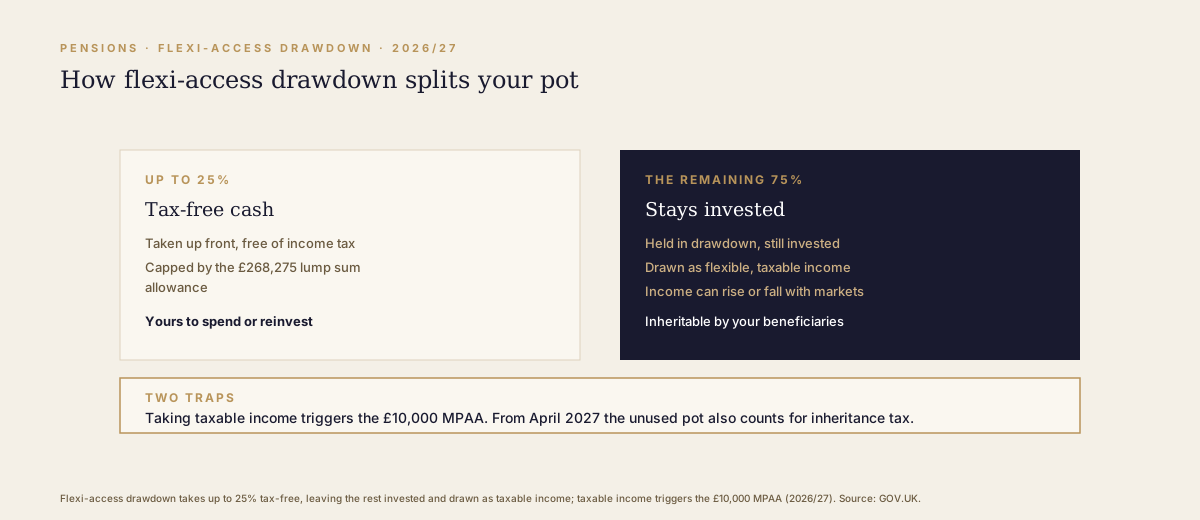
Flexi-access drawdown is a method of drawing retirement income from a defined contribution pension in which the fund stays invested and money is withdrawn flexibly rather than exchanged for a guaranteed income. You can take up to 25% of the pension tax-free and then draw the rest as income whenever you choose, but a withdrawal from the taxable 75% triggers the money purchase annual allowance, £10,000 a year for 2026/27. It is the income option most defined contribution savers have used since the 2015 pension freedoms, giving full control over how much you take and when. That control comes with the investment risk and the danger of running out of money sitting with you rather than an insurer.
Flexi-access drawdown is the route most UK retirees now use to turn a defined contribution pension into income. Instead of handing your pot to an insurer in exchange for a fixed income, you keep it invested and withdraw money as you need it, taking up to 25% tax-free and paying income tax on the rest. The flexibility is the appeal, and it is also where the complications sit: the investment risk stays with you, and one apparently routine decision about how you take the money can permanently cut what you are allowed to pay back into pensions. The figures and thresholds in this article are correct for the 2026/27 tax year.
How does flexi-access drawdown work?
You move some or all of a defined contribution pension into a drawdown fund from age 55, rising to 57 from 6 April 2028. Up to 25% can be taken tax-free, capped at the lump sum allowance of £268,275 for 2026/27. The rest stays invested, and you withdraw taxable income whenever you choose, in whatever amounts you want.
Contents
- What is flexi-access drawdown?
- How does flexi-access drawdown work?
- How is flexi-access drawdown taxed?
- The money purchase annual allowance trap
- What happens when you die
- Is it worth it?
- Drawdown vs an annuity
- Where drawdown fits in a retirement plan
What is flexi-access drawdown?
Flexi-access drawdown is a way of taking income from a defined contribution pension while the fund stays invested, rather than exchanging it for a guaranteed income. It was introduced on 6 April 2015 as part of the pension freedoms and replaced the older capped and flexible drawdown regimes, which limited how much income you could take. Today it is the standard drawdown arrangement offered to new retirees.
The defining feature is control. You decide how much to withdraw and when, with no cap on the amount, and the money you do not take remains invested in your chosen funds. That is the practical difference between drawdown and an annuity: with an annuity you give up the capital in return for certainty, whereas with drawdown you keep the capital and accept that its value, and the income it can support, will rise and fall with markets.
Flexi-access drawdown applies only to money purchase pensions, the kind where you build up a pot. It does not apply to defined benefit (final salary) schemes, which pay an income based on your salary and length of service rather than a fund you can draw down.
Risk warnings
Pensions
A pension is a long-term investment, the value of your investment and the income from it may go down as well as up. Your eventual income may depend upon the size of the fund at retirement, future interest rates and tax legislation.
Your pension income could also be affected by the interest rates at the time you take your benefits. The tax implications of pension withdrawals will be based on your individual circumstances, tax legislation and regulation which are subject to change in the future.
Defined benefit transfers
We do not currently provide advice on transferring out of defined benefit (final salary) pension schemes. If you require this advice, we will provide details of a suitably qualified adviser at a firm with the necessary regulatory permissions who can assist you.
How does flexi-access drawdown work?
Flexi-access drawdown works by moving some or all of your pension into a drawdown fund, from which you can take a tax-free lump sum and then draw taxable income on your own schedule. The mechanics break down into a few clear steps.
First, you decide how much of your pot to bring into drawdown, a step known as crystallising it. You can crystallise the whole pension at once or move it across in stages, a method often called phased drawdown. Each time you crystallise a slice, up to 25% of that slice is available as tax-free cash and the remaining 75% becomes a drawdown fund you can draw income from.
Second, you take your tax-free cash. You can take the full 25% as a single lump sum upfront, or take 25% of each withdrawal as you go, as long as the total tax-free amount stays within the overall cap.
Third, the balance stays invested. The drawdown fund remains in the market, held in whatever mix of investments you have chosen, so it can grow or fall while you are drawing on it. You then withdraw taxable income whenever you want, in whatever amounts you want.
You can normally start from age 55, although this minimum rises to 57 from 6 April 2028. Not every workplace scheme offers flexi-access drawdown in-house, so some people transfer to a personal pension or SIPP to access it.
How is flexi-access drawdown taxed?
Flexi-access drawdown is taxed in two parts: a tax-free element and a taxable element. Up to 25% of the amount you crystallise is available as a pension commencement lump sum, subject to the lump sum allowance of £268,275 for 2026/27. Everything you then withdraw from the remaining fund is treated as taxable income.
How is flexi-access drawdown taxed?
Up to 25% of what you crystallise is tax-free, capped at the lump sum allowance of £268,275 for 2026/27. The remainder is taxed as income at your marginal rate: 20%, 40%, or 45% depending on your total income in the tax year. HMRC typically applies an emergency tax code to the first withdrawal, which can usually be reclaimed.
That taxable income is added to any other income you receive in the year, such as the state pension, and taxed at your marginal rate. For 2026/27 that means nothing on income within your £12,570 personal allowance, then 20%, 40% or 45% as your total income climbs through the basic, higher and additional rate bands. Scotland sets its own income tax bands, so Scottish residents face a slightly different scale.
Because the income is taxed in the tax year you take it, how you phase withdrawals matters. Taking a large amount in a single tax year can push part of it into a higher band, whereas spreading the same sum across several tax years can keep more of it in the basic rate band.
One practical wrinkle catches almost everyone: HMRC usually applies an emergency tax code to your first withdrawal, which often over-taxes it. The excess is either refunded automatically over the year or reclaimed using an HMRC form.
Risk warnings
The Financial Conduct Authority does not regulate Cashflow Planning.
HM Revenue and Customs practice and the law relating to taxation are complex and subject to individual circumstances and changes which cannot be foreseen.
Does flexi-access drawdown trigger the money purchase annual allowance?
Taking only your tax-free cash does not trigger the money purchase annual allowance, but drawing any taxable income from the fund does. This is the single most misunderstood point about flexi-access drawdown, and the distinction matters enormously if you are still working.
The money purchase annual allowance, or MPAA, is a reduced limit on how much you can pay into defined contribution pensions while still receiving tax relief. Once you trigger it by taking flexible taxable income, your annual allowance for money purchase contributions falls from the standard £60,000 to £10,000 a year for the rest of your life. The reduction is permanent and cannot be reversed.
What does and does not trigger it is precise. Taking the 25% tax-free lump sum, on its own, does not start the clock. Nor does buying a lifetime annuity or taking income from most defined benefit schemes. It is the act of drawing taxable income from a flexi-access drawdown fund, or taking an uncrystallised funds pension lump sum (a lump sum straight from an untouched pot, part tax-free and part taxed), that triggers the MPAA.
The trap catches people who dip into a pension early while still earning and contributing. Once the MPAA applies, you also lose the ability to use pension carry forward for money purchase contributions, so unused allowance from previous years cannot rescue you. HMRC’s rules on the reduced annual allowance set out the current position.
Diana and Paul, both 56, both with a £400,000 pension
Diana and Paul are the same age, each still working and each paying £25,000 a year into a workplace pension. Both have a £400,000 defined contribution pot, and both decide to take their 25% tax-free cash, worth £100,000 each, moving the remaining £300,000 into flexi-access drawdown.
Diana stops there. She takes the tax-free lump sum but draws no taxable income, leaving the £300,000 invested. Paul takes the same £100,000, but also withdraws £15,000 of taxable income to clear a loan.
Diana’s annual allowance stays at £60,000, so her £25,000 of contributions continues to attract full tax relief. Paul’s withdrawal triggers the MPAA, cutting his allowance to £10,000. His £25,000 of contributions now exceeds the limit by £15,000 every year, leaving him with an annual allowance charge for the rest of his working life.
Risk warning
Levels and bases of, and reliefs from, taxation are subject to change and their value will depend upon personal circumstances. Taxation and pension legislation may change in the future.
What happens to your pension in drawdown when you die?
What happens to a drawdown pot on death depends on your age when you die and, from 2027, on the size of your estate. Under the current rules, if you die before 75 the funds remaining in flexi-access drawdown can usually pass to your beneficiaries free of income tax. If you die at or after 75, your beneficiaries can still inherit the pot but pay income tax at their own marginal rate on whatever they withdraw. Beneficiaries can take the money as a lump sum or keep it invested in their own drawdown account, a route known as beneficiary drawdown.
This is the area facing the biggest change. From 6 April 2027, under HMRC’s published rules on pension inheritance tax, most unused pension funds will count towards your estate for inheritance tax, removing the long-standing exemption that made drawdown so useful for passing on wealth. The 2027 pension inheritance tax change covers the mechanics in detail, including which pensions are affected and who bears the charge.
For those who die after 75, the change also raises the prospect of the same pot being taxed twice, first for inheritance tax and then for income tax as beneficiaries draw on it. Anyone whose estate is close to the threshold may want their inheritance tax planning reviewed well before April 2027.
Risk warning
The Financial Conduct Authority (FCA) does not regulate Inheritance Tax Planning or Trust Advice.
Is flexi-access drawdown worth it?
For someone with a defined contribution pension who wants control over their retirement income and can tolerate investment risk, flexi-access drawdown is the natural choice; for someone who needs a guaranteed income they cannot outlive, it usually is not. The honest answer turns on how much certainty you need.
The strengths are real. Drawdown lets you vary your income year to year, take more in early retirement and less later, keep your capital invested for potential growth, and adjust as circumstances change. Nothing is locked in: if your priorities shift towards certainty, you can use part of the pot to buy an annuity at any point.
The trade-offs are equally real. You carry the investment risk and the longevity risk, which is the danger of drawing too much, or of poor returns early in retirement, leaving the pot unable to last. This is where modelling matters: lifetime cashflow modelling tests whether a given level of income is sustainable across a range of market outcomes rather than relying on a single assumption.
Drawdown gives you control over your retirement income, but control and responsibility are the same thing here: the decisions, and the consequences, are yours.
Deciding how much you can safely take is the question that matters more than the product itself, and it sits at the centre of working out what a comfortable retirement income actually requires.
How is flexi-access drawdown different from an annuity?
The core difference is certainty versus flexibility: an annuity buys you a guaranteed income for life, whereas flexi-access drawdown keeps your pot invested and leaves the income, and the risk, in your hands. With an annuity you hand your capital to an insurer and receive a set income, typically for the rest of your life, with no exposure to markets and no further decisions to make. The price of that certainty is that the decision is usually irreversible and the capital is gone.
Drawdown keeps both the capital and the optionality. You can change your income, leave the remainder to beneficiaries, and respond to events, but you accept that the pot can fall in value and could run out. Annuity income also depends heavily on interest rates: because providers back annuities with government bonds, movements in gilt yields feed directly into the rates on offer.
In practice the choice is not always binary. Many retirees use a mix, securing their essential spending with an annuity and keeping the rest in drawdown for flexibility. If you are weighing that combination, the deeper question of whether annuities are worth it for your situation is worth exploring separately.
Where does flexi-access drawdown fit in a retirement plan?
Flexi-access drawdown sits at the centre of most defined contribution retirement plans as the primary mechanism for converting a pension pot into income, but it requires active management for decades rather than a single decision at retirement. The headline mechanics, 25% tax-free and the rest taxed as income, are the easy part. The decisions that shape the outcome are quieter: how much to crystallise and when, how to sequence withdrawals across tax years, whether an early withdrawal is worth triggering the money purchase annual allowance, and how the 2027 inheritance tax change reshapes what you leave behind.
None of these has a single right answer that applies to everyone, because each one interacts with the rest of your income, your other assets, and your plans for the money. The value of drawdown is the flexibility it gives you. The work is in using that flexibility deliberately rather than by default, which is where pensions and retirement planning advice earns its keep.
Risk warning
Some accounts have notice periods or fixed terms. During these periods, you may not be able to access your funds, or may incur penalties for early withdrawal.
Frequently asked questions
What is flexi-access drawdown?
Flexi-access drawdown is a way of taking income from a defined contribution pension while the fund stays invested, rather than buying an annuity. You can normally take up to 25% tax-free and draw the rest as taxable income whenever you choose, from age 55 (57 from 6 April 2028). It is the standard drawdown arrangement offered to UK retirees today.
How does flexi-access drawdown work?
You move some or all of your defined contribution pension into a drawdown fund, take up to 25% of it tax-free, and leave the balance invested. From there you withdraw taxable income as and when you want, with no upper limit on how much you take. The pot can grow or fall with markets while you draw on it.
Is flexi-access drawdown worth it?
Flexi-access drawdown suits people who want control over their retirement income and can accept investment risk, but it is not right for everyone. It offers flexibility an annuity cannot match, yet it offers no guarantee, so the pot can run out if markets fall or withdrawals are too high. The choice usually turns on how much certainty you need from your income.
Does flexi-access drawdown trigger the money purchase annual allowance?
Taking only your tax-free cash does not trigger the money purchase annual allowance, but drawing any taxable income from the fund does. Once triggered, the amount you can pay into defined contribution pensions each year while still getting tax relief drops to £10,000 a year for the rest of your life. This catches people who dip into a pension while still working and contributing.
What happens to my pension in drawdown when I die?
If you die before 75, funds in flexi-access drawdown can usually pass to your beneficiaries free of income tax. If you die at 75 or older, they pay income tax at their own marginal rate on withdrawals. From 6 April 2027, most unused pension funds will also count towards your estate for inheritance tax, which significantly changes how pension wealth passes on.
Can you take your whole pension as a lump sum with flexi-access drawdown?
Yes, you can withdraw the entire pot if you want, but only the first 25% (up to £268,275 for 2026/27) is tax-free; the remaining 75% is added to your taxable income for the year. Taking a large amount in one go can push you into a higher tax band and is rarely the most tax-efficient approach.
What is the difference between flexi-access drawdown and an annuity?
An annuity exchanges your pension pot for a guaranteed income for life, while flexi-access drawdown keeps the pot invested and lets you withdraw money flexibly. An annuity removes investment and longevity risk but is usually irreversible; drawdown keeps your options open but puts those risks on you. Many people now use a combination of both.