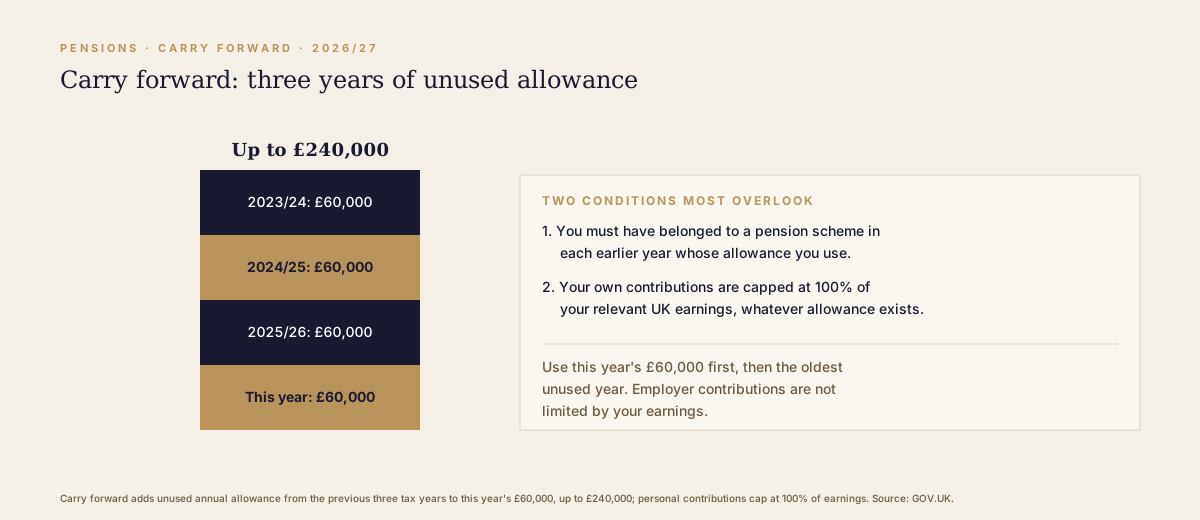
Pension carry forward is an HMRC rule that permits unused annual pension allowance from the preceding three tax years to be added to the current year's contribution limit. It is most valuable in a year of unusually high income, such as a bonus, a business sale, or a large dividend, when the standard £60,000 allowance would otherwise cap how much tax relief is available. Unused allowance from the previous three tax years is added to this year's limit, but two conditions apply. You must have belonged to a pension scheme in the relevant earlier years, and your own contributions are always capped at 100% of your Relevant UK earnings, regardless of how much allowance is technically available.
Pension carry forward lets you pay more than the £60,000 annual allowance into a pension in a single tax year by using allowance left unused over the previous three years. It is one of the most valuable tools in UK pension planning and one of the most widely misunderstood, because two conditions quietly decide whether it works at all. All figures in this article reflect the 2026/27 tax year. This guide explains how pension carry forward operates, who genuinely qualifies, how it interacts with the tapered annual allowance and the money purchase annual allowance, and where it sits within a broader financial plan.
How does pension carry forward work?
Pension carry forward works by using the current year’s full £60,000 allowance first, then drawing on unused allowance from the three previous tax years, oldest year first. In 2026/27, the eligible years are 2023/24, 2024/25, and 2025/26. You must have belonged to a registered pension scheme in each of those years, even if you contributed nothing.
Contents
- What is pension carry forward?
- How does pension carry forward work?
- Who can use carry forward?
- Carry forward in practice
- How does carry forward interact with the tapered allowance?
- What if I have already taken my pension?
- Is pension carry forward worth using?
- How long does unused allowance last?
What is pension carry forward?
Pension carry forward is a rule that lets you carry unused annual allowance from the previous three tax years into the current year, so you can make a larger pension contribution than the standard £60,000 limit would normally allow. The annual allowance is the most you can pay into all your pensions in a tax year while still receiving tax relief, and it stands at £60,000 a year for 2026/27. It has been £60,000 since April 2023, when it rose from £40,000.
Because the allowance has been £60,000 for the whole carry forward window, the arithmetic in 2026/27 is unusually clean. The three years you can look back to (2023/24, 2024/25 and 2025/26) each carried a £60,000 allowance, as does the current year.
Maximum pension carry forward in 2026/27
A pension scheme member who made no contributions across the three previous tax years.
| Input | Value |
|---|---|
| 2026/27 annual allowance | £60,000 |
| 2023/24 unused allowance | £60,000 |
| 2024/25 unused allowance | £60,000 |
| 2025/26 unused allowance | £60,000 |
- Use current year allowance: £60,000
- Add 2023/24 unused (oldest, used first): £60,000
- Add 2024/25 unused allowance: £60,000
- Add 2025/26 unused allowance: £60,000
Result: Maximum contribution in 2026/27 is £240,000, subject to the earnings cap on personal contributions.
That headline figure is rarely the real limit. Two conditions sit behind carry forward and decide whether you can use it and how much of it is genuinely available to you. The first concerns whether you belonged to a pension in the earlier years. The second caps personal contributions at your earnings. Both are covered below.
Risk warning
Levels and bases of, and reliefs from, taxation are subject to change and their value will depend upon personal circumstances. Taxation and pension legislation may change in the future.
How does pension carry forward work?
Carry forward works by using the current tax year’s full annual allowance first, and only then drawing on unused allowance from earlier years, starting with the oldest. So in 2026/27 you would use your £60,000 current allowance, then any unused allowance from 2023/24, then 2024/25, then 2025/26. Using the oldest year first matters, because each year’s unused allowance is only available for three years before it drops away.
There is nothing to claim or pre-register. You do not tell HMRC in advance that you intend to use carry forward, and there is no application form. You simply make the contribution. If your total pension input for the year comes in above your annual allowance, you report the position through a Self Assessment tax return, and the unused allowance from earlier years is set against the excess automatically. HMRC’s guidance on the annual allowance sets out the mechanics in full.
If a contribution does breach the allowance and is not fully covered by carry forward, the excess is taxed at your marginal rate through an annual allowance charge, clawing back the relief. Where the charge is large, you can sometimes ask the scheme to pay it for you, known as scheme pays, in exchange for a reduction in your benefits.
Risk warning
HM Revenue and Customs practice and the law relating to taxation are complex and subject to individual circumstances and changes which cannot be foreseen.
Who can use carry forward?
Anyone who belonged to a registered pension scheme in the relevant tax years and has UK earnings can use carry forward, though two conditions decide how much is genuinely available. The first is membership. You must have belonged to a registered pension scheme in each tax year you want to carry forward from, even if you contributed nothing in that year. Someone who was not a pension member at all three years ago has no allowance to bring forward from that year, however much headroom the numbers seem to suggest.
The second is earnings. Tax relief on personal contributions is always capped at 100% of your relevant UK earnings, no matter how much unused allowance you have. Carry forward lifts the annual allowance ceiling, but it does nothing to the earnings cap. If your relevant earnings are £80,000, your own contributions cannot exceed £80,000 in that year and still attract relief, even with £200,000 of allowance available. The way higher-rate relief is reclaimed is unchanged by carry forward.
There is an important exception for company directors and business owners. Employer contributions, including those a director’s own company makes, are tested against the annual allowance and carry forward but not against the individual’s earnings. That is why routes such as salary sacrifice and employer pension funding often access allowance that personal contributions cannot. You can check whether you have unused allowance on GOV.UK.
Risk warning
It is important to note that salary sacrifice is not suitable for all employees. Employees’ pre-tax salary will be reduced. This may affect their entitlement to State Benefits.
Carry forward in practice
The effect of carry forward, and of the earnings cap that sits alongside it, is easiest to see in a real situation.
Priya, 52, marketing director earning £85,000
Priya earns £85,000 and this year receives a £150,000 bonus, taking her relevant UK earnings to £235,000. Over the previous three tax years she paid £10,000 a year into her pension, leaving £50,000 of unused allowance in each of 2023/24, 2024/25 and 2025/26.
She wants to shelter as much of the bonus as possible from higher and additional rate tax, so she makes a one-off pension contribution of £120,000.
That contribution uses her full current-year allowance of £60,000, then £60,000 of carry forward, taking the £50,000 from 2023/24 first and £10,000 from 2024/25. Her earnings of £235,000 comfortably exceed the contribution, so the earnings cap does not bite. Because the bonus pushes part of her income above £125,140, the contribution attracts relief at her marginal rates of 40% and 45%, recovering tax relief that would otherwise have been lost.
Now compare Priya with Marcus, also 52 and also sitting on £150,000 of unused allowance, with a similar headline income. The difference is where his income comes from. Marcus runs his own company and pays himself a £50,000 salary topped up by dividends. Dividends are not relevant UK earnings, so tax relief on his personal contributions is capped at £50,000 this year, regardless of the £210,000 of allowance the numbers say is available. The allowance he has spent years accruing is, for personal contributions, largely stranded. The route that releases it is an employer contribution from his company, which is measured against the annual allowance and carry forward but not against his salary, allowing the company to pay in well beyond £50,000 (provided the contribution is a justifiable business expense).
How does carry forward work with the tapered annual allowance?
For high earners, carry forward starts from a reduced allowance, because the tapered annual allowance shrinks the £60,000 limit in the years it applies. In 2026/27, when your adjusted income exceeds £260,000 and your threshold income exceeds £200,000, your allowance falls by £1 for every £2 of adjusted income above £260,000, down to a floor of £10,000. The unused allowance you carry forward from a tapered year is that lower, tapered figure, not the full £60,000.
How does the tapered annual allowance affect carry forward?
If your annual allowance was tapered in a previous year, only the reduced, tapered figure carries forward, not the full £60,000. Someone tapered all the way to the £10,000 floor in 2023/24 can carry forward only that £10,000 from that year. The taper thresholds for 2026/27 are adjusted income above £260,000 and threshold income above £200,000.
This matters because the years you are looking back to may each have had a different allowance. Someone whose income has been high and variable could be carrying forward the £10,000 floor from one year, £35,000 from another and the full £60,000 from a third. Working out the tapered annual allowance for each of those years is the first step in knowing how much carry forward you really have.
There is a useful interaction here. Because pension contributions reduce threshold income, a contribution made now can pull this year’s income back under the taper thresholds, which can restore part of the current year’s allowance at the same time as you mop up earlier years with carry forward. The order in which these effects apply is fiddly, and the figures often cannot be finalised until the tax year has ended.
What happens if you have already taken your pension?
If you have flexibly accessed a defined contribution pension, carry forward is usually off the table for further contributions to money purchase pensions. Taking taxable income flexibly, through drawdown or an uncrystallised funds pension lump sum (a lump sum taken straight from savings you have not yet drawn on), triggers the money purchase annual allowance, which caps contributions to defined contribution pensions at £10,000 a year for 2026/27. Once triggered, you cannot use carry forward to lift that £10,000 limit.
The trap catches people who dip into a pension while still working and contributing. Taking only your tax-free cash does not trigger the money purchase annual allowance, but taking taxable income on top of it generally does. For anyone over 55 (rising to 57 from 6 April 2028) who is still building pension savings, the sequencing of when to start drawing income deserves real thought, because the limit, once triggered, is permanent.
Risk warnings
Pensions
Your pension income could also be affected by the interest rates at the time you take your benefits. The tax implications of pension withdrawals will be based on your individual circumstances, tax legislation and regulation which are subject to change in the future.
Pension drawdown
Drawdown pension plans (unsecured income) are complex and are not suitable for everyone. Pension decisions can affect your income for the rest of your life (and that of any partner and other dependants). Where benefits are accessed on a flexible basis, these are not fixed or safeguarded for life. If security of income is important to you then you should consider purchasing an annuity or taking a scheme pension to provide a secured level of income.
Is pension carry forward worth using?
Pension carry forward is worth using when you have an unusually high-income year and the earnings to support a large contribution, because it lets you capture tax relief at your highest marginal rate on money that would otherwise be taxed heavily. A bonus, a strong trading year, the sale of a business or a large dividend are the classic triggers. For someone whose contributions already sit comfortably below £60,000, carry forward changes nothing, because there is no need to exceed the standard allowance in the first place.
Carry forward is a tax opportunity, not an instruction. A contribution that is efficient on tax can still be wrong for a plan if it leaves you short of accessible savings.
The trade-off is access. Money paid into a pension is locked away until at least age 55, rising to 57 from 6 April 2028, and a large contribution can tie up capital you might otherwise want for other goals. Setting the contribution against what a good pension to retire on actually looks like, rather than against the allowance alone, keeps the decision grounded in the outcome rather than the tax.
How long does unused pension allowance last?
Unused annual allowance lasts for three tax years and is then lost. In 2026/27 you can reach back to 2023/24, but the allowance you left unused in 2023/24 has to be used by 5 April 2027. After that the window rolls forward to cover 2024/25 to 2026/27. This rolling expiry is the reason the oldest year is always used first, and the reason a high-income year that lines up with several years of unused allowance is worth planning for rather than discovering after the fact. The HMRC Pensions Tax Manual entry on carry forward sets out the formal legislative basis.
Where does carry forward fit in a wider plan?
Carry forward is best treated as a release valve rather than a routine target. Its real value is in smoothing the mismatch between when income arrives and when allowance is available: irregular earners, business owners approaching a sale, and people whose pay is weighted towards bonuses rarely earn evenly, yet the annual allowance resets every year whether they have used it or not. Carry forward lets the plan absorb a spike of income efficiently instead of surrendering relief to the calendar.
What a large contribution changes downstream is worth mapping before it is made. It moves capital out of reach until pension age, alters the balance between pension and accessible savings, and, after the 2027 change that brings unused pension funds within the scope of inheritance tax, feeds into estate planning too. Modelling the contribution through lifetime cashflow modelling shows how it lands across the years that follow and where it sits alongside your other allowances.
For most people the real question is not whether carry forward exists, but whether a particular contribution serves the plan, which is the territory of pension and retirement planning rather than the allowance rules in isolation.
The rules reward people who look ahead. Carry forward turns three years of unused allowance into a single opportunity, but only for those who notice it is there before the oldest year quietly expires.
Risk warning
The Financial Conduct Authority does not regulate some aspects of Trust, Tax and Estate Planning.
Frequently asked questions
What is pension carry forward?
Pension carry forward is an HMRC rule that lets you add unused annual allowance from the previous three tax years to the current year's £60,000 limit, so you can pay more into a pension in one year. It is most useful when income spikes, for example after a bonus or a business sale. Two conditions apply: you must have belonged to a pension scheme in the earlier years, and tax relief on your own contributions is still capped at your earnings.
How does pension carry forward work?
You use the current tax year's full annual allowance first, then draw on unused allowance from the earliest of the previous three years. For 2026/27 that means 2023/24, followed by 2024/25, then 2025/26. There is nothing to claim in advance: you make the contribution and report any excess over the allowance through a Self Assessment tax return.
Is pension carry forward worth it?
Carry forward is worth using when you have a genuinely high-income year and the earnings to support a large contribution, because it captures tax relief at your highest marginal rate on money that would otherwise be taxed heavily. It adds nothing for someone whose contributions already sit below £60,000. The main trade-off is that the money is locked away until at least age 55, rising to 57 from 6 April 2028.
Do I need to claim or register for carry forward?
No. There is no form to complete and no need to tell HMRC in advance. You simply make the contribution, and if it exceeds your annual allowance you report it on a Self Assessment tax return. The unused allowance from earlier years is set against the excess automatically.
Can I use carry forward if I have already taken my pension?
Usually not for defined contribution pensions. Once you have flexibly accessed a defined contribution pension and triggered the money purchase annual allowance, your contribution limit falls to £10,000 a year for 2026/27 and carry forward no longer applies to those savings. Taking only tax-free cash does not trigger it.
How far back can pension carry forward go?
Carry forward reaches back three tax years. For contributions made in 2026/27, the eligible years are 2023/24, 2024/25 and 2025/26. Unused allowance from 2023/24 has to be used by 5 April 2027, which is why it is used first.