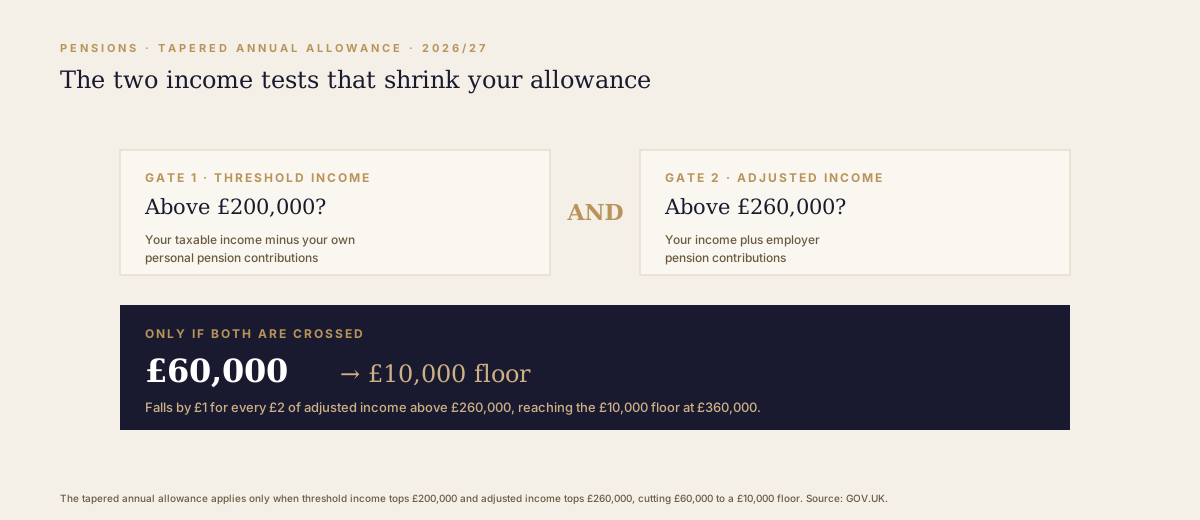
The tapered annual allowance is a reduced pension contribution limit for high earners, scaling the standard £60,000 allowance down towards a £10,000 floor as adjusted income rises beyond £260,000 a year for 2026/27. If your adjusted income tops £260,000 and threshold income tops £200,000, your £60,000 pension allowance falls by £1 for every £2 above £260,000, down to a £10,000 floor. It applies only when both thresholds are crossed, so threshold income is the first figure to check. How contributions are structured, not just total income, often decides whether it applies.
The tapered annual allowance reduces the £60,000 standard pension contribution limit for higher earners, scaling it down by £1 for every £2 of adjusted income above £260,000 a year for 2026/27. Two people on identical salaries can end up with very different pension allowances, because the taper depends on how their contributions are made as well as how much they earn. It applies only when both an income test and a contribution test are crossed, and at the extreme it shrinks the allowance to £10,000. All figures and thresholds in this article reflect the 2026/27 tax year.
What triggers the tapered annual allowance?
The tapered annual allowance is triggered only when two tests are both met in the same tax year: threshold income, taxable income minus personal pension contributions, exceeds £200,000, and adjusted income, which adds back pension contributions, exceeds £260,000. If either test fails, the taper does not apply. These figures apply for 2026/27.
Contents
- How the taper works
- Threshold income and adjusted income
- How it is calculated
- When the taper does not apply
- Carry forward
- Should you stop contributing?
- What it means for your plan
How does the tapered annual allowance work?
The tapered annual allowance works by reducing the standard £60,000 annual allowance once a high earner crosses two separate income thresholds in the same tax year. The pension annual allowance is the maximum that can be paid into your pensions each year, from every source combined, before a tax charge applies. For most people that ceiling is the full £60,000 a year for 2026/27. For higher earners it can be considerably lower.
Two tests decide whether the taper applies. The first is threshold income, which must exceed £200,000. The second is adjusted income, which must exceed £260,000. Both have to be breached: clearing one but not the other leaves your allowance untouched.
Once both are crossed, the allowance falls by £1 for every £2 of adjusted income above £260,000. The reduction continues until the allowance reaches its floor of £10,000, which happens once adjusted income reaches £360,000. Above that point, no further reduction applies. The practical result is a sliding allowance somewhere between £10,000 and £60,000 for affected earners, set entirely by where their adjusted income lands in that £100,000 band. These figures are tracked in the House of Commons Library briefing on pensions tax relief.
Risk warning
Levels and bases of, and reliefs from, taxation are subject to change and their value will depend upon personal circumstances. Taxation and pension legislation may change in the future.
What are threshold income and adjusted income?
Threshold income and adjusted income are the two measures HMRC uses to decide whether your annual allowance is tapered. They start from the same place, your taxable income for the year, but treat pension contributions differently, and that difference is where most of the planning sits.
Threshold income is, broadly, your total taxable income less the personal pension contributions you make, such as those paid through relief at source. It strips out your own contributions but not those your employer makes. Adjusted income works the other way: it is your total taxable income plus all pension contributions, including employer contributions and the growth in any defined benefit pension.
Because personal contributions reduce threshold income but employer contributions do not, the way contributions are made can decide whether the taper applies at all. A large salary sacrifice arrangement reduces your headline salary, but the resulting payment counts as an employer contribution, and the salary given up is generally added back to threshold income in any case. Identical total pension funding can therefore leave one person tapered and another with their full allowance intact.
Risk warnings
Salary sacrifice
It is important to note that salary sacrifice is not suitable for all employees. Employees’ pre-tax salary will be reduced. This may affect their entitlement to State Benefits.
Employees earning more than £260,000 with a tapered annual allowance may incur additional annual allowance tax charges.
Tax, trusts and estate planning
The Financial Conduct Authority does not regulate Cashflow Planning.
HM Revenue and Customs practice and the law relating to taxation are complex and subject to individual circumstances and changes which cannot be foreseen.
Defined benefit transfers
We do not currently provide advice on transferring out of defined benefit (final salary) pension schemes. If you require this advice, we will provide details of a suitably qualified adviser at a firm with the necessary regulatory permissions who can assist you.
How is the tapered annual allowance calculated?
To calculate your tapered annual allowance, work out your adjusted income, subtract £260,000, halve the result, and deduct that figure from £60,000. The answer is your reduced allowance for the year, subject to the £10,000 floor. The taper only runs if your threshold income also exceeds £200,000, so it is worth confirming that gateway first.
Calculating the tapered annual allowance for 2026/27
Rachel, 48, has adjusted income of £310,000. Her threshold income also exceeds £200,000, so both gateway tests are met.
| Input | Value |
|---|---|
| Adjusted income | £310,000 |
| Excess over £260,000 | £50,000 |
| Standard annual allowance | £60,000 |
- Check gateway: threshold income above £200,000, taper applies
- Calculate excess: £310,000 - £260,000 = £50,000
- Halve the excess: £50,000 ÷ 2 = £25,000 reduction
- Apply reduction: £60,000 - £25,000 = £35,000 tapered allowance
Result: Rachel’s tapered annual allowance is £35,000, leaving £35,000 of combined pension funding headroom.
A worked example makes the mechanics concrete across two contrasting cases.
Priya and Daniel, both earning £250,000
Priya, 54, has a salary of £250,000. Her employer pays £40,000 into her pension and she makes no contributions of her own. Her threshold income is £250,000 and her adjusted income, once the employer contribution is added, is £290,000. Both limits are breached, so her allowance is cut by half of the £30,000 excess over £260,000. Her tapered annual allowance is £45,000, and with £40,000 already paid in she has £5,000 of headroom left.
Daniel, also 54, earns the same £250,000. The difference is that his pension is funded by a £40,000 personal contribution rather than by his employer. That contribution reduces his threshold income to £210,000, and with no employer contribution his adjusted income stays at £250,000, below the £260,000 limit. Because one of the two tests is not met, the taper does not apply and Daniel keeps the full £60,000 a year for 2026/27.
Same salary, same £40,000 into the pension, yet Daniel’s allowance is £15,000 higher than Priya’s. The figure that separated them was not how much they earned but who made the contribution.
In practice, the figures rarely arrive neatly. Bonuses, dividends, rental profits, savings interest and the input value of a defined benefit pension all feed into the calculation, and the defined benefit figure in particular is often much larger than people expect. HMRC publishes detailed guidance and an annual allowance calculator for working through the numbers, and the input value of a final salary scheme is best confirmed with the scheme administrator rather than estimated.
When does the tapered annual allowance not apply?
The tapered annual allowance does not apply if either of the two tests is not met. If your threshold income is £200,000 or less, you keep the full £60,000 allowance no matter how high your adjusted income climbs. Equally, if your adjusted income is £260,000 or less, the taper never starts, even on a large salary.
This is why the taper catches fewer people than the £200,000 figure suggests. Someone earning £210,000 with no employer pension contributions and modest income from other sources may have adjusted income well below £260,000 and never be tapered at all. The £200,000 threshold income test is a gateway, not the trigger: clearing it simply opens the door to the second test.
It also means personal contributions can be a deliberate lever. Because contributions you make yourself reduce threshold income, a large enough personal contribution can pull it back under £200,000 and switch the taper off, whereas salary sacrificed for an employer contribution is generally added back to threshold income and does not have the same effect. The method, not just the amount, is what counts, which is why the difference between net pay and salary sacrifice matters for higher earners.
One distinction is worth drawing clearly. The tapered annual allowance is not the same as the money purchase annual allowance. The money purchase annual allowance is a separate £10,000 limit triggered by flexibly accessing a defined contribution pension, and it can apply on top of, or instead of, the taper.
What is the minimum tapered annual allowance in 2026/27?
The minimum tapered annual allowance is £10,000. This floor is reached when adjusted income is £360,000 or above. Below that level, the allowance falls by £1 for every £2 of adjusted income above £260,000, giving an allowance somewhere between £10,000 and £60,000.
How does the taper interact with carry forward?
Pension carry forward can soften the taper, but it does not remove it. Carry forward lets you use unused annual allowance from the previous three tax years, on top of the current year’s allowance, provided you were a member of a pension scheme in those years. For a high earner whose current allowance is tapered, this unused headroom can be the difference between funding a large contribution cleanly and triggering a charge.
Two details matter. First, you must use the whole of the current year’s allowance, tapered or not, before you can draw on carry forward. Second, the unused allowance you bring forward from an earlier tapered year is the tapered figure, not the full £60,000, so a run of high-earning years leaves less to carry forward than the headline allowance implies.
Carry forward also interacts with the earnings cap on tax relief. You can only receive tax relief on personal contributions up to 100% of your relevant UK earnings in the year, regardless of how much carry forward you have available. Employer contributions are not bound by that cap but still count towards the allowance. Sequencing a large contribution across tax years, and deciding whether it is made personally or by an employer, is the kind of question that sits within broader pension and retirement planning.
Should you stop pension contributions if the taper applies?
Being caught by the taper is rarely a reason to stop pension contributions altogether. Even the minimum £10,000 allowance still attracts full tax relief at your marginal rate, so contributions up to that level remain tax-efficient. The decision is less about whether to contribute and more about how much, in what form, and across which tax years.
“Even a £10,000 tapered allowance still attracts full tax relief at the marginal rate. Stopping contributions entirely to avoid the charge means surrendering both the allowance and the relief, which often costs more than the charge itself.”
The trade-off worth weighing is the annual allowance charge against the relief you would otherwise lose. If contributions exceed your tapered allowance and you have no carry forward left, the excess is added to your taxable income and taxed at your marginal rate, effectively clawing back the relief on that slice. Stopping or reducing contributions avoids the charge, but it also forgoes employer contributions and the long-term, tax-advantaged growth that makes pensions efficient in the first place.
There is also a planning angle beyond the charge itself. From 6 April 2027, most unused pension funds will fall within the scope of inheritance tax, which changes the calculation of leaving large sums in a pension untouched. For a high earner, the taper is one constraint among several, and reacting to it in isolation can create a worse outcome elsewhere. Modelling the contribution decision against income, other allowances and longer-term goals usually matters more than the taper on its own, which is where lifetime cashflow modelling earns its place.
What does the tapered annual allowance mean for your plan?
The tapered annual allowance is best understood not as a penalty but as a moving constraint on how quickly a high earner can build pension wealth. For someone whose income sits comfortably below the thresholds, it is irrelevant. For someone hovering around them, it can change from year to year as bonuses, dividends or employer contributions shift the figures, which makes it a number to monitor rather than calculate once.
The deeper point is that the taper rewards attention to structure. Two people with the same income and the same pension funding can end up with allowances £15,000 apart, decided by whether contributions are personal or employer-paid and how income is taken. That sensitivity runs in both directions: a year of high earnings can quietly erode the allowance, while a well-timed personal contribution can restore it.
What the taper changes about a plan is the sequencing. It pushes high earners towards thinking about pension funding across several years rather than one, towards understanding which allowances are being used and which are being wasted, and towards coordinating pension contributions with the rest of their income. The allowance itself is a single figure. Using it well is a question of how the whole plan fits together.
Frequently asked questions
What is the tapered annual allowance?
The tapered annual allowance is a reduced annual pension limit for high earners. It lowers the standard £60,000 allowance once adjusted income exceeds £260,000, down to a minimum of £10,000, and only applies if threshold income is also above £200,000.
How is the tapered annual allowance calculated?
Take your adjusted income, subtract £260,000, halve the result, and deduct that figure from £60,000. The answer is your tapered allowance, subject to a £10,000 floor. The taper only runs if your threshold income also exceeds £200,000 a year for 2026/27.
Does the tapered annual allowance apply to everyone earning over £200,000?
No. You only face the taper if both your threshold income exceeds £200,000 and your adjusted income exceeds £260,000. Many people over £200,000 keep their full £60,000 allowance because their adjusted income stays below £260,000 or a personal contribution reduces their threshold income.
What is the lowest the tapered annual allowance can go?
The tapered annual allowance cannot fall below £10,000 a year for 2026/27. You reach this floor once your adjusted income is £360,000 or more. Below that point, your allowance sits somewhere between £10,000 and £60,000.
Do employer contributions count towards the tapered annual allowance?
Yes. Employer contributions count towards both your total pension input and your adjusted income. They do not reduce your threshold income, which is why large employer contributions can push high earners into the taper even when their salary alone would not.
Should I stop paying into my pension if I am affected by the taper?
Not necessarily. Even the minimum £10,000 allowance still attracts full tax relief, and unused allowance from the previous three tax years may be available through carry forward. Stopping contributions to avoid a charge can cost more in lost relief than the charge itself.