Relief at source is a method of giving pension tax relief in which a pension provider adds basic rate tax relief to a member's contribution and reclaims that amount directly from HMRC. The part that catches people out is higher and additional rate relief: it is never added automatically and must be claimed through Self Assessment or HMRC, arriving as a reduced tax bill rather than money in the pension. Basic rate relief, by contrast, is added automatically, topping up every pound you pay by 20%. Most personal pensions and SIPPs use relief at source; many workplace schemes use net pay instead.
Contents
- What is relief at source?
- Relief at source vs net pay
- Claiming higher rate relief
- What it means for your plan
- Is it worth claiming?
- If you pay no tax
- Relief at source in Scotland
- The bigger picture
Relief at source is the most common way that tax relief reaches a UK pension, and most people paying into a personal pension or a SIPP are using it without ever being told the name. You contribute from money that has already been taxed, your provider adds 20% basic rate relief and reclaims it from HMRC, and the topped-up amount lands in your pot. That part is automatic. The part that is not automatic, and the part that quietly reshapes a financial plan, is everything above the basic rate. All figures and thresholds in this article reflect the 2026/27 tax year.
How much extra does relief at source add to a pension contribution?
Relief at source adds 20% basic rate tax relief to every personal pension contribution, worked out as 25% of the amount you pay in. For every £80 paid from take-home pay, the provider claims £20 from HMRC, so £100 reaches the pension. This applies automatically in the 2026/27 tax year, even if you pay no income tax.
What is relief at source?
Relief at source is a method of giving pension tax relief in which you contribute from taxed income and your provider claims the basic rate back from HMRC on your behalf. For every £80 you pay in, the provider adds £20, so £100 reaches your pension. The £20 is calculated as 25% of the net amount, which is the same as 20% of the grossed-up total, and it is added whether or not you actually pay income tax.
GOV.UK’s guidance on private pension tax relief confirms this mechanism covers almost every personal pension, stakeholder pension, and self-invested personal pension, as well as a large number of group personal pensions arranged through employers. A pension is a type of investment wrapper, and the way relief is delivered is one of the features that makes that particular wrapper behave so differently from an ISA or a general account.
How relief at source tops up a pension contribution
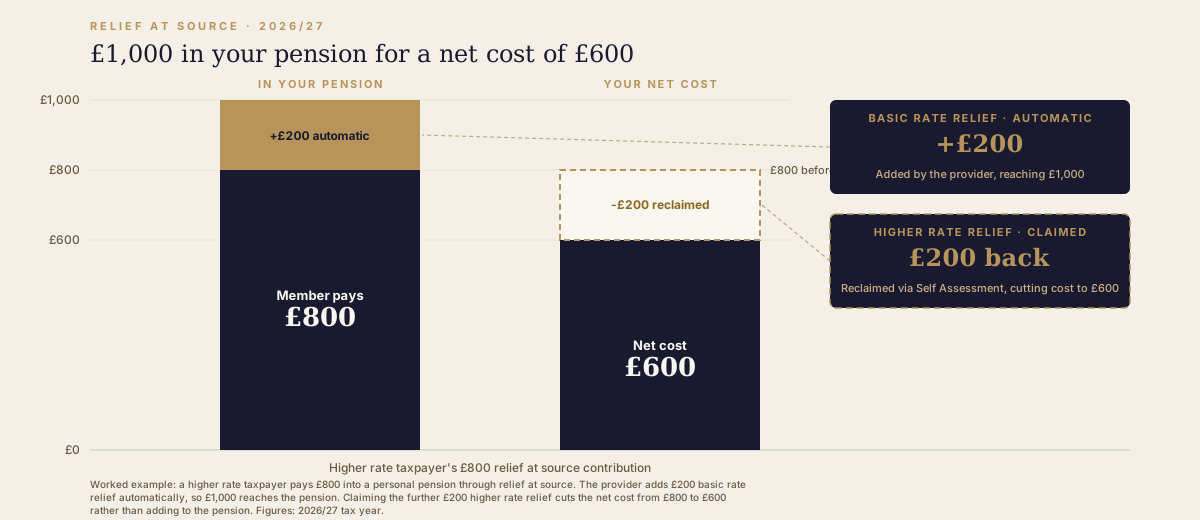
A higher rate taxpayer pays £800 into a personal pension through relief at source.
| Input | Value |
|---|---|
| Member pays in | £800 |
| Basic rate relief added by provider | £200 |
| Total reaching pension | £1,000 |
| Further higher rate relief claimable | £200 |
- Member pays £800 from taxed income to the provider
- Provider claims 20% basic rate relief from HMRC: 25% of £800 is £200
- Total reaching the pension: £800 plus £200 is £1,000
- Higher rate taxpayer claims a further £200 via Self Assessment, returned as a lower tax bill
Result: £1,000 reaches the pension at a net cost of £800 for a basic rate taxpayer, or £600 for a 40% taxpayer who claims all available relief.
The headline is simple enough that it is easy to stop there. Relief at source adds 20% to your pension automatically, and everything above 20% is yours to claim. That second half is where most of the planning lives.
Risk warnings
ISAs
The favourable tax treatment of ISAs may be subject to changes in legislation in the future.
Pensions
Levels and bases of, and reliefs from, taxation are subject to change and their value will depend upon personal circumstances. Taxation and pension legislation may change in the future.
A pension is a long-term investment, the value of your investment and the income from it may go down as well as up. Your eventual income may depend upon the size of the fund at retirement, future interest rates and tax legislation.
Tax, trusts and estate planning
HM Revenue and Customs practice and the law relating to taxation are complex and subject to individual circumstances and changes which cannot be foreseen.
What is the difference between relief at source and net pay?
The difference between relief at source and net pay comes down to when the relief is applied, and it matters more than most savers realise. Under net pay, your contribution is taken from your salary before income tax is calculated, so you automatically receive full relief at your highest marginal rate with nothing further to do. Under relief at source, you pay from income that has already been taxed, the provider restores the basic rate, and any relief above that has to be claimed separately.
Relief at source vs net pay
| Feature | Relief at source | Net pay |
|---|---|---|
| Contribution comes from | Post-tax income | Pre-tax salary |
| Basic rate relief (20%) | Added automatically by provider | Applied before deduction |
| Higher rate relief | Must be claimed separately | Applied automatically |
| Non-taxpayers | Receive 20% top-up | Receive no relief |
| Typical schemes | Personal pensions, SIPPs | Many workplace and DB schemes |
For a basic rate taxpayer the two methods produce the same result. For a higher rate taxpayer they do not, at least not without action. A higher rate taxpayer in a net pay scheme receives 40% relief automatically. The same person in a relief at source scheme receives 20% automatically and has to claim the rest. Most savers cannot choose which method applies, because it is set by the scheme rather than the member, so the first useful question is often simply which one you are in. The net pay arrangement article explains the mechanics of the alternative method in detail.
How do you claim higher rate pension tax relief?
For most PAYE taxpayers, the simplest route is HMRC’s online service for claiming tax relief on private pension payments, which does not require registering for Self Assessment. If you already file a Self Assessment return, enter your gross contributions in the pension section instead. Either way, the extra relief does not arrive automatically for higher and additional rate taxpayers in a relief at source scheme: it only comes once a claim is made. A higher rate taxpayer claims a further 20% on top of the 20% already added, and an additional rate taxpayer claims a further 25%. A claim can usually be backdated across the four previous tax years, which means relief missed in earlier years is often still recoverable, but only up to that point. The how to claim higher rate pension tax relief guide covers the process step by step.
The detail that catches people out is where the relief goes. The basic rate top-up is paid into your pension. The higher and additional rate relief is paid to you, as a lower tax bill or a refund. They are the same incentive, but they arrive in two very different places.
Higher rate relief lands in your bank account, not your pension. Knowing which part goes where changes what a contribution actually costs you after tax.
A surprising number of higher rate taxpayers never make the claim at all. Industry estimates put it well over a million people, each leaving a few hundred to several thousand pounds with HMRC every year. The relief is not lost because it was never available. It is lost because nothing in the system prompts you to ask for it.
How far back can I claim higher rate pension tax relief?
Higher rate pension tax relief can be backdated for up to four previous tax years. In the 2026/27 tax year you can still claim for 2022/23, 2023/24, 2024/25, and 2025/26. Claims are made through HMRC’s online claim service, through Self Assessment, or by writing to HMRC directly.
What does relief at source mean for your plan?
Relief at source matters to a plan because it changes the true cost of every pound you save, and a plan is built on true costs rather than headline ones. Once you account for relief that comes back as cash, the net cost of building a pension can be materially lower than the amount that appears to leave your account, which in turn affects how much you can sustainably contribute and when you can realistically stop working. The two people below contribute in exactly the same way, and end up in very different positions.
James and Priya, both 44, both earning £62,000
James and Priya each pay £400 a month into a personal pension through relief at source. Their providers add basic rate relief, so £500 a month, or £6,000 a year, reaches each pot. As higher rate taxpayers, both are entitled to relief at 40% on those contributions, not just the 20% added automatically.
James completes a Self Assessment return and claims the extra 20%. That is £1,200 a year returned to him as a lower tax bill, and he backdates his first claim across the four previous tax years. Priya is on PAYE, assumes the relief is fully handled, and never claims it.
Their pension pots look identical. Their wider finances do not. Over fifteen years James reclaims around £18,000 in tax that Priya leaves with HMRC, and because a claim only reaches back four years, most of Priya’s shortfall can never be recovered. The relief was there for both of them. Only one of them collected it.
The second way relief at source shapes a plan has nothing to do with how much you contribute, and everything to do with where your income sits. For someone whose income falls between £100,000 and £125,140 in 2026/27, where the personal allowance is gradually withdrawn, a relief at source contribution can restore some or all of the personal allowance, lifting the effective relief towards 60% on the amount inside that band. This is particularly relevant for anyone whose income is lifted into that band by variable elements such as bonuses or restricted stock units, where one year can look very different from the next. Mapping how relief actually flows is the kind of detail that lifetime cashflow modelling is designed to capture, because it feeds directly into both what you can afford to save and when you can afford to stop.
Is it worth claiming higher rate pension tax relief?
Yes, in almost every case. A higher rate taxpayer in a relief at source scheme who does not claim the additional 20% is leaving money with HMRC that it has no obligation to return unprompted. On a gross pension contribution of £10,000, the unclaimed relief amounts to £2,000 in a single year. Claims can be backdated for up to four tax years, but beyond that point unclaimed relief is gone permanently.
The only scenario where the calculation becomes less straightforward is if a Self Assessment claim surfaces other adjustments to your tax position, for instance by bringing you into scope for the high income child benefit charge. That is worth checking with an adviser, but it does not change the default answer. For most people, the claim takes one entry in a Self Assessment return and returns money that is already owed.
Does relief at source work if you pay no tax?
Yes. Under relief at source, a non-taxpayer still receives the 20% basic rate top-up, and HMRC does not ask for it back. In 2026/27, you can pay up to £2,880 a year into a pension and the provider adds £720, bringing the total to £3,600, even with no earnings at all. This applies to non-working spouses, people on low incomes, and children, and it is one of the genuinely valuable quirks of the relief at source mechanism.
The contrast with net pay is sharp. A non-taxpayer in a net pay scheme receives no relief, because there was no tax to relieve in the first place. For a low earner, the relief method a scheme uses can be the difference between a 25% top-up and nothing at all, which is one of several reasons that pension and retirement planning structure can matter as much as the amount contributed.
How does relief at source work in Scotland?
For Scottish taxpayers, relief at source adds the same 20% as everywhere else in the UK, even though Scottish income tax rates are set separately by the Scottish Parliament. The provider claims 20% regardless of the rate you actually pay, and you then claim or keep the difference depending on your band. GOV.UK’s guidance on Scottish income tax sets out the current rate bands in full.
- Starter rate and non-taxpayers. Scottish starter rate taxpayers (19% in 2026/27), and those who pay no tax, keep the full 20% added by the provider, and HMRC does not reclaim the difference.
- Intermediate rate. A Scottish intermediate rate taxpayer (21% in 2026/27) can claim an extra 1% above the 20% already given.
- Higher rate and above. A Scottish higher rate taxpayer (42% in 2026/27) claims a further 22%, with larger gaps again at the advanced and top rates.
As Scotland sets its bands each tax year, the precise percentages can move, but the principle holds: in a relief at source scheme you receive 20% automatically and claim the rest up to your marginal Scottish rate, whereas a net pay scheme applies the correct rate without any claim.
How do the rules connect to the bigger picture?
Relief at source is generous on the way into a pension, but a plan is judged on the full picture, not on the entry point alone. The relief is one input among several, and it has to be weighed against how and when the money comes out, the tax paid on withdrawals, and what happens to anything left behind. Framed that way, the value of relief is real but partial, and it sits alongside the wider question of what makes a good pension to retire on rather than answering it on its own.
That balance is shifting. From 6 April 2027, most unused pension funds and death benefits are due to fall within the scope of inheritance tax, under the Finance Act 2026, which changes a treatment that had stood for years. This does not undo the relief on the way in, but it does change how the generous front end should be weighed against what happens to the pot later, which moves part of the conversation firmly into the territory of inheritance tax planning.
Risk warnings
Pensions
Your pension income could also be affected by the interest rates at the time you take your benefits. The tax implications of pension withdrawals will be based on your individual circumstances, tax legislation and regulation which are subject to change in the future.
Tax, trusts and estate planning
The Financial Conduct Authority (FCA) does not regulate Inheritance Tax Planning or Trust Advice.
The planning value is in the part that stays silent
Relief at source is easy to take for granted precisely because the visible part works on its own. The basic rate top-up appears, the pot grows, and nothing prompts you to look closer. The planning value sits in the part that stays silent: the relief above 20% that has to be claimed, the way it returns as cash rather than pension, and the way an identical contribution can behave completely differently depending on where your income sits. Knowing which of those applies to you is the difference between a pension that quietly works and one that quietly leaves money on the table.
Frequently asked questions
What is relief at source?
Relief at source is a method of giving pension tax relief where your provider adds 20% basic rate relief to your contribution and reclaims it from HMRC. It applies whether or not you pay income tax. Higher and additional rate taxpayers must claim any relief above 20% themselves through Self Assessment or by contacting HMRC.
What is the difference between relief at source and net pay?
Under relief at source you contribute from your take-home pay and the provider adds 20% relief, with anything above that claimed separately. Under net pay your contribution is taken from your salary before income tax, so full relief is given automatically at your highest rate. Most personal pensions and SIPPs use relief at source, while many workplace and defined benefit schemes use net pay.
How do I claim higher rate pension tax relief?
Higher and additional rate taxpayers in a relief at source scheme claim the extra relief through a Self Assessment tax return or by writing to HMRC. The relief is given as a reduction in your tax bill or a refund, not as money added to your pension. You can usually backdate a claim for up to four previous tax years.
Does relief at source work if you do not pay tax?
Yes. Under relief at source a non-taxpayer still receives the 20% basic rate top-up, and HMRC does not reclaim it. You can pay up to £2,880 a year into a pension and the provider adds £720, making £3,600 in total, even with no earnings. This is a key difference from net pay schemes, where non-taxpayers receive no relief.
How does relief at source work for Scottish taxpayers?
Relief at source still adds 20% for Scottish taxpayers regardless of their actual rate. Scottish starter rate (19%) taxpayers and non-taxpayers keep the full 20% with no clawback. Intermediate, higher, advanced and top rate taxpayers can claim the difference between 20% and their marginal rate through Self Assessment or by contacting HMRC.
How much pension tax relief can I get each year?
For 2026/27 you can usually get tax relief on contributions up to £60,000 or 100% of your relevant UK earnings, whichever is lower. This annual allowance is reduced for very high earners and for those who have flexibly accessed a pension. Unused allowance from the previous three tax years can sometimes be carried forward.
Is it worth claiming higher rate pension tax relief?
Yes, in almost every case. A higher rate taxpayer who does not claim the additional 20% is leaving money with HMRC unnecessarily. On a gross pension contribution of £10,000, unclaimed relief amounts to £2,000 in a single year. Claims can be backdated for up to four tax years, but beyond that point unclaimed relief is gone permanently.
Important information
We do not currently provide advice on transferring out of defined benefit (final salary) pension schemes. If you require this advice, we will provide details of a suitably qualified adviser at a firm with the necessary regulatory permissions who can assist you.