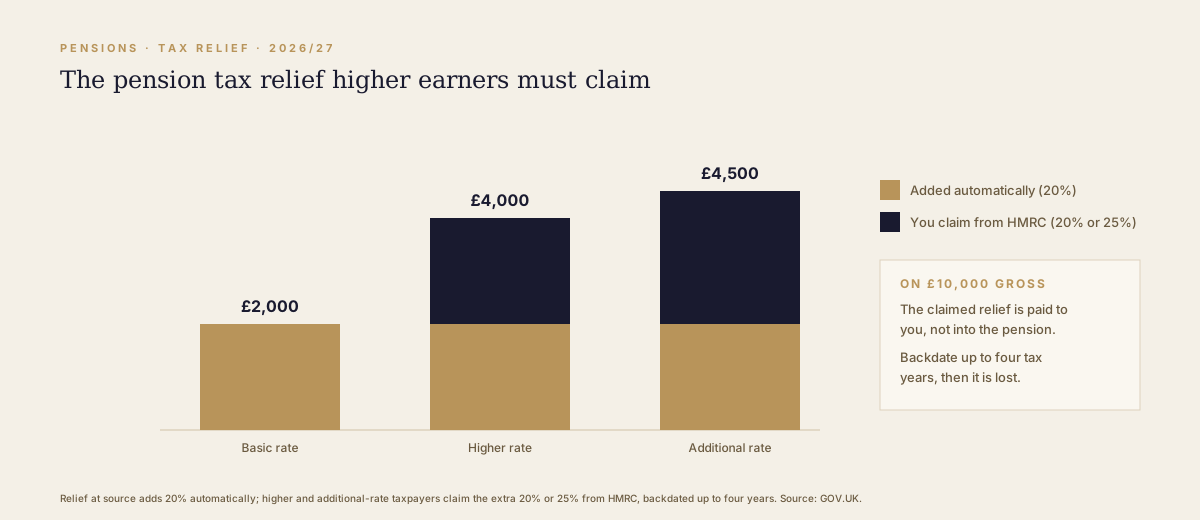
Higher rate pension tax relief is the portion of pension tax relief above the basic 20% rate, available to people who pay income tax at the higher or additional rate. Claim higher rate pension tax relief through your Self Assessment return if you file one, and through HMRC's online service or in writing if you do not. The extra 20% or 25% above basic-rate relief is never added automatically under relief at source, so it goes unclaimed unless you ask for it. Claims can be backdated only four tax years, so relief left unclaimed eventually expires.
If you pay income tax at 40% or 45% and contribute to a personal pension or a relief-at-source workplace scheme, part of your higher rate pension tax relief does not arrive on its own. Your provider adds 20% basic-rate relief to every contribution automatically, but the extra relief due at the higher or additional rate has to be claimed back from HMRC. Many higher earners assume the full amount is handled for them and quietly leave money with the taxman, year after year. This guide explains how to claim it, how much you can reclaim, the four-year deadline that applies, and how the rules differ in Scotland. The figures throughout reflect the 2026/27 tax year.
How much higher rate pension tax relief can you claim?
A higher-rate taxpayer in a relief-at-source pension can reclaim a further 20% on top of the 20% basic-rate relief added automatically. An additional-rate taxpayer can reclaim a further 25%. The extra relief is paid to you, usually as a tax refund or a change to your tax code, not into the pension.
Contents
- How the relief works
- Who needs to claim
- How to claim it
- How much you can claim
- How far back you can go
- Claiming in Scotland
- Is it worth it?
How does higher rate pension tax relief work?
Higher rate pension tax relief works by giving you the difference between the basic 20% rate and your actual marginal rate of tax on the money you put into a pension. With a relief-at-source pension, this comes in two parts. When you pay in, the provider claims 20% basic-rate relief from HMRC and adds it to your pot, so a £4,000 payment becomes £5,000 in the pension. That covers the relief due on a basic-rate taxpayer’s contribution in full. If you pay tax at 40% or 45%, though, you are entitled to more, and the system does not hand it over automatically.
The extra relief is given by extending your basic-rate band by the gross contribution. In effect, a slice of income that would have been taxed at 40% is instead taxed at 20%, and you reclaim the 20% difference. Relief at source only ever adds the basic rate, whatever rate you actually pay. Seeing how relief at source works explains why a separate claim exists at all: the provider has no way of knowing your marginal rate, so it applies the basic rate to everyone and leaves the rest to you and HMRC.
Risk warnings
Pensions
Levels and bases of, and reliefs from, taxation are subject to change and their value will depend upon personal circumstances. Taxation and pension legislation may change in the future.
Tax, trusts and estate planning
HM Revenue and Customs practice and the law relating to taxation are complex and subject to individual circumstances and changes which cannot be foreseen.
Who needs to claim, and who does not?
Whether you need to claim depends entirely on how your pension collects its tax relief, not on how much you earn. Three methods are common, and only one of them leaves anything to reclaim.
Relief at source is used by most personal pensions, self-invested personal pensions (SIPPs) and many workplace schemes. Contributions come out of your take-home pay, the provider adds 20%, and higher and additional-rate taxpayers must claim the rest. This is the group that needs to act.
A net pay arrangement works differently. Your contribution is taken from your salary before income tax is calculated, so you receive full relief at your marginal rate straight away through payroll. There is nothing to reclaim, because nothing was overtaxed in the first place.
Salary sacrifice goes a step further: you formally give up part of your salary in return for an employer pension contribution. Because the money never counts as your taxable pay, you receive full relief automatically, and there is no higher-rate claim to make. The diagram below shows which route applies to you.
The chart shows that only relief-at-source pensions can leave higher-rate relief unclaimed. If you pay 40% or 45% tax, or 21% and above in Scotland, and your scheme uses relief at source, there is extra relief to claim from HMRC. Net pay and salary sacrifice arrangements settle the full relief automatically, so no further action is needed.
Risk warning
A pension is a long-term investment, the value of your investment and the income from it may go down as well as up. Your eventual income may depend upon the size of the fund at retirement, future interest rates and tax legislation.
How do I claim higher rate pension tax relief?
You claim higher rate pension tax relief either through your Self Assessment tax return or, if you do not file one, directly from HMRC. The route you use changes one important detail: the figure you report. None of this applies if your pension uses salary sacrifice or a net pay arrangement, where your relief is already complete.
If you complete a Self Assessment return, enter your contributions in the pensions section using the gross figure, meaning the amount you paid in plus the 20% the provider added. Entering the net figure here is the single most common mistake, and it understates your relief. HMRC then adjusts your tax calculation, and the higher or additional-rate relief flows through. You must use the return for the current year and any earlier years you are correcting.
If you do not file a return, you claim through HMRC’s dedicated online service or by post. You sign in with a Government Gateway account, or create one; the online form asks for the net amount you actually paid and grosses it up to work out your relief. A letter is free-form, so make the figures unambiguous: give the net amount you paid and the gross contribution (your net payments plus the 20% relief), together with your gross earnings for the year. For the current tax year, the relief is usually given by adjusting your tax code; for years that have already ended, it is normally paid as a refund.
Whichever route you use, keep your evidence to hand. Since 2025, HMRC has asked claimants to provide proof of the contributions and of the 20% relief already received, such as a statement from your provider or a payslip from your employer.
Risk warning
Note that salary sacrifice arrangements should be appropriately documented with the employee signing an agreement letter unless it is written into the employment contract. In addition, you would need to ensure that your employee payslips can display the amount of the salary exchanged.
How much can you claim back?
How much you can claim back depends on how much of your income is taxed above the basic rate, not on the size of your contribution. For 2026/27, the higher rate is 40% on income above £50,270, and the additional rate is 45% above £125,140. A higher-rate taxpayer reclaims 20% of the gross contribution that falls within their higher-rate band; an additional-rate taxpayer reclaims 25% of the portion taxed at 45%.
How much higher rate relief a £66,300 earner reclaims on a £12,000 contribution
Priya, 44, earns £66,300 and pays £9,600 a year into a relief-at-source SIPP.
| Input | Value |
|---|---|
| Net contribution paid | £9,600 |
| Gross contribution after 20% added | £12,000 |
| Income taxed at 40% (above £50,270) | £16,030 |
- Basic-rate relief at source: £9,600 divided by 0.80 is £12,000 gross, so the provider adds £2,400
- All £12,000 sits within her higher-rate band, because £16,030 of her income is taxed at 40%
- Extra relief to claim: 20% of £12,000 is £2,400
Result: Priya reclaims £2,400 from HMRC, so £12,000 in her pension costs her £7,200.
Priya’s case is clean because her whole contribution sits inside the higher-rate band. It does not always work that way. Consider someone earning £53,000 in 2026/27. Only £2,730 of their income is taxed at 40%, because the higher-rate threshold is £50,270. If they pay the same £12,000 gross into a relief-at-source pension, only £2,730 of it attracts the extra 20%, worth £546. The rest received all the relief it was due at the basic rate. Same contribution, very different reclaim: the figure tracks the income taxed at the higher rate, not the amount paid in.
Two limits sit behind all of this, both measured for the 2026/27 tax year. You can only get tax relief on personal contributions up to 100% of your relevant UK earnings, or £3,600 gross if you earn less than that. Total contributions from every source are capped by the pension annual allowance, which for most people is £60,000 gross.
There is one group for whom claiming is worth even more than the headline rate suggests. If your income sits between £100,000 and £125,140 in 2026/27, every £2 above £100,000 strips £1 from your personal allowance. A pension contribution that pulls your income back below £100,000 restores that allowance, so the effective relief can reach around 60%. This is the heart of the 60% tax trap, and it makes a higher-rate claim particularly valuable for those earners.
How far back can you claim?
You can claim for the current tax year and the four previous tax years, after which unclaimed relief is gone. The deadline runs from the end of each tax year, so the window closes on a rolling basis. HMRC pays the extra relief in one of three ways: a refund, a lower tax bill for the year, or an adjustment to your tax code.
In the 2026/27 tax year, that means you can still claim relief on contributions made in 2022/23, 2023/24, 2024/25 and 2025/26, alongside the current year. The oldest of those, 2022/23, must be claimed by 5 April 2027. Miss that date and a year of relief is lost for good.
Higher-rate relief left unclaimed is not waiting patiently in your pension. It sits with HMRC, and once four tax years have passed the oldest of it is gone, with no way to recover it.
If you have several years to put right, you can claim for each of them, though you handle one tax year at a time: a Self Assessment return covers the year it relates to, and the online service and postal route are completed separately for each tax year. Gather a contribution statement for each year before you start, because you will need the figures for every year you claim.
How does claiming work in Scotland?
Claiming works the same way in Scotland, but the amount you reclaim is different because Scottish income tax has more bands and different rates. Crucially, relief at source still adds the 20% UK basic rate to your pension, whatever Scottish rate you actually pay. Your claim is for the gap between that 20% and your Scottish marginal rate.
For 2026/27, a Scottish intermediate-rate taxpayer (21%) reclaims a further 1%, a higher-rate taxpayer (42%) reclaims a further 22%, an advanced-rate taxpayer (45%) reclaims a further 25%, and a top-rate taxpayer (48%) reclaims a further 28%. Scottish starter-rate taxpayers (19%) are a quirk in the other direction: they receive 20% relief at source but pay only 19% tax, and HMRC does not claw back the difference, so they come out slightly ahead.
What extra pension tax relief can Scottish taxpayers claim in 2026/27?
Relief at source adds 20% to all Scottish pensions automatically. Beyond that, Scottish intermediate-rate taxpayers (21%) reclaim a further 1%, higher-rate taxpayers (42%) a further 22%, advanced-rate taxpayers (45%) a further 25%, and top-rate taxpayers (48%) a further 28%. The claim routes are the same as the rest of the UK.
The claiming routes are identical to the rest of the UK: Self Assessment if you file one, otherwise HMRC’s online service or a letter. The only thing that changes north of the border is the size of the reclaim.
Is it worth claiming higher rate pension tax relief?
Yes, claiming higher rate pension tax relief is almost always worth it, because the relief is money you are legally entitled to and the claim itself is straightforward. For a higher-rate taxpayer paying £9,600 a year into a relief-at-source pension, the reclaim is around £2,400, repeated every year you contribute. Over a decade, leaving that unclaimed runs into five figures.
The one genuine trade-off is not whether to claim, but what the reclaimed money is doing for you. The relief is paid to you in cash, not into the pension, so it only compounds for retirement if you choose to reinvest it. Spent rather than saved, it is still a real saving on your tax bill, but it does not grow your pension. How that decision fits the rest of your finances is the kind of question pension and retirement planning is built around.
For anyone whose scheme uses relief at source and who pays tax above the basic rate, the answer is simple: the relief exists whether you claim it or not, and only one of those outcomes puts it back in your hands.
The relief nobody claims for you
Relief at source is built for simplicity, and for basic-rate taxpayers it delivers full relief with no effort. For higher and additional-rate taxpayers, that same simplicity hides a gap: the system adds the basic rate to everyone and leaves the rest to you. Closing that gap is a short administrative task with a direct financial reward, and the four-year clock means there is little reason to put it off. Check how your pension collects its relief, gather your contribution figures, and claim what the basic rate alone does not give you.
Frequently asked questions
What is higher rate pension tax relief?
Higher rate pension tax relief is the extra income tax relief above the basic 20% rate, due to people who pay tax at the higher or additional rate. For these taxpayers, total relief reaches 40% or 45%. Under relief at source, the part above 20% must usually be claimed from HMRC rather than being added automatically.
How does higher rate pension tax relief work?
Higher rate pension tax relief works by extending your basic-rate tax band by the size of your gross pension contribution, so that portion of income is taxed at 20% instead of 40% or 45%. Under relief at source, your provider adds 20% to the pension automatically; you then claim the remaining 20% or 25% from HMRC separately, and it is paid to you, not into the pension.
How do I claim higher rate pension tax relief?
If you complete a Self Assessment tax return, claim it there using the gross figure, meaning your payments plus the 20% basic-rate relief. If you do not file one, use HMRC's online service, which asks for the net amount you paid, or write to HMRC. The relief is paid to you, not added to your pension.
How far back can I claim pension tax relief?
You can claim for the current tax year and the four previous tax years. In 2026/27 that means claims going back to 2022/23 are still open, but the window for 2022/23 closes on 5 April 2027. After four years, unclaimed relief is lost.
Do I need to claim if I am in a salary sacrifice or net pay scheme?
No. Under salary sacrifice, your contributions are taken from gross pay, so you never paid tax on them and there is no relief to reclaim. Net pay arrangements also give full relief automatically through payroll. Only relief-at-source schemes may leave higher-rate relief to claim.
Is it worth claiming higher rate pension tax relief?
Yes. For a higher-rate taxpayer, claiming turns a £12,000 gross contribution that cost £9,600 into one that effectively costs £7,200, by reclaiming a further £2,400. The relief is money you are entitled to, and not claiming it simply leaves it with HMRC.
Does relief at source work the same way in Scotland?
No. Relief at source still adds the 20% UK basic rate to the pension, whatever Scottish rate you pay. A Scottish intermediate-rate taxpayer reclaims a further 1%, a higher-rate taxpayer a further 22%, an advanced-rate taxpayer a further 25%, and a top-rate taxpayer a further 28%.