The 60% tax trap is the effective marginal income tax rate created when the personal allowance is gradually withdrawn from income above £100,000. Between £100,000 and £125,140 of income, every extra pound is effectively taxed at 60%, because £1 of personal allowance is withdrawn for every £2 earned. That marginal rate is higher than the 45% paid on income above £125,140, so a pay rise into the band can be worth surprisingly little. Pension contributions and Gift Aid reduce adjusted net income, the figure the taper is measured against, and can restore some or all of the lost allowance.
The 60% tax trap is one of the most counterintuitive features of the UK income tax system: earn between £100,000 and £125,140 and every extra pound is effectively taxed at 60%, not the 40% the rate tables suggest. The cause is the gradual withdrawal of your personal allowance, which falls by £1 for every £2 of income above £100,000. The figures and thresholds throughout this article are correct for the 2026/27 tax year. Understanding how the trap works, and how a pension contribution can reset it, is the difference between handing HMRC three-fifths of a pay rise and keeping most of it.
Why is the effective tax rate 60% and not 40%?
Between £100,000 and £125,140, each extra £1 of income is taxed at 40%, and it also removes 50p of personal allowance. That 50p, previously tax-free, is now taxed at 40% as well, adding 20p. The combined 60p of tax on every £1 is the 60% effective rate.
Contents
- What is the 60% tax trap?
- How does the personal allowance taper create a 60% rate?
- What else do you lose when your income passes £100,000?
- How do you escape the 60% tax trap?
- Is it worth contributing to a pension just to avoid the 60% rate?
- Does the 60% tax trap apply in Scotland?
- Does a bonus tip you into the 60% band?
What is the 60% tax trap?
The 60% tax trap is the effective marginal income tax rate that applies to income between £100,000 and £125,140 in England, Wales and Northern Ireland. It is not a statutory tax band. No table of income tax rates shows a 60% rate, because the rate is produced indirectly, by the withdrawal of the personal allowance rather than by a headline rate rise.
The personal allowance is the slice of income taxed at 0%, set at £12,570 a year for 2026/27 and published alongside the year’s other direct tax rates by the House of Commons Library. Once your income passes £100,000, that allowance is reduced by £1 for every £2 you earn above the threshold, and by £125,140 it has gone entirely. Two things therefore happen to each extra pound in this band: it is taxed at the 40% higher rate, and it quietly strips away part of the tax-free allowance underneath it.
The figure that matters here is adjusted net income, not gross salary. Adjusted net income is your total taxable income from all sources, less grossed-up pension contributions and Gift Aid donations, calculated before the personal allowance is applied. That distinction is what makes the trap escapable, as later sections show.
Risk warning
Your pension income could also be affected by the interest rates at the time you take your benefits. The tax implications of pension withdrawals will be based on your individual circumstances, tax legislation and regulation which are subject to change in the future.
How does the personal allowance taper create a 60% rate?
The personal allowance taper turns a 40% headline rate into a 60% effective one through a simple piece of arithmetic. For every extra £1 of income between £100,000 and £125,140, you pay 40p in higher-rate tax. That same £1 also removes 50p of personal allowance, and because that 50p was previously untaxed, it now falls into the higher-rate band too, costing a further 20p. The result is 60p of tax on every £1.
The chart shows the effective marginal rate climbing from 20% to 40% as income rises, then spiking to 60% across the £100,000 to £125,140 band before falling back to 45% above it. The 60% band is the only point in the system where earning more is taxed more heavily than the income immediately above it.
The taper makes the £100,000 to £125,140 band the most heavily taxed slice of income in the country. Earnings above £125,140 are taxed at the 45% additional rate, lower than the 60% paid just below it.
For an employee, the picture is slightly worse. National Insurance still applies at 2% on earnings in this band, lifting the true marginal rate to around 62%. The headline figure of 60% refers to income tax alone, but the cash that reaches your bank account from a pay rise in this range is closer to 38p in the pound.
What else do you lose when your income passes £100,000?
Crossing £100,000 a year for 2026/27 of adjusted net income withdraws Tax-Free Childcare and the funded childcare hours entirely, on top of the personal allowance taper, which is why working parents can face an even steeper effective rate. We cover that interaction in detail in our explainer on the £100,000 childcare limit, where a pay rise of a few thousand pounds can cost a family far more than it adds once childcare support is lost.
What other allowances do you lose once income passes £100,000?
Once adjusted net income exceeds £100,000, Tax-Free Childcare and the 30 hours of funded childcare are withdrawn. The High Income Child Benefit Charge starts at £60,000 of adjusted net income and removes Child Benefit completely by £80,000. All three thresholds use the same adjusted net income figure as the 60% tax trap for 2026/27.
Adjusted net income is the common trigger across these rules. The same figure that withdraws your personal allowance also governs Tax-Free Childcare eligibility, which requires adjusted net income below £100,000 for each parent. The High Income Child Benefit Charge uses adjusted net income too, although its threshold sits lower, at £60,000 a year for 2026/27.
There is also a hard edge at £125,140 a year for 2026/27. This is both the point at which the personal allowance reaches zero and the threshold for the 45% additional rate. Cross it and the 60% band is behind you, but you are now an additional-rate taxpayer, with a dividend allowance of £500 and a personal savings allowance of £0.
How do you escape the 60% tax trap?
The most direct way to escape the 60% band is to reduce your adjusted net income below £100,000 a year for 2026/27, and a pension contribution is the cleanest lever. Because adjusted net income is measured after grossed-up pension contributions, every £1 of gross contribution reduces the figure the taper is measured against by £1. Bring adjusted net income down to £100,000 and the full personal allowance is restored.
How a £10,000 pension contribution resets the 60% band
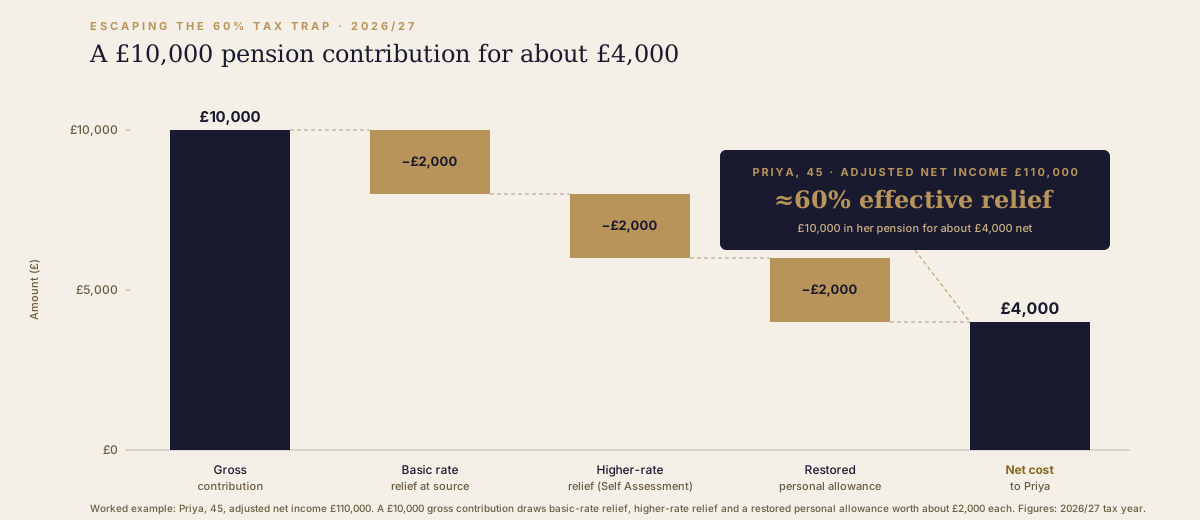
Priya, 45, has an adjusted net income of £110,000, all from salary.
| Input | Value |
|---|---|
| Adjusted net income | £110,000 |
| Personal allowance after taper | £7,570 |
| Gross pension contribution | £10,000 |
- The £10,000 between £100,000 and £110,000 is taxed at 40%, and the £5,000 of allowance lost in that band is also taxed at 40%: (£10,000 × 40%) + (£5,000 × 40%) = £6,000.
- A £10,000 gross contribution costs £8,000 net and brings adjusted net income to £100,000, restoring the full £12,570 allowance.
- Total relief: £2,000 added at source, £2,000 higher-rate relief via Self Assessment, and £2,000 from the restored allowance = £6,000.
Result: Priya puts £10,000 into her pension at a net cost of about £4,000. The relief on that slice of income works out at roughly 60%.
There are two routes for the contribution, and they are not equivalent. With salary sacrifice, you give up gross salary before it is paid, so the sacrificed amount never counts as income at all and your employer’s National Insurance saving can be added to the pot. With a personal contribution paid under relief at source, you pay from net income, the provider adds basic-rate relief, and you reclaim the higher-rate portion through Self Assessment.
Charitable giving works on the same principle. Gift Aid donations are grossed up and deducted from adjusted net income, so a donation can restore the allowance in the same way a pension contribution does, with the money leaving your estate rather than being saved for later.
The size of contribution you can make is not unlimited. Contributions are capped by the pension annual allowance, which for most people is £60,000 a year for 2026/27, and by your relevant UK earnings. For most people caught by the 60% band neither cap bites, but very high earners and those who have already drawn pension benefits should check both before contributing.
Risk warnings
Pensions
Levels and bases of, and reliefs from, taxation are subject to change and their value will depend upon personal circumstances. Taxation and pension legislation may change in the future.
Salary sacrifice
It is important to note that salary sacrifice is not suitable for all employees. Employees’ pre-tax salary will be reduced. This may affect their entitlement to State Benefits.
Employees earning more than £260,000 with a tapered annual allowance may incur additional annual allowance tax charges.
Is it worth contributing to a pension just to avoid the 60% rate?
For most people in the £100,000 to £125,140 band, yes, provided you can afford to lock the money away. A contribution that lands in the 60% band attracts roughly 60% effective relief, which is the highest rate of pension tax relief available anywhere in the system. Few other financial decisions offer that return with so little uncertainty.
The trade-off is access. Money in a pension cannot normally be touched until age 55, rising to 57 from 6 April 2028, so the decision is really about whether that income is needed sooner. Someone clearing a mortgage, building an emergency fund, or planning a near-term expense may rationally choose to pay the 60% rate and keep the cash. This is the kind of trade-off that pension and retirement planning is designed to weigh, because the right answer depends on the whole balance sheet, not the tax saving alone.
What does not make sense is ignoring the band entirely. Even a partial contribution, enough to clip the top of your income out of the 60% range, captures relief at the highest effective rate before reverting to 40% on the remainder.
Risk warnings
Your home may be repossessed if you do not keep up repayments on your mortgage. Think carefully before securing debts against your home.
Not all mortgage contracts are regulated by the Financial Conduct Authority.
Does the 60% tax trap apply in Scotland?
Scottish taxpayers face a steeper version of the same trap. The personal allowance is set by the UK Government and is withdrawn above £100,000 a year for 2026/27 in exactly the same way across the UK, but Scotland sets its own income tax rates. In the £100,000 to £125,140 band, Scottish income is taxed at the 45% advanced rate, so each extra £1 costs 45p directly plus 22.5p from the lost allowance, an effective rate of 67.5%.
That makes the case for reducing adjusted net income stronger still north of the border, because the relief on a pension contribution in this band is correspondingly higher.
Does a bonus tip you into the 60% band?
A bonus is treated as income in the year it is paid, so a bonus that lifts your adjusted net income above £100,000 a year for 2026/27 pulls the relevant slice into the 60% band, even if your basic salary sits below the threshold. The same applies to other one-off income, such as a chargeable event gain or a large dividend.
This is where timing and planning matter. If a bonus pushes you well into the band, a larger pension contribution may be needed to bring adjusted net income back down, and carry forward of unused allowance from earlier years can make a contribution above the standard annual allowance possible.
Company directors have more control than most, because they decide how and when to take income. The choice between salary, dividends, and employer pension contributions can keep adjusted net income below £100,000 by design rather than by correction after the fact.
Is the 60% band a penalty or a signal?
The 60% tax trap is best read as a signal rather than a penalty. It marks the point where pension contributions and charitable giving deliver their highest return, and where the order in which income is taken starts to matter as much as the amount. For anyone whose income hovers around £100,000, the figure to watch is not the salary on the payslip but the adjusted net income behind it. More people reach that point each year without their real income having changed at all, because the threshold has not moved since 2010 while pay has: that is the income tax threshold freeze at work, and it is the reason the band is worth understanding before you are in it rather than after. Working through these numbers as part of a lifetime cashflow plan shows whether the 60% band is worth planning around now or simply riding out for a year or two.
Frequently asked questions
What is the 60% tax trap?
The 60% tax trap is the effective income tax rate on earnings between £100,000 and £125,140, where the personal allowance is withdrawn at £1 for every £2 earned. In England, Wales and Northern Ireland this produces a 60% marginal rate. In Scotland, where the same slice of income is taxed at 45%, the equivalent rate is 67.5%.
How does the personal allowance taper work?
The personal allowance falls by £1 for every £2 of adjusted net income above £100,000. With a standard allowance of £12,570 a year for 2026/27, this means the allowance is gone entirely once income reaches £125,140. The reduction is based on adjusted net income, not gross salary.
How can I avoid the 60% tax trap?
Reduce your adjusted net income below £100,000. A gross pension contribution lowers that figure pound for pound, restoring the lost personal allowance and earning relief at the 60% effective rate. Gift Aid donations work the same way. The trade-off is that pension money is locked away until at least age 55, rising to 57 from 6 April 2028.
Does the £100,000 threshold use my salary or my adjusted net income?
It uses adjusted net income, not gross salary. Adjusted net income is your total taxable income from all sources, less grossed-up pension contributions and Gift Aid donations. This is why someone earning over £100,000 can still keep their full personal allowance by contributing to a pension.
Is the 60% rate an official tax band?
No. There is no statutory 60% income tax band. The rate is an effective marginal rate produced by the withdrawal of the personal allowance alongside the 40% higher rate. It does not appear in any table of income tax rates because no headline rate of 60% exists.
At what income does the personal allowance disappear completely?
The personal allowance reaches zero once adjusted net income hits £125,140 a year for 2026/27. That figure is £100,000 plus twice the £12,570 allowance. Above £125,140 you are an additional-rate taxpayer, paying 45% on income in that band, with a personal savings allowance of £0.