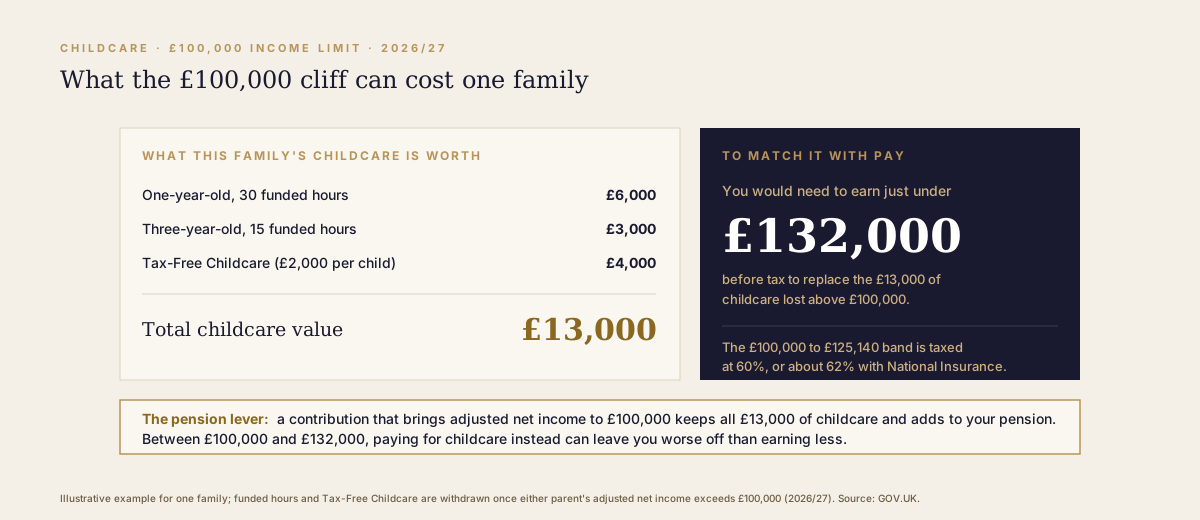
The £100,000 childcare limit is the adjusted net income threshold above which a parent loses Tax-Free Childcare and government-funded childcare hours for working parents. Childcare support in England is withdrawn entirely once either parent's adjusted net income passes £100,000, regardless of household income. Because the same threshold also triggers the 60% personal allowance taper, a stretch of income above £100,000, as much as £32,000 for a family with two young children in funded childcare, can leave a parent no better off after childcare costs. Pension contributions reduce adjusted net income and are the main lever a parent near the threshold has to keep the support.
Childcare support in England disappears the moment a parent’s adjusted net income passes £100,000, and it goes for the whole family even if the other parent earns very little. The £100,000 childcare limit applies to Tax-Free Childcare and to the funded hours for working parents, and it is tested on each parent individually rather than on combined household income. Because the same £100,000 figure also triggers the withdrawal of the personal allowance, a parent who drifts just over it can lose thousands of pounds of support while keeping almost none of the extra pay. All figures in this article reflect the 2026/27 tax year.
How does the £100,000 childcare limit work?
The £100,000 childcare limit is tested on each parent’s adjusted net income individually for the 2026/27 tax year. If either parent’s adjusted net income exceeds £100,000, the whole family loses Tax-Free Childcare and the working-parent funded hours, even if the other parent earns very little. Children aged three to four keep the universal 15 hours regardless.
Contents
- How the limit works
- What the support is worth
- Earning just over £100,000
- The 60% tax trap
- Using a pension to stay under
- Is it worth it?
How does the £100,000 childcare limit work?
The £100,000 childcare limit works as a hard cut-off: if either parent expects an adjusted net income above £100,000 in the tax year, the family loses access to both Tax-Free Childcare and the funded childcare hours for working parents. Adjusted net income is your total taxable income before the personal allowance is deducted, minus reliefs such as grossed-up pension contributions and Gift Aid donations. It is not the same as your salary, which is why two people on identical pay can land on opposite sides of the line.
How is adjusted net income calculated?
Adjusted net income is calculated by taking your total taxable income for the tax year and subtracting certain tax reliefs, mainly gross pension contributions and Gift Aid donations. Taxable income includes salary, bonuses, rental income, dividends and savings interest. For childcare eligibility, the key test is whether this adjusted figure stays at or below £100,000.
The test is applied to each parent on their own, not to the household. A couple earning £99,000 each, £198,000 between them, still qualifies, while a single parent or sole earner on £101,000 does not. That per-parent design is what makes the limit feel so arbitrary to the families it catches.
Because the test is on adjusted net income rather than salary, it is worth working the figure out properly before assuming which side of the line you are on. Eligibility itself is HMRC’s decision, taken on your expected income for the whole tax year when you apply and again at each reconfirmation. Near the line in particular, a bonus not yet paid or a benefit in kind you have not counted can move you across a threshold that has no taper in it.
It also matters that the childcare limit is a cliff rather than a slope. Tax thresholds usually taper, but childcare eligibility is binary: a single pound over £100,000 removes the support entirely. There is a lower bar too, since each working parent must expect to earn at least the equivalent of 16 hours a week at the National Living Wage, which is £12.71 an hour for 2026/27 for a parent aged 21 or over, or about £10,575 a year. HMRC tests it over the three months after you apply rather than across the whole year, and waives it during parental leave and in the first year of self-employment. For most readers near the top of the scale, though, it is the £100,000 ceiling that bites. You can check the detailed conditions on GOV.UK’s eligibility guidance for working parents.
Risk warnings
Pensions
Levels and bases of, and reliefs from, taxation are subject to change and their value will depend upon personal circumstances. Taxation and pension legislation may change in the future.
Tax, trusts and estate planning
The Financial Conduct Authority does not regulate Cashflow Planning.
HM Revenue and Customs practice and the law relating to taxation are complex and subject to individual circumstances and changes which cannot be foreseen.
What are Tax-Free Childcare and the free hours worth?
In a full year, Tax-Free Childcare is worth up to £2,000 for 2026/27 per child, and the funded hours are worth thousands more, with the exact value depending on the child’s age and where you live. Tax-Free Childcare tops up what you pay: the government adds £2 for every £8 you put into a registered childcare account. The cap is applied every three months at £500 rather than once a year, so a quarter you pay nothing in is a quarter of the top-up you cannot recover later. For a disabled child the cap is £4,000 for 2026/27, and the scheme runs until the September after the child’s eleventh birthday. Full eligibility and how to open an account are set out in GOV.UK’s Tax-Free Childcare guidance.
The funded hours are the larger prize. Working parents of children from nine months to four years can claim 30 funded hours a week for 38 weeks of the year. This is where the most common misunderstanding sits, and it is worth being precise about. All three and four year olds in England receive a universal 15 hours a week regardless of parental income, so a higher-earning family with a three or four year old does not lose everything: they drop from 30 hours to the universal 15. There is no universal offer below age three, so a higher earner with a child under three loses all funded hours, not just the working-parent top-up.
On value, 15 funded hours is worth roughly £2,500 to £3,000 a year on a national average, and a full 30 hours for a child under two can be worth far more, with some estimates putting it close to £13,000 a year in the highest-cost areas. These funded-hours figures apply to England. Scotland and Wales run different schemes, although Tax-Free Childcare and the £100,000 limit apply across the UK.
What happens when you earn just over £100,000?
Earning just over £100,000 can leave you worse off than earning under it, because the childcare cut-off is a cliff: cross it by a single pound and the support stops. The effect is sharpest for families with children in paid care, where the lost support runs to thousands of pounds a year. The two parents below earn only £2,000 apart, yet end the year in very different places.
Two parents, £2,000 of salary apart
Adam and Beth each have one three-year-old at the same nursery, using the funded hours plus a few paid sessions. Adam expects to earn £99,000 this year; Beth expects £101,000.
Adam’s adjusted net income stays under £100,000, so he keeps Tax-Free Childcare and the 30 funded hours, support worth around £5,000 a year. Beth’s £101,000 puts her over the limit, so she loses Tax-Free Childcare and the working-parent hours, and her three-year-old keeps only the universal 15 hours.
Beth’s extra £2,000 of salary gives her about £1,000 more take-home, but she now has to find roughly £5,000 for the childcare Adam gets supported. She ends the year close to £4,000 worse off than Adam, despite earning £2,000 more. Had her child been under three, the loss would be larger still, because there is no universal offer below that age.
This is the part that surprises people: a pay rise that pushes a parent over £100,000 can reduce the family’s spendable income. Bonuses count towards the test, so the danger is not limited to base salary.
How does the 60% tax trap make the £100,000 limit worse?
The £100,000 limit is made worse by the 60% tax trap, because the same threshold that removes childcare support also begins withdrawing your personal allowance. The personal allowance taper removes £1 of the £12,570 tax-free personal allowance for every £2 of adjusted net income above £100,000, and the allowance is gone entirely at £125,140. That withdrawal creates an effective 60% marginal income tax rate on income between £100,000 and £125,140 in England, Wales and Northern Ireland, and employee National Insurance pushes the effective rate to around 62%. Scottish income tax rates make it higher still. The chart and worked example below include National Insurance, which is why the break-even point for the family shown sits just under £132,000.
So a parent in this band is hit twice: they lose childcare support outright, and they keep only about 40p of each extra £1 they earn. The combined effect is easiest to see as a curve.
The chart shows a family with two children in funded childcare gaining almost nothing from earning between £100,000 and around £132,000. Net spendable income peaks at £100,000, drops by around £13,000 the moment childcare support is lost, then takes until nearly £132,000 to climb back to where it started. Inside that band, extra salary is largely cancelled out by the 60%-plus tax rate and the childcare bill the family now has to cover.
Risk warning
Your pension income could also be affected by the interest rates at the time you take your benefits. The tax implications of pension withdrawals will be based on your individual circumstances, tax legislation and regulation which are subject to change in the future.
How can pension contributions restore childcare support?
Pension contributions restore childcare support by reducing your adjusted net income: paying enough into a pension to bring it back to £100,000 or below makes the family eligible again. Both salary sacrifice and personal contributions reduce adjusted net income by the gross amount paid in. With salary sacrifice, your employer reduces your taxable salary directly. With a personal contribution, you pay from your own pocket, the provider adds basic-rate relief, and you claim the higher-rate relief through self-assessment. Either way, the figure that childcare eligibility depends on comes down.
What makes this so effective is the 60% trap working in your favour. Because income in that band is taxed at an effective 60%, a contribution there is unusually cheap in take-home terms: every £1 paid in costs only about 40p of net pay, because 40p is all you would have kept anyway.
How a pension contribution restores childcare support above £100,000
Maya, 38, earns £132,000 and has a one-year-old and a three-year-old in funded childcare worth around £13,000 a year.
| Input | Value |
|---|---|
| Gross salary | £132,000 |
| Pension contribution | £32,000 |
| Adjusted net income after contribution | £100,000 |
| Childcare support at risk | £13,000 |
- Without the contribution, the £32,000 above £100,000 is taxed at the 62% effective rate in the taper band and 47% above £125,140, leaving only about £13,000 in take-home pay.
- Crossing £100,000 also removes childcare support worth around £13,000, which Maya then has to pay for herself.
- Paying the £32,000 into her pension brings adjusted net income to exactly £100,000, restoring the support and her full personal allowance.
- Take-home pay falls by roughly £13,000, but the childcare she no longer pays for is worth about the same amount.
Result: Maya’s spendable income is broadly unchanged, around £13,000 of childcare support is restored, and £32,000 goes into her pension instead of being lost to tax and childcare costs.
There are limits to respect. The contribution must sit within your annual allowance, which is £60,000 a year for 2026/27 for most people and counts employer contributions too, and for personal contributions tax relief is capped at 100% of your relevant UK earnings. One change is also on the horizon: salary sacrifice will attract National Insurance on amounts above £2,000 a year from 6 April 2029. That affects National Insurance only. The income tax treatment is unchanged, so a contribution will still reduce adjusted net income and still protect childcare support and the personal allowance after that date.
Risk warnings
It is important to note that salary sacrifice is not suitable for all employees. Employees’ pre-tax salary will be reduced. This may affect their entitlement to State Benefits.
Employees earning more than £260,000 with a tapered annual allowance may incur additional annual allowance tax charges.
Is it worth contributing to a pension just to keep childcare support?
For a parent caught just above £100,000 with young children in paid childcare, contributing to a pension is usually worth it, but the support is not free: the money is locked away until age 55, rising to 57 from 6 April 2028. The case in favour is strong, because one contribution restores the childcare support, restores the personal allowance, and builds retirement savings, all for an effective cost far below the headline contribution. This is one reason pension and retirement planning and tax planning are hard to separate for higher earners with young children.
The trade-offs are real, though. The £100,000 test is per parent, so a pension can only fix your own income, not a partner’s. You need spare cashflow to fund the contribution, even though it is cheap in net terms.
For a parent caught just above £100,000, a pension contribution is rarely about retirement first. It is the one move that restores childcare support and the personal allowance at the same time, for a fraction of the headline cost.
Where this sits in a wider plan matters. Redirecting income into a pension changes your retirement timeline and your access to cash before age 55, rising to 57 from 6 April 2028, which is exactly the kind of trade-off lifetime cashflow modelling is built to test.
Does the £100,000 limit apply to each parent or the household?
The £100,000 limit applies to each parent separately, not to household income. A couple earning £99,000 each, £198,000 between them, both qualify, while a single parent or sole earner on £101,000 does not. This is the single most common misunderstanding about the rules, and it explains why two families with very different total incomes can be treated so differently. If only one parent is over the limit, that alone is enough to remove the support for the whole family.
What if your income goes over £100,000 during the year?
If your adjusted net income is heading over £100,000 during the year, you stop being eligible and must declare it when you reconfirm with HMRC’s childcare service, which it asks you to do every three months. The figure that counts is your expected adjusted net income for the whole tax year, so a large bonus late in the year can tip you over even if your monthly pay would not. The practical response is to project your full-year income early and, if you are close, decide before the tax year ends whether a pension contribution will bring you back under the line.
A cliff edge stacked on a steep slope
The £100,000 childcare limit is unusual because it stacks a true cliff on top of a steep slope: lose every pound of childcare support the moment you cross the line, then keep only 40p of each pound above it. For a parent with young children in paid care, that combination can make a stretch of income above £100,000, as much as £32,000 for a family with two children in funded childcare, almost worthless as take-home pay, while the same money routed into a pension keeps the support, restores the personal allowance, and builds retirement savings the family would otherwise never see. The figure that decides all of it is adjusted net income, not salary, and that is the number worth watching as bonuses and pay rises land.
Frequently asked questions
What is the £100,000 childcare limit?
The £100,000 childcare limit is the adjusted net income figure above which a parent loses Tax-Free Childcare and the government-funded hours for working parents. It is tested on each parent individually in the current tax year, so the whole family loses access if either parent goes over, regardless of combined household income.
How does adjusted net income affect childcare eligibility?
Eligibility is based on adjusted net income, not salary. Adjusted net income is your total taxable income before the personal allowance, minus reliefs such as grossed-up pension contributions and Gift Aid. Because pension contributions reduce the figure, a parent close to £100,000 can sometimes stay eligible by paying more into a pension.
How is adjusted net income calculated?
Adjusted net income is calculated by starting with your total taxable income for the tax year, including salary, bonuses, rental income, dividends and savings interest, then subtracting eligible tax reliefs such as gross pension contributions and Gift Aid donations. The final figure determines whether you stay below the £100,000 childcare limit.
Do you keep any free childcare if you earn over £100,000?
It depends on the child's age. All three and four year olds in England get a universal 15 hours a week regardless of parental income, so a higher earner with a three or four year old drops from 30 hours to 15. There is no universal offer below age three, so a higher earner with a child under three loses all funded hours.
Should you use a pension to stay under the £100,000 childcare limit?
For a parent just over £100,000 with young children in paid childcare, it is usually worth it, because a contribution restores the support and the personal allowance at the same time, at an effective cost far below the headline. The trade-off is that the money is locked in a pension until age 55, rising to 57 from 6 April 2028, and cannot be used for current spending.
Does the £100,000 limit apply to household income or each parent?
It applies to each parent separately. A couple earning £99,000 each, £198,000 between them, still qualifies, while a single parent or sole earner on £101,000 does not. This per-parent test is the most common point of confusion and the main reason the limit can feel arbitrary.
How much is Tax-Free Childcare and Free Childcare for Working Parents worth?
Tax-Free Childcare is worth up to £2,000 a year for each child. The government adds £2 for every £8 you pay towards registered childcare, and the cap is applied every three months at £500 rather than annually, so a parent who pays nothing in for a quarter cannot recover that top-up later. For a disabled child the cap rises to £4,000 a year, and the scheme runs until the September after the child's eleventh birthday. For Free Childcare for Working Parents, 15 funded hours is worth roughly £2,500 to £3,000 per year on average.