The pension annual allowance is the maximum pension contribution that receives tax relief in a tax year: £60,000 for 2026/27, capped at 100% of relevant UK earnings if lower. Two things catch people out: what counts towards the allowance, and how it shrinks for higher earners. It counts your contributions, your employer's, and tax relief combined, though employer contributions are not themselves restricted by your earnings. High earners can see it tapered to as little as £10,000, and unused allowance from the previous three years can often be carried forward.
The pension annual allowance is the maximum you can pay into pensions in a single tax year with tax relief, and for most people that figure is £60,000 a year for 2026/27. But your own contributions are also capped at 100% of your relevant UK earnings if that is lower: someone earning £40,000 can personally contribute a maximum of £40,000, not £60,000. You can pay in more than the limit, but the excess triggers an annual allowance charge that claws back the relief on it. The allowance also catches people out because it counts your employer’s contributions as well as your own, it shrinks for high earners, and unused allowance from earlier years can sometimes be reclaimed. All figures in this article reflect the 2026/27 tax year.
How does the pension annual allowance apply if you have more than one pension?
The pension annual allowance is a single combined limit, not a separate allowance for each pension. For 2026/27 it is £60,000, covering contributions across every workplace pension, personal pension, and SIPP you hold, measured over the tax year from 6 April to 5 April.
Contents
- How does the pension annual allowance work?
- What counts towards the annual allowance?
- The tapered annual allowance for high earners
- Carry forward: using unused allowance
- What happens if you exceed the annual allowance?
- Is it worth maxing the annual allowance?
- How does the annual allowance fit your wider plan?
How does the pension annual allowance work?
The pension annual allowance works as a single limit across all your pensions, not a separate limit for each one. For the 2026/27 tax year it stands at £60,000, and it covers every pension you contribute to, from a workplace scheme to a personal pension or SIPP. The tax year runs from 6 April to 5 April, and the allowance resets at the start of each one.
What the allowance measures depends on the type of pension. For a defined contribution pension, it is the total amount paid in during the year by you, your employer, and anyone else, including the tax relief added on top. For a defined benefit, or final salary, pension it is the capitalised growth in your promised benefits over the year rather than a cash contribution. The way relief reaches the pension also varies by scheme; under relief at source the provider reclaims basic rate tax and you claim any higher rate relief separately.
The £60,000 figure is the upper ceiling on total contributions from all sources. Your own contributions are also capped at 100% of your relevant UK earnings, or £3,600 if you earn less than that, so if your earnings are below £60,000 that lower figure is your effective personal limit. Relevant UK earnings means broadly your salary and self-employment profits; dividends, rental, and most investment income do not count. Employer contributions use up the annual allowance but are not restricted by your earnings, so an employer can contribute up to the full £60,000 regardless of what you earn. For the official position, see the GOV.UK guidance on the annual allowance.
Risk warning
Pensions
Levels and bases of, and reliefs from, taxation are subject to change and their value will depend upon personal circumstances. Taxation and pension legislation may change in the future.
Defined benefit transfers
We do not currently provide advice on transferring out of defined benefit (final salary) pension schemes. If you require this advice, we will provide details of a suitably qualified adviser at a firm with the necessary regulatory permissions who can assist you.
What counts towards the annual allowance?
Everything paid into your pensions in the tax year counts towards the annual allowance: your own contributions, anything your employer adds, contributions from a third party, and the tax relief topped up by HMRC. For defined benefit pensions, the figure used is the increase in the value of your benefits over the year, known as the pension input amount.
Some things do not count. Your State Pension, ISAs, and other savings sit outside the annual allowance entirely. It is purely a measure of pension contributions.
This is where employer contributions matter most. Many people focus only on what comes out of their own pay and forget that employer contributions use up the same allowance. If your employer is generous, or you receive a large one-off employer contribution, you can approach the limit faster than you expect. Contributions made through a salary sacrifice arrangement are treated as employer contributions, which also has a bearing on the high earner taper covered below.
Risk warnings
ISAs
The favourable tax treatment of ISAs may be subject to changes in legislation in the future.
Salary sacrifice
It is important to note that salary sacrifice is not suitable for all employees. Employees’ pre-tax salary will be reduced. This may affect their entitlement to State Benefits.
Employees earning more than £260,000 with a tapered annual allowance may incur additional annual allowance tax charges.
Tax, trusts and estate planning
HM Revenue and Customs practice and the law relating to taxation are complex and subject to individual circumstances and changes which cannot be foreseen.
The tapered annual allowance for high earners
The tapered annual allowance reduces the standard £60,000 for people with high incomes. For 2026/27, it only applies if you meet two income tests in the same year: your threshold income is over £200,000 and your adjusted income is over £260,000. If either test is not met, the taper does not apply and you keep the full allowance.
Broadly, threshold income is your total taxable income less your own pension contributions, while adjusted income is your total taxable income plus all pension contributions, including your employer’s. The £200,000 threshold income gate matters: keep threshold income at or below it and the taper cannot bite, however high your adjusted income. For people whose pay swings from year to year, a bonus or restricted stock units vesting can push income over the line in some years and leave them clear in others.
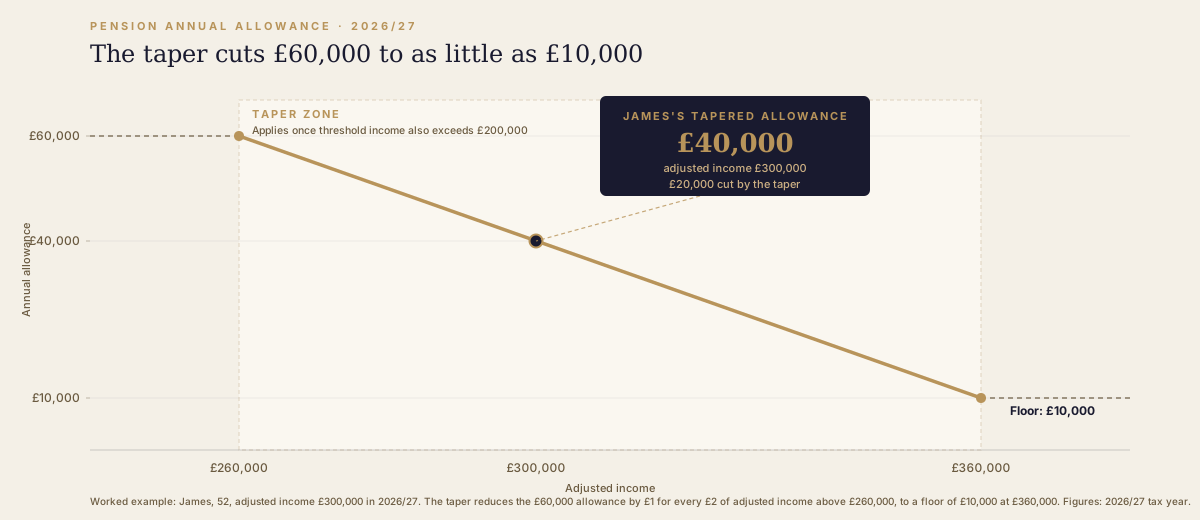
Once both tests are met for 2026/27, the allowance falls by £1 for every £2 of adjusted income above £260,000, down to a floor of £10,000 once adjusted income reaches £360,000. Because the calculation turns on definitions that are easy to misread, this is one area where the tapered annual allowance rules reward a careful look before you assume your allowance is the full £60,000.
How the tapered annual allowance reduces a high earner’s allowance
James, 52, has adjusted income of £300,000 in 2026/27 after a bonus and employer pension contributions.
| Input | Value |
|---|---|
| Standard annual allowance | £60,000 |
| Adjusted income | £300,000 |
| Adjusted income limit | £260,000 |
- Adjusted income above the £260,000 limit: £40,000
- Allowance reduced by £1 for every £2 over: a £20,000 reduction
- Tapered allowance: £60,000 less £20,000 = £40,000
Result: James can contribute £40,000 with tax relief this year, not £60,000. Anything above that faces an annual allowance charge.
How is the tapered annual allowance calculated for high earners?
For 2026/27, the tapered annual allowance reduces the standard £60,000 allowance by £1 for every £2 that adjusted income exceeds £260,000, once threshold income also exceeds £200,000. The reduction stops at a floor of £10,000, reached once adjusted income hits £360,000 or more.
Carry forward: using unused allowance
Carry forward lets you use unused annual allowance from the previous three tax years on top of the current year’s allowance. To use it, you must have been a member of a registered pension scheme in the years you are carrying forward from, even if you contributed nothing. You use the current year’s allowance first, then the oldest of the three earlier years, working forwards.
Carry forward does not lift the separate earnings limit. Your own contributions still cannot exceed 100% of your relevant UK earnings this year, no matter how much unused allowance you have. Employer contributions are not capped by your earnings, which is part of why carry forward is often more useful for company directors funding through their business than for individuals on a fixed salary. The mechanics, and how they interact with the taper, are worth understanding before relying on them, and the detail sits in our guide to pension carry forward.
One important limit applies first. If you have flexibly accessed a defined contribution pension, for example by taking taxable income through drawdown, the money purchase annual allowance of £10,000 applies, and carry forward cannot be used to pay more than that into defined contribution pensions. Taking only your tax-free cash does not trigger it.
Daniel, 55, making a one-off contribution of £90,000
Daniel earns £120,000 and has paid around £20,000 a year into his pension for the past three years. A bonus has left him with cash he wants to add to his pension in 2026/27.
His standard allowance this year is £60,000. Because he has unused allowance from the three previous years, he can carry forward roughly £120,000 on top, so a £90,000 contribution sits comfortably within his limit and avoids any charge. It is also within 100% of his earnings, so the full amount qualifies for tax relief.
A colleague on the same salary who only joined a pension this year has no unused allowance to carry forward. The identical £90,000 contribution would exceed the £60,000 allowance by £30,000. For a higher rate taxpayer that triggers an annual allowance charge of around £12,000, removing the tax relief on the excess. Same contribution, very different outcome, decided entirely by whether unused allowance exists.
Risk warnings
Pensions
Your pension income could also be affected by the interest rates at the time you take your benefits. The tax implications of pension withdrawals will be based on your individual circumstances, tax legislation and regulation which are subject to change in the future.
Pension drawdown
Drawdown pension plans (unsecured income) are complex and are not suitable for everyone. Pension decisions can affect your income for the rest of your life (and that of any partner and other dependants). Where benefits are accessed on a flexible basis, these are not fixed or safeguarded for life. If security of income is important to you then you should consider purchasing an annuity or taking a scheme pension to provide a secured level of income.
What happens if you exceed the annual allowance?
If you exceed the annual allowance, the excess is added to your taxable income for the year and taxed at your marginal rate. This is the annual allowance charge, and its effect is to claw back the tax relief you received on the contributions over your limit. Importantly, going over does not undo or block the contribution; it stays in your pension. What you lose is the tax advantage on the excess.
You normally report and pay the charge through Self Assessment. In some cases, where the charge is large enough, you can ask your pension scheme to pay it from your benefits instead, an option known as Scheme Pays, though conditions apply. HMRC provides a tool to check whether you have an annual allowance charge.
Because the charge simply removes the relief, deliberately paying past the allowance rarely achieves anything beyond locking money away with no tax benefit. The usual exception is where carry forward or the earnings position has been misjudged, which is why the numbers are worth checking before a large contribution rather than after.
Is it worth maxing the annual allowance?
Maxing the annual allowance is not automatically the right move, and for most people it is a ceiling rather than a target. The case for contributing more is straightforward: pension contributions attract tax relief at your marginal rate, and for a higher rate taxpayer that is a meaningful uplift on the way in. The case against is that pension money is locked away until at least age 55, rising to 57 from 6 April 2028, and a pound inside a pension cannot also clear a mortgage, top up an ISA, or sit in an accessible emergency fund.
The annual allowance is a ceiling, not a target. The right contribution is the one that fits your plan, not the largest the rules permit.
For higher earners the question is sharper still, because the taper can quietly cut the allowance and turn an intended contribution into an excess. The amount that makes sense in any given year depends on how a contribution interacts with the rest of your finances, which is the kind of trade-off that lifetime cashflow modelling is designed to make visible.
Risk warnings
Your home may be repossessed if you do not keep up repayments on your mortgage. Think carefully before securing debts against your home.
Not all mortgage contracts are regulated by the Financial Conduct Authority.
How does the annual allowance fit your wider plan?
The annual allowance fits into a wider financial plan as one input among several, alongside how you time contributions across tax years, whether you have unused allowance to draw on, and how much of your funding comes through an employer rather than your own pay. Treating it as one input into a broader plan, rather than a box to fill each April, tends to produce better decisions.
Two changes on the horizon make pension funding decisions more consequential. The minimum pension access age is 55 today, rising to 57 from 6 April 2028. From 6 April 2027, most unused pension funds are due to be brought within the scope of inheritance tax, changing the long-standing role of pensions in passing wealth on. Neither alters the annual allowance itself, but both affect how a contribution today fits a plan that runs for decades. Structured pension and retirement planning treats the allowance as a tool for shaping retirement income and estate outcomes, not an end in itself.
Risk warning
A pension is a long-term investment, the value of your investment and the income from it may go down as well as up. Your eventual income may depend upon the size of the fund at retirement, future interest rates and tax legislation.
The useful detail lives around the number
The pension annual allowance looks like a single number, but the useful detail lives around it: what counts towards it, how the taper can shrink it without warning, and how carry forward can stretch it. Get those right and the allowance becomes a planning tool rather than a trap. The headline £60,000 is where the conversation starts, not where it ends.
Frequently asked questions
What is the pension annual allowance?
The pension annual allowance is £60,000 for most people in 2026/27, but your own contributions are capped at 100% of your relevant UK earnings if that is lower. It applies across all your pensions combined, not separately per scheme. Employer contributions count towards the annual allowance too but are not restricted to your earnings, so an employer could contribute the difference if your earnings are below £60,000.
How does the pension annual allowance work?
The allowance is a single limit across every pension you hold, measured over the tax year from 6 April to 5 April. For defined contribution pensions it counts all money paid in, including employer contributions and tax relief. For defined benefit pensions it counts the growth in your benefits over the year.
What counts towards the pension annual allowance?
Everything paid into your pensions counts: your own contributions, your employer's, any third-party contributions, and the tax relief added by HMRC. For defined benefit schemes, the increase in the value of your benefits over the year is used. ISAs, the State Pension, and other savings do not count.
What happens if I exceed the annual allowance?
If you exceed the annual allowance, the excess is added to your taxable income and taxed at your marginal rate through an annual allowance charge. This claws back the tax relief on the contributions over your limit. The contribution itself stays in your pension; only the tax advantage on the excess is lost.
Can I carry forward unused annual allowance?
Yes. You can usually carry forward unused allowance from the previous three tax years, provided you were a member of a registered pension scheme in those years. Your own contributions are still capped at 100% of this year's earnings, and carry forward cannot be used above the money purchase annual allowance.
Is it worth contributing up to the annual allowance?
Not automatically. The annual allowance is a tax ceiling, not a savings target. Contributing more attracts more tax relief, but pension money is locked away until at least age 55, rising to 57 from 6 April 2028. The right amount depends on how a contribution fits the rest of your plan.