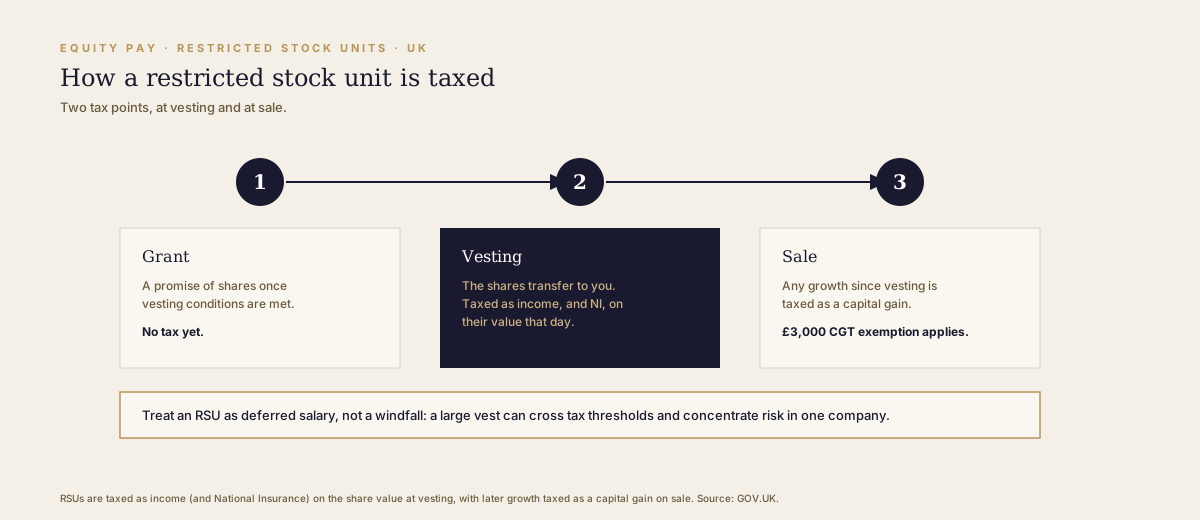
A restricted stock unit is a form of employee share compensation where company shares are transferred to a worker after specified vesting conditions, usually linked to continued employment, are met. You are taxed on RSUs as income when they vest, on the share value that day, with any later growth taxed as a capital gain when you sell. An RSU itself is simply an employer's promise to hand over company shares once vesting conditions are met. The bigger questions are about concentration risk, tax thresholds and how each vest fits your wider plan.
If part of your pay arrives as company shares rather than cash, you are almost certainly dealing with restricted stock units. RSUs have become one of the most common forms of equity compensation in the UK, particularly across technology, finance and fast growing private firms. They are simple in principle and easy to misread in practice. The questions that matter are rarely about whether the shares are worth holding. They are about tax, timing, risk and how each award fits the plan you are already running.
All rates and thresholds in this article reflect the 2026/27 tax year.
How are RSUs taxed in the UK?
In the UK, RSUs are taxed as employment income when they vest, based on the market value of the shares on that date. Income Tax and National Insurance usually apply through PAYE, and any later increase in value is taxed under Capital Gains Tax rules when you sell. The first £3,000 of gains in 2026/27 is covered by the annual exempt amount.
Contents
- What is a restricted stock unit?
- How are RSUs taxed in the UK?
- Deferred pay, not free money
- Why RSUs are riskier than they look
- How a vest moves your wider plan
- What happens once shares vest
- Bringing RSUs into a coherent plan
What is a restricted stock unit?
A restricted stock unit is a promise from your employer to give you company shares at a future date, provided certain conditions are met. The most common condition is simply staying employed for a set period, known as the vesting period. Until the shares vest you do not own them, cannot sell them, and receive no dividends or voting rights. At that stage an RSU is a contractual entitlement rather than an asset you hold.
Most schemes vest in stages. A typical arrangement runs over four years with a one year cliff, meaning a quarter of the award vests after twelve months and the rest follows in regular instalments. Each vesting date delivers real shares into your name and triggers the tax position set out below. The grant date itself, by contrast, usually carries no tax at all.
How are RSUs taxed in the UK?
In the UK, RSUs are taxed as employment income at the point they vest, not when they are granted and not when you eventually sell. On each vesting date the market value of the shares is added to your earnings for the year and is subject to Income Tax and National Insurance, usually collected through PAYE. Many employers operate a sell to cover arrangement, automatically selling enough of the vesting shares to settle the tax due. HMRC’s guidance on tax and employee share schemes sets out the full tax treatment, including the rules that apply where your employer has no UK payroll.
What you are left with after that is an ordinary shareholding. The value of the shares at vesting becomes your base cost for Capital Gains Tax. If you later sell for more than that figure, the growth above it is a capital gain, taxed at 18% within your remaining basic-rate band and 24% above it for 2026/27, with the first £3,000 of gains each year covered by the annual exempt amount. Your income is counted first and the gain stacks on top of it, so the vest that delivered the shares has usually filled that band already and most of any later gain falls at 24%. If you sell immediately at vesting there is usually no further tax, because you are selling at the same value you were already taxed on. The official rates are set out on the gov.uk income tax pages and the Capital Gains Tax rates guidance.
One trap catches people out. If your employer has no UK payroll, which is common with US listed companies, the Income Tax may not be deducted automatically and you may need to report and pay it yourself through self assessment. The shares can be worth far less by the time the bill lands than they were at vesting, yet the tax is fixed at the vesting value. Keeping a clear record of the value on each vesting date is essential.
Risk warnings
Investments
The taxation of the investment is dependent on the individual circumstance of each investor, and may be subject to change in the future.
Tax, trusts and estate planning
The Financial Conduct Authority does not regulate Cashflow Planning.
HM Revenue and Customs practice and the law relating to taxation are complex and subject to individual circumstances and changes which cannot be foreseen.
Why is an RSU really deferred pay, not free money?
The single most useful shift in thinking is to treat a vested RSU as salary that happened to arrive in shares. You have been taxed on it as income, exactly as you would be on a cash bonus. The fact that it is sitting in stock is incidental. This reframing changes the question you ask when the shares land in your account.
Instead of asking whether to sell shares you already own, the honest question is whether you would take that same after tax sum in cash and choose to buy your employer’s stock with it. For most people, framed that way, the answer is no. Very few would voluntarily put a large slice of their savings into one company. Yet holding vested RSUs is precisely that decision, made by default rather than on purpose.
A vested RSU is simply salary that arrived in shares. The real decision is never whether to sell; it is whether you would choose to buy that amount of your employer’s stock with cash today.
Why are RSUs riskier than they look?
The risk is concentration. With RSUs, the company that signs your salary is also the company holding a growing share of your wealth. If it runs into trouble, you can face a falling share price, a frozen or reduced bonus, and questions over job security all at once. These risks are correlated, which is exactly what a sensible plan tries to avoid.
This is where understanding what genuine diversification looks like matters. Spreading capital across different companies, sectors, asset types and regions is what stops a single setback from derailing everything. A portfolio that is 60 or 70 percent invested in one employer is not really a portfolio, it is a concentrated bet that happens to coincide with your career.
None of this means RSUs are a bad thing. They are a valuable part of pay. It simply means the holding deserves the same scrutiny as any other large position, and that scrutiny belongs inside your wider investment planning rather than being treated as a special case because it came from work.
How does a single vesting event affect the rest of your plan?
A vest does more than add to your share count. Because it counts as income, it can push you across thresholds that have nothing to do with shares. The most significant in 2026/27 is the £100,000 mark, where the personal allowance is withdrawn by £1 for every £2 of income above it. This mechanism, known as the personal allowance taper, creates an effective tax rate of around 60% on income between £100,000 and £125,140 in 2026/27. A large vest can also tip you into the 45% additional rate above £125,140 in 2026/27, trigger the High Income Child Benefit Charge, or interact with how much you can usefully pay into a pension.
Because the value of a vest depends on the share price on the day, this income is also lumpy and hard to predict. A plan built around steady earnings can be knocked off course by a large award in a strong year, or left short when a weak year delivers less than expected. This is one of the clearest cases for lifetime cashflow modelling, which maps uneven inflows against your goals rather than assuming a smooth salary.
The interaction with retirement planning is worth highlighting, because pension contributions are one of the few levers that can change where a vest lands relative to these thresholds. Salary sacrifice is typically the most efficient mechanism for employed earners, as contributions reduce adjusted net income before PAYE is applied rather than requiring a claim through self assessment. The worked example shows how much difference that can make on identical awards.
Daniel and Priya, both 39, both earning £94,000
Daniel and Priya are colleagues with identical pay and an identical RSU award. In the same tax year, a tranche worth £14,000 vests for each of them and is taxed as income. That takes their taxable income to £108,000, pushing £8,000 into the band above £100,000 where the personal allowance is being withdrawn.
Daniel does nothing and keeps the cash. The slice of his income above £100,000 is effectively taxed at around 60% once the lost personal allowance is counted, so roughly £4,800 of that £8,000 disappears in tax.
Priya redirects £8,000 into her pension before the tax year closes. That brings her adjusted net income back to £100,000, restores her full personal allowance and lifts that slice out of the 60% band. Same salary, same award, same year, yet their net positions differ by several thousand pounds, decided by where the income was allowed to land.
Risk warnings
Pensions
Levels and bases of, and reliefs from, taxation are subject to change and their value will depend upon personal circumstances. Taxation and pension legislation may change in the future.
Salary sacrifice
It is important to note that salary sacrifice is not suitable for all employees. Employees’ pre-tax salary will be reduced. This may affect their entitlement to State Benefits.
Employees earning more than £260,000 with a tapered annual allowance may incur additional annual allowance tax charges.
What happens to the shares once they vest?
Once RSUs vest and the Income Tax is settled, the shares are yours to keep or sell like any other holding. Selling at vesting is the cleanest option from a tax point of view, because the sale price matches the value you were taxed on, so there is little or no capital gain. The proceeds can then be redirected wherever they are most useful.
Do you pay tax on RSUs twice?
No. You pay Income Tax and National Insurance on the market value of the shares when they vest. Capital Gains Tax then applies only to any growth above that vesting value when you later sell for more. The vesting value becomes your base cost, so the same money is not taxed as income again.
Where they go matters as much as whether you sell. Moving proceeds into tax efficient accounts, for example through a Bed and ISA process or pension contributions via salary sacrifice, can shelter future growth and income. This is why understanding which wrapper an investment sits in is central, because the same shares behave very differently for tax depending on whether they are held in a general account, an ISA or a pension. The £3,000 annual capital gains exemption and the £20,000 ISA allowance in 2026/27 both reward selling and reinvesting in a planned, staged way rather than all at once.
For many people the proceeds are best deployed towards long term goals, and channelling them into building a pension you can retire on often does more for the plan than holding a concentrated position in the hope of further gains. The contrast below shows why the habit you adopt at each vest, repeated over years, tends to matter more than any single decision.
Marcus and Elena, both 45, after eight years of awards
Marcus and Elena have worked at the same US listed technology firm for eight years, on similar pay, receiving similar RSU grants throughout. Each year a tranche vests for both of them.
Marcus holds every tranche, reasoning that the shares have done well and that selling feels like a step backwards. Elena sells each tranche at vesting, where there is no extra tax to pay, and reinvests the proceeds across a diversified portfolio inside her ISA and pension.
By year eight, the shares Marcus had let accumulate made up roughly 70 percent of his investable wealth, all in the company that also paid his salary. Elena had the same job and the same history of awards, but no single company accounted for more than a tenth of her portfolio. If the firm hits a rough patch, Marcus faces a hit to his investments and his job security at once, while Elena’s plan barely notices.
Risk warnings
ISAs
The favourable tax treatment of ISAs may be subject to changes in legislation in the future.
Pensions
A pension is a long-term investment, the value of your investment and the income from it may go down as well as up. Your eventual income may depend upon the size of the fund at retirement, future interest rates and tax legislation.
Bringing RSUs into a coherent plan
Restricted stock units are neither a windfall nor a problem. They are deferred pay delivered in a form that carries its own tax treatment and its own concentration risk. Handled deliberately, they can accelerate progress towards your goals. Left on autopilot, they quietly tilt your finances towards a single company and a single set of fortunes.
The thread running through all of this is that the share price is rarely the most important variable. What tends to move a plan is the unglamorous detail: where income lands relative to a threshold, which account holds the shares, and whether each vest is treated as a fresh decision or simply allowed to pile up. Get those right, consistently, and RSUs become a genuine asset to the plan rather than a risk hiding inside it.
Frequently asked questions
What is an RSU?
An RSU, or restricted stock unit, is a promise from your employer to give you company shares at a future date once certain conditions are met, most commonly staying employed for a set period. You do not own the shares, and have no voting or dividend rights, until they vest. At that point the shares are delivered into your name.
How are RSUs taxed in the UK?
In the UK, RSUs are taxed as employment income at the point they vest, based on the market value of the shares on that date. Income Tax and National Insurance apply and are usually collected through PAYE. Any increase in value after vesting is then subject to Capital Gains Tax when you sell the shares.
Do you pay tax on RSUs twice?
Not on the same money. You pay Income Tax and National Insurance on the value of the shares when they vest, and then Capital Gains Tax only on any growth above that vesting value when you later sell. The vesting value becomes your base cost, so it is not taxed as income again.
Should I sell my RSUs as soon as they vest?
Selling at vesting creates little or no extra tax, because the shares are sold at the same value they were already taxed on. Whether holding makes sense is really a fresh investment question: would you choose to buy that much of your employer's stock with cash today? This depends on your circumstances and is best discussed with a regulated adviser.
What happens to my RSUs if I leave my job?
Unvested RSUs are usually forfeited when you leave, while shares that have already vested are yours to keep. The exact treatment depends on your plan rules and the reason for leaving. It is worth checking your grant documents carefully before resigning, as forfeiting unvested awards can be a significant hidden cost of moving.
Are RSUs the same as share options?
No. The key difference is that an RSU has no purchase price: once it vests you receive the shares having paid Income Tax and National Insurance on their value, but with no separate cost to acquire them. A share option instead gives you the right to buy shares at a set exercise price, so it only has value if the share price rises above that price. That is why an RSU keeps value as long as the share price is above zero, whereas an option can expire worthless.
Why are RSUs considered risky?
RSUs concentrate your wealth in the same company that pays your salary, so a single downturn can hit your income and your investments at the same time. Many people also underestimate the Income Tax due at vesting, which can create an unexpected bill, especially where an overseas employer does not deduct it automatically.