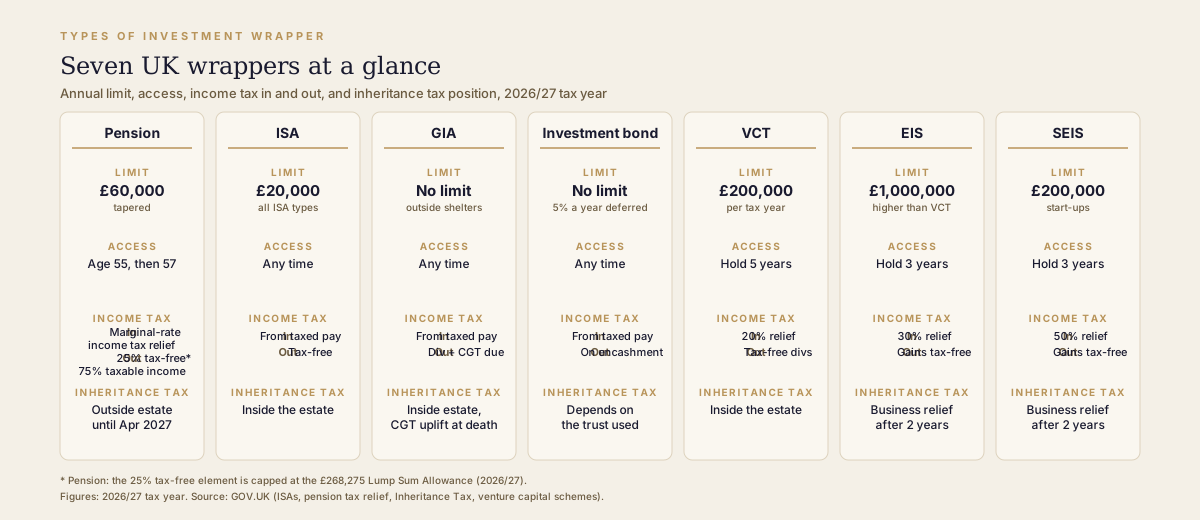
An investment wrapper is the legal structure that holds investments such as funds, shares, cash or bonds, separate from the investments held inside it. The main UK investment wrappers are pensions, ISAs, general investment accounts, investment bonds, and higher-risk schemes such as venture capital trusts (VCTs), the Enterprise Investment Scheme (EIS) and the Seed Enterprise Investment Scheme (SEIS), which give tax relief for investing in small companies. The wrapper you choose changes how much tax you pay, when you can reach the money, and whether it forms part of your estate for inheritance tax in the 2026/27 tax year. Most people end up using a mix of wrappers, because no single one covers every stage of a financial plan.
Two people can buy the same global equity fund on the same day and end up in very different financial positions twenty years later. Not because one made a better investment choice, but because they held that same fund inside a different wrapper. The types of investment wrapper available in the UK each behave in distinct ways: taxed differently during life, accessed under different rules, and treated differently when you die. The choice between them is one of the most consequential decisions in a long-term plan, and it is often made by default rather than design.
All figures in this article reflect the 2026/27 tax year.
How do I decide which investment wrapper to use first?
Most UK investors should fill any workplace pension matching first, then use the ISA allowance of £20,000 a year for 2026/27, before considering a general investment account. The right order depends on when you need access, your tax position, and whether allowances such as the £60,000 pension annual allowance or the ISA limit are already used.
Contents
- What is an investment wrapper?
- How does a pension work as an investment wrapper?
- How does an ISA work as an investment wrapper?
- What is a general investment account, and when do you need one?
- How do the main UK investment wrappers compare?
- Why does wrapper choice shape the whole plan?
- Should you use more than one type of investment wrapper?
- How does drawdown sequencing work in retirement?
What is an investment wrapper?
An investment wrapper is the legal vehicle that holds an investment, rather than the investment itself. The shares, funds, bonds or cash inside the wrapper are the same in every case. What changes is the tax treatment that applies to income, gains and growth, the rules around when you can take the money out, and what happens to whatever is left when you die. Wrappers are the structural choices in a plan; investments are the contents.
For a useful broader view of what those contents can be, our article on the main types of investment covers asset classes such as cash, bonds and alternatives in detail.
How does a pension work as an investment wrapper?
A pension works as an investment wrapper by giving tax relief on contributions, letting investments grow free of income tax and capital gains tax inside the fund, and then taxing most withdrawals as income later on. Contributions attract income tax relief at your marginal rate, and HMRC adds basic-rate relief automatically for relief-at-source schemes, often topped up further by the recovery of National Insurance through salary sacrifice. 25% of the pot can usually be taken tax-free at retirement up to the Lump Sum Allowance of £268,275 for 2026/27. Income drawn beyond that tax-free amount is taxable in the year of withdrawal, which is why pensions tend to suit people whose marginal tax rate is lower in retirement than in their working years.
How much tax-free cash can I take from my pension?
Most pension savers can take up to 25% of their pot tax-free when they access it, subject to the Lump Sum Allowance of £268,275 for 2026/27. Anything taken above the tax-free portion is added to your income and taxed at your marginal rate in the year you withdraw it.
The two features that matter most for planning are the access age and the estate treatment. Pension funds cannot generally be touched before age 55 (rising to 57 from 6 April 2028), which makes pensions powerful for disciplined long-term saving but unhelpful for goals before that age. Pensions have historically sat outside the estate for inheritance tax, but from 6 April 2027 unused pension funds and death benefits will be brought into the inheritance tax net. That change is large enough to require many plans built around pensions as an estate planning tool to be revisited. We cover the pension question in more depth in our article on what makes a good pension to retire on.
Risk warnings
Investments
The taxation of the investment is dependent on the individual circumstance of each investor, and may be subject to change in the future.
Pensions
Levels and bases of, and reliefs from, taxation are subject to change and their value will depend upon personal circumstances. Taxation and pension legislation may change in the future.
A pension is a long-term investment, the value of your investment and the income from it may go down as well as up. Your eventual income may depend upon the size of the fund at retirement, future interest rates and tax legislation.
Your pension income could also be affected by the interest rates at the time you take your benefits. The tax implications of pension withdrawals will be based on your individual circumstances, tax legislation and regulation which are subject to change in the future.
Salary sacrifice
It is important to note that salary sacrifice is not suitable for all employees. Employees’ pre-tax salary will be reduced. This may affect their entitlement to State Benefits.
Tax, trusts and estate planning
The Financial Conduct Authority does not regulate some aspects of Trust, Tax and Estate Planning.
HM Revenue and Customs practice and the law relating to taxation are complex and subject to individual circumstances and changes which cannot be foreseen.
How does an ISA work as an investment wrapper?
An ISA works as an investment wrapper by letting you pay in money you have already paid tax on, and then take all growth, income and withdrawals back out completely free of tax, with no penalty for accessing it at any time. The annual subscription limit is £20,000 across all ISA types combined, with sub-limits for the Lifetime ISA (£4,000, attracting a 25% government bonus) and the Junior ISA (£9,000 per child).
ISAs sit inside the estate for inheritance tax, but spouses can inherit the ISA value through an Additional Permitted Subscription, which preserves the wrapper after the first death. Cash ISA subscriptions for the under-65s will be capped at £12,000 a year from 6 April 2027 within the overall £20,000 allowance, with the remainder needing to go into Stocks and Shares or Innovative Finance ISAs. That change nudges the ISA wrapper further towards long-term investment rather than tax-sheltered savings.
The defining strength of the ISA is flexibility. The money is yours, in your name, accessible on demand, and outside the tax net while invested. That makes ISAs particularly powerful for the years between giving up a salary and reaching pension age.
Risk warnings
The favourable tax treatment of ISAs may be subject to changes in legislation in the future.
An investment in a Stocks & Shares ISA will not provide the same security of capital associated with a Cash ISA.
What is a general investment account, and when do you need one?
A general investment account, or GIA, is an unwrapped investment account with no contribution limit and no access restrictions, which means it sits entirely outside the ISA and pension tax shelters. Interest is taxed as savings income, dividends are taxed once the dividend allowance of £500 a year for 2026/27 is used, and gains are subject to capital gains tax once the £3,000 annual exempt amount is used. The annual allowances on a GIA are now small enough that any meaningful invested balance will generate a tax position to manage.
You need a GIA once your savings capacity exceeds the combined ISA and pension limits, or when you need flexible access to large sums without pension restrictions. GIAs also offer one significant benefit on death: a capital gains tax uplift, so latent gains are wiped out when the asset passes through the estate. That can make GIAs more useful for late-stage estate planning than the lifetime tax position would suggest. The trade-off is that the GIA value itself remains inside the estate for inheritance tax.
How do investment bonds work as a wrapper?
Investment bonds work as a wrapper by pooling your money inside a single premium life assurance contract, and they come in two flavours. Onshore bonds are issued by UK insurers and pay tax inside the wrapper at an effective rate of around 20%. Offshore bonds are issued from jurisdictions such as the Isle of Man, Dublin or Guernsey, and roll up gross, with all tax assessed when a chargeable event is triggered, typically on encashment, partial withdrawal above the 5% allowance, or assignment.
Both bond types allow up to 5% of the original investment to be withdrawn each year, cumulatively up to 100%, with no immediate tax charge. That feature makes bonds useful where someone wants regular tax-deferred cashflow without crystallising a tax event. Bonds also work well alongside trusts, because they are non-income producing in the conventional sense, which simplifies trust taxation. The inheritance tax planning considerations around discounted gift trusts and loan trusts often centre on a bond as the underlying investment.
Bonds are not for everyone. They suit specific planning scenarios: trust planning, an expected drop in marginal rate at encashment, or the need to defer realised gains beyond the limited capacity of a GIA. Used outside those scenarios, they often add cost without adding planning value.
Risk warnings
Tax, trusts and estate planning
The Financial Conduct Authority (FCA) does not regulate Inheritance Tax Planning or Trust Advice.
Protection
Benefits of insurance products will be put at risk or cease altogether if premium payments are not maintained.
What are VCTs, EIS and SEIS?
VCTs, EIS and SEIS are higher-risk specialist investment wrappers that the government uses tax relief to encourage investors to put capital into small, growing UK companies. Venture capital trusts, the Enterprise Investment Scheme and the Seed Enterprise Investment Scheme offer generous reliefs in exchange for that risk: VCT subscriptions attract income tax relief of 20% for 2026/27, EIS subscriptions 30%, and SEIS subscriptions 50%, alongside tax-free dividends from VCTs, capital gains tax deferral on EIS, and inheritance tax business relief on EIS holdings after two years.
The reliefs are real, but so is the risk. Underlying investments are illiquid, valuations are infrequent, and capital loss is a meaningful possibility. These wrappers belong in a small allocation for investors who already have sufficient tax-efficient capacity elsewhere and who can afford the loss of the capital invested. They are not a first port of call for someone still building their core pension and ISA.
Risk warnings
EIS and SEIS’s by their nature are illiquid and invest in small unlisted companies, which are not traded on a stock market exchange and tend to fluctuate more in value.
Loss of investment capital, in part or full, must be considered prior to investing in an EIS or SEIS.
Loss of investment capital, in part or full, must be considered prior to investing in a VCT.
How do the main UK investment wrappers compare?
The main UK investment wrappers differ most in three ways for the 2026/27 tax year: how much you can put in each year, when you can take money out, and how the wrapper is treated for inheritance tax.
Annual limits and access by wrapper type (2026/27)
| Wrapper | Annual limit | Access |
|---|---|---|
| Pension | £60,000 (tapered for high earners) | Age 55, rising to 57 from 6 April 2028 |
| ISA | £20,000 | Any time |
| GIA | No limit | Any time |
| Investment bond | No limit (5% a year tax-deferred) | Any time |
| VCT / EIS / SEIS | £200,000 for a VCT, £1 million for EIS, £200,000 for SEIS | Relief withdrawn if sold inside five years for a VCT, three for EIS and SEIS |
Inheritance tax position by wrapper type
| Wrapper | Inheritance tax position |
|---|---|
| Pension | Outside the estate until 6 April 2027 |
| ISA | Inside the estate |
| GIA | Inside the estate, with CGT uplift on death |
| Investment bond | Depends on the trust used |
| VCT / EIS / SEIS | EIS gains business relief after two years |
The pension’s combination of the highest annual limit and, for now, its position outside the estate is why it remains the default long-term wrapper. But the April 2027 change to pension inheritance tax narrows that advantage, and is one reason a single-wrapper plan is increasingly fragile.
Why does wrapper choice shape the whole plan?
Wrapper choice shapes the whole plan because it determines flexibility, sequencing, the shape of retirement income, and what your family eventually inherits, not just how much tax is paid today. The temptation is to treat wrapper choice as a tax optimisation exercise. It is not.
The wrapper mix determines flexibility, sequencing, the shape of your retirement income, and what your family inherits. The fund choice inside the wrapper, by comparison, mostly affects the rate of return.
Three features make wrappers structurally different from investments themselves. First, access varies dramatically: you can take ISA money on a Tuesday afternoon, but pension money before 55 is locked away. Second, when tax is paid depends entirely on the wrapper. Pension income is taxed in the tax year you draw it, ISA withdrawals carry no tax at any point, and GIA gains can be paced across tax years to stay within the annual exempt amount. Third, estate position sits at the wrapper level: a fund inside one wrapper is outside your estate, inside another it is taxed at 40% above the nil rate band.
A plan built around a single wrapper is therefore a one-dimensional plan. Most plans benefit from a deliberate mix, weighted by the goals the wrapper is meant to serve.
A tale of two pre-retirees
Anna and Robert are both 55, both have £600,000 of investable wealth, and both want to retire at 60 on around £35,000 a year of net income until the State Pension begins at 67. They have identical net wealth and identical income goals. Their wrapper mix is different.
Anna has £500,000 in a pension and £100,000 in a Stocks and Shares ISA. Most of her saving life was through workplace pension contributions and she did not start an ISA until her forties.
Robert has £300,000 in a pension, £200,000 in an ISA, and £100,000 in a GIA. He was self-employed for part of his career and built his savings across more wrappers as a result.
Between 60 and 67, Robert has more levers to pull. The natural shape of his plan is to draw taxable pension income up to his personal allowance each year, putting an allowance to use that would otherwise be wasted, and then to top up to his £35,000 net target using a blend of ISA (tax-free) and GIA (drawn against the £3,000 annual exempt amount with careful gain realisation). The effect is that Robert spends those years either as a non-taxpayer or a basic-rate taxpayer. In any year where additional pension income would tip him into the higher rate band, he reverses the priority and leans on ISA and GIA, because those withdrawals carry no income tax and a much lower CGT rate respectively, both well below higher-rate income tax on pension income.
Anna can run a similar playbook with the wrappers she has. She can use her personal allowance against pension income, take part of her 25% tax-free cash, and supplement with ISA withdrawals. Across the same stretch before State Pension she can also stay as a basic-rate taxpayer. The constraint is what happens once her smaller ISA depletes, which it does sooner because there is less of it. From that point her income comes almost entirely from her pension, and any unexpected expense, such as a new roof, a medical procedure, or helping a child onto the property ladder, has to be funded by an extra pension drawdown. Those one-off draws often push the total taxable income for that year into the higher rate band. Her estate position, post-April 2027, is also dominated by the pension sitting inside the inheritance tax net.
Robert reaches State Pension age with a pension that has been drawn down more slowly, and with ISA and GIA reserves still intact. He can take a measured pension income for the rest of his life, much of it within the basic rate band, and dip into his ISA and GIA in years when one-off costs would otherwise drag him into higher rate. His estate position is more mixed, but he has had years of flexibility to manage it through gifting, seven-year planning and other steps.
The two plans look almost identical on the spreadsheet at age 60. They diverge sharply by age 75, and they diverge more sharply still by death. Same money, different wrapper mix, different plan.
Should you use more than one type of investment wrapper?
Yes, for most people the right approach is to hold more than one type of investment wrapper rather than relying on a single one, because each wrapper covers a gap the others leave open. A pension brings tax relief and the largest annual allowance, an ISA brings tax-free flexible access, and a GIA absorbs savings once the other two are full. Anna and Robert, above, show how the same total wealth produces very different outcomes depending on how it is spread across these wrappers.
The trade-off is added complexity. More wrappers means more accounts to manage, more decisions about which one to draw from in a given year, and more moving parts when circumstances change. For someone with modest savings and a single clear goal, one or two wrappers may be entirely sufficient. The case for spreading across more wrappers grows as wealth, time horizon and the number of competing goals all increase. A tailored investment strategy takes account of wrapper choice as well as fund selection, so the mix keeps working as circumstances change.
Where should your next pound of savings go?
Where your next pound of savings goes depends on which allowances you have already used and what those allowances are currently doing to your tax position, not simply on which wrapper feels most familiar.
Caroline is 48, earns £108,000, and saves £15,000 a year. She currently puts the full £15,000 into her Stocks and Shares ISA. Her employer offers salary sacrifice on pension contributions but she has never used it for anything beyond the matched contribution. She is considering redirecting that £15,000 into her pension via salary sacrifice instead.
How salary sacrifice can restore personal allowance for a £108,000 earner
Caroline, 48, earns £108,000 and saves £15,000 a year, currently into her ISA.
| Input | Value |
|---|---|
| Adjusted net income before sacrifice | £108,000 |
| Amount sacrificed into pension | £15,000 |
| Personal allowance taper starts at | £100,000 |
- Start with adjusted net income before sacrifice: £108,000
- Sacrifice £15,000 of salary into her workplace pension, reducing adjusted net income to £93,000
- Falling below £100,000 restores the £4,000 of personal allowance previously tapered away
- Combining the income tax relief with the restored allowance gives an effective relief rate of around 60% on the portion of income above £100,000
Result: Caroline’s £15,000 contribution attracts an effective tax relief rate of around 60% on the slice above £100,000, instead of the 40% it would attract as a simple higher-rate contribution.
The mechanics look subtle. The number on her savings statement does not change. But the planning canvas does. Her National Insurance bill falls, her employer may pass on some of the employer NI saving, and the gross amount entering the pension can be materially higher than the net amount she would have put into the ISA.
Compounded over twelve years to age 60, that difference in effective contribution rate becomes a substantially larger pension pot. But the plan changes in more ways than just size. Caroline now has a pension she cannot access early, and the access age rises to 57 from 6 April 2028, which constrains an earlier retirement option. Her ISA balance grows more slowly, which reduces her flexible bridge to State Pension age. Her estate position, post-2027, is more weighted to assets inside the inheritance tax net.
There is no single correct answer here. There is, however, a quite different plan that emerges from the same person making the same level of savings flow through a different wrapper. That is how much difference wrapper choice makes.
Risk warning
Employees earning more than £260,000 with a tapered annual allowance may incur additional annual allowance tax charges.
How does drawdown sequencing work in retirement?
Drawdown sequencing works by choosing, year by year, which wrapper you draw income from first, pension, ISA or GIA, so as to minimise tax and preserve flexibility for as long as possible. With ISAs, pensions and GIAs sitting alongside each other, there are many possible sequences, and the right one depends on your tax position now, your expected tax position later, your estate goals, and the legislative direction of travel.
A few principles tend to hold. Drawing taxable income from a pension when you have no other taxable income lets you use your personal allowance against it. Realising GIA gains in modest annual amounts can wipe out latent gains using the annual exempt amount over time. Holding ISAs back can preserve a tax-free reserve for irregular expenses. The 2027 change to pension inheritance tax treatment will, for many people, weaken the case for leaving pensions untouched as a legacy asset.
This is where lifetime cashflow modelling earns its place. The numerical difference between drawdown sequences is often surprisingly large, and the difference is essentially free: same wealth, same investments, different order of withdrawals.
What does wrapper choice mean for your financial plan?
Wrapper choice means your underlying investments do not change, but how and when you can use them, and what your family eventually receives, change completely. They change when you can have the money, how much tax you pay on it along the way, and what is left at the end. The most useful question to ask of a portfolio is rarely “what is it invested in” and far more often “what wrappers is it held in, in what proportions, for what purpose”. The choice of investments is consequential. The choice of wrappers is structural.
Frequently asked questions
What is an investment wrapper?
An investment wrapper is the account or structure, such as a pension, ISA or general investment account, that holds your investments and determines how they are taxed and accessed. It is not the investment itself: the same fund can sit inside different wrappers and behave very differently for tax and inheritance purposes.
What are the types of investment wrapper in the UK?
The main types of investment wrapper in the UK are pensions (including SIPPs and workplace schemes), ISAs (Stocks and Shares, Cash, Lifetime, Junior and Innovative Finance), general investment accounts, and investment bonds (onshore and offshore). Higher-risk specialist wrappers include venture capital trusts, the Enterprise Investment Scheme and the Seed Enterprise Investment Scheme.
What is the difference between an ISA and a pension?
An ISA is funded from money you have already paid tax on; growth and withdrawals are tax-free, and you can access the money at any time. A pension gives tax relief on contributions and grows tax-free, but withdrawals are taxable income and you generally cannot access it before age 55, rising to 57 from 6 April 2028.
What is a general investment account?
A general investment account, or GIA, is an unwrapped investment account with no annual contribution limit and no access restrictions. Income, dividends and gains inside a GIA are potentially subject to income tax, dividend tax and capital gains tax respectively, after the small annual allowances available outside an ISA or pension.
Are investment bonds tax-free?
Investment bonds are not tax-free, but they have distinct tax treatment. Onshore bonds pay an effective 20% tax inside the wrapper, while offshore bonds roll up gross. Both allow up to 5% of the original investment to be withdrawn each year for twenty years with no immediate tax charge, with the tax position assessed at encashment.
Which investment wrapper has the highest annual contribution limit?
For most people the pension annual allowance of £60,000 a year for 2026/27 is the highest, although it tapers to as little as £10,000 for high earners, and is replaced by the £10,000 money purchase annual allowance once you have flexibly accessed a pension. The ISA allowance is £20,000 per tax year. General investment accounts have no annual contribution limit.
How does wrapper choice affect inheritance tax?
Wrapper choice has a material effect on inheritance tax. ISAs and GIAs sit inside the estate and are exposed to IHT at 40% above the available nil rate bands. Most pension funds are currently outside the estate, although this changes from 6 April 2027 when unused pensions and death benefits are brought into the IHT net. Investment bonds held in certain trusts can sit outside the estate after the relevant qualifying period.
Should you use more than one type of investment wrapper?
Yes, for most people the right approach is to hold more than one type of investment wrapper rather than relying on a single one, because each wrapper covers a gap the others leave open. Combining a pension, an ISA and, where appropriate, a GIA gives you tax relief, tax-free flexible access, and capacity for larger savings. The trade-off is added complexity in deciding which wrapper to draw from and when.