The seven year rule is the mechanism by which most outright gifts to individuals become exempt from inheritance tax, provided the giver survives seven years from the date of making the gift. The headline is straightforward, but the detail is where plans go wrong: taper relief is widely misread, the order of gifts matters more than expected, and reservation of benefit rules can quietly undo the planning. A gift is exempt only if the giver survives the full seven years; die within them and it is reassessed for inheritance tax, with earlier gifts using up the nil-rate band first.
The seven year rule for inheritance tax sits at the heart of most discussions about estate planning, and most explanations stop at the headline: survive seven years after making a gift, and it falls outside your estate. That is broadly accurate, but the framework behind it is more textured than the summary suggests, and the texture is where the planning actually happens. All figures in this article reflect the 2026/27 tax year.
How does the seven year rule work for inheritance tax?
Most outright gifts to individuals are treated as potentially exempt transfers. Survive seven years from the date of the gift and it falls outside your estate completely. Die within seven years and the gift is brought back into the estate calculation, with inheritance tax charged at up to 40% on the amount above the nil rate band, £325,000 for 2026/27.
Contents
- What does the seven year rule actually say?
- How does taper relief work on lifetime gifts?
- Why does the nil rate band matter when a gift fails?
- Why does the order of gifts matter?
- Which gifts are immediately exempt from inheritance tax?
- Should I use the seven year rule to reduce inheritance tax?
- How does the seven year rule fit into a wider plan?
- What is changing for inheritance tax in 2027?
What does the seven year rule actually say?
In UK inheritance tax, most outright gifts to another individual are treated as “potentially exempt transfers”, or PETs, the category the Inheritance Tax Act 1984 defines at section 3A. A potentially exempt transfer is a gift that sits in limbo for seven years: if the donor survives that period, the gift is fully exempt from inheritance tax; if the donor dies within seven years, the gift becomes a “failed PET” and is brought back into the estate calculation.
A separate category covers gifts into most types of trust. These are “chargeable lifetime transfers”, or CLTs, and they behave differently. A CLT above the donor’s available nil rate band attracts an immediate 20% inheritance tax charge at the point the gift is made, with a further potential charge if the donor dies within seven years.
Available is the word to hold on to, because it is not always £325,000 for 2026/27. Each CLT is measured against the nil rate band left after deducting every chargeable lifetime transfer made in the seven years before it. Someone who settled £150,000 into a trust four years ago has £175,000 available today, so a second settlement of £325,000 would put £150,000 into immediate charge and cost £30,000 at 20%. The same £325,000 made three years later, once the first transfer has dropped out of the seven-year window, costs nothing. This is the mechanism the article on discretionary trusts and inheritance tax works through in full, including how the same figure sets the trust’s own ten-year and exit charges.
Some gifts sit outside this framework entirely. Spousal and civil partner transfers between UK-domiciled individuals, gifts to UK-registered charities, and several specific exemptions are immediately exempt, with no seven year clock attached, as set out in GOV.UK’s guidance on inheritance tax and gifts.
How does taper relief work on lifetime gifts?
Taper relief reduces the inheritance tax charge on failed gifts, but only on the portion above the nil rate band. The phrase appears in nearly every mainstream article on the seven year rule and is widely misread: taper relief does not reduce the value of the gift, it reduces the tax payable on it.
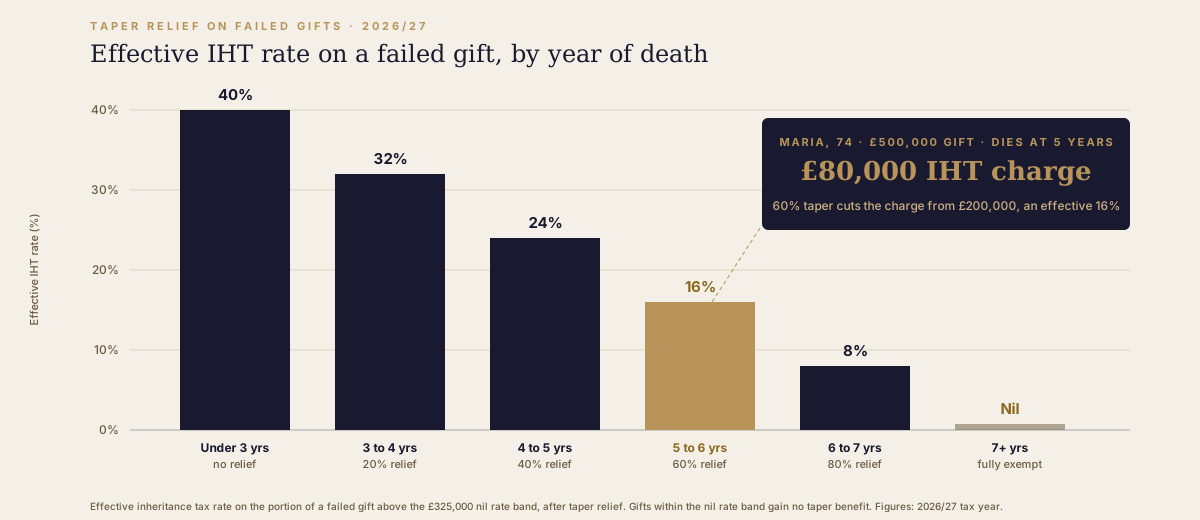
The relief operates on a sliding scale based on the number of complete years between the date of the gift and the date of death, for 2026/27:
- Less than 3 years: no relief, the full 40% applies
- 3 to 4 years: the charge is cut by 20%, so 32% of the amount above the band
- 4 to 5 years: cut by 40%, so 24%
- 5 to 6 years: cut by 60%, so 16%
- 6 to 7 years: cut by 80%, so 8%
- 7 years or more: gift is fully exempt
How taper relief reduces the IHT charge on a gift of £500,000 made five years before death
Maria, 74, gifts £500,000 to her children five years before she dies. Her nil rate band has already been fully used by earlier gifts.
| Input | Value |
|---|---|
| Gift amount | £500,000 |
| Nil rate band available | £0 (already used) |
| Years between gift and death | 5 years |
| Taper relief rate | 60% reduction in charge |
- Full IHT charge at 40%: £500,000 x 40% = £200,000
- Taper relief at 5-6 years applies a 60% reduction to the charge
- Reduction: £200,000 x 60% = £120,000
- IHT payable: £200,000 - £120,000 = £80,000
Result: Taper relief reduces the charge from £200,000 to £80,000, saving £120,000 compared with no taper.
The critical point is that taper relief only ever applies to tax that is actually due. If a gift is fully covered by the nil rate band (£325,000 per individual), there is no tax to taper. Many people who survive five or six years after a moderate gift believe they are most of the way to safety. In practice, if the gift was within the nil rate band, the position is binary rather than gradual: survive seven years, or do not.
What is taper relief and when does it apply?
Taper relief reduces the inheritance tax charge on failed gifts, but only on the portion above the nil rate band, £325,000 for 2026/27. It applies from year three after the gift was made, cutting the rate on that portion from 40% to 32% at three to four years, and to 8% at six to seven. Gifts within the nil rate band receive no benefit, because there is no tax to reduce.
Why does the nil rate band matter when a gift fails?
When a failed gift is brought back into the estate calculation, it consumes the nil rate band first, reducing the allowance available against the rest of the estate. Whatever is left of the nil rate band, if anything, then applies to the death estate.
Consider an individual with an estate of around £900,000 who made a £325,000 gift four years before death. The gift itself attracts no inheritance tax, because it sits within the nil rate band. But the entire nil rate band has now been allocated to the gift. The remaining estate of £900,000 faces inheritance tax with no nil rate band available against it, only the residence nil rate band where the relevant conditions are met.
The headline says no tax was due on the gift. The estate-level numbers tell a different story. A plan that stops at “the gift is within the allowance” can quietly worsen the position rather than improve it.
Why does the order of gifts matter?
The sequence in which gifts are made creates surprisingly different outcomes. A small chargeable lifetime transfer made before a larger potentially exempt transfer occupies part of the nil rate band when the calculation is later run on the PET. The reverse order has different consequences again.
There is also a longer shadow. A failed PET can affect the inheritance tax calculation on a CLT made up to seven years afterwards, because the failed PET enters the cumulation total for that CLT. This is sometimes referred to as the “fourteen year rule”, although it is really an interaction of two seven year periods rather than a separate rule.
The practical implication is that planning around lifetime gifts needs to look at all transfers in sequence, not in isolation. A gift made today does not stand alone.
Reservation of benefit can quietly undo everything
If the donor continues to benefit from the gifted asset, the gift is treated as a “gift with reservation of benefit” and is added back into the estate at death, regardless of when the gift was made. The seven year clock effectively never starts.
The most common example is gifting the family home to children but continuing to live there without paying full market rent. Other examples include gifting a holiday property but continuing to use it, or gifting investments while retaining the income they produce.
There is also a separate regime called the pre-owned asset tax, which can apply income tax charges to certain arrangements designed to sidestep reservation of benefit. Both regimes need consideration alongside any gift involving an asset the donor expects to continue using.
Which gifts are immediately exempt from inheritance tax?
Several exemptions allow gifts to leave the estate immediately, with no seven year wait:
- The annual exemption of £3,000 per tax year, with the ability to carry forward one unused year
- Small gifts of up to £250 per recipient per tax year, separate from the annual exemption
- Wedding gifts, subject to different limits depending on the giver’s relationship to the couple
- Gifts to UK-registered charities, political parties, and certain national institutions
- Gifts between UK-domiciled spouses and civil partners, which are unlimited
Most usefully for clients with significant pension or investment income, gifts from “normal expenditure out of income” are immediately exempt. The conditions are specific: the gifts must come from income rather than capital, form part of a regular pattern, and not reduce the donor’s standard of living. Documented properly, this exemption can move meaningful sums out of the estate every year without engaging the seven year rule at all. A separate article covers how the normal expenditure out of income exemption works in full, including the record-keeping required.
This last exemption is widely underused, partly because it requires consistent record-keeping over time and partly because it is less prominent in mainstream summaries than the more dramatic seven year rule.
Risk warnings
The value of pensions and any income from them can fall as well as rise. You may not get back the full amount invested.
Levels and bases of, and reliefs from, taxation are subject to change and their value will depend upon personal circumstances. Taxation and pension legislation may change in the future.
A pension is a long-term investment and the value is not guaranteed. Any advice or considerations are personal to each individual’s circumstances.
A pension is a long-term investment, the value of your investment and the income from it may go down as well as up. Your eventual income may depend upon the size of the fund at retirement, future interest rates and tax legislation.
Two scenarios
Anna, aged 73, has an estate of around £1.4m. A lifetime cashflow projection confirms that her own income and capital needs are comfortably covered for the rest of her life with significant headroom. She gifts £350,000 to her two adult children to help each with a property purchase. She lives another 11 years and dies at 84.
The gift is outside her estate at death. Her remaining estate, which has grown back to around £800,000 over the intervening period, benefits from the full nil rate band and the full residence nil rate band. The plan worked the way the headline suggests it should.
Robert, also aged 73, has a similar estate of around £1.4m and a similar instinct to help his family. He gifts £350,000 to his children. About a year later, when his daughter mentions that her own son is starting at university, Robert agrees to settle £40,000 into a discretionary trust that will support the family with fees and living costs over the coming years. He dies four years after his original gift to his children.
At death, the picture is materially different from Anna’s. The original £350,000 gift is a failed potentially exempt transfer and is reassessed for inheritance tax. The £40,000 trust settlement was a chargeable lifetime transfer and is reassessed alongside it. The order of the two gifts, and the cumulation between them, changes the nil rate band available against each. The estate-level calculation, in turn, faces an inheritance tax position that the family was not expecting, and that the original thinking around the single £350,000 gift did not anticipate.
The second gift, which felt to Robert like a separate decision made for an unrelated reason, did not stand outside the inheritance tax calculation of the first. Plans that look at gifts in isolation tend to miss exactly this kind of interaction.
Should I use the seven year rule to reduce inheritance tax?
Lifetime gifting under the seven year rule can reduce an inheritance tax bill substantially, but the case for it rests on two foundations: the gift must be genuinely affordable, and the seven year risk must be planned for.
The affordability question comes first. A lifetime cashflow projection is the right starting point: the gift should leave income and capital needs comfortably covered for the rest of your life, including healthcare and the possibility of care costs. In most cases a gift to an individual cannot be undone, and circumstances can change significantly between the date of the gift and the date of death.
The main trade-off is exposure during the seven year window. A gift made in years one or two carries the full 40% inheritance tax charge if the donor dies within three years, with no taper relief applied. The recipient, not the estate, is usually responsible for any tax on a failed gift, which can create an unexpected burden. Life assurance written in trust can offset this liability during the waiting period, and the cost is worth factoring into the planning before the gift is made.
For most people with a clear estate planning objective and a cashflow base that comfortably supports the gift, lifetime gifting is a sensible part of an inheritance tax planning strategy. The strongest plans use it alongside immediately exempt routes such as normal expenditure out of income, rather than relying on the seven year rule alone.
Risk warnings
Tax, trusts and estate planning
HM Revenue and Customs practice and the law relating to taxation are complex and subject to individual circumstances and changes which cannot be foreseen.
Protection
Benefits of insurance products will be put at risk or cease altogether if premium payments are not maintained.
How does the seven year rule fit into a wider plan?
The seven year rule is rarely the right starting point for inheritance tax planning. It is a feature of the system rather than a strategy. Used in isolation, it concentrates risk in the survival period and tends to overlook the exemptions that operate independently of it.
A more useful framing is to ask what the gifting is intended to achieve. If the purpose is to provide a specific asset to a specific person at a specific time, the seven year rule is the mechanism, and the planning question becomes what happens to the rest of the plan if the donor does not survive the seven years. That question typically pulls in the cashflow projection, the surviving spouse’s position, the recipient’s potential liability for tax on the failed gift, and whether any form of contingent protection is appropriate.
What is changing for inheritance tax in 2027?
From 6 April 2027, most unused pension funds will fall within the scope of inheritance tax for the first time, under the Finance Act 2026. This is the most significant change to UK inheritance tax in a generation, and it changes the calculus on lifetime gifting substantially.
Pensions have historically sat outside the estate. For many clients with the option, they have been one of the most tax-efficient assets to leave untouched until later in life, with non-pension assets drawn down first. As pensions move within the inheritance tax net, the relative position of pension and non-pension assets in a lifetime gifting strategy shifts. Plans built around the previous treatment are likely to need revisiting, and understanding how pensions are currently taxed on death makes clear why bringing them into the inheritance tax net changes the planning picture so substantially.
The seven year rule itself is not changing. The assets to which it is most relevant are. The HMRC Inheritance Tax Manual remains the authoritative reference for the technical rules as they apply in 2026/27.
A single number inside a network of rules
The seven year rule looks like a single number on the page. In practice, it sits at the centre of a small network of overlapping rules, exemptions, and timing effects. Most can be managed comfortably with a clear view of the wider plan. Some can quietly undermine the intended outcome if they are missed. Treating the rule as a planning question, rather than a planning answer, tends to be the more useful starting point.
Frequently asked questions
What is the seven year rule for inheritance tax?
The seven year rule means most gifts to individuals are free from inheritance tax if the giver survives for seven years from the date of the gift. Most outright gifts are treated as potentially exempt transfers, sitting in limbo until the seven-year period expires. If the donor dies within seven years, the gift is reassessed and brought back into the estate calculation.
How does taper relief work on lifetime gifts?
Taper relief reduces the inheritance tax payable on a failed gift on a sliding scale between three and seven years after the gift. It applies only to the portion of the gift above the nil rate band, and only to tax that is actually due. Gifts within the nil rate band do not benefit from taper relief, because no tax was due in the first place.
What is the difference between a PET and a CLT?
A potentially exempt transfer (PET) is an outright gift to another individual, or a bare trust. It becomes fully exempt if the donor survives seven years. A chargeable lifetime transfer (CLT) is typically a gift into a discretionary trust. CLTs above the donor's available nil rate band attract an immediate 20% inheritance tax charge at the point of the gift. Available means £325,000 for 2026/27 less any chargeable lifetime transfers made in the previous seven years, so an earlier settlement can leave little or none of it for the next one.
What is a gift with reservation of benefit?
A gift with reservation of benefit occurs when the donor continues to benefit from the asset they have gifted, such as gifting a property but continuing to live in it without paying market rent. The asset is treated as remaining in the donor's estate regardless of how long they live after making the gift, so the seven year clock effectively never starts.
Are gifts out of income subject to the seven year rule?
No. Gifts made from normal expenditure out of income are immediately exempt from inheritance tax, with no seven year wait, provided three conditions are met: the gifts come from income rather than capital, they form part of a regular pattern, and they do not reduce the donor's standard of living. This exemption can be significant for clients with substantial pension or investment income, but it requires careful documentation.
How does the seven year rule interact with the nil rate band?
When a failed gift is brought back into the estate calculation, it uses the nil rate band before the remaining estate does. A gift fully within the nil rate band attracts no tax in itself, but the entire nil rate band has then been allocated to the gift rather than to the rest of the estate. The estate-level inheritance tax position can be worse than the headline of 'no tax on the gift' suggests.
How will the 2027 pension changes affect lifetime gifting?
From 6 April 2027, most unused pension funds will fall within the scope of inheritance tax for the first time, under the Finance Act 2026. This changes the relative position of pension assets versus other assets in any lifetime gifting strategy. Plans built around the previous treatment of pensions are likely to need revisiting in light of the change.
Should I use the seven year rule to reduce inheritance tax?
Lifetime gifting can reduce an inheritance tax bill effectively, but only if the gift is genuinely affordable and the seven year risk is planned for. The key trade-off is exposure during the window: a gift made in years one or two carries the full inheritance tax charge, 40% for 2026/27, if the donor dies before the third anniversary, with no taper relief applied. For most people with a clear estate objective and a cashflow base that comfortably supports the gift, lifetime gifting is a sensible part of the plan, particularly when combined with immediately exempt routes such as normal expenditure out of income.