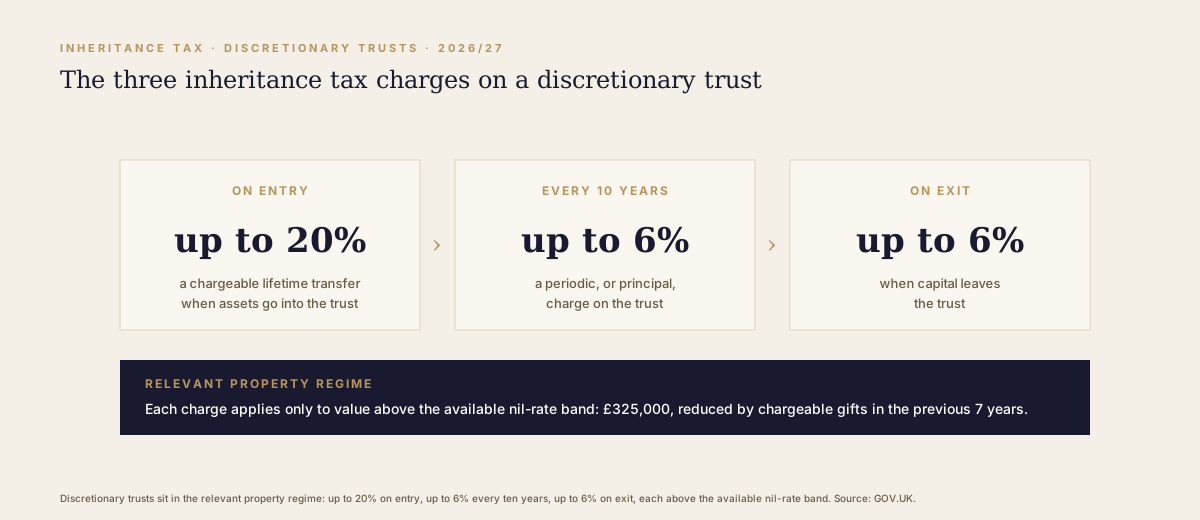
A discretionary trust is a legal arrangement in which trustees hold assets and decide, at their discretion, which beneficiaries receive what and when, rather than fixed entitlements being set in advance. Discretionary trusts sit in the relevant property regime: in 2026/27, up to 20% on entry, up to 6% every ten years, and up to 6% on exit. Every charge falls only on value above the trust's available nil-rate band, which starts at £325,000 but is reduced by any chargeable lifetime transfers the settlor made in the preceding seven years. Gift capital outright within that band and the entry charge is nil, and after seven years that capital and all its growth sit outside your estate. A loan trust is the exception, because nothing is gifted: the loan stays in your estate and only the growth ever leaves.
A discretionary trust gives trustees the power to decide which beneficiaries receive money, and when, rather than handing fixed shares to named people. It does two jobs at once: it takes assets out of your estate, and it keeps a hand on what happens to them afterwards. The price is that they then sit under a separate set of inheritance tax charges from the rest of your estate, applied when money goes in, every ten years it stays there, and when it comes out. What those charges actually cost turns almost entirely on one number, and that number is the subject of most of this article. All figures here reflect the 2026/27 tax year.
Why does a discretionary trust have its own inheritance tax charges?
Because no beneficiary has a fixed right to the assets, a discretionary trust falls under the relevant property regime. HMRC cannot tax the property as belonging to any one person, so it charges the trust directly: up to 20% on entry, up to 6% at each ten-year anniversary, and up to 6% when assets leave. Each applies only above the trust's available nil-rate band, which is £325,000 for 2026/27 less any chargeable transfers the settlor made in the previous seven years.
Contents
- What is a discretionary trust?
- How does inheritance tax apply to a discretionary trust?
- How is the 10-year charge calculated?
- Does a discretionary trust remove assets from inheritance tax?
- How does a discretionary trust fit into a wider estate plan?
- Is a discretionary trust worth it?
- What is changing for inheritance tax and trusts?
What is a discretionary trust?
A discretionary trust is an arrangement where trustees hold assets for a class of beneficiaries and decide who gets what, and when, rather than each beneficiary owning a fixed share. The person who creates it, the settlor, transfers assets to the trustees and usually leaves a letter of wishes to guide their decisions. That letter is not binding: the trustees retain full discretion throughout the life of the trust.
This is the feature that defines the structure and drives its tax treatment. Because no beneficiary has an automatic right to the income or capital, no single person can be said to own the assets for inheritance tax purposes. A discretionary trust is therefore taxed in its own right, not as part of any beneficiary’s estate.
That contrasts with a bare trust, where a named beneficiary has an absolute right to the assets and is treated as the owner for tax, and cannot be changed afterwards. Insurers offer both, and the standard form most families sign when writing life insurance in trust is a discretionary one, because children, marriages and circumstances move over a twenty-year term and a bare trust cannot follow them. The relevant property charges apply to those policy trusts too, and in practice they rarely cost anything: a term policy on a healthy life has almost no value to charge at a ten-year anniversary, and once a claim is paid the proceeds are normally distributed within months rather than held for a decade.
Risk warning
Benefits of insurance products will be put at risk or cease altogether if premium payments are not maintained.
How does inheritance tax apply to a discretionary trust?
Inheritance tax applies to a discretionary trust through the relevant property regime, which charges the trust at three points: when assets enter, at each ten-year anniversary, and when assets leave. The phrase relevant property regime simply means the framework taxing property held in a trust where no beneficiary has a fixed entitlement to it.
The first charge is the entry charge. Transferring assets into a discretionary trust is a chargeable lifetime transfer, and anything above the settlor’s available nil-rate band is taxed immediately, at 20% in 2026/27 if the trustees pay, as set out in HMRC’s guidance on trusts and Inheritance Tax. If the settlor pays the tax personally the effective rate rises to 25%, because that payment is itself a further reduction of their estate.
Available is the word carrying the weight. The band starts at £325,000 for 2026/27, but every chargeable lifetime transfer made in the previous seven years comes off it before this one is measured, so a settlor who put £200,000 into an earlier trust three years ago has £125,000 to work with, not £325,000. It is the same cumulation that drives the seven year rule for gifts, read forwards into the next transfer rather than backwards from a death.
Settle within the available band and the entry charge is nil. That is how most discretionary trusts are funded, and it is the piece of planning that decides everything downstream: the band refreshes seven years after each chargeable transfer, so a settlor with time can move a further £325,000 out of their estate each cycle with no entry charge on any of them, and a couple can do it twice over.
The second and third charges fall on the trust itself. At every ten-year anniversary the trustees face a principal charge of up to 6% on the value above the trust’s own available nil-rate band, and a proportionate exit charge of up to 6% applies when assets are paid out between anniversaries, both confirmed in GOV.UK’s overview of trusts and Inheritance Tax.
The trust’s band is built the same way the settlor’s was: £325,000, less the chargeable transfers the settlor made in the seven years before this trust was created, and less any capital that has already left the trust during the current ten-year period. A trust whose fund is still below its available band at the anniversary pays nothing at all. What a trust does not do is leave the tax system. It exchanges a single 40% charge on death for a much smaller set of charges spread across its life, and 6% a decade is a different proposition from 40% once.
Risk warning
HM Revenue and Customs practice and the law relating to taxation are complex and subject to individual circumstances and changes which cannot be foreseen.
How is the 10-year charge calculated?
The 10-year charge, also called the principal or periodic charge, is calculated on the value of the trust above its available nil-rate band at each ten-year anniversary, at a maximum effective rate of 6% for 2026/27. That ceiling comes from the way the charge is built: it is 30% of the 20% lifetime rate, so it can never exceed 6% of the chargeable value.
How the 10-year charge applies to a discretionary trust worth £760,000
Howard settled £700,000 into a discretionary trust ten years ago. It is now worth £760,000 at its first anniversary, and he made no chargeable transfers in the seven years before creating it, so the trust has the full band available.
| Input | Value |
|---|---|
| Trust value at 10-year anniversary | £760,000 |
| Nil-rate band available | £325,000 |
| Maximum effective rate | 6% |
- Value above the nil-rate band: £760,000 - £325,000 = £435,000
- Maximum 10-year charge at 6%: £435,000 x 6% = £26,100
- As a proportion of the whole fund: £26,100 / £760,000 = about 3.4%
Result: The trustees pay £26,100 at the 10-year anniversary, an effective rate of around 3.4% across the whole fund.
The headline 6% applies only to the slice above the nil-rate band, so the rate across the whole fund is always lower. Howard’s figures assume the maximum band, and that assumption is doing real work. Had he settled £200,000 into a different trust in the seven years before this one, only £125,000 would be available here, £635,000 of the fund would be chargeable, and the maximum charge would rise from £26,100 to £38,100 on the same £760,000.
The full method is set out in HMRC’s Inheritance Tax Manual, and capital that has already left the trust in the current period reduces the band again. Trustees should diarise the anniversary well in advance, because the charge is due whether or not the trust holds cash to pay it.
How much is the 10-year charge on a discretionary trust?
The 10-year charge is a maximum of 6% of the trust value above the trust's available nil-rate band. That band is £325,000 in 2026/27 where the settlor made no chargeable transfers in the seven years before creating the trust, and less where they did. On the full band, a trust worth £760,000 faces up to £26,100, around 3.4% of the whole fund. A fund still below its available band pays nothing.
Does a discretionary trust remove assets from inheritance tax?
It removes the capital you genuinely give away, which is the part that decides most of the bill. Once you have survived seven years from an outright gift into the trust, the value you settled and everything it has grown by since sits outside your death estate, and the 40% charge that would have fallen on it does not. Your own nil-rate band is restored at the same point, ready to work against whatever is left behind.
That depends on the capital actually leaving, and several common structures deliberately keep part of it back. In a loan trust you lend the money to the trustees rather than gift it, so nothing is transferred at outset: the outstanding loan sits in your estate at full value until it is repaid or spent, there is no seven-year clock on it, and only the investment growth ever escapes. In a discounted gift trust the capital is given away, but the fixed payments coming back to you land in your estate as you receive them, so anything you do not spend rebuilds it. The guide to loan, discounted gift and reversionary trusts sets out how much each one shelters and how fast. The principle underneath is the same one that drives the reservation of benefit rules below: inheritance tax follows what you have kept.
What the trust does not do is take the assets out of inheritance tax altogether. They move into the relevant property regime, which exists because trusts once sheltered wealth from death charges indefinitely. The periodic and exit charges close that gap by taxing trust property roughly once a generation instead of at each death, and the arithmetic of closing it is mild. A ceiling of 6% every ten years is around 0.6% a year, set against 40% on the whole value once.
What a £318,000 discretionary trust costs against leaving the same money in the estate
Marcus, 64, has made no chargeable transfers, so his full nil-rate band is available. He gifts £318,000 outright into a discretionary trust for his children and grandchildren, survives the seven years, and the fund is worth £512,000 at its first ten-year anniversary. The rest of his estate is large enough to absorb his nil-rate bands, so anything he holds personally is taxed at 40% at the margin.
| Input | Value |
|---|---|
| Amount settled | £318,000 |
| Available nil-rate band at entry | £325,000 |
| Fund at the 10-year anniversary | £512,000 |
| Trust's available nil-rate band | £325,000 |
- Entry charge: £318,000 is within the available band, so nil
- 10-year charge: (£512,000 - £325,000) x 6% = £11,220
- The same £512,000 taxed in his estate on death: £512,000 x 40% = £204,800
- Difference on the same money: £204,800 - £11,220 = £193,580
Result: The trust's first decade costs £11,220 where a death charge on the same fund would have been £204,800, and the £194,000 of growth from £318,000 to £512,000 never entered the estate at all.
Later anniversaries carry the same 6% ceiling, and an exit charge its own 6%, each measured above whatever band the trust has available. None of them approaches a single death charge on the same fund, and each one is calculated on the excess rather than the whole.
That is the real answer to whether the regime is expensive. Every charge in it falls on the excess above the available band, so a settlement made within that band pays no entry charge, a fund still below it at the anniversary pays no periodic charge, and the same test governs exits.
Only the first of those three can be settled on the day you sign. The other two are measured against the fund on the date they fall due, and no plan controls what ten years of investment returns do to it. Marcus above is the illustration: he settled inside the band, paid nothing to do it, and still faced £11,220 at the anniversary because the fund had grown to £512,000 by the time it was tested.
Nor is there much to be done about it once the trust is running. The obvious move, paying capital out to bring the fund back under the band, does not work: distributions during a ten-year period are fed into the calculation at the next anniversary, so the band comes down by roughly what the fund came down by and the excess barely moves. Where the trust is already in charge, the distribution pays an exit charge on its way out as well.
The levers that count are all at outset: how much goes in against the band available on the day, whether an earlier chargeable transfer should be left to drop out of the seven-year window first, whether the money is better settled in stages across successive cycles than in one movement, and whether what the trust holds carries a relief of its own. After that the periodic charge is a cost to budget for and pricing it honestly before the deed is signed is the more useful exercise.
Settle within the available band and there is no entry charge, and none at the anniversary or on the way out for as long as the fund is still below the band. The charges people worry about are charges on the excess, and growth is what creates the excess. What is left to pay for either way is the deed, the advice and the running of it.
One condition sits underneath all of this and it is absolute. You cannot be a beneficiary of your own discretionary trust, or keep any benefit from what you have settled. If you can still be paid from it, the gift with reservation of benefit rules treat the assets as still yours, the seven year clock never starts, and the fund is back in your estate at 40% on death having paid the trust’s own charges in the meantime for nothing. The money has to be money you can genuinely do without, which is why the affordability question comes before the structure.
Where a trust does look expensive is a single large settlement. Above the available band the 20% entry charge is real money on day one, and a fund that will always sit well clear of £325,000 pays close to the full 6% each decade. Trusts of that size are usually built to hold assets carrying their own relief, such as business property relief, or funded in stages across successive seven-year cycles rather than in one movement.
How does a discretionary trust fit into a wider estate plan?
A discretionary trust earns its place in an estate plan when control over the assets matters as much as the tax outcome. Common reasons include providing for a beneficiary who cannot manage money, protecting an inheritance from a child’s potential divorce, or holding assets for grandchildren not yet born. In each case the discretion is the point: the trustees adapt to circumstances the settlor cannot foresee.
What that control costs comes back to the cumulation rules, and the same gift can be free or expensive depending on nothing more than when the last one was made.
Eleanor, 67, settling £325,000 into a discretionary trust
Eleanor has made no significant lifetime gifts. She settles £325,000 into a discretionary trust for her grandchildren. The transfer is fully within her nil-rate band, so there is no entry charge to pay.
Her friend Frances, also 67, settles the same £325,000 into a comparable trust. But Frances put £200,000 into a different trust three years earlier, leaving only £125,000 of her nil-rate band available.
For Frances, £200,000 of the new settlement now sits above her available nil-rate band and is taxed at 20%, an entry charge of £40,000. The same £325,000 gift produces a £40,000 bill for one settlor and nothing for the other, purely because of a transfer made three years before.
That sequencing effect is why a trust should be planned alongside every other lifetime transfer, not in isolation. A lifetime cashflow projection confirms the settlor can afford to give the money away in the first place, and a coordinated inheritance tax planning strategy makes sure each chargeable transfer is timed so the nil-rate band is not wasted.
Risk warning
The Financial Conduct Authority (FCA) does not regulate Inheritance Tax Planning or Trust Advice.
Is a discretionary trust worth it?
A discretionary trust is worth it when you want the assets out of your estate and you also want a say in what happens to them afterwards. For a vulnerable beneficiary, a spendthrift adult child, or assets you want kept clear of a future divorce or remarriage, the ability to direct who benefits and when is something no outright gift can offer. Inside the available nil-rate band you get that governance without an inheritance tax charge, which is why a trust is usually the better instrument at that size.
The trade-off is administration more than tax. Trustee duties, trust tax returns and professional fees recur for as long as the trust exists, and income and gains arising inside it are taxed at trust rates rather than at a beneficiary’s. Where a large sum needs to move in one go, an outright gift to an individual carries no entry charge at any size, because it is a potentially exempt transfer rather than a chargeable one, and it leaves no structure to run afterwards. Immediately exempt gifts from surplus income avoid the seven year wait altogether.
The comparison is closer than that makes it sound, because both routes run the same seven-year clock. Die inside it and the outright gift and the trust settlement alike are brought back into the calculation and take the nil-rate band before the rest of the estate does, so an estate that expected £325,000 of relief gets none either way. Taper relief only ever reduces tax that was genuinely due above the band, so on £325,000 or less there is no gradual safety on either route: you survive the seven years or you do not.
Where they part company is who pays, and how much is still owed. On a failed outright gift the tax on the excess is the recipient’s to find, so a child who has already spent the money on a house can be handed a bill for a decision they had no part in; on a settlement it falls on the trustees, who are still holding the fund it has to come from. A trust has also already paid 20% on anything above the band, and that is credited against the death charge, so what remains is the difference rather than the whole 40%. Set against all of that, an outright gift can be any size with nothing due at the time, so the sum left exposed is usually the larger one. The seven year rule for gifts works through the whole interaction, and life cover written in trust is the usual way to fund the window on either route.
The honest test is what you want the structure to do. If you want the assets out of your estate and you want trustees deciding what happens next, a discretionary trust does both, and inside the nil-rate band it does the first with no entry charge to pay. If you are content to hand the money to a person and never see it again, an outright gift to an individual reaches the same estate position with less paperwork and no ceiling on how much moves at once. The seven-year clock runs whichever route you take, so that is not what separates them. What an outright gift gives up is the control, and the trustees standing behind the tax if it fails.
What is changing for inheritance tax and trusts?
The nil-rate band that drives every trust charge is frozen at £325,000 until April 2031, so as estates and trust funds grow, more value is pushed above the threshold and into charge each year. Frozen thresholds quietly increase the real cost of the relevant property regime even though the headline rates have not moved.
The larger shift sits outside the trust rules. From 6 April 2027, most unused pension funds will fall within the scope of inheritance tax for the first time, under the Finance Act 2026. As pensions lose their privileged position, more families will look again at trusts and lifetime gifting to manage estates that were previously sheltered by a pension. Any trust planning should be reviewed in light of that change rather than set up once and left.
Risk warnings
The value of pensions and any income from them can fall as well as rise. You may not get back the full amount invested.
Levels and bases of, and reliefs from, taxation are subject to change and their value will depend upon personal circumstances. Taxation and pension legislation may change in the future.
A pension is a long-term investment and the value is not guaranteed. Any advice or considerations are personal to each individual’s circumstances.
Where the cost is actually decided
Almost everything that determines what a discretionary trust costs is settled before the deed is signed: how much of the nil-rate band is available on the day, when the last chargeable transfer was made, and how large the fund is likely to be by its first anniversary. Get that sequence right and a trust moves assets, and all the growth on them, out of your estate with nothing to pay on the way in. Get it wrong and the same £325,000 that costs Eleanor nothing costs Frances £40,000, on a decision made three years earlier for reasons that had nothing to do with this trust. The relevant property regime is not the obstacle here. The dates are.
Frequently asked questions
What is a discretionary trust?
A discretionary trust is an arrangement where trustees hold assets and decide which beneficiaries receive money, and when, rather than fixed shares passing to named people. The settlor sets up the trust and usually leaves a non-binding letter of wishes to guide the trustees. The beneficiaries have no automatic entitlement until the trustees exercise their discretion.
How does a discretionary trust work?
The settlor transfers assets to trustees, who become the legal owners and manage the trust for a defined class of beneficiaries, such as children and grandchildren. The trustees decide how much each beneficiary receives and when, guided by the trust deed and a letter of wishes. Because no beneficiary has a fixed interest, the trustees retain full discretion throughout the life of the trust.
Can a discretionary trust avoid inheritance tax?
It takes out the assets you genuinely give away. Survive seven years from the transfer and the value, plus everything it has grown by since, sits outside your death estate and its 40% charge. The assets move into the relevant property regime instead, which in 2026/27 charges up to 20% on entry and up to 6% every ten years, but only on value above the trust's available nil-rate band. A trust funded within that band, and still below it at its anniversary, pays neither.
Who pays the inheritance tax charges on a discretionary trust?
The trustees are responsible for the 10-year charge and exit charges, paid from the trust's assets. The entry charge is usually paid by the trustees, at 20% in 2026/27 on the amount above the available nil-rate band, but if the settlor pays it personally the effective rate is 25% because the payment is itself a further loss to the estate. Trustees must report and pay these charges to HMRC.
How does the nil-rate band apply to a discretionary trust?
Each chargeable transfer into a trust uses the settlor's nil-rate band, £325,000 for 2026/27, and that band is not refreshed for seven years. Making a second settlement within seven years leaves less nil-rate band available, so more of the new transfer is taxed. The trust's own nil-rate band at each ten-year anniversary is also reduced by any chargeable gifts the settlor made in the seven years before creating it.
What happens to a discretionary trust when the settlor dies?
The trust continues; it does not end automatically. The assets remain inside the trust and outside the settlor's death estate, because they no longer belong to the settlor. The 10-year and exit charges carry on applying to the trust as before. If the settlor died within seven years of creating the trust, the original transfer is reassessed at death rates with credit for the 20% (2026/27) already paid, and it takes the nil-rate band ahead of the rest of the estate.
Is a discretionary trust worth it?
A discretionary trust is worth it when you want the assets out of your estate and a say in what happens to them afterwards, for example providing for a vulnerable beneficiary or keeping an inheritance out of a divorce settlement. Funded within the available nil-rate band it costs no tax to create. The recurring cost is administration: trustee duties, trust tax returns, and professional fees for as long as it runs. Above the band an outright gift to an individual moves a large sum with no entry charge at any size, but both routes run the same seven-year clock, so large transfers of either kind are the ones to model first.