Writing life insurance in trust is a legal arrangement that places ownership of a life insurance policy with trustees, who hold any payout for chosen beneficiaries rather than the policyholder's estate. The payout sits outside your estate, so it normally escapes the 40% inheritance tax charge and avoids the delay of probate, often reaching your family within weeks. Trustees hold the proceeds for your chosen beneficiaries rather than letting the money pass through your estate. The premiums count as gifts and most trusts are hard to reverse, so the choice of trust type and beneficiaries needs to be right at the outset.
Writing life insurance in trust places your policy in the legal ownership of trustees, so any payout goes straight to the people you choose rather than into your estate. That single distinction decides whether your family receives the full sum or watches up to 40% of it disappear in inheritance tax, and whether they wait weeks or months for the money. The arrangement is free to set up on most policies and is one of the few estate planning moves with almost no downside for the typical family. All figures in this article reflect the 2026/27 tax year. What follows is how it works, what it costs, and the handful of cases where it needs more thought.
How does putting life insurance in trust work?
Putting life insurance in trust transfers legal ownership of the policy to trustees you appoint. When you die, they receive the payout and pass it to your chosen beneficiaries, so the money bypasses your estate and probate. Most insurers provide a standard trust form at no cost.
Contents
- What is life insurance in trust?
- How does writing life insurance in trust work?
- Why is a life insurance payout taxed without a trust?
- How do I put a life insurance policy in trust?
- What are the drawbacks of a life insurance trust?
- How does a life insurance trust fit your wider plan?
- Should you put your life insurance in trust?
What is life insurance in trust?
Life insurance in trust is an arrangement in which the policy is owned by trustees who hold any payout for the people you have chosen to benefit. You create the trust as the settlor, name the trustees who will manage the money, and name the beneficiaries who will ultimately receive it. The policy still pays out on your death in the normal way, but it pays to the trust, not to you or your estate.
The point of the structure is ownership. A policy you own personally pays into your estate; a policy held in trust never legally belongs to you, so it sits outside your estate from the start. Two broad types are used. A bare trust fixes named beneficiaries who cannot be changed, while a discretionary trust gives the trustees a group to choose from and the flexibility to decide who gets what. The right one depends on how settled your wishes are, a point covered further below.
How does writing life insurance in trust work?
Writing life insurance in trust works by separating the policy from your estate, so the proceeds never legally belong to you when you die. On death, the insurer pays the trustees rather than your personal representatives, and the trustees pass the money to your beneficiaries under the terms of the trust. Because nothing waits for the grant of probate that releases the rest of your estate, the payout can reach your family far sooner, often within a few weeks.
Two practical features make the arrangement straightforward. Most insurers supply a ready-made trust deed, so you rarely need a solicitor for a standard policy, and you can put a policy in trust either when you take it out or at any time afterwards. A policy written in trust keeps the payout separate from the estate and pays it directly to the beneficiaries. The same mechanism is one of the main ways couples address the income a survivor loses, explored in our guide to insuring the state pension for a surviving spouse.
Risk warnings
The value of pensions and any income from them can fall as well as rise. You may not get back the full amount invested.
A pension is a long-term investment and the value is not guaranteed. Any advice or considerations are personal to each individual’s circumstances.
Why is a life insurance payout taxed without a trust?
Without a trust, a life insurance payout is paid to your estate, where it is added to everything else you own and can be taxed at 40%. Inheritance tax is charged at 40% on the value of an estate above the nil-rate band, which is £325,000 for 2026/27 and frozen at that level until April 2031, as set out by GOV.UK. A large policy can push an estate that was previously under the threshold well over it, so the cover bought to protect a family ends up partly funding their tax bill.
The thresholds that decide whether an estate is taxable, including the residence nil-rate band, are explained in our guide to the nil-rate band and residence nil-rate band. The key figure is the marginal one: every pound of a payout that falls above the available allowances is taxed at 40%, so on a policy of any size the difference between in trust and not in trust is rarely small.
Two £300,000 policies, one form apart
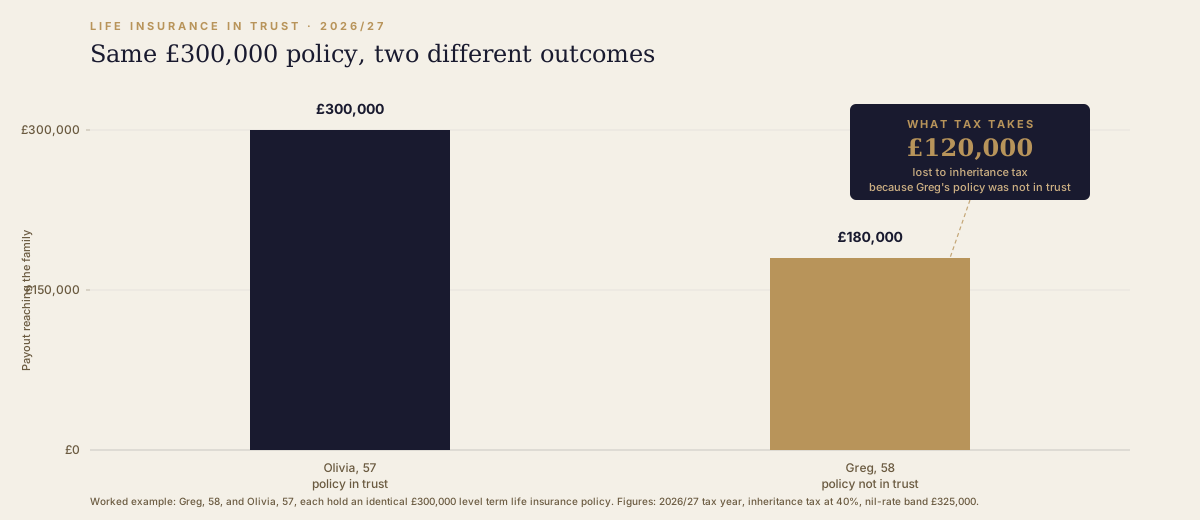
Greg, 58, holds a £300,000 level term policy that is not in trust. His house and savings already take his estate above the nil-rate band, so on his death the £300,000 is added to his estate and the whole sum is taxed at 40%. That is £120,000 to HMRC, and his family must wait for probate before the rest is released.
Olivia, 57, has an identical £300,000 policy, but she signed her insurer’s trust form when she took it out. On her death the payout goes straight to her two children, free of inheritance tax, and reaches them within weeks rather than months.
The policies, the premiums, and the sum assured were the same. The only difference was a single form completed at the outset, and it was worth £120,000 and several months to the family that had it.
A trust form signed when a policy starts can be worth more to a family than years of premiums: it decides whether the payout arrives in full, or arrives minus 40% after a wait for probate.
Risk warnings
Tax, trusts and estate planning
HM Revenue and Customs practice and the law relating to taxation are complex and subject to individual circumstances and changes which cannot be foreseen.
Protection
Generally, these plans have no cash in value at any time and will cease at the end of the term. If premiums are not maintained, then cover will lapse.
How do I put a life insurance policy in trust?
You put a life insurance policy in trust by completing your insurer’s trust form, naming your trustees and beneficiaries, and returning it, which most providers allow free of charge on a new or existing policy. The process is short, but each choice has consequences, so it is worth treating with care rather than rushing through the paperwork.
There are four practical steps. First, choose the type of trust: a bare trust for fixed beneficiaries, or a discretionary trust where the trustees choose between a group. Second, appoint your trustees, who manage and pay out the money; you are usually one yourself, and a second trusted adult is sensible so the trust does not rest on one person. Third, name your beneficiaries, and with a discretionary trust you can add a letter of wishes to guide the trustees without binding them. Fourth, sign and return the deed to the insurer. Because the cover only sits outside your estate from the date the trust takes effect, doing this sooner rather than later is the safer course.
What are the drawbacks of a life insurance trust?
The main drawback is that most trusts are hard to reverse, so the trustees, beneficiaries, and trust type you choose are difficult to change once the trust is made. A bare trust in particular fixes its beneficiaries permanently, which can be a problem if family circumstances shift. Giving up personal control is the price of taking the policy out of your estate, and for a small number of people that trade-off does not suit them.
Premiums need a moment’s thought too, though they rarely cause a problem. Each premium you pay once the policy is in trust counts as a gift for inheritance tax. In practice the £3,000 annual exemption or the normal expenditure out of income exemption covers them, and anything left over is usually a potentially exempt transfer that falls away under the seven year gifting rule.
Are life insurance premiums taxed when the policy is in trust?
Once your policy is in trust, each premium counts as a gift for inheritance tax. In practice the £3,000 annual exemption or the normal expenditure out of income exemption almost always covers these gifts, so they create no charge. Any larger premium is usually a potentially exempt transfer.
There is one more technical point. GOV.UK’s guidance on trusts and Inheritance Tax explains that a discretionary trust can face a periodic charge of up to 6% every ten years and an exit charge when money leaves it. For a protection policy these rarely apply, because while you are alive and in good health the policy’s value for those tests is usually negligible, and once a claim is paid the proceeds are normally distributed promptly rather than held for years.
How does a life insurance trust fit your wider plan?
A life insurance trust fits a wider plan as a liquidity tool: it puts a tax-free lump sum in your family’s hands at the moment other assets are frozen or being taxed. Inheritance tax is generally due within six months of death, often before the estate can be sold or accessed, so a trust payout can supply the cash to settle the bill without forcing a rushed sale of a home or investments.
That role is growing in importance. From 6 April 2027, most unused pension funds will be counted as part of the estate for inheritance tax, a change explained in our guide to pensions and inheritance tax from April 2027. More families will face a tax bill they did not previously expect, and how a pension itself is taxed on death, set out in how pensions are taxed on death, interacts with the rest of the estate. Cover written in trust is one of the cleaner ways to provide the liquidity those bills will need, and its place is best judged as part of a coordinated inheritance tax planning review.
The trust is also only as good as the cover behind it. The type and size of policy, and how long it needs to run, are protection questions in their own right, and matching the cover to the need is the core of any protection planning exercise. Seeing how a payout would land alongside pensions, savings, and the survivor’s own income is exactly what lifetime cashflow modelling is designed to show.
Risk warnings
Pensions
Levels and bases of, and reliefs from, taxation are subject to change and their value will depend upon personal circumstances. Taxation and pension legislation may change in the future.
A pension is a long-term investment, the value of your investment and the income from it may go down as well as up. Your eventual income may depend upon the size of the fund at retirement, future interest rates and tax legislation.
Tax, trusts and estate planning
The Financial Conduct Authority (FCA) does not regulate Inheritance Tax Planning or Trust Advice.
Should you put your life insurance in trust?
For most people with life insurance, putting the policy in trust is worth doing, because it is free, speeds up payment to your family, and usually removes the payout from inheritance tax with almost no offsetting cost. If your estate is anywhere near the nil-rate band, or could be after the 2027 pension changes, the case is stronger still, since a payout outside the estate can be the difference between your family keeping the full sum and losing 40% of it.
The exceptions are narrow but real. A policy with a surrender value that you might want to cash in yourself is a poor fit, because putting it in trust gives up your access to it. Business protection and arrangements with unusual beneficiary needs are often better served by a bespoke trust drafted with advice than by a standard insurer form. And anyone uncomfortable with the loss of control that a trust involves should weigh that against the tax saving rather than assume the saving settles it. For the large majority, though, the honest answer is that a free form which can save a family six figures and months of delay is rarely a close call.
Making sure the money actually arrives
Life insurance exists to put money in your family’s hands when they most need it, and writing the policy in trust makes sure as much of it as possible actually arrives. The mechanism is simple, the cost is usually nothing, and the effect is to keep the payout out of your estate, away from probate delay, and clear of a 40% tax charge. The decision deserves a moment’s thought about trustees, beneficiaries, and the type of trust, but for most families it is one of the highest-value forms a financial plan ever asks them to sign.
Frequently asked questions
What is writing life insurance in trust?
Writing life insurance in trust means placing legal ownership of the policy with trustees, who hold any payout for your chosen beneficiaries instead of it passing through your estate. This keeps the proceeds outside your estate for inheritance tax and lets them be paid without waiting for probate. You can do it on a new or existing policy.
Does putting life insurance in trust avoid inheritance tax?
Usually, yes. A policy written in trust normally falls outside your estate, so the payout is not part of the value taxed at 40% in 2026/27. Without a trust, a payout is added to your estate and can be taxed if your total estate exceeds the nil-rate band of £325,000.
How much does it cost to put life insurance in trust?
For most policies it costs nothing. Insurers provide a standard trust form free of charge, and you can complete it when you take out the policy or later. Bespoke trusts drafted by a solicitor carry a fee, which most straightforward cases do not need.
Can you put an existing life insurance policy in trust?
Yes. An existing policy can be placed in trust at any time by completing your insurer's trust form. The protection is the same as setting it up at outset, though the cover only sits outside your estate from the date the trust takes effect, so doing it sooner is better.
What type of trust is best for life insurance?
It depends on how much flexibility you want. A bare trust pays fixed, named beneficiaries and is simple, but you cannot change who benefits. A discretionary trust lets trustees decide between a group of people, which suits changing family circumstances but carries more complex tax rules.
Can you change the beneficiaries after putting a policy in trust?
Only with a discretionary trust. A bare trust fixes the beneficiaries when it is created and they cannot be changed afterwards. A discretionary trust lets you and your trustees adjust who benefits over time, which is why it is often preferred where children or family circumstances may change.
Are the premiums taxed as gifts when a policy is in trust?
Each premium counts as a gift for inheritance tax once the policy is in trust, but a charge rarely arises. The £3,000 annual exemption or the normal expenditure out of income exemption almost always covers them. Anything not covered is usually a potentially exempt transfer under the seven year rule.
Should you put your life insurance in trust?
For most people with life insurance, yes. It is free, speeds up payment to your family, and usually removes the payout from inheritance tax with almost no offsetting cost. The main exceptions are policies you may want to cash in yourself and arrangements better handled by a bespoke trust, such as some business protection.