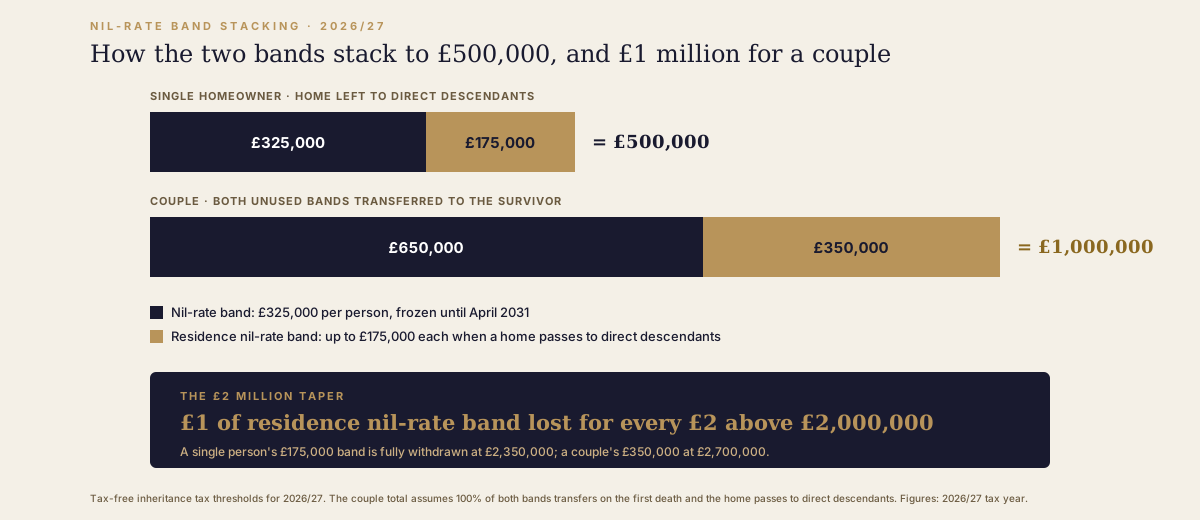
The nil-rate band is the threshold of an estate's value taxed at 0% for inheritance tax, and the residence nil-rate band is an additional threshold for a home left to direct descendants. In 2026/27 every estate has a £325,000 nil-rate band, plus up to £175,000 of residence nil-rate band when a home passes to direct descendants, with everything within them taxed at 0%. Together they let many couples pass on up to £1 million, but the residence band carries strict conditions and shrinks above larger estates. Both thresholds are frozen until April 2031, so more estates are drawn into inheritance tax each year.
The nil-rate band is the first and most important number in any inheritance tax calculation: it sets how much of an estate passes to the next generation at a 0% rate before the 40% charge begins. In 2026/27 it stands at £325,000 per person, and a second threshold, the residence nil-rate band, can add up to £175,000 more when a home is left to direct descendants. Used together, and transferred between spouses, these two bands shape almost every estate plan in the UK. All figures in this article reflect the 2026/27 tax year.
How do the nil-rate band and residence nil-rate band work together?
The nil-rate band shelters the first £325,000 of any estate from inheritance tax in 2026/27. The residence nil-rate band adds up to £175,000 more when a home passes to direct descendants. A surviving spouse can inherit both unused bands, so a couple can combine them to pass on up to £1 million tax-free.
Contents
- What is the nil-rate band?
- How does the residence nil-rate band work?
- How do the nil-rate bands stack together?
- Can you inherit a spouse’s unused nil-rate bands?
- Why does the £2 million taper reduce the residence nil-rate band?
- Should you rely on the residence nil-rate band?
- How do the nil-rate bands fit into a wider plan?
- What is changing for inheritance tax thresholds after 2031?
What is the nil-rate band?
The nil-rate band is the slice of an estate that is taxed at 0% for inheritance tax, set at £325,000 per person for 2026/27. Everything in the estate above the available band is generally taxed at 40% on death. The band applies to the whole estate regardless of what it contains, whether cash, investments, property, or business assets that do not qualify for other reliefs.
The £325,000 figure has not moved since April 2009. The standard rate above the threshold is 40%, falling to 36% where at least 10% of the net estate is left to charity, as set out in GOV.UK’s guidance on how inheritance tax works. The band is allocated before the residence nil-rate band and before working out any tax due.
One point is often missed: lifetime gifts can use the nil-rate band before the death estate does. A gift made within seven years of death is brought back into the calculation and consumes the band first, which can leave less, or none, of it available against the rest of the estate. The seven year rule for lifetime gifting explains how that interaction plays out.
How does the residence nil-rate band work?
The residence nil-rate band is an extra threshold of up to £175,000 in 2026/27, available only when a main residence is left to direct descendants. It sits on top of the standard nil-rate band, so a single homeowner leaving their home to their children can shelter up to £500,000 in total before any inheritance tax is due.
The conditions are specific. The band applies to a “qualifying residential interest”, meaning a property that was the deceased’s home at some point. As GOV.UK’s guidance on passing on a home sets out, the home must pass to direct descendants: children, grandchildren, and their spouses, including adopted, foster, and stepchildren. A home left to a sibling, a niece, or a friend does not attract the band at all.
The residence nil-rate band is the part of the system most likely to be lost through a detail rather than a number. Leaving the home to the wrong beneficiary, or having no qualifying residence at death, removes it entirely. There are downsizing provisions that preserve the band for someone who sells or moves to a smaller home before death, but they have to be claimed and evidenced.
How do the nil-rate bands stack together?
The two bands stack rather than overlap: the residence nil-rate band is added to the standard nil-rate band, not blended into it. For a single person who owns a home and leaves it to direct descendants, that means £325,000 plus £175,000, a combined £500,000 tax-free threshold in 2026/27.
The chart shows that a single homeowner reaches £500,000 of tax-free threshold by adding the £175,000 residence nil-rate band to the £325,000 standard band. A couple who pass both unused bands to the survivor reach £1 million, because two of each band are available on the second death. The doubling only happens where the residence band’s conditions are met on that second death.
Can you inherit a spouse’s unused nil-rate bands?
Yes. When the first spouse or civil partner dies, the percentage of their nil-rate band and residence nil-rate band left unused transfers to the survivor’s estate, an entitlement known as the transferable nil-rate band. Because transfers between spouses are themselves exempt from inheritance tax, the first death frequently uses none of either band, so 100% of both can carry across to the second death.
This transfer is what allows a couple to reach the £1 million figure that dominates headlines. It is expressed as a percentage rather than a cash amount, which matters: if the survivor dies in a later year when the bands are higher, the inherited percentage is applied to the higher figure. The claim is made by the survivor’s executors and is not granted automatically, so the paperwork from the first death needs to be kept.
Eleanor and Frances, both widowed at 79 with £950,000 estates
Eleanor and Frances are neighbours, each widowed, each with an estate of around £950,000 that includes a £500,000 home. Both inherited everything from their late husbands, so each has 100% of a transferred nil-rate band and residence nil-rate band available on top of their own.
Eleanor leaves her home and the rest of her estate to her daughter. Two nil-rate bands (£650,000) and two residence nil-rate bands (£350,000) give her £1 million of tax-free threshold. Her £950,000 estate falls entirely within it, so the inheritance tax due is £0.
Frances has no children and leaves everything to her niece. A niece is not a direct descendant, so no residence nil-rate band applies, on either her own or her late husband’s share. Her threshold is the two standard bands only, £650,000. The remaining £300,000 is taxed at 40%, a bill of £120,000 on an estate the same size as Eleanor’s.
Why does the £2 million taper reduce the residence nil-rate band?
The residence nil-rate band is withdrawn from larger estates by a taper that reduces it by £1 for every £2 the estate is worth above £2 million in 2026/27. The taper exists to direct the relief towards more modest estates, but it is based on the total estate value before reliefs and exemptions are applied, which can catch families who do not consider themselves wealthy.
How the £2 million taper reduces the residence nil-rate band on an estate of £2.1 million
Geoffrey, 81, leaves an estate of £2.1 million including his home to his two children.
| Input | Value |
|---|---|
| Total estate value | £2,100,000 |
| Taper threshold | £2,000,000 |
| Full residence nil-rate band | £175,000 |
- Excess over the taper threshold: £2,100,000 - £2,000,000 = £100,000
- Reduction at £1 for every £2 over: £100,000 / 2 = £50,000
- Residence nil-rate band remaining: £175,000 - £50,000 = £125,000
Result: The taper cuts Geoffrey’s residence nil-rate band from £175,000 to £125,000, adding £20,000 to the inheritance tax bill at the 40% rate.
The effect compounds at the top. A single person loses the entire £175,000 band once the estate reaches £2.35 million, and a couple with both residence bands available lose the combined £350,000 by £2.7 million. HMRC’s guidance on working out the residence nil rate band confirms the taper applies to the value of the estate, not the value of the home, so growth in any asset, not just property, can erode the band.
At what estate value is the residence nil-rate band lost completely?
A single person’s £175,000 residence nil-rate band is fully withdrawn once their estate reaches £2.35 million in 2026/27. A couple with both residence bands available lose the combined £350,000 by an estate of £2.7 million. The taper removes £1 of band for every £2 above the £2 million threshold.
Risk warning
HM Revenue and Customs practice and the law relating to taxation are complex and subject to individual circumstances and changes which cannot be foreseen.
Should you rely on the residence nil-rate band?
Relying on the residence nil-rate band is reasonable for many homeowners but risky for some, because it is conditional in ways the standard band is not. The standard nil-rate band is certain: it applies to every estate. The residence band can vanish if the estate exceeds £2.35 million, if there are no direct descendants, or if the home leaves the family on a route the rules do not protect.
The main trade-off is between simplicity and certainty. Building a plan around a £1 million couple’s threshold is straightforward and often correct, but it bakes in an assumption that the conditions will still hold at the second death, which may be decades away. House price growth alone can push an estate over the taper threshold and quietly remove a band the plan depended on. A lifetime cashflow projection that models the estate forward, rather than at today’s values, is the way to test whether the assumption survives.
The residence nil-rate band rewards a specific shape of estate: a home, direct descendants, and a total value below £2 million. Plans that assume it without checking those three conditions are the ones that fail when it matters most.
For estates near or above the taper threshold, the more durable approach is to reduce the estate itself rather than depend on a band that is being withdrawn. That is where lifetime gifting and exemptions earn their place.
How do the nil-rate bands fit into a wider plan?
The nil-rate band and residence nil-rate band are the floor of an estate plan, not the whole structure. They define what passes tax-free by default, and the planning question is what to do about the value above them. For estates comfortably within the combined thresholds, the work is mostly about making sure the conditions are met and the transferable bands are claimed. For larger estates, the bands are a starting point that other strategies build on.
Two routes do the heaviest lifting alongside the bands. Lifetime gifting can move value out of the estate over time, and gifts from surplus income through the normal expenditure out of income exemption are immediately exempt with no seven year wait. A coherent inheritance tax planning strategy uses these to manage the value above the bands rather than leaving it exposed to the 40% charge.
The bands also interact with everything else in the estate. Pensions, business assets, and life policies written in trust all change how much of the nil-rate band is needed and when, which is why the bands are best reviewed as part of the whole picture rather than in isolation.
Risk warnings
Pensions
The value of pensions and any income from them can fall as well as rise. You may not get back the full amount invested.
Levels and bases of, and reliefs from, taxation are subject to change and their value will depend upon personal circumstances. Taxation and pension legislation may change in the future.
A pension is a long-term investment and the value is not guaranteed. Any advice or considerations are personal to each individual’s circumstances.
Tax, trusts and estate planning
The Financial Conduct Authority (FCA) does not regulate Inheritance Tax Planning or Trust Advice.
What is changing for inheritance tax thresholds after 2031?
The nil-rate band and residence nil-rate band are frozen at £325,000 and £175,000 until 5 April 2031, with the £2 million taper threshold frozen alongside them. The freeze was extended by a year at Budget 2025, having previously been set to end in 2030. Because the thresholds do not rise with inflation or house prices, more estates cross them each year, an effect known as fiscal drag.
A larger change sits alongside the freeze. From April 2027, most unused pension funds are expected to fall within the scope of inheritance tax for the first time, bringing assets that have sat outside the estate into the nil-rate band calculation. For families who planned to leave a pension untouched and draw on other assets first, this can absorb the bands far faster than expected, and understanding how pensions are taxed on death becomes part of the same planning conversation.
The combination of frozen thresholds and a widening tax base means the bands shelter a shrinking share of the typical estate over time. The figures are static; the estates around them are not.
Two simple numbers with complicated conditions
The nil-rate band and residence nil-rate band look like two simple numbers, and for many estates they behave that way: £325,000, plus £175,000 for a home left to children, doubled for a couple. The detail is in the conditions. The residence band can be lost to the wrong beneficiary, a large estate, or a missed claim, and both bands are being quietly outpaced by frozen thresholds and an expanding tax base. Treating them as the foundation to build on, rather than the finished plan, is what keeps an estate plan working as the numbers around it move.
Frequently asked questions
What is the nil-rate band for inheritance tax?
The nil-rate band is the amount of an estate that is taxed at 0% for inheritance tax, fixed at £325,000 per person in 2026/27. Anything above the available threshold is generally taxed at 40%. The band is the same for everyone and applies before any other allowance, regardless of what the estate is made up of.
What is the residence nil-rate band?
The residence nil-rate band is an extra inheritance tax threshold of up to £175,000 in 2026/27, available when a main home is left to direct descendants such as children, grandchildren, or stepchildren. It sits on top of the standard nil-rate band but only applies to a qualifying residential interest, and it is reduced for larger estates.
How much can a couple pass on free of inheritance tax?
A married couple or civil partners can pass on up to £1 million free of inheritance tax in 2026/27. This combines two nil-rate bands of £325,000 and two residence nil-rate bands of £175,000. It depends on a home passing to direct descendants and the surviving estate staying below the £2 million taper threshold.
Who counts as a direct descendant for the residence nil-rate band?
Direct descendants include children, grandchildren, and great-grandchildren, plus adopted, foster, and stepchildren, and their spouses or civil partners. Nieces, nephews, siblings, and other relatives do not qualify. If a home is left to anyone outside this group, the residence nil-rate band is not available, even where the rest of the estate would otherwise meet the conditions.
How does the £2 million taper affect the residence nil-rate band?
For estates worth more than £2 million in 2026/27, the residence nil-rate band is reduced by £1 for every £2 above the threshold. A single person's £175,000 band is lost entirely once the estate reaches £2.35 million. The taper is based on the total estate value before reliefs and exemptions, which can catch estates that do not feel especially large.
Can you transfer an unused nil-rate band to a spouse?
Yes. When the first spouse or civil partner dies, any percentage of their nil-rate band and residence nil-rate band not used can be transferred to the survivor's estate. Because transfers between spouses are themselves exempt, the first death often uses none of either band, leaving the full amount to carry across. The transfer is claimed by the survivor's executors, not granted automatically.
Is the nil-rate band changing soon?
The nil-rate band and residence nil-rate band are frozen at £325,000 and £175,000 until 5 April 2031. The £2 million taper threshold is frozen too. Because the thresholds do not rise with inflation or house prices, more estates are pulled into inheritance tax each year, an effect known as fiscal drag.
Should you rely on the residence nil-rate band in your planning?
Relying on the residence nil-rate band carries real risk, because it is conditional and can be lost. It disappears if your estate exceeds £2.35 million, if you have no direct descendants, or if you sell your home and the downsizing rules are not met. It is a useful threshold to build around, but a plan that assumes it without testing the conditions can fail at exactly the wrong moment.