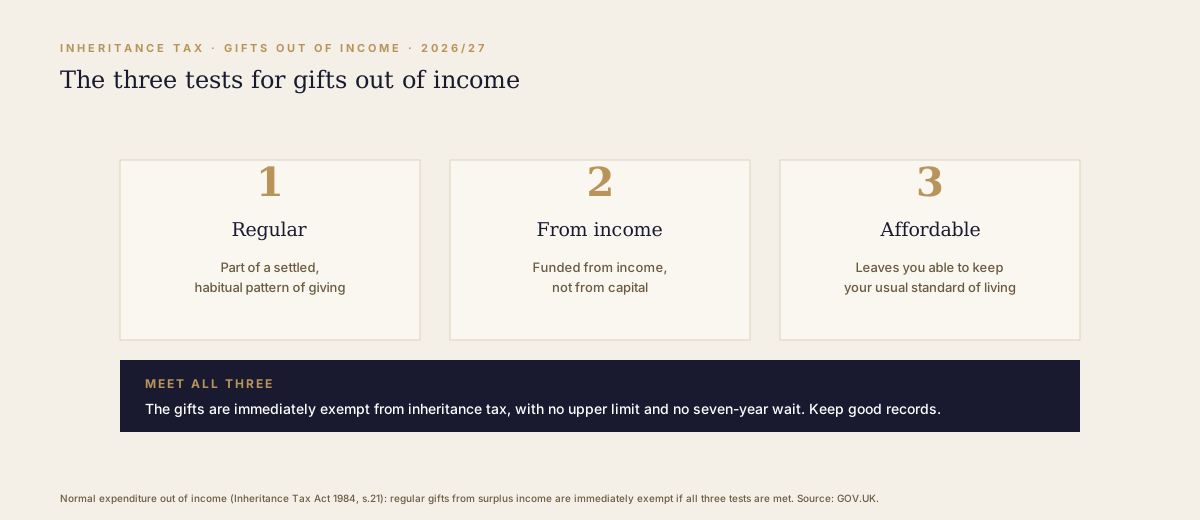
Normal expenditure out of income is a UK inheritance tax exemption, set out in section 21 of the Inheritance Tax Act 1984, that covers regular gifts made from a person's income rather than their capital. Its rare advantage is that qualifying gifts leave your estate immediately, with no monetary cap and no need to survive seven years, unlike most lifetime gifts. Often called gifts out of income, it covers regular giving funded from what you earn rather than your capital. The gifts must form a settled pattern, come from income rather than capital, and leave you able to maintain your usual standard of living.
Normal expenditure out of income is the inheritance tax exemption that lets you make regular gifts from your income and have them fall outside your estate straight away. Set out in section 21 of the Inheritance Tax Act 1984, it sidesteps the seven-year wait that applies to most gifts, and it carries no upper limit. The conditions are strict: the gifts must be genuinely regular, paid from income rather than capital, and small enough that your own standard of living is unaffected. The figures in this article are correct for the 2026/27 tax year. Used well, it is one of the most effective ways to reduce a future inheritance tax bill.
What counts as income for the normal expenditure out of income exemption?
Income means receipts that are income in nature: earnings, pension income, dividends, rental profits, and savings interest, measured after tax has been paid. Capital does not qualify. Withdrawals from ISAs, proceeds from selling assets, and regular payments from investment bonds or discounted gift trusts count as capital, even when received regularly.
Contents
- What is the normal expenditure out of income exemption?
- How does the gifts out of income exemption work?
- What counts as income, and what counts as capital?
- Why do gifts from income beat gifts from capital?
- How does the exemption fit into a wider estate plan?
- Is the normal expenditure out of income exemption worth using?
- How do I keep records to support the exemption?
What is the normal expenditure out of income exemption?
The normal expenditure out of income exemption removes regular gifts funded from your income from your estate for inheritance tax. It is sometimes called the gifts out of income exemption, or simply gifts from surplus income. Most lifetime gifts are potentially exempt transfers: they escape inheritance tax only if you survive for seven years, and they are taxed on a sliding scale if you die sooner. A gift that qualifies under section 21 is different. It is exempt the day it is made, which is what sets it apart from almost every other lifetime gift.
The exemption is also uncapped. The annual exemption lets you give away £3,000 a year for 2026/27, and there are smaller allowances for wedding gifts and for gifts of up to £250 a year per person. Gifts from surplus income sit outside all of those limits. If your income genuinely exceeds your outgoings by a wide margin, you can give the difference away every year, exempt, for as long as the pattern continues.
How does the gifts out of income exemption work?
Three conditions must all be met. First, the gift must form part of your normal expenditure, meaning a settled pattern rather than a one-off. Second, it must be made out of income, taking one year with another. Third, it must leave you with enough income to maintain your usual standard of living. HMRC’s own guidance on normal expenditure out of income sets out these tests and how it interprets them.
The word “normal” here means usual. The courts have treated it as requiring a settled pattern of giving, established either by a track record of regular gifts or by a clear intention, recorded at the outset, to keep making them. The phrase “taking one year with another” means income is assessed across a run of years, not matched pound-for-pound to the gifts made in any single tax year. This gives some flexibility: income does not have to be spent in the exact year it arrives, and an occasional year of higher spending will not break the pattern. Income that is retained and allowed to build up over a long period, though, can lose its character and start to be treated as capital.
How regular gifts from surplus income reduce a future inheritance tax bill
Margaret, 72, is retired with pension and dividend income that comfortably exceeds her spending.
| Input | Value |
|---|---|
| Annual income (after tax) | £55,000 |
| Normal annual expenditure | £40,000 |
| Annual gift to grandchildren | £12,000 |
- Surplus income: £55,000 income less £40,000 spending leaves £15,000 a year.
- Margaret gifts £12,000 a year, keeping £3,000 spare so her standard of living is unaffected.
- Over eight years that removes £96,000 from her estate.
- At the 40% inheritance tax rate, that is £38,400 of tax that would otherwise be due.
Result: Every gift is outside Margaret’s estate immediately, so the £38,400 saving holds even if she dies within seven years.
The exemption rewards habit, not generosity in the moment. A documented standing order from genuine surplus income is worth far more, for inheritance tax, than a larger gift made once and never repeated.
Because the surplus is measured against your actual spending, the exemption naturally suits people whose income has outgrown their lifestyle: retirees with generous pensions, landlords with rental profits, and those with substantial dividend or investment income.
Risk warnings
Pensions
Levels and bases of, and reliefs from, taxation are subject to change and their value will depend upon personal circumstances. Taxation and pension legislation may change in the future.
A pension is a long-term investment, the value of your investment and the income from it may go down as well as up. Your eventual income may depend upon the size of the fund at retirement, future interest rates and tax legislation.
Tax, trusts and estate planning
HM Revenue and Customs practice and the law relating to taxation are complex and subject to individual circumstances and changes which cannot be foreseen.
What counts as income, and what counts as capital?
This is the distinction that decides most claims. Income means receipts that are income in nature: salary, pension income, dividends, rental profits, and savings interest. Income drawn from a flexi-access drawdown arrangement counts too, which matters for retirees funding gifts from a drawdown pension. Capital is different. Withdrawals from an ISA, proceeds from selling shares or property, and regular payments from an investment bond or a discounted gift trust are all capital, even when they are taken at regular intervals and feel like income.
Getting this line wrong is where claims fall down. Take David, 68. His pension and other income come to £30,000 a year after tax, and his normal spending is £28,000, leaving a surplus of £2,000. He wants to give his daughter £20,000 a year towards her mortgage, funding the extra £18,000 by drawing on his ISA. Only the £2,000 from genuine surplus income can qualify under section 21. The £18,000 from the ISA is capital, so each year’s £18,000 is a potentially exempt transfer that leaves his estate only if he survives seven years. Margaret and David are making gifts that look similar from the outside. The source of the money is what decides whether they are exempt now or carry a seven-year risk.
Risk warnings
Investments
Investing in shares should be regarded as a long-term investment and should fit in with your overall attitude to risk and financial circumstances.
The taxation of the investment is dependent on the individual circumstance of each investor, and may be subject to change in the future.
ISAs
The favourable tax treatment of ISAs may be subject to changes in legislation in the future.
Pension drawdown
Drawdown pension plans (unsecured income) are complex and are not suitable for everyone. Pension decisions can affect your income for the rest of your life (and that of any partner and other dependants). Where benefits are accessed on a flexible basis, these are not fixed or safeguarded for life. If security of income is important to you then you should consider purchasing an annuity or taking a scheme pension to provide a secured level of income.
Mortgages
Your home may be repossessed if you do not keep up repayments on your mortgage. Think carefully before securing debts against your home.
Not all mortgage contracts are regulated by the Financial Conduct Authority.
Why do gifts from income beat gifts from capital?
The advantage is timing. A gift of capital is a bet on your own survival: if you die within seven years, some or all of it is pulled back into your estate, with the seven-year rule and taper relief softening the blow only after the third year. Surplus income gifted today never enters that calculation at all. It is outside your estate from the moment the standing order leaves your account.
The diagram shows the difference in timing between the two routes. A gift from capital remains inside the estate for up to seven years, with taper relief reducing the charge only after year three and full exemption reached at year seven. A gift from surplus income is outside the estate from the moment it is made, with no period of ongoing exposure regardless of when the donor dies.
That immediacy is worth most to older donors, and to anyone whose health makes seven years a real uncertainty. A donor in their late seventies with surplus pension income can move money out of their estate with certainty, where the same person making a large capital gift would be taking on years of exposure. The exemption rewards regular, modest giving from income over a single dramatic gift from savings.
How does the exemption fit into a wider estate plan?
The exemption works best as one part of a coordinated plan, not a standalone trick. It runs alongside your annual exemption and your nil-rate bands rather than replacing them, and it is most powerful when you know precisely how much income you can give away without ever touching the lifestyle you have built. That figure is rarely obvious, which is where lifetime cashflow modelling earns its place: it tests whether a gifting pattern is genuinely affordable across a long retirement, including years of higher care or health costs.
The exemption also matters more from April 2027. Under the rules bringing unused pensions into the inheritance tax net, pension funds left at death will count towards your estate for the first time. For retirees drawing more pension income than they spend, regularly gifting the surplus is a clean way to reduce an estate that will, from 2027, include the pension itself. It turns income you were never going to spend into wealth that has already left your estate, well before any pension is tested for inheritance tax.
Why does the normal expenditure out of income exemption matter more after April 2027?
From April 2027, unused pension funds count towards a person’s estate for inheritance tax. Retirees drawing more pension income than they spend can use this exemption to gift the surplus regularly, removing it from their estate immediately rather than leaving it inside a pension that will then be taxed at up to 40% for 2026/27.
Is the normal expenditure out of income exemption worth using?
For anyone with income they reliably do not spend, the exemption is one of the most efficient tools in inheritance tax planning, because the gifts leave your estate at once and the amount is uncapped. The trade-off is discipline. The exemption rewards a documented, repeated pattern, so casual or irregular giving tends to fail when executors try to claim it. It also asks you to part with money for good: a gift is a gift, and it cannot be a disguised loan you quietly expect back.
It is not the right tool for everyone. If your income only just covers your outgoings, there is no surplus to give, and forcing gifts from capital simply creates potentially exempt transfers with all the seven-year risk attached. The exemption suits a specific situation well: a comfortable, predictable income that genuinely exceeds your needs, paired with the willingness to give regularly and keep good records.
Risk warning
The Financial Conduct Authority (FCA) does not regulate Inheritance Tax Planning or Trust Advice.
How do I keep records to support the exemption?
The exemption is claimed after death, not during your lifetime, which is precisely why records matter. Your executors complete form IHT403, which includes a schedule setting out your income and expenditure for the years in which gifts were made, alongside details of the gifts themselves. They use it to show HMRC that the gifts came from income and did not erode your standard of living.
HMRC treats these claims as exempt only to the extent they are shown to its satisfaction, so the burden of proof sits with your estate. The strongest evidence is built in life, not reconstructed afterwards: a simple record of annual income and outgoings, bank statements showing the gifts, and a note of your intention to keep making them. Where gifts are funded from income that has been accumulated rather than spent promptly, HMRC will look harder, so the paperwork matters even more. Setting up gifts as regular standing orders, and writing down at the outset that you intend to continue, turns a difficult probate claim into a straightforward one.
The exemption asks little beyond regularity and honesty about what you can afford. Get those two things right, document them, and surplus income that would otherwise be taxed at 40% can pass to the people you choose, in full and without delay.
Frequently asked questions
What is the normal expenditure out of income exemption?
The normal expenditure out of income exemption removes regular gifts funded from your income, rather than your capital, from your estate for inheritance tax. It sits in section 21 of the Inheritance Tax Act 1984. Qualifying gifts are exempt straight away, so they are not affected by the seven-year rule that applies to most other gifts.
How does the gifts out of income exemption work?
Gifts qualify if they form a regular pattern, are paid from income, and leave you with enough income to maintain your usual standard of living. There is no limit on the amount, but you must be able to show the gifts came from surplus income. Your executors claim the exemption after your death using form IHT403.
Is it worth using the normal expenditure out of income exemption?
For anyone with income they consistently do not spend, it is one of the most efficient ways to reduce inheritance tax, because gifts leave the estate immediately and the amount is uncapped. The trade-off is the discipline it requires, as irregular or poorly documented gifts often fail at probate. It works best alongside your other allowances, not instead of them.
Do gifts from income have to be the same amount every year?
No. The amount can vary and the recipients can change, provided there is a clear and settled pattern of giving from income. What matters is regularity and intent, not a fixed figure. A single one-off gift rarely qualifies unless you can show a prior commitment to keep making it.
Does pension income count for the exemption?
Yes. Regular pension income, including income drawn from a flexi-access drawdown arrangement, counts as income for this exemption. Withdrawals that are capital in nature, such as a large one-off lump sum or proceeds from an investment bond, do not. The line between income and capital is where many claims fail.
How do my executors claim the exemption after I die?
Your executors complete form IHT403, which includes an income and expenditure schedule covering the years in which gifts were made. They use it to show HMRC that the gifts came from surplus income without reducing your standard of living. Clear records kept during your lifetime make this far easier and faster.