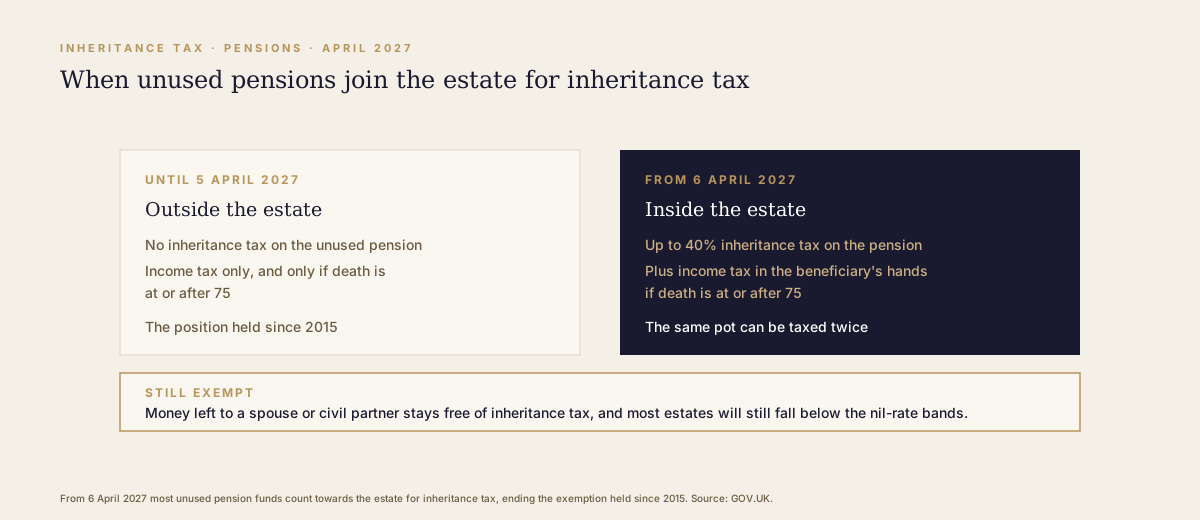
Pension inheritance tax from April 2027 is the inclusion of most unused pension funds and pension death benefits within a deceased person's taxable estate under the Finance Act 2026. The change that matters is double taxation: from April 2027 the same pot can face both a 40% inheritance tax charge and income tax in the beneficiary's hands where death is at or after 75. This is the first time since 2015 that most unused pension funds and death benefits have counted towards the estate. Money passing to a surviving spouse or civil partner remains exempt from inheritance tax, and most estates will still fall below the threshold.
From 6 April 2027, most unused pension funds and pension death benefits will be counted as part of your estate for inheritance tax. This is the headline change introduced by the Finance Act 2026, and it ends a decade in which a pension was one of the most inheritance-tax-efficient assets you could hold. The pension rules themselves are not changing. What changes is whether the money left in your pension when you die is added to the rest of your estate and taxed alongside it. The figures in this article reflect the 2026/27 tax year. For estates large enough to pay inheritance tax, the change reshapes how pension wealth passes to the next generation.
Are all pensions subject to inheritance tax from April 2027?
No. From 6 April 2027 most unused pension funds and death benefits count towards your estate, but money left to a surviving spouse, civil partner, or charity stays exempt. Estates below the £325,000 nil-rate band, plus any residence nil-rate band, still pay no inheritance tax. HMRC expects around 10,500 estates to be newly affected each year.
Contents
- What is changing in April 2027
- How does the 2027 change bring your pension into your estate?
- Which pensions and death benefits are affected?
- The age 75 rule and two tax charges
- Who pays the inheritance tax, and when?
- What does the change mean for your wider plan?
- Should you change your plans before April 2027?
What is changing for pensions and inheritance tax in April 2027?
From 6 April 2027, the value of your pension on the day you die is brought into the inheritance tax calculation alongside everything else you own, ending an exemption that has applied since 2015. Until then, the unused funds in most defined contribution pensions sat outside your estate entirely. The government’s stated view is that this exemption turned pensions into a vehicle for passing on wealth rather than funding retirement, and the Finance Act 2026 has removed that advantage.
The timing matters precisely. The change applies to deaths on or after 6 April 2027. If you die before 6 April 2027, the current rules apply to your pension even if the money is paid out to your family afterwards. The Finance Act 2026 received Royal Assent on 18 March 2026, so the principle is now law, and the regulations setting out how schemes, executors and beneficiaries exchange information were made on 13 July 2026 and come into force on 6 April 2027, the same day as the tax change itself.
The treatment splits depending on who inherits the pension. For a spouse, civil partner, or charity, there is no inheritance tax, but the age 75 income tax rule still applies to their withdrawals. For any other beneficiary, the pension enters the estate and, if it sits above the nil-rate bands, inheritance tax is charged first, with income tax on withdrawals applying on top where death is at or after 75. The diagram below shows both paths.
The diagram shows both paths a pension can take on death. On the spousal and charitable route, there is no inheritance tax, but the age 75 rule still determines whether the beneficiary pays income tax on withdrawals. On the taxable estate route, if the estate exceeds the nil-rate bands, inheritance tax is charged first, and where death is at or after 75, income tax then applies to withdrawals from what remains, the scenario that can reach an effective rate of around 67% at the extremes.
Risk warning
Your pension income could also be affected by the interest rates at the time you take your benefits. The tax implications of pension withdrawals will be based on your individual circumstances, tax legislation and regulation which are subject to change in the future.
How does the 2027 change bring your pension into your estate?
The change works by severing the link between discretionary trust treatment and inheritance tax: from April 2027, a pension is included in your estate regardless of how the scheme holds its death benefits. Until now, most modern schemes held death benefits on a discretionary basis, with the trustees deciding who receives the money, which kept those funds outside the member’s estate. From April 2027 that discretion no longer determines the inheritance tax outcome, and the pension is added to the value of everything else you leave, what the legislation calls your estate, and taxed as one.
Crucially, the existing inheritance tax allowances still apply across the whole estate. The nil-rate band of £325,000 for 2026/27, plus the residence nil-rate band of up to £175,000 where you leave your main home to direct descendants, are set against the combined total and then apportioned proportionately between your pension and the rest. The practical effect is that your pension bears its share of the bill, rather than a flat 40% of the fund. Both uncrystallised savings and undrawn drawdown funds are caught, so whether your pension has been crystallised does not change whether it falls into scope.
One quieter pressure compounds the change. The nil-rate bands are frozen at their current levels until April 2031, so as asset values rise, more estates are drawn over the threshold each year without anyone becoming meaningfully wealthier.
Risk warning
HM Revenue and Customs practice and the law relating to taxation are complex and subject to individual circumstances and changes which cannot be foreseen.
Which pensions and death benefits are affected?
The change applies to both defined contribution and defined benefit schemes, although it falls most heavily on defined contribution wealth. The funds most obviously in scope are uncrystallised pots and money you have moved into drawdown but not yet spent. Money you have left in flexi-access drawdown and not drawn before you die counts towards your estate in the same way as an untouched pot.
How your beneficiaries take that money is a separate question from whether it is taxed. They may take a lump sum or inherit the pension as beneficiary drawdown, but the inheritance tax position is fixed by the value in the scheme at the date of death, not by how or when the benefits are eventually paid.
Several important benefits sit outside the new charge. Death-in-service lump sums paid from a registered scheme are excluded, whether or not they are at the trustees’ discretion, and so are dependants’ scheme pensions, including the typical defined benefit pension paid to a surviving spouse. Joint-life and dependants’ annuities bought together with the member’s own annuity are also excluded, as are charity lump sum death benefits. Because most defined benefit death benefits take one of these forms, the change leaves the majority of defined benefit members untouched. A defined benefit lump sum that is neither a survivor’s pension nor a death-in-service benefit, such as a discretionary lump sum or a guarantee-period payment, can still fall within the estate. Separately, anything passing to a surviving spouse or civil partner is exempt from inheritance tax, exactly as transfers between spouses are exempt for the rest of the estate.
The age 75 rule and the risk of two tax charges
The income tax rules on inherited pensions are not changing, and they sit on top of the new inheritance tax charge. If you die before 75, your beneficiaries can usually withdraw the inherited pension free of income tax. If you die at or after 75, they pay income tax at their own marginal rate on whatever they withdraw. This is the same age 75 boundary that governs how pensions are taxed on death today.
From April 2027, an estate large enough to pay inheritance tax can therefore see the same pension hit by both taxes. Income tax on an inherited pension is charged on what is left after any inheritance tax, not on the tax itself, so the two do not strike the same pound. Even so, stacked together they can reach an effective rate of around 67% for an additional-rate beneficiary inheriting from someone who died at or after 75.
How inheritance tax and income tax can stack on an inherited pension from April 2027
John, 78, dies in 2027 leaving a £200,000 pension to his son, an additional-rate taxpayer. His other assets already use his nil-rate bands.
| Input | Value |
|---|---|
| Unused pension fund | £200,000 |
| Inheritance tax rate | 40% for 2026/27 |
| Son’s income tax rate | 45% for 2026/27 |
- The pension sits above John’s nil-rate bands, so 40% inheritance tax applies: £200,000 x 40% = £80,000
- The £80,000 is paid from the fund, leaving £120,000 for his son
- As John died after age 75, his son pays income tax on withdrawals: £120,000 x 45% = £54,000
Result: Of the £200,000 pension, £134,000 is lost to inheritance tax and income tax combined, leaving £66,000, an effective rate of about 67%.
That figure is the upper end, not the norm. It assumes the pension sits entirely above the nil-rate bands and the beneficiary pays tax at the top rate. Had John instead left the pension to his wife, the spousal exemption would have removed the inheritance tax charge altogether, leaving only income tax on her withdrawals.
Can an inherited pension face both inheritance tax and income tax?
Yes, from April 2027. Where the pension member died at or after age 75 and the estate exceeds the nil-rate bands, the pension fund can face inheritance tax at 40% first, then income tax at the beneficiary’s marginal rate on withdrawals from what remains. At the extremes, the combined effective rate reaches around 67%.
The precise mechanics of how the income tax and inheritance tax interact are among the points still to be settled in further regulations.
Who pays the inheritance tax, and when?
Responsibility for the tax falls on your personal representatives, the executors of your estate, who must report and pay the inheritance tax due on your pension. This is a significant change from the original proposal, which would have placed the duty on pension scheme administrators. Once the trustees vest a beneficiary’s share of the benefits in them, that beneficiary becomes jointly and severally liable with the executors for the tax attributable to it, which means HMRC can pursue either party for the whole of that slice rather than a proportion of it.
Executors cannot value a pension from the outside, so they are given a way to compel the figure. The Registered Pension Schemes (Provision of Information) (Miscellaneous Amendments) Regulations 2026, made on 13 July 2026 and in force from 6 April 2027, will require a scheme administrator to supply basic scheme information within 28 days of a request from the personal representatives, and the fuller detail needed for the inheritance tax account within 28 days, or within 14 days of the beneficiaries being decided if that is later. Insurance companies paying death benefits will work to the same 28-day window. Where a member held several pensions, each administrator has to be asked separately, and the estate’s return cannot be finalised until the last of them replies.
The deadline is tight. Inheritance tax on the pension is due at the end of the sixth month after the date of death, with interest accruing after that, even though schemes have historically taken up to two years to decide how to pay death benefits. To bridge that gap, executors can either direct the scheme to pay the tax from the fund before releasing it, or issue a withholding notice instructing the scheme to hold back up to 50% of the taxable pension for up to 15 months while the position is finalised. Until the tax is paid, beneficiaries other than a spouse, civil partner, or charity cannot be paid more than half their entitlement.
Shorter clocks run through the rest of that process, all of them 14 days from 6 April 2027. A scheme has 14 days to confirm the beneficiary allocations once it has decided them, 14 days to acknowledge a withholding notice and to tell the beneficiaries one has been served, and 14 days to confirm that a payment of inheritance tax has been made. The useful thing for an executor to understand is what these clocks are and are not. They give you a right to demand a figure that you would otherwise have to wait for, which is worth knowing when a scheme is slow. They do not move the six-month deadline for paying the tax, so the pressure on the estate is unchanged. And none of them start at all until somebody knows which schemes to write to, which is why a list of your pensions and their reference numbers, kept with your will, is worth more to your executors than any of these deadlines.
This is where liquidity becomes a live planning issue, and where lifetime cashflow modelling can show whether an estate has enough accessible cash to meet a bill that now includes pension wealth.
What does the change mean for your wider plan?
The most immediate effect is that leaving a pension undrawn while spending other assets first is no longer a straightforward inheritance tax saving: once pensions are inside the estate, the order in which different pots are drawn is a question worth revisiting rather than assuming. What the change also does is unsettle a piece of conventional wisdom, the idea that you should preserve the pension as a tax-free legacy. Once it is inside the estate, that logic weakens.
Several existing inheritance tax levers become more relevant as a result. Regular gifts made out of surplus income, including income drawn from a pension, can qualify for the normal expenditure out of income exemption, which means they leave the estate immediately without starting a seven-year clock. Larger lifetime gifts fall under the seven year rule on lifetime gifts. Leaving pension wealth to a spouse defers any charge, though the funds then form part of the survivor’s estate on the second death. None of these is a default course of action, and each carries trade-offs that need weighing against retirement income needs.
For estates likely to be affected, the value of coordinated inheritance tax planning rises sharply, because the pension can no longer be treated as a separate, sheltered pot and instead has to be planned as part of the whole.
This change also does not arrive on its own. Three further changes land on the same day, and more follow through to 2031, so it is worth reading against the full timetable of dated pension and tax changes rather than in isolation.
Risk warning
The Financial Conduct Authority (FCA) does not regulate Inheritance Tax Planning or Trust Advice.
Should you change your plans before April 2027?
For most people there is no need to act in haste, but there is a strong case for reviewing your beneficiary nominations, your will, and the order you intend to draw your assets well before the change takes effect. Acting early is about preparation, not about rushing money out of a pension to beat a deadline.
The pension that once sat outside your estate was a shelter. From April 2027 it sits inside it as an asset to be sequenced alongside the rest, with the same disciplines as everything else in the plan.
The trade-off cuts both ways. Stripping a pension out now can trigger an income tax charge today, remove the money from a flexible and tax-efficient environment, and give up future tax-free growth, which may cost more than the inheritance tax it seeks to avoid. Doing nothing, on the other hand, risks an unplanned liability and a liquidity squeeze for your executors. A further timing point sits alongside this one: the minimum age at which you can normally access a pension, currently 55, rises to 57 from 6 April 2028, which affects when any of this money is available to you in the first place. Working these questions through as part of your pension and retirement planning, rather than in isolation, is what turns the change from a worry into a manageable adjustment.
The exemption is ending, but most estates still pay nothing
The exemption that made pensions a quiet tool for passing on wealth is ending. From April 2027, a pension is taxed much like the rest of your estate, with an additional income tax layer where death comes at or after 75. Most estates will still pay nothing, and the headline 67% figure applies only at the extremes. The real work is not in the tax rate but in the plan: who your pension is nominated to, the order in which your assets are spent, and whether your executors will have the cash to settle a bill that now reaches your pension too.
Frequently asked questions
What is changing for pensions and inheritance tax in 2027?
From 6 April 2027 the unused funds and death benefits left in your pension form part of your taxable estate under the Finance Act 2026. Nothing about the pension changes while you are alive: contributions, tax relief, the annual allowance and your tax-free cash all work as they do now, and no scheme requires you to draw money out or restructure anything before the date arrives. The reform reaches only what is still in the fund when you die, which is why it changes the order you spend your assets in rather than the pension itself.
How is inheritance tax on a pension calculated?
Your pension is added to the rest of your estate, and your nil-rate bands are shared proportionately across the whole. Inheritance tax at 40% then applies to the value above those bands, with the pension bearing its share. The pension is not automatically taxed at a flat 40%, because the nil-rate bands shelter part of the total estate.
Will most estates pay inheritance tax on their pension?
No. Most estates will remain below the threshold and pay nothing. HMRC estimates that of around 213,000 estates with inheritable pension wealth in 2027 to 2028, roughly 10,500, about 1.5% of UK deaths, will become liable for inheritance tax where they would not have been before. The change mainly affects larger estates.
Should I take money out of my pension before April 2027?
Not necessarily, and stripping a pension out early carries its own costs. Withdrawing large sums can trigger income tax now, remove the money from a flexible and tax-efficient environment, and forfeit future tax-free growth. The right response depends on personal circumstances, so this is a decision to review well ahead of April 2027 rather than rush.
Are death-in-service benefits affected by the change?
No. Lump sums paid under a registered scheme's death-in-service arrangement are excluded, whether or not they are paid at the trustees' discretion. Dependants' scheme pensions, such as a typical defined benefit survivor's pension, are also excluded. These benefits stay outside the estate for inheritance tax purposes.
Who is responsible for paying the inheritance tax on a pension?
Personal representatives, the executors of the estate, are responsible for reporting and paying the inheritance tax on pension wealth from April 2027. This is a shift from the original proposal, which placed the duty on pension scheme administrators. Beneficiaries become jointly and severally liable once trustees vest their share in them, and scheme administrators must supply a valuation within 28 days of a request.
Risk warning
Levels and bases of, and reliefs from, taxation are subject to change and their value will depend upon personal circumstances. Taxation and pension legislation may change in the future.