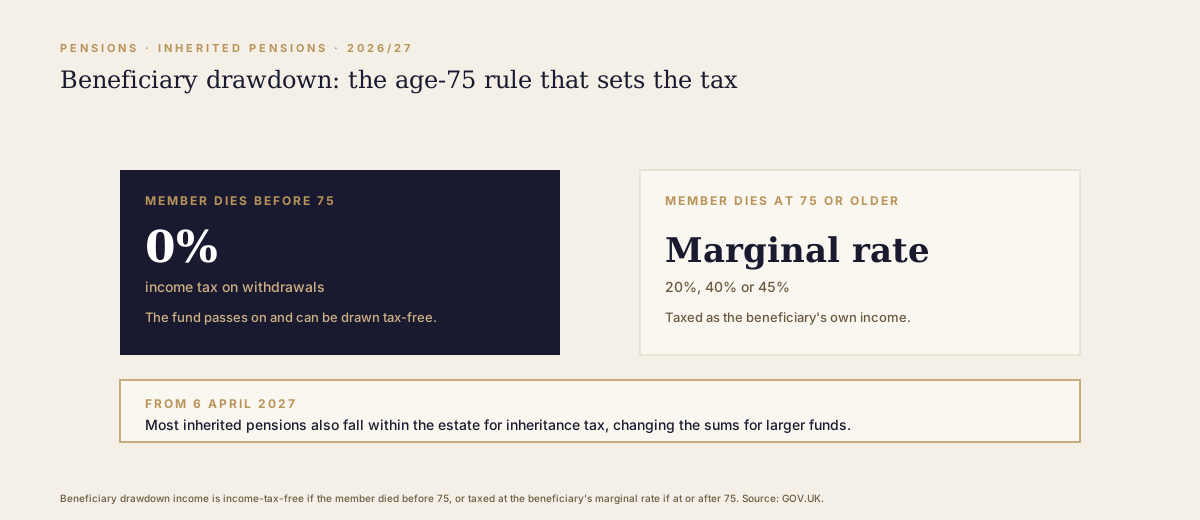
Beneficiary drawdown is a death benefit option that holds an inherited defined contribution pension inside a drawdown account, allowing a beneficiary to take flexible income withdrawals at any time. Its appeal over a one-off lump sum is control: the fund stays invested and the beneficiary draws what they need, when they need it. Income is free of income tax if the original member died before age 75, and taxed at the beneficiary's marginal rate if they died at or after 75. From 6 April 2027 most inherited pensions also fall within the estate for inheritance tax, which changes the calculation for larger funds.
Beneficiary drawdown is the arrangement that lets someone who inherits a defined contribution pension keep the money invested and draw it as income, instead of taking a one-off lump sum. It is available to dependants, nominees and successors, and it can pass down through generations. The figures and thresholds in this article are correct for the 2026/27 tax year. How the income is taxed, and from April 2027 whether inheritance tax also applies, depends largely on the age the original member reached and who the money passes to.
Who can inherit a pension as beneficiary drawdown?
Any individual the member nominates can inherit a defined contribution pension as beneficiary drawdown. A dependant, such as a spouse or a child under 23, can always use drawdown; anyone else can only do so if the member nominated them before death, otherwise they may receive a lump sum only.
Contents
- What is beneficiary drawdown?
- How does beneficiary drawdown work?
- Who can inherit a pension as beneficiary drawdown?
- How is beneficiary drawdown taxed?
- How does the April 2027 inheritance tax change affect inherited pensions?
- Does inheriting a pension affect your own allowances?
- Is beneficiary drawdown worth it?
- How does beneficiary drawdown fit into a wider retirement plan?
What is beneficiary drawdown?
Beneficiary drawdown is a death benefit option that lets a dependant, nominee or successor receive an inherited defined contribution pension as flexible income, with the fund staying invested in a drawdown account. It is the inherited equivalent of the flexi-access drawdown a pension holder uses in their own retirement: the beneficiary can withdraw as much or as little as they like, whenever they like, and what is left stays invested and can grow.
Two features set it apart from a lump sum. The fund remains inside the pension wrapper, so it continues to grow free of income tax and capital gains tax while it is there. And on the beneficiary’s own death, anything left can pass to a further beneficiary, so an inherited pension can move down a family rather than being cashed out in a single generation.
Beneficiary drawdown applies only to defined contribution (money purchase) pensions. Defined benefit schemes pay a scheme-defined dependant’s pension instead, set by the scheme rules rather than by a fund the beneficiary controls.
Risk warning
Pensions
Your pension income could also be affected by the interest rates at the time you take your benefits. The tax implications of pension withdrawals will be based on your individual circumstances, tax legislation and regulation which are subject to change in the future.
Defined benefit transfers
We do not currently provide advice on transferring out of defined benefit (final salary) pension schemes. If you require this advice, we will provide details of a suitably qualified adviser at a firm with the necessary regulatory permissions who can assist you.
How does beneficiary drawdown work?
When a defined contribution pension holder dies, the scheme offers their beneficiaries a choice: take the fund as a lump sum, use it to buy an annuity, or designate it to beneficiary drawdown and take income flexibly. Choosing drawdown moves the inherited fund into the beneficiary’s own drawdown account, from which they can take income at any time and in any amount.
A few rules shape how it works in practice. No tax-free cash is available on inherited funds, because the 25% pension commencement lump sum is a retirement benefit for the original member, not something a beneficiary can claim. No new contributions can be paid into a beneficiary drawdown plan. And once the fund has been designated, the plan can be transferred to another provider if the beneficiary prefers a different one.
There is also a sequencing point worth knowing. A beneficiary cannot transfer a death benefit straight to a new provider; the fund must first be designated to drawdown within the existing scheme, after which the resulting plan can be moved. This is why having a scheme that offers beneficiary drawdown matters: if it does not, the beneficiary’s only options may be a lump sum or an annuity.
Risk warning
A pension is a long-term investment, the value of your investment and the income from it may go down as well as up. Your eventual income may depend upon the size of the fund at retirement, future interest rates and tax legislation.
Who can inherit a pension as beneficiary drawdown?
Three groups can hold an inherited pension in drawdown, and the distinction between them decides who actually gets the option. A dependant is a spouse or civil partner at the date of death, a child under 23, or someone who was financially dependent on the member. A nominee is any other individual the member names with their provider. A successor is whoever inherits unused drawdown funds when a dependant, nominee or earlier successor dies.
The critical point is that only dependants get drawdown automatically. For anyone else, the scheme administrator can usually only offer drawdown if the member nominated that person, or if there are no surviving dependants and no nominee at all. So if you want an adult child to inherit your pension as drawdown while your spouse is still alive, you must nominate the child: without that nomination, the scheme cannot appoint them, and they may be limited to a lump sum.
This is the single most common and most expensive oversight in pension death benefits, and it is fixed by a form, not by a will. A nomination, sometimes called an expression of wish, tells the scheme who you want to benefit and opens the full range of options to them.
Two savers, one missing nomination form
Brian and Keith are both 78, both married, and both want their adult daughter to inherit their £200,000 SIPP rather than their spouse, who is already comfortably provided for. Brian completed a nomination naming his daughter. Keith never got round to it.
When Brian dies, the scheme can appoint his daughter as a nominee. She moves the £200,000 into nominee drawdown, takes income gradually to control her tax year by year, and names her own children as successors.
When Keith dies, his spouse survives as a dependant, so the scheme cannot appoint the daughter as a nominee. Her only realistic option is a lump sum. Because Keith died after 75, the whole £200,000 is taxable as her income in one tax year, pushing most of it into the 45% band and stripping her personal allowance. A missing form, not a different pension, produced the worse outcome.
A nomination form determines whether a beneficiary can inherit as drawdown or only as a lump sum. One missing form can shift the effective tax burden by tens of thousands of pounds, and no will or trust can fix that after the event.
How is beneficiary drawdown taxed?
Income from beneficiary drawdown is free of income tax if the original member died before age 75, and taxed at the beneficiary’s marginal rate if the member died at or after 75. This age 75 line is the single biggest factor in how much an inherited pension is worth, and it does not change once set: a fund inherited from someone who died at 74 is drawn tax-free for as long as it lasts, even decades later.
One deadline applies to the tax-free treatment. Where the member died before 75, the fund must be designated to drawdown, or the lump sum paid, within two years of the scheme being notified of the death. Miss that window and the income becomes taxable even though the member died before 75. The same age 75 rules, and the same broader picture of how pensions are taxed on death, apply whether the beneficiary chooses drawdown, an annuity or a lump sum.
There is one advantage drawdown has over a lump sum for larger funds. Designating a fund to beneficiary drawdown is not a relevant benefit crystallisation event, the point at which a tax-free lump sum is measured against your allowances, so it is not tested against the lump sum and death benefit allowance of £1,073,100 for 2026/27. A lump sum is tested: where the member died before 75, any amount above the available allowance is taxed at the beneficiary’s marginal rate. For a fund comfortably over £1,073,100, drawdown can therefore pass more across free of an immediate charge than a lump sum would.
The HMRC Pensions Tax Manual covers the death benefit rules in full at PTM070000, including the designation deadlines and the interaction with the lump sum and death benefit allowance.
Risk warning
HM Revenue and Customs practice and the law relating to taxation are complex and subject to individual circumstances and changes which cannot be foreseen.
How does the April 2027 inheritance tax change affect inherited pensions?
From 6 April 2027, most unused pension funds and death benefits will count towards the value of the deceased’s estate for inheritance tax, ending the long-standing position that kept pensions outside it. Pensions passing to a surviving spouse or civil partner, and to registered charities, stay exempt, and death in service benefits from a registered pension scheme are excluded. For most other inherited pensions, the value will be added to the estate and may be taxed at 40% above the available nil-rate bands. The full detail of who is affected and when the charge falls is covered in the dedicated article on how pensions and inheritance tax interact from April 2027.
What changes for inherited pensions from April 2027?
From 6 April 2027, most unused pension funds count towards the deceased’s estate for inheritance tax at 40%. A fund already subject to that charge is then taxed again as the beneficiary draws income, producing a combined effective rate of around 64% for a higher-rate taxpayer. Pensions passing to a surviving spouse or civil partner, and registered charities, remain exempt.
The change matters most for funds inherited from someone who died at or after 75, because two taxes can then apply to the same money. Inheritance tax is charged on the fund as part of the estate, and the beneficiary then pays income tax on what they draw. For a fund fully within the inheritance tax net, that combination produces an effective rate of around 64% for a higher-rate taxpayer.
How inheritance tax and income tax can combine on an inherited pension from April 2027
Raymond, 80, dies in 2027/28 with a £100,000 pension; his estate already exceeds the nil-rate bands.
| Input | Value |
|---|---|
| Pension fund | £100,000 |
| Inheritance tax rate | 40% |
| Beneficiary’s income tax rate | 40% |
- Inheritance tax at 40% on £100,000 = £40,000, paid from the pension
- Fund remaining after inheritance tax = £60,000
- Income tax at 40% on the £60,000 drawn = £24,000
Result: The beneficiary keeps £36,000 of the original £100,000, an effective combined tax rate of 64%.
Two practical points follow. The inheritance tax falls on the fund however the beneficiary takes it, so choosing drawdown over a lump sum no longer avoids it, although drawdown still controls the income tax layer. And the spouse exemption can defer rather than remove the problem: a pension left to a surviving spouse is exempt on the first death but sits in their estate on the second, so the same fund can face the full charge later.
For larger estates, decisions about spending pension funds during life, or gifting other assets to start the seven-year clock, now interact directly with how the pension will be taxed on death. These trade-offs sit at the centre of inheritance tax planning, and there is rarely a single right answer: spending a pension to reduce inheritance tax can increase income tax, while preserving it can increase the eventual estate. The government’s consultation on inheritance tax and unused pension funds sets out the policy rationale and scope of the change.
Risk warning
The Financial Conduct Authority (FCA) does not regulate Inheritance Tax Planning or Trust Advice.
Does inheriting a pension affect your own allowances?
No. Taking income from beneficiary drawdown does not trigger the money purchase annual allowance and does not use any of your own annual allowance. The two are kept entirely separate: an inherited pension is treated as the deceased’s saving passing to you, not as you accessing your own pension flexibly.
This matters for beneficiaries who are still working and saving. Someone who inherits a pension in their fifties can take income from the inherited fund while continuing to contribute the full annual allowance to their own pension, with no reduction. The MPAA, which caps future contributions once you flexibly access your own money purchase pension, simply does not bite on inherited funds.
Risk warning
Levels and bases of, and reliefs from, taxation are subject to change and their value will depend upon personal circumstances. Taxation and pension legislation may change in the future.
Is beneficiary drawdown worth it?
For most beneficiaries of a defined contribution pension, drawdown is the more flexible and usually the more tax-efficient choice, but it is not automatically the right one. Its strengths are real: the fund stays invested and sheltered, income can be timed to manage the beneficiary’s tax position, and whatever is left can pass to the next generation rather than leaving the pension system.
The trade-offs are equally real. Keeping money invested means keeping it exposed to markets, and a beneficiary who draws heavily in the early years faces the same sequence of returns risk as any other drawdown investor: a fall in the first years of drawing does more damage than the same fall later, because units are sold while prices are down. A lump sum, by contrast, gives certainty and immediate access, which can matter more than tax efficiency if the money is needed now, or if the amount is small enough that the tax difference is marginal.
After April 2027 the calculation shifts again. Inheritance tax applies whichever route the beneficiary takes, so the question becomes less drawdown versus lump sum and more how to manage the income tax on a fund that has already been taxed once. The best route depends on the size of the fund, the beneficiary’s tax position, and whether the money is for spending now or preserving for later.
How does beneficiary drawdown fit into a wider retirement plan?
Beneficiary drawdown changes how a pension is treated not just after death but during life, because the prospect of passing a fund on efficiently affects how much of it you spend. Under the rules up to April 2027, the tax advantages of leaving a pension untouched were strong enough that many people drew on other assets first and left the pension as the last thing to be spent.
The April 2027 inheritance tax change weakens that logic without reversing it, and the right order in which to draw on pensions, ISAs and other savings is now genuinely contested for larger estates. This is where pension and retirement planning earns its place: the decision is no longer about a single pension in isolation but about how every asset is taxed, in what order, and across two generations.
For the beneficiary, the same discipline applies in reverse. An inherited pension is rarely free money to be spent quickly; treated as part of a long-term plan, it can fund income for decades and pass on again. The mechanics of beneficiary drawdown are straightforward, but the decisions around it, about tax timing, withdrawal pace and what to leave behind, are where the value is won or lost.
Risk warning
The favourable tax treatment of ISAs may be subject to changes in legislation in the future.
Frequently asked questions
What is beneficiary drawdown?
Beneficiary drawdown lets a dependant, nominee or successor inherit a defined contribution pension as flexible income, rather than a lump sum. The fund stays invested in a drawdown account, and income can be taken in any amount, at any time.
How does dependants' drawdown differ from nominee and successor drawdown?
They work in the same way; the difference is who inherits. A dependant is a spouse, civil partner or child under 23. A nominee is any other individual the member names with their provider. A successor is whoever inherits unused drawdown funds from a previous beneficiary.
How is an inherited pension taxed?
Income from beneficiary drawdown is free of income tax if the member died before age 75. If they died at or after 75, withdrawals are taxed at the beneficiary's marginal rate. From 6 April 2027, most inherited pensions also count towards the estate for inheritance tax.
Can I leave my pension to someone who is not a dependant?
Yes, but only if you nominate them with your provider. Without a nomination, the scheme can usually only offer drawdown to a dependant, and anyone else may receive a lump sum instead. Keeping your nomination up to date is essential to preserve the full range of options.
Does taking income from an inherited pension trigger the money purchase annual allowance?
No. Taking income from beneficiary drawdown does not trigger the MPAA and does not use any of your own annual allowance. The MPAA only applies to money you draw flexibly from your own pension, not to funds you inherit from someone else.
Is beneficiary drawdown worth it compared with taking a lump sum?
Drawdown suits beneficiaries who want to keep the fund invested and control when income is taxed, while a lump sum suits those who need immediate access. Drawdown also lets the remaining fund pass to your own nominated beneficiaries when you die.