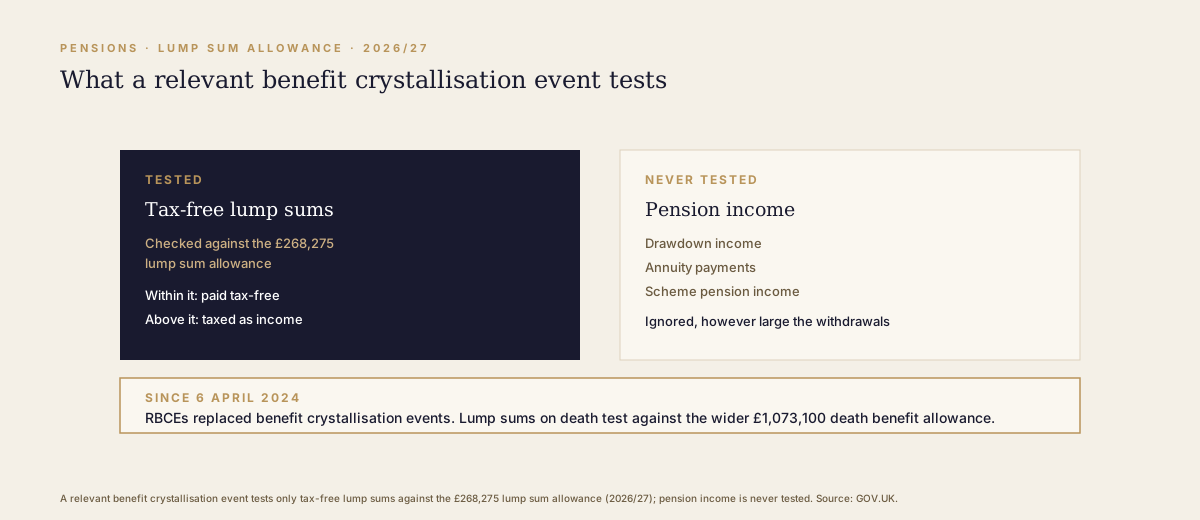
A relevant benefit crystallisation event is an occasion specified in pension tax legislation on which a lump sum is checked against an individual's lump sum allowance or lump sum and death benefit allowance. RBCEs replaced benefit crystallisation events in April 2024 and, unlike the old system, ignore pension income entirely. A test is triggered each time you take a tax-free pension lump sum, when the scheme checks the tax-free element against your £268,275 lump sum allowance and taxes any excess as income. Only that tax-free portion is tested, against the lump sum allowance or the wider £1,073,100 death benefit allowance.
When the lifetime allowance was abolished on 6 April 2024, the single cap that tested your pension benefits disappeared with it. In its place sits a narrower set of checks built entirely around tax-free lump sums. A relevant benefit crystallisation event is the point at which one of those lump sums is measured against your remaining allowance. It is the trigger that decides whether a payment comes out tax-free or attracts income tax. Unlike the regime it replaced, it ignores pension income completely. This guide explains what counts as a relevant benefit crystallisation event, what does not, and why the distinction shapes how and when you take money from a pension. All figures in this article reflect the 2026/27 tax year.
What counts as a relevant benefit crystallisation event?
A relevant benefit crystallisation event is triggered by a tax-free lump sum: a pension commencement lump sum, the tax-free part of an uncrystallised funds pension lump sum, a stand-alone lump sum, a serious ill-health lump sum, or a lump sum death benefit. Pension income never counts, and only the tax-free portion of a lump sum is tested.
Contents
- What is a relevant benefit crystallisation event?
- How does a relevant benefit crystallisation event work?
- Which lump sums count as RBCEs?
- What is not a relevant benefit crystallisation event?
- How do RBCEs differ from the old benefit crystallisation events?
- Do you need to worry about relevant benefit crystallisation events?
- What do RBCEs mean for pension death benefits?
- RBCEs and your retirement plan
What is a relevant benefit crystallisation event?
A relevant benefit crystallisation event is an occasion, defined in pension tax legislation, on which a scheme must check a lump sum payment against your available allowances. The term is closely related to pension crystallisation, the broader process of turning untouched savings into retirement benefits, but an RBCE refers specifically to the testing of a lump sum, not the act of crystallising itself.
Two allowances do the work. The lump sum allowance (LSA) is £268,275 for 2026/27 and caps the tax-free cash you can take across your lifetime. The lump sum and death benefit allowance (LSDBA) of £1,073,100 caps the total of tax-free lump sums paid both during your life and on your death before age 75. If you crystallised pension benefits before 6 April 2024, your available allowance is lower, reduced to reflect those earlier crystallisations under the old lifetime allowance, so you may have less than the full figures to work with. Every time a relevant lump sum is paid, the scheme tests it against whichever of these allowances applies and records how much you have used.
Risk warnings
Levels and bases of, and reliefs from, taxation are subject to change and their value will depend upon personal circumstances. Taxation and pension legislation may change in the future.
Your pension income could also be affected by the interest rates at the time you take your benefits. The tax implications of pension withdrawals will be based on your individual circumstances, tax legislation and regulation which are subject to change in the future.
How does a relevant benefit crystallisation event work?
A relevant benefit crystallisation event works by comparing the value of a lump sum against the allowance you have left, then taxing anything above it. When the payment is made, the scheme administrator deducts the relevant amount from your remaining allowance. Anything that fits within the allowance is paid free of income tax. Anything above it is taxed as income at your marginal rate, with no separate penalty charge on top. The detail of how schemes test each payment is set out in HMRC’s Pensions Tax Manual.
Where more than one relevant benefit crystallisation event happens on the same day, you can choose the order in which they are treated as occurring. That ordering can matter when an allowance is nearly exhausted, because it determines which payment absorbs the last of the tax-free headroom and which one tips into taxable territory.
Daniel, 60, with a £900,000 pension
Daniel has a £900,000 SIPP and no previous benefit crystallisation events or protections, so his full lump sum allowance of £268,275 is available.
He wants £150,000 as tax-free cash to clear his mortgage. To take a pension commencement lump sum of £150,000, he must crystallise £600,000 of his SIPP, because £150,000 is 25% of £600,000. The £150,000 PCLS is a relevant benefit crystallisation event, reducing his lump sum allowance to £118,275. The remaining £450,000 from the crystallised portion moves into flexi-access drawdown. The other £300,000 stays uncrystallised in his SIPP, continuing to grow free of income tax.
The drawdown income Daniel takes from the £450,000 is never a relevant benefit crystallisation event. The uncrystallised £300,000 will trigger further RBCEs only when it is eventually drawn, and those will be tested against whatever allowance he has left at that point.
Risk warnings
Tax, trusts and estate planning
HM Revenue and Customs practice and the law relating to taxation are complex and subject to individual circumstances and changes which cannot be foreseen.
Mortgages
Your home may be repossessed if you do not keep up repayments on your mortgage. Think carefully before securing debts against your home.
Not all mortgage contracts are regulated by the Financial Conduct Authority.
Which lump sums count as RBCEs?
Five kinds of payment can trigger a relevant benefit crystallisation event, and each one has a tax-free element that uses up allowance. The list is short and specific:
- A pension commencement lump sum, the formal name for the tax-free cash most people take at retirement
- The tax-free 25% portion of an uncrystallised funds pension lump sum
- A stand-alone lump sum, a narrower category linked to certain protected benefits
- A serious ill-health lump sum, paid when a member with poor health expectancy commutes their pension
- A lump sum death benefit paid in respect of someone who has died
The first three are tested against the lump sum allowance during your lifetime, and all of them count towards the lump sum and death benefit allowance. In practice the lump sum allowance is the one most people meet first, because it governs everyday tax-free cash. The wider death benefit allowance tends only to come into play on serious ill health or death before 75.
What is not a relevant benefit crystallisation event?
Pension income is not a relevant benefit crystallisation event, and neither are several lump sums that sit outside the system. This is the single most important thing to understand about the new regime. Drawdown income, annuity payments, and scheme pensions from a defined benefit arrangement are never tested against any allowance. The same is true of the taxable 75% of any flexi-access drawdown or uncrystallised funds lump sum: only the 25% tax-free slice is measured.
Several small lump sums are also ignored. Small pot payments, trivial commutation lump sums, and winding-up lump sums fall outside the definition, as does a pension commencement excess lump sum. Unauthorised payments are not relevant benefit crystallisation events either, although they carry their own tax charges.
The diagram separates the five payments that count as relevant benefit crystallisation events, all of which are tested against the £268,275 lump sum allowance or the £1,073,100 lump sum and death benefit allowance for 2026/27, from the payments that never count. Drawdown income, annuity and scheme pension income, the taxable 75% of a UFPLS, and small lump sums such as trivial commutation never reduce either allowance, however large they become.
How do RBCEs differ from the old benefit crystallisation events?
The difference is fundamental, not cosmetic. Relevant benefit crystallisation events were introduced by Finance Act 2024, which abolished the lifetime allowance from 6 April 2024 and replaced it with the lump sum allowances described above. Under the lifetime allowance, there were thirteen benefit crystallisation events, and almost everything you did with a pension triggered one. Putting money into drawdown, buying an annuity, starting a scheme pension, and reaching age 75 with untouched funds were all tested against a single lifetime cap. Crucially, the test captured pension income as well as lump sums, valuing future income streams and counting them towards the limit. Breaching the cap brought a dedicated lifetime allowance charge of up to 55%.
Relevant benefit crystallisation events strip almost all of that away. Income is no longer tested at all. Only tax-free lump sums are checked, and only against the two lump sum allowances. The old percentage-based charge is gone, replaced by ordinary income tax at your marginal rate on any excess. The effect is that the tax test has moved off your pension as a whole and onto the cash you take out of it.
This also clears up a frequent muddle. The pension annual allowance limits what you can pay in each year, while the lump sum allowances limit the tax-free cash you can take out. They are entirely separate caps that work in opposite directions, and a relevant benefit crystallisation event concerns only the second of them.
Do you need to worry about relevant benefit crystallisation events?
For most people, relevant benefit crystallisation events never bite, because the lump sum allowance only constrains those whose total pensions exceed about £1,073,100. Below that level, taking 25% of your pots as tax-free cash produces a figure within the £268,275 allowance, so every penny of that cash is paid free of tax and the test passes without consequence.
The trade-off is that the allowances are frozen. There is no automatic uprating in legislation, so the £268,275 figure stays fixed unless Parliament changes it. As pots grow and people consolidate, more savers drift towards the ceiling over time even though the number on paper never moves. The Chancellor ruled out cutting the tax-free lump sum at the Autumn Budget 2025, but a frozen allowance still tightens in real terms every year, which is why modelling the timing of lump sums across a retirement, through lifetime cashflow planning, is more useful than checking a single figure once.
It is also worth being clear that going over the allowance is not a disaster of the kind the old 55% charge implied. The excess is simply taxed as income. That can still be a meaningful cost, but it is a marginal rate of tax on a slice of money, not a penalty on the whole pot.
Risk warning
Tax, trusts and estate planning
The Financial Conduct Authority does not regulate Cashflow Planning.
Defined benefit transfers
We do not currently provide advice on transferring out of defined benefit (final salary) pension schemes. If you require this advice, we will provide details of a suitably qualified adviser at a firm with the necessary regulatory permissions who can assist you.
What do RBCEs mean for pension death benefits?
On death, a lump sum paid from your pension is a relevant benefit crystallisation event tested against the £1,073,100 lump sum and death benefit allowance, but the tax outcome depends heavily on your age when you die. If you die before 75, lump sum death benefits within the allowance are generally paid free of income tax, and only the amount above the allowance is taxed at the beneficiary’s marginal rate. If you die at 75 or older, the income tax shelter falls away entirely and the whole lump sum is taxed at the recipient’s marginal rate. Estate planning that involves pensions usually runs alongside wider inheritance tax planning, because the two interact.
How is a pension lump sum death benefit taxed after a relevant benefit crystallisation event?
If you die before age 75, a lump sum death benefit within the £1,073,100 lump sum and death benefit allowance is paid to your beneficiary free of income tax. If you die at 75 or older, the same lump sum is taxed at the beneficiary’s marginal rate, regardless of the allowance position.
The age at which someone dies, not the size of their pension, decides how a lump sum death benefit is taxed.
Consider two savers, each leaving a £400,000 untouched pension to an adult child. One dies at 74. The lump sum death benefit is tested against the £1,073,100 allowance, sits within it, and because death is before 75 the beneficiary receives the full £400,000 free of income tax. The other dies at 76. The same £400,000 paid to the same beneficiary is now taxed at their marginal rate. For a higher rate taxpayer that is £160,000 of income tax on an identical sum.
A further change arrives on 6 April 2027, when most unused pension funds will be brought within the value of your estate for inheritance tax. This sits alongside the income tax treatment above rather than replacing it, and it interacts with longstanding rules such as the seven year rule on gifting. The combined effect is that pension death benefits, once almost entirely outside the tax net, now sit at the centre of estate planning.
Risk warnings
The Financial Conduct Authority does not regulate some aspects of Trust, Tax and Estate Planning.
The Financial Conduct Authority (FCA) does not regulate Inheritance Tax Planning or Trust Advice.
RBCEs and your retirement plan
The shift from benefit crystallisation events to relevant benefit crystallisation events did more than rename a piece of jargon. It moved the tax test off your pension as a whole and onto the tax-free lump sums you take from it, and it left pension income outside the system entirely. For the majority of savers that means the allowances quietly pass in the background and never change a decision.
For those with larger pensions, or for families thinking about what passes on death, the picture is different. The questions that matter are no longer about a single lifetime cap, but about when and in what form lump sums are taken, how much tax-free headroom remains, and how death benefits sit within an estate that, from 2027, will increasingly be exposed to inheritance tax. Understanding what does and does not count as a relevant benefit crystallisation event is the starting point for answering any of them. Working through the timing and ordering of lump sums as part of pensions and retirement planning helps make sure tax-free cash is used in the right order before any allowance is reached.
Frequently asked questions
What is a relevant benefit crystallisation event?
A relevant benefit crystallisation event is an occasion on which a pension scheme must test a lump sum against your lump sum allowance or lump sum and death benefit allowance. It replaced benefit crystallisation events on 6 April 2024. Only lump sums are tested, never pension income.
How does a relevant benefit crystallisation event work?
When you take a tax-free lump sum, the scheme deducts it from your remaining allowance. Anything within the allowance is paid free of income tax, and anything above it is taxed at your marginal rate. The lump sum allowance is £268,275 for 2026/27.
Is pension income a relevant benefit crystallisation event?
No. Drawdown income, annuity payments and scheme pension income are never relevant benefit crystallisation events. They are not tested against any allowance, however large the withdrawals become. Only tax-free lump sums trigger an RBCE.
What happens if a lump sum exceeds the lump sum allowance?
The amount above your available allowance is subject to income tax at your marginal rate. There is no separate lifetime allowance charge anymore. For a higher rate taxpayer that means 40% tax on the excess in the year it is paid.
Should you be concerned about relevant benefit crystallisation events?
For most people the allowances are never reached, because the lump sum allowance only constrains those whose total pensions exceed about £1,073,100. The allowances matter most for larger pensions and for death benefits, where the tax outcome can be significant.
Are benefit crystallisation events still used?
No. Benefit crystallisation events were replaced by relevant benefit crystallisation events on 6 April 2024, when the lifetime allowance was abolished. Benefits crystallised before that date are not retested, but they do reduce the lump sum allowance available to you under the new rules.