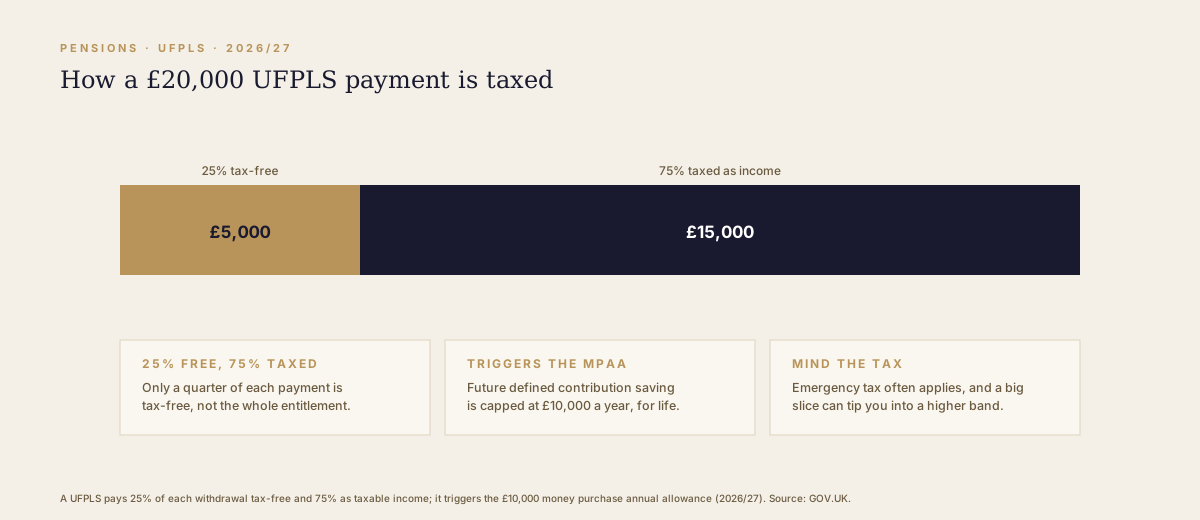
An uncrystallised funds pension lump sum (UFPLS) is a withdrawal taken directly from untouched defined contribution pension savings, where 25% is paid tax-free and the remaining 75% is taxed as income. It is one of the simplest ways to access a defined contribution pension, but a withdrawal triggers the money purchase annual allowance and is taxed in the year you take it. 25% of each payment is tax-free and the rest is charged as income, so taking too much in one year can push you into a higher tax band. The size and timing of each payment therefore matter far more than the headline 25% figure.
An uncrystallised funds pension lump sum, almost always shortened to UFPLS, is one of the ways to take money out of a defined contribution pension once you reach pension age. Each payment is split the same way: 25% arrives tax-free and the rest is taxed as income. Unlike moving your whole pot into drawdown, a UFPLS lets you leave the bulk of your savings untouched and invested, taking lump sums as and when you need them. The figures and thresholds in this article are correct for the 2026/27 tax year. It is the simplest of the pension freedoms options to understand, but simple does not always mean efficient, and the way each withdrawal is taxed has consequences that outlast the payment itself.
How is a UFPLS taxed?
With a UFPLS, 25% of each withdrawal is tax-free and the remaining 75% is taxed as income at your marginal rate for the 2026/27 tax year. The tax-free portion counts towards your £268,275 lump sum allowance. HMRC usually taxes the first payment under an emergency code, which can be reclaimed.
Contents
- How does a UFPLS work?
- How is a UFPLS taxed?
- Why is the first UFPLS payment overtaxed?
- What does a UFPLS do to your annual allowance?
- How is a UFPLS different from flexi-access drawdown?
- Is a UFPLS worth it?
- How does a UFPLS fit into a retirement plan?
How does a UFPLS work?
A UFPLS works by paying out a chosen amount straight from the part of your pension you have not yet accessed, splitting each payment into 25% tax-free cash and 75% taxable income. You tell your provider how much you want, and only the amount you withdraw is crystallised. The rest of the pot stays uncrystallised and invested, ready for future withdrawals or another retirement option later.
You can take a single UFPLS that empties the whole pot, or a series of smaller payments spread over months or years. There is no minimum or maximum number of withdrawals, provided uncrystallised funds remain. This makes it a flexible way to draw irregular amounts: a one-off payment for a car or home improvement, or a top-up in a year when other income is low.
Two conditions matter. First, a UFPLS is only available from money purchase, or defined contribution, pensions. Final salary and other defined benefit schemes cannot pay one. Second, you must have reached normal minimum pension age, currently 55 and rising to 57 from 6 April 2028. A handful of older schemes carry a protected earlier age. You do not have to stop working to take a UFPLS, which is part of its appeal for people easing into retirement rather than stopping outright.
Risk warning
Pensions
Your pension income could also be affected by the interest rates at the time you take your benefits. The tax implications of pension withdrawals will be based on your individual circumstances, tax legislation and regulation which are subject to change in the future.
Defined benefit transfers
We do not currently provide advice on transferring out of defined benefit (final salary) pension schemes. If you require this advice, we will provide details of a suitably qualified adviser at a firm with the necessary regulatory permissions who can assist you.
How is a UFPLS taxed?
A UFPLS is taxed by treating 25% of each payment as tax-free and adding the remaining 75% to your taxable income for that tax year, where it is charged at your marginal rate. There is no separate, gentler rate for pension money. The taxable 75% stacks on top of everything else you earn, so a single large withdrawal can do far more damage than the 25% headline suggests.
The tax-free portion is not unlimited. Across all your pensions, the total tax-free cash you can take in your lifetime is capped at the lump sum allowance of £268,275 for 2026/27. Most people never reach it, but anyone with pension wealth above roughly £1.07 million needs to track it carefully.
The bigger risk for most savers is bunching. A withdrawal large enough to push the taxable portion past the higher rate threshold of £50,270 for 2026/27 is taxed at 40%, and once total income passes £100,000 the personal allowance starts to fall away, creating an effective rate of around 60% on income between £100,000 and £125,140. Deciding how much to draw, and in which tax year, is exactly the sort of question lifetime cashflow modelling is built to test, because the answer depends on your other income across several years rather than one figure in isolation.
Margaret, 62, with a £400,000 pension
Margaret has retired early and has no other taxable income yet. She wants to free up £100,000 from her pension to help her two children and clear some debt, and she is weighing whether to take it in one go or over several years.
Taken as a single UFPLS, £25,000 is tax-free and £75,000 is taxable. With no other income, that taxable slice runs well into higher rate, producing a tax bill of about £17,400. Taken instead as £25,000 a year for four years, each year leaves £18,750 taxable, almost all within basic rate, for about £4,900 in total.
The tax-free cash is identical either way, £25,000 in total. Spreading the same £100,000 across four tax years, rather than crystallising it in one, is the difference between a £17,400 and a £4,900 tax bill. A state pension or earnings in those years would lift both figures.
Why is the first UFPLS payment overtaxed?
Your first UFPLS payment is usually overtaxed because your provider applies an emergency tax code on a “month one” basis. Under those rules the provider must tax the payment as though you will take the same amount every month for the rest of the year, which inflates the assumed annual income and the tax deducted. A one-off £20,000 withdrawal is taxed as if it were the first slice of £240,000.
How is emergency tax applied to a UFPLS payment?
HMRC applies a “month one” emergency tax code to the first UFPLS payment, treating the withdrawal as if it will repeat every month for the rest of the tax year. A one-off £20,000 withdrawal is taxed as though it were the first of twelve such monthly payments, which usually means an overdeduction that can be reclaimed from HMRC.
The result is often an eye-watering deduction on money you needed in full. The overpayment is not lost, but you have to get it back. You can either wait for HMRC to reconcile your tax at the end of the year, or reclaim it sooner using the right form. There are three: a P55 if you have taken part of your pot and left the rest, a P50Z if you have emptied the pot and have no other income, and a P53Z if you have emptied it but have other taxable income such as the state pension.
This is not a flaw to be feared so much as a timing quirk to plan around. If a withdrawal is funding a specific, time-sensitive purchase, it pays to assume the first payment will land lighter than expected and to budget for the refund arriving weeks later.
Risk warning
HM Revenue and Customs practice and the law relating to taxation are complex and subject to individual circumstances and changes which cannot be foreseen.
What does a UFPLS do to your annual allowance?
Taking any UFPLS immediately triggers the money purchase annual allowance, or MPAA. This is the single most overlooked consequence of the option. The moment you take your first UFPLS, the amount you can pay into money purchase pensions each year while still getting tax relief falls from the standard £60,000 to just £10,000 a year for 2026/27.
It also stops you using one of the most valuable contribution tools available. Once the MPAA applies, you can no longer carry forward unused allowance from earlier years into a money purchase scheme. For someone still working and contributing, or planning a large pension top-up before retiring properly, this can quietly close off tens of thousands of pounds of future tax-relieved saving.
The trigger is permanent and cannot be undone. That makes the order of decisions important: people who intend to keep building their pension often deliberately avoid taking a UFPLS until they have finished making serious contributions. Taking even a modest lump sum to cover a short-term need can cost far more than the tax on the withdrawal itself, if it shuts down years of future contribution capacity.
Risk warning
Levels and bases of, and reliefs from, taxation are subject to change and their value will depend upon personal circumstances. Taxation and pension legislation may change in the future.
How is a UFPLS different from flexi-access drawdown?
The core difference is how and when you take your tax-free cash. With a UFPLS, every payment is blended: 25% tax-free and 75% taxable, every time. With flexi-access drawdown, you separate the two. You can take up to all of your 25% tax-free cash up front as a pension commencement lump sum, then draw taxable income from the rest whenever you choose.
That separation gives drawdown an edge for anyone wanting a regular income, because you can front-load the tax-free money and then control the taxable element year by year. A UFPLS, by contrast, forces you to use up tax-free entitlement gradually alongside taxable income you may not want.
The other meaningful distinction is the MPAA trigger:
- Taking only your tax-free cash and moving the rest into drawdown does not trigger the money purchase annual allowance.
- Drawing taxable income from drawdown does trigger it.
- Taking any UFPLS triggers it straight away, because every UFPLS payment includes a taxable element.
In practice, a UFPLS suits occasional, deliberately sized lump sums, while drawdown suits a structured, ongoing income. Many people end up using a blend across different pots.
Is a UFPLS worth it?
A UFPLS is worth it when you want the occasional lump sum from a pension you are otherwise leaving invested, and you value administrative simplicity over fine-grained tax control. It is genuinely useful for clearing a small pot in one payment, or for dipping in once or twice without setting up a formal drawdown arrangement.
The trade-off is efficiency. Because every payment forces the 25% and 75% split together, you cannot separate your tax-free cash from your taxable income the way drawdown allows, and you sacrifice flexibility over how your tax is spread. You also accept the immediate, permanent MPAA trigger, which matters if you intend to keep contributing.
For a one-off need from a pot you are not relying on for regular income, a UFPLS is often the cleanest route. For funding an ongoing retirement income, or for anyone still building their pension, it is usually the wrong tool, and drawdown, or a phased approach that moves the pot into drawdown in stages, tends to give a better result. The deciding factor is rarely the headline tax-free figure and almost always what you plan to do with the rest of the pot.
Risk warning
A pension is a long-term investment, the value of your investment and the income from it may go down as well as up. Your eventual income may depend upon the size of the fund at retirement, future interest rates and tax legislation.
How does a UFPLS fit into a retirement plan?
Within a broader plan, a UFPLS is best treated as a precision instrument rather than a default income method. Its value lies in filling specific gaps: a lump sum need, a low-income year where the taxable portion sits comfortably within an unused allowance, or a deliberate decision to draw down one pot while leaving others to grow. Used carelessly, it bunches taxable income and triggers the MPAA before you are ready.
The interaction with other income is what makes the timing decision matter. Drawing UFPLS payments before the state pension starts, when more of your personal allowance is free, can be markedly more efficient than drawing the same amount later. Coordinating withdrawals with the rest of your income is central to retirement income planning, and the right pattern depends on the wider picture of what makes a pension enough to retire on rather than any one year in isolation.
One forward-looking factor is changing the calculus for larger estates. From 6 April 2027, unused pension funds are due to come within the scope of inheritance tax, having sat outside it until now. For some savers that strengthens the case for drawing pension income sooner; for others, leaving the pot invested still makes sense. It is a moving part worth modelling rather than assuming.
Can you take a UFPLS and keep working?
Yes, you can take a UFPLS while still working, and you do not need to reduce your hours or leave your job to do so. From age 55, rising to 57 from 6 April 2028, you can draw from a defined contribution pension regardless of employment status.
The catch is contributions. Once you take a UFPLS, the £10,000 money purchase annual allowance replaces your standard annual allowance for money purchase pensions. If you are still earning and paying into a workplace or personal pension, that lower ceiling can be reached quickly, and contributions above it lose tax relief. For people who want to keep working and keep building their pension, that is often reason enough to leave a UFPLS until later.
Where a UFPLS earns its place
A UFPLS rewards a clear sense of purpose. It is the simplest way to take a defined contribution pension, and that simplicity is exactly why it is so often used in situations that call for more control. Take it for an occasional, well-timed lump sum and it does its job cleanly. Lean on it for regular income, or use it before you have finished contributing, and the gradual erosion of tax-free cash and the permanent allowance cut tend to cost more than the headline 25% ever saves.
Frequently asked questions
What is an uncrystallised funds pension lump sum (UFPLS)?
A UFPLS is a way of taking cash directly from an untouched defined contribution pension, with 25% tax-free and 75% taxed as income. You can take a single lump sum or several over time. It is not available from final salary or other defined benefit schemes.
How does a UFPLS work?
You ask your provider to pay out a chosen amount from your uncrystallised pot. 25% is paid tax-free and the rest is taxed at your marginal rate. Anything you leave behind stays invested, and you can take further UFPLS payments later.
Is a UFPLS worth it?
A UFPLS can be worth it when you want occasional lump sums and value simplicity over structure. The trade-off is that each payment mixes taxable and tax-free money, so you cannot take all your tax-free cash up front the way phased drawdown allows. For regular income, drawdown is often more flexible.
Does taking a UFPLS use up all my tax-free cash at once?
No. A UFPLS does not pay your whole 25% tax-free entitlement in one go. Only 25% of each individual withdrawal is tax-free, and the rest is taxable. To take the full tax-free cash from a pot up front, you would normally use a pension commencement lump sum instead.
Can I still pay into my pension after taking a UFPLS?
Yes, but taking a UFPLS triggers the money purchase annual allowance, which limits tax-relieved contributions to money purchase pensions to £10,000 a year for 2026/27. You also lose the ability to carry forward unused allowance into those pensions.
What age can I take a UFPLS?
You can normally take a UFPLS from age 55, rising to 57 from 6 April 2028. Some older schemes carry a protected lower pension age. You do not need to have stopped working to take one.