Emergency tax on pension withdrawals is income tax taken from a first flexible payment under a temporary Month 1 code that taxes the withdrawal as if it recurred every month. The sting is that a single withdrawal can be taxed as if you earn twelve times as much, dragging it into higher rates and leaving you overpaid from the start. This happens only because HMRC has not yet issued a correct code for that payment, not because the tax is genuinely due. The overpayment is always recoverable, either automatically after the tax year or sooner using HMRC forms P55, P50Z or P53Z.
Emergency tax on pension withdrawals is the income tax your provider deducts from a first flexible payment using a temporary code, and it almost always takes more than you actually owe. The cause is mechanical rather than punitive: HMRC’s Pay As You Earn (PAYE) system treats a one-off withdrawal as if it will repeat every month, so the tax is worked out against a fraction of your allowances and a slice of every band. The figures and thresholds in this article are correct for the 2026/27 tax year. The overpayment is recoverable in every case, but how quickly you see the money back depends on which form you use and how the rest of your income is arranged.
Why is so much tax taken from a first pension withdrawal?
Providers must apply an emergency tax code to a first flexible pension payment, because they hold no up-to-date code from HMRC. The code taxes the payment on a Month 1 basis, as if the same amount were drawn every month for a year. For 2026/27 that leaves only £1,048.25 tax-free and pushes much of the withdrawal into higher rates.
Contents
- Why does emergency tax hit your first pension withdrawal?
- How is emergency tax on pension withdrawals calculated?
- How can you reclaim overpaid pension tax?
- What changed for pension tax codes in April 2025?
- How can you avoid emergency tax on a pension withdrawal?
- Should you worry about emergency tax on a pension withdrawal?
- Where emergency tax sits in your retirement plan
Why does emergency tax hit your first pension withdrawal?
Emergency tax hits because your pension provider has no live tax code for you when you take a flexible payment for the first time. Without one, HMRC’s rules require the provider to use the emergency code, 1257L, on a non-cumulative Month 1 basis. The payment is treated as the first of twelve identical monthly amounts, so the provider applies only one month’s worth of your allowances and bands rather than the full year’s.
This affects any taxable money drawn from a defined contribution pension: a lump sum taken straight from an untouched pot (an uncrystallised funds pension lump sum, or UFPLS), the taxable income element of flexi-access drawdown, or a small-pot lump sum. It does not touch the tax-free element. When you take tax-free cash as a pension commencement lump sum, that 25% is paid free of tax and is not subject to emergency deductions. The problem is confined to the taxable 75%.
The scale is not marginal. HMRC has refunded more than £1.5 billion in overpaid pension tax since the freedoms began in 2015, with the average reclaim running at roughly £3,500. That figure is not a sign of a broken system so much as a predictable feature of applying PAYE to irregular, lump-sum income it was never designed for.
Risk warnings
Pensions
Levels and bases of, and reliefs from, taxation are subject to change and their value will depend upon personal circumstances. Taxation and pension legislation may change in the future.
Your pension income could also be affected by the interest rates at the time you take your benefits. The tax implications of pension withdrawals will be based on your individual circumstances, tax legislation and regulation which are subject to change in the future.
Pension drawdown
Drawdown pension plans (unsecured income) are complex and are not suitable for everyone. Pension decisions can affect your income for the rest of your life (and that of any partner and other dependants). Where benefits are accessed on a flexible basis, these are not fixed or safeguarded for life. If security of income is important to you then you should consider purchasing an annuity or taking a scheme pension to provide a secured level of income.
Tax, trusts and estate planning
HM Revenue and Customs practice and the law relating to taxation are complex and subject to individual circumstances and changes which cannot be foreseen.
How is emergency tax on pension withdrawals calculated?
Emergency tax on pension withdrawals is calculated by setting one month’s share of each allowance and tax band against the payment, then taxing it as though it were a single month’s income. For 2026/27 that means £1,048.25 of the payment is tax-free, the next £3,142 is taxed at 20%, the following £6,239 at 40%, and anything beyond that at 45%. A withdrawal large enough to use up a month’s worth of the basic-rate band therefore tips quickly into higher and additional rates.
The taxable element stacks on whatever else the Month 1 code assumes, which is why a one-off payment is hit so hard. GOV.UK confirms that taxable pension income is charged at your marginal rate through PAYE, but the emergency code distorts which marginal rate applies in that first month. Your true liability for the year is almost always lower, because across the full year you have the whole personal allowance of £12,570 and the full basic-rate band of £37,700 for 2026/27 to set against your income.
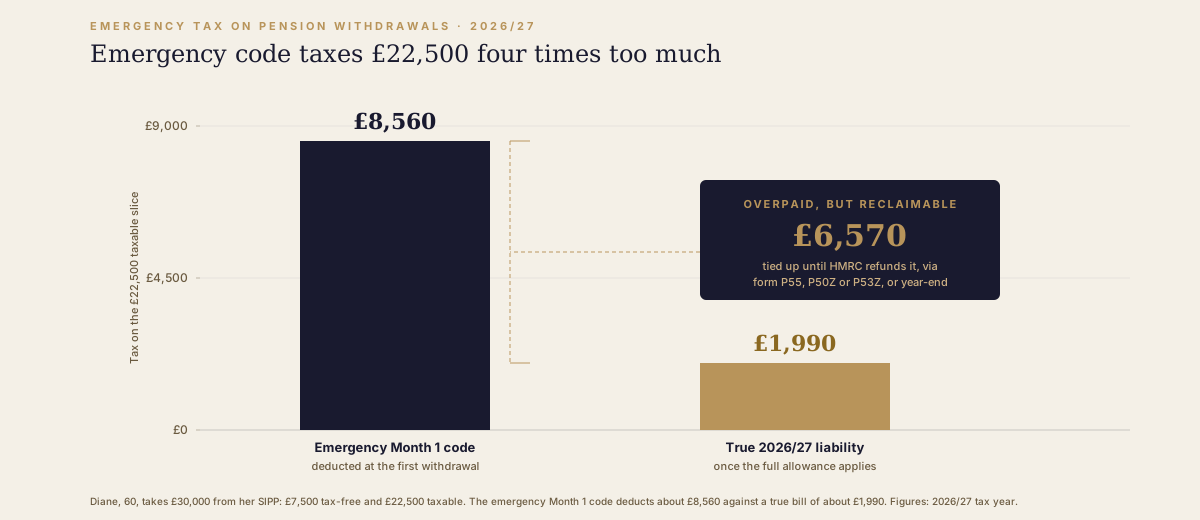
Diane, 60, taking £30,000 from her SIPP
Diane has just retired with no other income this tax year. She asks her provider for a £30,000 payment as her first withdrawal: £7,500 is tax-free and £22,500 is taxable. Because it is her first flexible payment, the provider must use the emergency Month 1 code.
On a Month 1 basis the £22,500 taxable slice loses about £8,560 in tax, with a large part falling into the 40% and 45% bands. Her actual liability for the year, once her full personal allowance is applied, is closer to £1,990. She is overtaxed by roughly £6,570.
Had Diane first drawn a nominal £1,000 to prompt HMRC to issue a correct code, then taken the £29,000 balance once that code reached her provider, almost none of the overcharge would have arisen. The size of that first payment, not the total, is what decides how much cash is tied up waiting for a refund.
How can you reclaim overpaid pension tax?
You reclaim overpaid pension tax from HMRC using one of three forms, chosen by your circumstances rather than the size of the payment. Each routes to a different situation, and picking the right one is what gets the refund paid in about 30 days rather than held up.
- Form P55 if you have taken part of your pot flexibly, are leaving the rest invested, and are not drawing regular income. HMRC’s P55 service handles this most common case.
- Form P50Z if you have emptied the whole pot and have no other taxable income that year.
- Form P53Z if you have emptied the whole pot but do have other taxable income, such as the state pension or earnings.
You do not have to claim at all. If you wait, HMRC reconciles your tax automatically after the tax year ends and refunds any overpayment, though that can take several months. The forms simply bring the money forward. For anyone who needed the full withdrawal for a specific purpose, claiming promptly is usually worth the few minutes it takes.
How do you get emergency tax back from a pension?
You reclaim overpaid pension tax from HMRC using form P55 if you have taken part of your pot, P50Z if you have emptied it with no other income, or P53Z if you have emptied it but have other taxable income. Refunds normally arrive within 30 days; otherwise HMRC corrects it automatically after the tax year ends.
What changed for pension tax codes in April 2025?
From 6 April 2025, HMRC began updating pension tax codes during the year rather than waiting until it ends. When you take a first flexible payment, HMRC now uses the real-time information it already holds to issue your provider a correct cumulative code more quickly, so later payments in the same tax year are taxed properly without a claim.
The change narrows the problem rather than removing it. The underlying PAYE rules are unchanged, so a genuine first payment with no code in place can still be taxed on the emergency Month 1 basis. What is different is the clean-up: where someone taking regular drawdown might once have been overtaxed on several payments in a row, the code now tends to correct itself after the first. HMRC may also repay any excess automatically once your code is up to date.
The April 2025 reform fixes how fast HMRC reacts, not how the first payment is taxed. A single large opening withdrawal can still trigger the full Month 1 overcharge, so the first payment is where the planning effort belongs.
How can you avoid emergency tax on a pension withdrawal?
The most reliable way to avoid emergency tax on a pension withdrawal is to make your first flexible payment a small one, then take the larger amount once HMRC has issued a correct code. A nominal first withdrawal, even a few hundred pounds, prompts HMRC to send your provider a cumulative code, so the substantial payment that follows is taxed on the right basis from the start.
Timing within the tax year helps too. Taking a first payment early in the year leaves more time for the code to correct before any further withdrawals, and spreading a large sum across two tax years keeps more of it inside the basic-rate band. Where a withdrawal is big enough to lift total income toward £100,000, the personal allowance begins to taper, creating the 60% tax trap: an effective rate of around 60% on income between £100,000 and £125,140 in 2026/27. Sequencing withdrawals to sidestep that band is exactly the kind of question lifetime cashflow modelling is built to answer, because the right amount depends on your income across several years rather than one.
One caution sits alongside the timing point. Taking any taxable pension income triggers the money purchase annual allowance, cutting future tax-relieved contributions to money purchase pensions to £10,000 a year for 2026/27. A priming withdrawal made only to fix a tax code still trips that switch, so it is a tactic for people who have finished serious pension saving, not those still building their pot.
Should you worry about emergency tax on a pension withdrawal?
You should not lose sleep over emergency tax itself, because it is a timing problem rather than a permanent cost. Every penny overdeducted comes back, either on a claim within about 30 days or automatically after the tax year. For most people it changes when they hold the money, not how much of it they ultimately keep.
It matters in one situation: when you need the full amount immediately. If a withdrawal is funding a house completion, a car, or a tax bill with a deadline, an overdeduction of several thousand pounds can leave you short at the worst moment, with the refund arriving weeks later. There the answer is to plan the withdrawal so the cash you actually receive, after emergency tax, still covers the need, and to claim the balance back straight away.
The trade-off is simply attention against cashflow. Ignoring emergency tax costs you nothing in the long run but can create a short, awkward gap. A few minutes spent choosing the right form, or sizing the first payment deliberately, removes that gap entirely.
Where emergency tax sits in your retirement plan
Within a wider plan, emergency tax is a detail to manage, not a force that should shape how you draw your pension. The decisions that genuinely move the numbers are how much you withdraw, in which order across your pensions and other accounts, and in which tax years. Emergency tax rides on top of those choices and washes out once your code settles.
The place it earns real attention is the first withdrawal and any year with an unusually large one. Coordinating the size and timing of payments with the rest of your income is central to retirement income planning, and getting the opening move right spares you a refund chase later. Treat the emergency code as a known quirk to plan around, and it stops being a surprise and becomes one more thing the plan already accounts for.
Risk warning
A pension is a long-term investment, the value of your investment and the income from it may go down as well as up. Your eventual income may depend upon the size of the fund at retirement, future interest rates and tax legislation.
Frequently asked questions
What is emergency tax on a pension withdrawal?
Emergency tax on a pension withdrawal is income tax deducted from a first flexible payment using a temporary Month 1 code. The code assumes the withdrawal will repeat every month, so it usually takes far more than you owe. The excess is refundable by HMRC.
How much emergency tax will I pay on a pension lump sum?
It depends on the size of the payment, but the emergency Month 1 code gives only one twelfth of your allowances and bands. A £20,000 taxable slice can lose several thousand pounds more than the correct figure for 2026/27. The exact overcharge is reclaimable in full.
How long does a pension tax refund take?
If you claim using the right form, HMRC normally pays a pension tax refund within about 30 days. If you do nothing, HMRC reconciles your tax automatically after the tax year ends, which can take several months longer.
Should I worry about emergency tax on a pension withdrawal?
Emergency tax is a cashflow timing problem, not a permanent loss, so it rarely justifies changing a sound withdrawal plan. It matters most when you need the full amount immediately, for example to complete a purchase, because the refund can arrive weeks later.
Does emergency tax apply every time I take pension money?
No, but the risk can return at the start of each new tax year. Emergency tax applies whenever your provider holds no valid code from HMRC for the current year. Regular drawdown income is usually protected, as HMRC updates codes each April. Those taking occasional lump sums are more exposed: leave a pot untouched for a full tax year and the provider's code can lapse, meaning the first withdrawal in the next year may again be taxed on a Month 1 emergency basis.
Will HMRC refund overpaid pension tax automatically?
Yes, eventually. HMRC reconciles overpaid pension tax automatically after the end of the tax year if you make no claim. Submitting form P55, P50Z or P53Z simply brings the refund forward, usually to within 30 days.