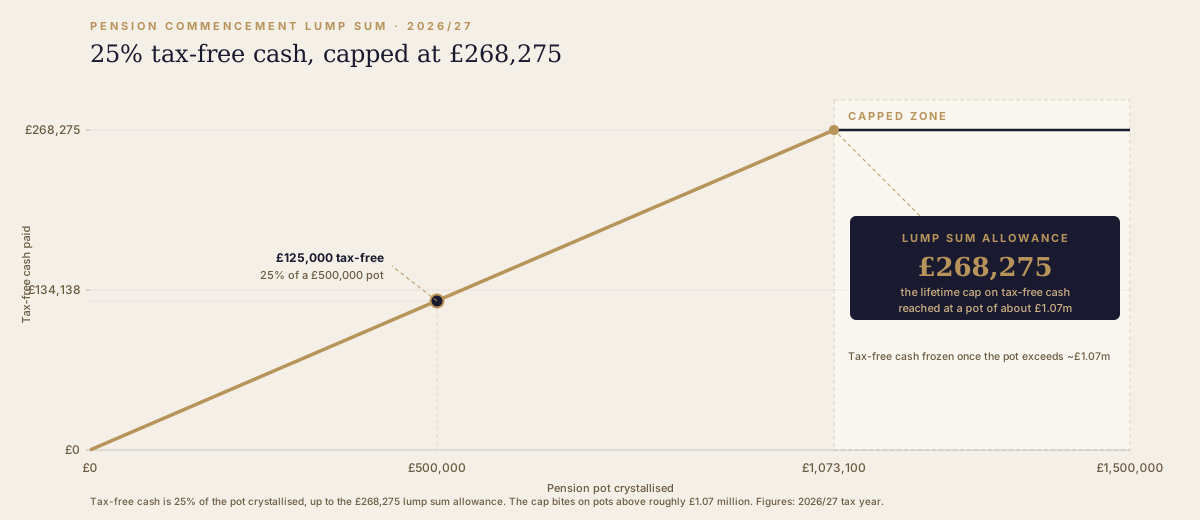
A pension commencement lump sum is the tax-free cash a member can take from a registered pension scheme when they turn untouched savings into retirement benefits (known as crystallising), normally up to 25% of the amount accessed. Most people can take 25% of a pension tax-free, but the binding limit is the £268,275 lump sum allowance, which starts to bite on pots above £1,073,100. This tax-free cash, formally the pension commencement lump sum or PCLS, is the most valuable feature of UK pension tax rules because it comes out entirely free of income tax. It must be paid within a fixed window around when your pension starts.
The pension commencement lump sum, almost always shortened to PCLS, is the tax-free cash you can draw from a pension when you start taking benefits. For most people that means up to a quarter of a defined contribution pot paid with no income tax due, while the rest stays invested and is taxed as income later. It is the single most valuable feature of the UK pension system, and also one of the most misunderstood: the headline 25% sits underneath a lifetime cap, a strict payment window, and an anti-avoidance rule that can turn a tax-free payment into a tax charge. All figures in this article reflect the 2026/27 tax year.
How does a pension commencement lump sum work?
You take a pension commencement lump sum when you crystallise a defined contribution pension, usually from age 55 (rising to 57 from 6 April 2028). Up to 25% of the amount you bring into payment is paid tax-free, and the remaining 75% becomes taxable as income when you draw it.
Contents
- What is a pension commencement lump sum?
- How does a pension commencement lump sum work?
- How does the lump sum allowance cap your tax-free cash?
- Should you take all your tax-free cash at once?
- What happens if you recycle tax-free cash?
- How does tax-free cash fit into a wider plan?
What is a pension commencement lump sum?
A pension commencement lump sum is the tax-free portion of a registered pension that you can take when you first draw benefits, normally up to 25% of the funds being brought into payment. It applies to defined contribution pensions such as workplace schemes, personal pensions, and SIPPs, and to defined benefit (final salary) schemes, though the way it is calculated differs between the two.
For a defined contribution pension the arithmetic is straightforward: take a pot, set aside up to a quarter of whatever you access, and that slice is paid free of income tax. For a defined benefit scheme there is no pot to take a quarter of, so the lump sum is created by giving up some of the guaranteed annual pension at a conversion rate set by the scheme, known as a commutation factor. A poor commutation factor can make the tax-free cash look generous while quietly costing a large amount of inflation-protected income.
The PCLS is the formal name; in practice most people, and most providers, simply call it the 25% tax-free cash or tax-free lump sum. The percentage itself has not changed. What changed in April 2024 was the structure sitting above it, when the lifetime allowance was abolished and replaced by a cap expressed directly in pounds rather than as a percentage of a notional limit.
Risk warning
Your pension income could also be affected by the interest rates at the time you take your benefits. The tax implications of pension withdrawals will be based on your individual circumstances, tax legislation and regulation which are subject to change in the future.
How does a pension commencement lump sum work?
Taking a pension commencement lump sum is part of an event called crystallisation, which simply means moving pension funds from their untouched (uncrystallised) state into a form that is being used to provide retirement benefits. You do not have to crystallise everything at once. You can crystallise a slice of a pot, take the 25% tax-free cash from that slice, and leave the rest untouched for later.
When you crystallise, the tax-free amount is the lower of two figures: 25% of the funds you are crystallising, or your remaining lump sum allowance. The other 75% does not have to be taken as income immediately. It moves into flexi-access drawdown or is used to buy an annuity, and is taxed as income only when it is actually paid out to you.
There is a timing rule that catches people out. A pension commencement lump sum has to be paid within a window that starts six months before, and ends twelve months after, you become entitled to the linked pension. Take the cash too far ahead of, or too long after, drawing the pension it relates to, and it can lose its tax-free status.
An alternative route to the same 25% is an uncrystallised funds pension lump sum, where each withdrawal is automatically a blend of 25% tax-free and 75% taxable. The two methods reach a similar destination but behave very differently for future contributions, which matters if you are still paying in.
Risk warning
A pension is a long-term investment, the value of your investment and the income from it may go down as well as up. Your eventual income may depend upon the size of the fund at retirement, future interest rates and tax legislation.
How does the lump sum allowance cap your tax-free cash?
The lump sum allowance is the ceiling on how much tax-free cash you can take across every pension you hold. For the 2026/27 tax year it is £268,275, a figure that is not arbitrary: it is exactly 25% of the old lifetime allowance of £1,073,100, frozen in place when the lifetime allowance was abolished. The cap was confirmed unchanged at the Autumn 2025 Budget.
The allowance is a lifetime, cumulative limit, not an annual one. Every tax-free lump sum you take, whether a PCLS or the tax-free element of an uncrystallised funds pension lump sum, uses up part of it. Once it is gone, you can still take cash from a pension, but anything above the allowance is taxed as income at your marginal rate rather than paid tax-free. The current rules are set out in HMRC’s guidance on the lump sum allowance.
How the lump sum allowance limits tax-free cash when some has already been used
David, 64, took £150,000 tax-free cash from an earlier pension and is now crystallising a £300,000 SIPP.
| Input | Value |
|---|---|
| Lump sum allowance (2026/27) | £268,275 |
| Tax-free cash already taken | £150,000 |
| Pot being crystallised | £300,000 |
- Remaining lump sum allowance: £268,275 minus £150,000 already used = £118,275
- 25% of the pot being crystallised: £300,000 x 25% = £75,000
- Compare the two figures and take the lower: £75,000 is less than the £118,275 remaining allowance
- Tax-free cash paid: the full £75,000, since it falls within the remaining allowance
Result: David receives £75,000 tax-free, the full 25% of his £300,000 pot, leaving £43,275 of lump sum allowance for future pensions.
For most savers the cap is academic. A pot would need to be worth more than £1,073,100 before 25% of it bumped against £268,275. For higher earners, and anyone with several pensions, the cap is a live planning constraint that needs tracking across schemes, because no single provider sees your full picture.
A separate and larger limit, the lump sum and death benefit allowance of £1,073,100, governs tax-free lump sums paid on serious ill health or to beneficiaries on death. Some people also hold a protected allowance from the lifetime allowance era, which can lift their personal cap above the standard figure: fixed protection 2016, for example, gives a tax-free entitlement of up to £312,500 for 2026/27. These protections, and the higher caps that come with them, are explained in HMRC’s guidance on taking higher tax-free lump sums.
How much tax-free cash can you take with a protected pension allowance?
Savers who registered protection during the lifetime allowance era can have a personal lump sum allowance above £268,275. Fixed protection 2016, for example, gives a tax-free entitlement of up to £312,500 in 2026/27. The protection must already be registered with HMRC, and certain new contributions can invalidate it.
Risk warning
HM Revenue and Customs practice and the law relating to taxation are complex and subject to individual circumstances and changes which cannot be foreseen.
Should you take all your tax-free cash at once?
Not necessarily, and the reason is that tax-free cash is a percentage of your pot at the moment you crystallise, not a fixed sum you are owed. Leave funds uncrystallised and they stay invested; if they grow, so does the 25% you can eventually take from them. Crystallise everything on day one and you lock the tax-free figure to today’s pot value, then typically move the cash into a savings or current account where it is exposed to tax on interest.
That does not make taking it all at once wrong. There are good reasons to do so: clearing a mortgage, funding a known large expense, or simply wanting certainty. But taking the maximum because it is there, with no use for it, is rarely the most efficient choice. Spreading crystallisation over several years, often called phasing, lets the tax-free entitlement keep growing inside the wrapper and gives far more control over the taxable income drawn alongside it.
Two £400,000 pots, two different choices
Ravi and Helen are both 58, both have a £400,000 SIPP, and both plan to wind down work gradually rather than stop overnight. Neither needs a large cash sum for any particular purpose.
Ravi crystallises the whole pot straight away and takes the full £100,000 tax-free cash, moving it into an easy-access savings account. Helen crystallises only what she needs, taking £20,000 of tax-free cash in the first year and leaving £320,000 uncrystallised and invested.
Five years on, assume both pots have grown by around a third before any further withdrawals. Ravi’s £100,000 has sat in cash, earning taxable interest outside the pension’s tax shelter. Helen’s uncrystallised funds have grown to well over £400,000, so the tax-free cash still available to her, a quarter of that larger figure, now comfortably exceeds the £100,000 Ravi locked in at 58. She has also kept her taxable income low across those years by taking only what she needed. The same starting pot and the same 25% rule produced very different positions.
The phasing decision is rarely about the lump sum in isolation. It interacts with the income you draw, the tax band that income falls into, and the order in which you spend different pots, which is the kind of question lifetime cashflow modelling is built to answer.
Risk warnings
Cash and deposits
While cash provides security of capital, it may not keep pace with inflation. Over time, the real value of your savings could fall.
Mortgages
Your home may be repossessed if you do not keep up repayments on your mortgage. Think carefully before securing debts against your home.
Not all mortgage contracts are regulated by the Financial Conduct Authority.
What happens if you recycle tax-free cash?
Taking tax-free cash and then paying a large chunk of it straight back into a pension to claim fresh tax relief is called recycling. HMRC’s Pensions Tax Manual guidance on recycling of pension commencement lump sums sets out that the recycled amount is treated as an unauthorised payment, which can trigger a tax charge of up to 70% of the lump sum. The rule exists to stop people manufacturing artificial tax relief by cycling the same money through a pension twice.
You are only at risk if a specific set of conditions all apply. The tax-free cash taken in a rolling twelve-month period has to exceed £7,500 for 2026/27; the recycling has to be pre-planned; and the resulting increase in pension contributions, measured cumulatively over the tax year of the lump sum plus the two years either side, has to be more than 30% of the lump sum. If any one of those is missing, it is not recycling.
The phrase pre-planned is doing a lot of work here. HMRC is looking for evidence that you took the cash with the intention of reinvesting it. Genuine retirement planning, and contribution increases that flow from a pay rise, a bonus, or an inheritance rather than from the lump sum, are not caught. Most people will never come close to the rule.
It still pays to be aware of it, because the consequences are severe and because reinvesting also runs into the ordinary contribution limits. Anyone thinking of paying tax-free cash back in needs to check it against both the recycling rule and the pension annual allowance, and to remember that drawing taxable income at the same time can trigger the money purchase annual allowance.
Risk warning
Levels and bases of, and reliefs from, taxation are subject to change and their value will depend upon personal circumstances. Taxation and pension legislation may change in the future.
How does tax-free cash fit into a wider plan?
Tax-free cash fits into a wider plan as one lever to coordinate with the income you draw, the tax bands that income falls into, and the order you spend different pots, rather than as a standalone windfall. The most common mistake with a pension commencement lump sum is treating it as a one-off win rather than a planning decision that ripples through the rest of your retirement plan. The money is genuinely tax-free coming out, but what happens to it next decides whether that advantage is kept or quietly eroded.
Once the cash leaves the pension it loses the wrapper’s protection. In a savings account it earns interest that is taxable above your personal savings allowance, and as cash it is fully exposed to inflation. Moving it into an ISA rebuilds some shelter but is capped at £20,000 a year for 2026/27, so a large sum can take several tax years to re-shelter. That makes it as much a question of investment wrapper choice as of pension rules, and one worth settling before you take the cash rather than after.
There is an estate dimension too. Funds left inside a pension have historically sat outside your estate for inheritance tax, while cash you have already withdrawn sits firmly inside it. That gap narrows from 6 April 2027, when most unused pension funds are due to come within the scope of inheritance tax, which may change the case for drawing cash early or gifting during your lifetime. The charge itself is law and the information duties on schemes and executors were made in July 2026, so this is a change to plan around rather than one to wait on.
One point reassures people still building a pension: taking the tax-free cash on its own, with no taxable income drawn alongside it, does not trigger the money purchase annual allowance, so you can take your 25% and keep contributing in full. The lump sum is best thought of not as a prize for reaching pension age, but as one lever among several, most valuable when it is pulled deliberately and in step with the rest of the plan.
Risk warning
The favourable tax treatment of ISAs may be subject to changes in legislation in the future.
Frequently asked questions
What is a pension commencement lump sum?
A pension commencement lump sum is the tax-free cash you can take from a pension when you start drawing benefits, usually up to 25% of the amount you access. It applies to both defined contribution and defined benefit pensions, though it is calculated differently for each. Most people simply call it the 25% tax-free cash.
How much tax-free cash can I take from my pension?
You can usually take up to 25% of each pension as tax-free cash, capped at a lifetime total across all your pensions of £268,275 for 2026/27. Anything taken above that allowance is taxed as income at your marginal rate. A protected allowance can raise the cap above £268,275.
Should I take my whole tax-free lump sum at once?
Not automatically. Because the 25% is calculated on your pot when you crystallise, leaving funds invested can increase the tax-free cash available later, and once withdrawn the money loses the pension's tax shelter. Taking it all at once makes sense for a specific need, such as clearing a mortgage, but less so simply because it is available.
How does taking a pension commencement lump sum work?
You take it by crystallising some or all of a pension, at which point up to 25% is paid tax-free and the remaining 75% moves into drawdown or buys an annuity. The cash must be paid within six months before and twelve months after you become entitled to the linked pension. You can crystallise in stages rather than all at once.
Can I pay my tax-free cash back into a pension?
You can, but recycling rules can apply a tax charge of up to 70% if you take more than £7,500 of tax-free cash, pre-plan to reinvest it, and increase contributions by more than 30% of the lump sum. Genuine retirement planning, and contribution rises funded by income rather than the lump sum, are not caught.
Do defined benefit pensions pay a 25% tax-free lump sum?
Defined benefit schemes pay tax-free cash, but it is created by giving up part of your guaranteed annual pension at a conversion rate called a commutation factor, not by taking a quarter of a pot. A poor commutation factor can make the cash look attractive while costing a large amount of inflation-linked income, so the headline 25% figure is not always the right comparison.