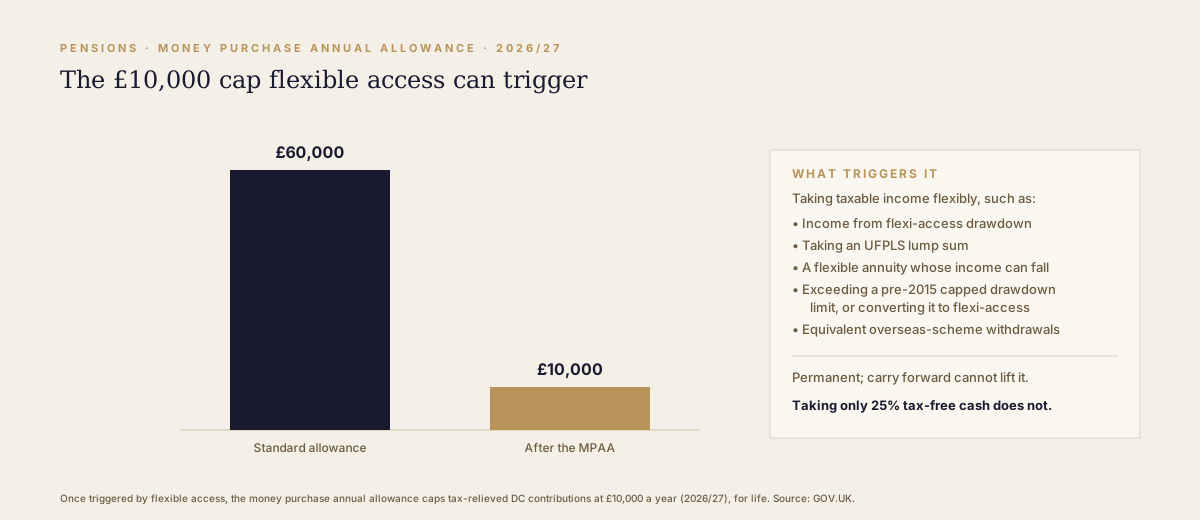
The money purchase annual allowance is a reduced annual allowance that limits tax-relieved contributions to defined contribution pensions to £10,000 a year for 2026/27 once an individual flexibly accesses their pension savings. It is triggered the moment you take taxable income flexibly from a defined contribution pension, and once triggered it applies for the rest of your life. From that point your tax-relieved contributions to such pensions are capped at £10,000 a year for 2026/27. Carry forward cannot lift it, so anyone still working and contributing should understand the trigger before drawing income.
The money purchase annual allowance, or MPAA, is a reduced limit on how much you can pay into a defined contribution pension and still receive tax relief. It applies from the moment you flexibly access taxable income from such a pension, and it brings the standard £60,000 annual allowance down to £10,000 a year for 2026/27. Once triggered, the money purchase annual allowance is permanent and cannot be restored. All figures in this article reflect the 2026/27 tax year.
Contents
- How the MPAA works
- What triggers it
- What does not trigger it
- The year you trigger it
- Who it catches out
- Can you avoid it?
- Fitting it into your plan
What is the money purchase annual allowance?
The money purchase annual allowance (MPAA) is a £10,000 limit on the pension contributions you can make with tax relief each year. It replaces the standard £60,000 annual allowance once you flexibly access a defined contribution pension, and it counts employer contributions too. For most people in 2026/27 it cannot be increased by carry forward.
How does the money purchase annual allowance work?
The money purchase annual allowance works by replacing your standard pension allowance with a much lower one as soon as you start taking taxable income flexibly from a defined contribution pension. In 2026/27 the standard pension annual allowance is £60,000, or 100% of your earnings if that is lower, and the MPAA reduces this to £10,000 for money purchase contributions. The figure covers everything paid in: your own contributions, the tax relief added to them, and anything your employer pays.
HMRC introduced the MPAA under the Taxation of Pensions Act 2014 to prevent pension recycling, where someone withdraws money from a pension and pays it straight back in to claim a second round of tax relief and a fresh entitlement to tax-free cash. The MPAA closes that loop by capping what can go back in once you have started drawing flexibly. It does not touch your defined benefit pension, and it does not reduce the standard allowance for anyone who has not flexibly accessed a defined contribution pension.
What counts towards the £10,000 MPAA limit?
The £10,000 MPAA limit for 2026/27 includes your own pension contributions, the tax relief added to them, and any employer contributions, including standard auto-enrolment payments. It applies across all your defined contribution pensions combined. Contributions to a defined benefit pension are not counted towards it; these are tested separately against the alternative annual allowance.
Risk warnings
Pensions
Levels and bases of, and reliefs from, taxation are subject to change and their value will depend upon personal circumstances. Taxation and pension legislation may change in the future.
Your pension income could also be affected by the interest rates at the time you take your benefits. The tax implications of pension withdrawals will be based on your individual circumstances, tax legislation and regulation which are subject to change in the future.
Tax, trusts and estate planning
The Financial Conduct Authority does not regulate Cashflow Planning.
HM Revenue and Customs practice and the law relating to taxation are complex and subject to individual circumstances and changes which cannot be foreseen.
What triggers the money purchase annual allowance?
The MPAA is triggered the first time you take taxable income flexibly from a defined contribution pension. The two most common trigger events are taking an uncrystallised funds pension lump sum (UFPLS), where 25% is tax-free and the rest is taxed, and drawing any income at all from a flexi-access drawdown fund. Even a single pound of drawdown income is enough.
Two less common triggers catch people out. Buying a flexible or investment-linked annuity, one whose income can fall, triggers the MPAA, because you have kept flexible access rather than locking into a guaranteed income. Exceeding the cap on a pre-April-2015 capped drawdown plan, or converting one into flexi-access drawdown, does the same. Equivalent withdrawals from an overseas scheme that has previously benefited from UK tax relief also count.
Risk warning
A pension is a long-term investment, the value of your investment and the income from it may go down as well as up. Your eventual income may depend upon the size of the fund at retirement, future interest rates and tax legislation.
What does not trigger the MPAA?
Taking only your tax-free cash does not trigger the money purchase annual allowance; drawing taxable income does. You can take the pension commencement lump sum, up to 25% and capped by the lump sum allowance of £268,275 for 2026/27, and move the rest into drawdown, and as long as you draw no taxable income your full allowance survives. Buying a conventional lifetime annuity, one that pays a guaranteed income that cannot fall, does not trigger it either, because you are not flexibly accessing the underlying fund. Income from a defined benefit (final salary) pension sits outside the rules entirely.
Small pots also escape. You can take up to three personal pensions worth £10,000 or less each as small pot lump sums, with no limit on the number of small occupational pots, without triggering the MPAA. This is one of the few routes that lets you take taxable cash from a defined contribution pension and still keep the full £60,000 allowance.
Two savers, one taxable withdrawal apart
Helen and Priya are both 58, both still working, and both hold a £400,000 SIPP alongside a workplace pension receiving £24,000 a year in combined employer and employee contributions.
Helen takes her £100,000 tax-free lump sum and moves the remaining £300,000 into drawdown, but draws no income from it. Her annual allowance stays at £60,000, so her £24,000 of workplace contributions continue without restriction.
Priya does the same, but also draws £6,000 of taxable income to top up her salary. That single withdrawal triggers the MPAA. From the next tax year her combined contributions must stay within £10,000 or face a tax charge, so around £14,000 a year of pension saving, including her employer’s share, is no longer efficient. Over the seven years to her planned retirement, that is close to £100,000 of contributions, before any investment growth.
Treat the first taxable withdrawal from a defined contribution pension as a one-way door. Before you step through it, be sure you have finished building.
What happens in the year you trigger the MPAA?
In the tax year you trigger the MPAA, only the money purchase contributions you make after the trigger date are tested against the £10,000 limit. Anything paid in before that date, along with the year’s total, is measured against the full £60,000 annual allowance as normal. From the following tax year onwards, every penny of money purchase contribution is tested against the £10,000 MPAA.
If you also build up a defined benefit pension, a second figure applies. Your DB accrual is measured against the alternative annual allowance, which is the standard allowance minus the MPAA: £50,000 in 2026/27. This sits alongside the tapered annual allowance that already restricts very high earners, and the two restrictions can apply at the same time.
One option that closes off entirely is pension carry forward. Normally you can carry forward unused allowance from the previous three tax years to pay in more than the annual limit, but pension carry forward cannot be used to lift the £10,000 MPAA. It can still be applied to the alternative annual allowance for defined benefit accrual, but never to money purchase contributions.
Who does the MPAA catch out?
The MPAA most often catches people who are still working, or still saving, while drawing income from a pension they have already opened. The rule was designed for deliberate recyclers, but in practice it tends to snare people who simply did not realise their allowance had changed.
A common example is someone in their late fifties who takes flexible income from one pension to ease back on work, while remaining a member of a workplace scheme. If contributions are still being paid into that scheme, even just through standard auto-enrolment, the combined employer and employee contributions can quietly exceed £10,000 and trigger a tax charge.
The trap is sharpest for higher earners and company directors who can contribute large sums, and for anyone planning a phased move into retirement. Drawing a modest taxable income early can quietly close off the larger contributions that often matter most in the final working years, exactly when people are trying to work out how much pension income they will need.
Can you avoid triggering the MPAA?
Yes, you can usually avoid triggering the MPAA, by separating the cash you need now from the income you draw flexibly. If you need a lump sum, taking only your tax-free cash, or using the small pots rules, releases money without tripping the allowance. If you want a regular income but still intend to contribute meaningfully, a guaranteed lifetime annuity provides income without triggering the MPAA, though it trades away flexibility and access to the underlying fund.
The trade-off is the heart of the decision. Flexible drawdown income is convenient and keeps your money invested and within reach, but it permanently caps future contributions. For someone who has genuinely finished contributing, that cost is irrelevant. For someone still building, the sensible sequence is to delay flexible withdrawals until pension saving is complete, or to fund early income from other sources such as ISAs or cash. Mapping that order out, often through lifetime cashflow modelling, is what turns the rule from a trap into a non-issue.
Risk warning
The favourable tax treatment of ISAs may be subject to changes in legislation in the future.
How does the MPAA fit into your wider plan?
The MPAA fits into your wider plan by sitting at the intersection of three decisions: when you stop contributing, when you start drawing income, and where that income comes from. The order in which you access pensions, ISAs and other savings shapes not only your tax bill but whether you keep the freedom to top up your pension later.
Getting that order right is a core part of retirement income planning, and it is far easier to plan before the first withdrawal than to unpick afterwards. Because the allowance moves in a single step, from £60,000 to £10,000, and then stays there, the value of getting the timing right is high and the cost of getting it wrong can run into tens of thousands of pounds in lost contributions. The discipline is simple to state: know exactly what counts as flexible access, and do not cross that line until your pension is built.
Frequently asked questions
What is the money purchase annual allowance?
The money purchase annual allowance is a £10,000 cap on the pension contributions you can make with tax relief each year, once you flexibly access a defined contribution pension. It replaces the standard £60,000 annual allowance and applies for the rest of your life.
What triggers the money purchase annual allowance?
Taking taxable income flexibly from a defined contribution pension triggers it. The main triggers are taking an uncrystallised funds pension lump sum (UFPLS) or drawing any income from a flexi-access drawdown fund. Buying a flexible annuity whose income can fall also triggers it.
Does taking tax-free cash trigger the MPAA?
No. Taking only your 25% tax-free lump sum (the pension commencement lump sum) does not trigger the MPAA, provided you do not also draw taxable income. You can move the rest into drawdown and leave it untouched while keeping your full £60,000 allowance.
Is the money purchase annual allowance permanent?
Yes. Once triggered, the MPAA applies for the rest of your life and cannot be reversed. There is no mechanism to restore the standard £60,000 annual allowance after you have flexibly accessed a defined contribution pension.
Does the MPAA affect defined benefit pensions?
No, defined benefit (final salary) accrual is not tested against the MPAA. If you have triggered the MPAA, and you pay into both a DC and a DB scheme, your DB growth is measured against the alternative annual allowance, which is £50,000 in 2026/27, while your DC contributions are capped at £10,000.
Can you use carry forward with the MPAA?
No. Carry forward of unused allowance from previous tax years cannot be used to increase the £10,000 money purchase annual allowance. It can still be applied to the alternative annual allowance for defined benefit accrual, but never to money purchase contributions.
Should I delay taking pension income to avoid triggering the MPAA?
If you are still making meaningful pension contributions, delaying flexible withdrawals until that saving is complete avoids a permanent cut to your allowance. If you have already finished contributing, triggering the MPAA carries little practical cost, so there is usually no reason to delay accessing your money on that basis alone.