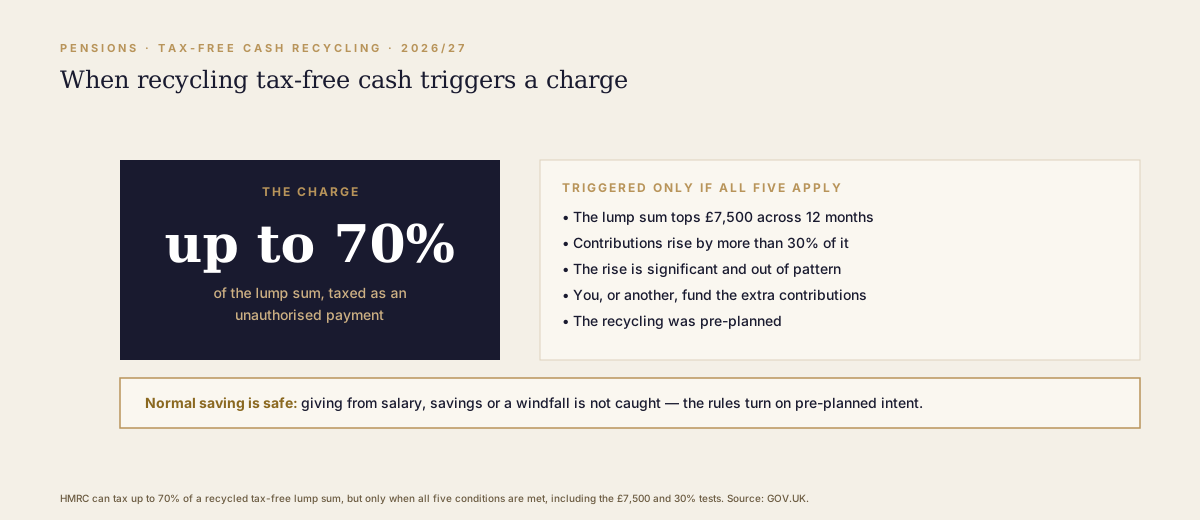
Tax-free cash recycling is the use of a pension commencement lump sum to fund significantly larger pension contributions, an arrangement HMRC treats as an unauthorised payment under anti-avoidance rules. HMRC charges up to 70% if the lump sum and a pre-planned increase in contributions breach its thresholds. The rules apply only when five conditions are met together, including a lump sum above £7,500 for 2026/27 and an increase in contributions exceeding 30% of that lump sum. Genuine retirement saving funded from salary, savings, or a windfall is not caught, because the rules turn on pre-planned intent.
Tax-free cash recycling happens when someone takes a pension commencement lump sum and pays it back into a pension to claim tax relief on the same money a second time. HMRC’s anti-avoidance rules catch this, treating the lump sum as an unauthorised payment that can be taxed at up to 70% of its value. The rules only bite when five separate conditions are met at the same time, so most people taking tax-free cash are never affected. The figures and thresholds in this article are correct for the 2026/27 tax year.
How do the tax-free cash recycling rules work?
The rules are caught only when five HMRC conditions are met together: a pension commencement lump sum is taken, the recycling is pre-planned, the lump sum exceeds £7,500 for 2026/27 across twelve months, and the increase in contributions exceeds 30% of the expected pattern and 30% of the lump sum itself. If all five apply, the lump sum is taxed as an unauthorised payment.
Contents
- What are the tax-free cash recycling rules?
- How does the recycling rule actually work?
- The two tests that trigger a recycling charge
- What happens if you are caught recycling tax-free cash?
- When do the tax-free cash recycling rules not apply?
- Is recycling tax-free cash ever worth it?
- Deciding what your tax-free cash is for
What are the tax-free cash recycling rules?
The tax-free cash recycling rules are HMRC provisions that stop people extracting a tax-free pension lump sum and recontributing it to win a second round of tax relief. They sit in paragraph 3A of Schedule 29 to the Finance Act 2004 and have applied to every pension commencement lump sum paid since 6 April 2006.
The logic is straightforward. A pension commencement lump sum is normally a quarter of the fund you crystallise, meaning the part of your pension you start drawing on, paid completely free of tax. Pension contributions, meanwhile, attract tax relief at your marginal rate. Without a rule against it, you could take tax-free cash, pay it straight back in, collect fresh relief, and create a brand new entitlement to 25% tax-free cash on the recontributed sum, repeating the trick indefinitely. The recycling rules close that loop.
The same treatment applies to the tax-free element of an uncrystallised funds pension lump sum, where each withdrawal from an untouched pot is paid partly tax-free, not just to a conventional lump sum. What the rules do not do is restrict the size of your tax-free cash itself. That is governed separately by the lump sum allowance, which stands at £268,275 for 2026/27 and was confirmed unchanged at the Autumn Budget 2025. Recycling can apply to a lump sum of any size above the £7,500 floor described below.
Risk warnings
Pensions
Levels and bases of, and reliefs from, taxation are subject to change and their value will depend upon personal circumstances. Taxation and pension legislation may change in the future.
Your pension income could also be affected by the interest rates at the time you take your benefits. The tax implications of pension withdrawals will be based on your individual circumstances, tax legislation and regulation which are subject to change in the future.
Pension drawdown
Drawdown pension plans (unsecured income) are complex and are not suitable for everyone. Pension decisions can affect your income for the rest of your life (and that of any partner and other dependants). Where benefits are accessed on a flexible basis, these are not fixed or safeguarded for life. If security of income is important to you then you should consider purchasing an annuity or taking a scheme pension to provide a secured level of income.
Tax, trusts and estate planning
HM Revenue and Customs practice and the law relating to taxation are complex and subject to individual circumstances and changes which cannot be foreseen.
How does the recycling rule actually work?
The recycling rule applies only when all of HMRC’s conditions for recycling a pension commencement lump sum are met together, and missing any one of them means the rule cannot bite. All of the following must apply:
- You receive a pension commencement lump sum.
- Because of that lump sum, contributions paid into a registered pension scheme are significantly greater than they otherwise would have been. The contributions can be paid by you or by someone else, such as an employer.
- The recycling was pre-planned: you intended, when taking the cash, to use it to fund higher contributions.
- The lump sum, added to any other tax-free lump sums taken in the previous twelve months, exceeds £7,500 for 2026/27.
- The cumulative increase in contributions exceeds 30% of the lump sum.
The flowchart shows that recycling only becomes a problem when a pension commencement lump sum was pre-planned to fund higher contributions, the lump sum exceeds £7,500, and the resulting increase in contributions clears both 30% tests. Failing any single test at any stage means no charge applies, and only the small minority of cases that clear all four tests face the unauthorised payment charge of up to 70%.
Pre-planning is the linchpin. What converts ordinary pension planning into recycling is pre-planned intent, not the act of contributing after taking cash. HMRC will weigh the evidence in each case, and the fact that a lump sum lands in the same bank account that funds a contribution does not, by itself, prove anything. Where you genuinely had no intention of recontributing when you took the cash, and only decided later, there is no pre-planning and the rule does not apply.
Two further limits sit alongside these conditions. Any recontribution still has to fit inside the pension annual allowance, which HMRC’s guidance on tax relief for private pension contributions sets at £60,000 a year for 2026/27, and once you have flexibly accessed taxable pension income, the much lower money purchase annual allowance, £10,000 a year for 2026/27, caps what you can pay back in at all.
The two tests that trigger a recycling charge
Two of the conditions both turn on 30%, and they are easy to confuse, so it is worth separating them. They are genuinely different hurdles, and both have to be cleared before the rule applies.
The first is the significant-increase test. Your contributions must rise by more than 30% above what would otherwise have been expected, judged against your contribution history and any contractual rate. To stop people drip-feeding the increase, HMRC measures this cumulatively across five tax years: the year you take the cash plus the two years either side.
The second is the cumulative test against the lump sum. The total increase in contributions across that same window must also exceed 30% of the lump sum itself. This is the test people most often overlook. A large percentage jump in contributions can still escape the rules if the extra cash is small relative to the lump sum, and a modest-looking increase can be caught if the lump sum is small.
How is the 30% tax-free cash recycling test calculated?
HMRC measures contribution increases cumulatively across five tax years: the year the lump sum is taken plus the two years either side. Two separate tests must both be cleared: the increase must exceed 30% of the expected contribution pattern, and the total increase must exceed 30% of the lump sum itself. Failing either test alone means no charge applies.
Eleanor and Graham, both 57, each take £50,000 tax-free
Eleanor and Graham each take a £50,000 pension commencement lump sum from a SIPP and each decide, before taking it, to lift their pension contributions using the money. Both normally pay £8,000 a year, so £40,000 would be expected across the five-year testing window.
Over that window Eleanor pays an extra £14,000 in total. Graham pays an extra £16,000. The cumulative test is 30% of the £50,000 lump sum, which is £15,000.
Eleanor’s £14,000 increase sits below the £15,000 cumulative threshold, so the recycling rule cannot apply and her lump sum stays tax-free. Graham’s £16,000 increase clears it, every other condition is met, and his £50,000 is reclassified as an unauthorised payment. At 40% that is a £20,000 charge, with a surcharge possible on top.
The gap between the two outcomes turns on £2,000 of contributions. Same lump sum, same intent, same starting pattern, and the difference between nothing to pay and a tax bill of £20,000 or more is which side of the cumulative threshold the contributions land.
What happens if you are caught recycling tax-free cash?
If the recycling rule applies, the entire pension commencement lump sum is reclassified as an unauthorised payment and taxed accordingly under HMRC’s unauthorised payments rules. Three separate charges can then stack up.
First, an unauthorised payments charge of 40% of the lump sum, which you are personally liable for. Second, an unauthorised payments surcharge of a further 15%, which applies where the unauthorised payments in a reference period reach 25% of the value of your benefits under the scheme. Third, a scheme sanction charge, which falls on the scheme administrator at a headline rate of 40%, reduced to 15% once your own charge has been paid.
Taken together, you can personally face up to 55% of the lump sum, and the combined tax across you and the scheme can reach 70%. There is also a reporting duty: where you take a lump sum as part of a recycling device, you must tell the scheme administrator within 30 days, and the charge is settled through self-assessment.
The scale is the point. A charge of this size can cost several times more than the extra relief the recycling was meant to capture, which is precisely why the rules exist as a deterrent rather than a revenue-raiser.
When do the tax-free cash recycling rules not apply?
The recycling rules do not apply to the great majority of pension activity, because they require deliberate, pre-planned intent to recycle. Several common situations sit firmly outside them.
A tax-free lump sum of £7,500 or less in any rolling twelve-month period sits outside the recycling rules entirely. So does any use of the cash that is not a pension contribution: spending it, clearing a mortgage, or paying it into an ISA cannot be caught, because the rules only reach contributions to a registered pension scheme.
Increasing your contributions is also fine where the money comes from somewhere other than the lump sum. HMRC’s own guidance confirms that funding higher contributions from salary, from a redundancy payment, through salary sacrifice, or from a windfall such as an inheritance or lottery win does not trigger the rules, provided the lump sum was not the planned means. Keeping a contribution rate the same, such as a fixed percentage of profits, is unaffected even if the cash amount rises because profits rose.
The recycling rules turn on intent, not arithmetic alone. HMRC’s question is whether you always meant to use the lump sum itself as the engine of larger contributions.
Two more carve-outs are worth knowing. Taking the cash with no intention at the time of recontributing, then deciding later to pay more in, is not recycling, because the pre-planning has to exist before the first relevant transaction. And a lump sum paid at or after age 75 is outside the rule, as long as none of the increased contributions are paid by an employer.
Risk warnings
ISAs
The favourable tax treatment of ISAs may be subject to changes in legislation in the future.
Salary sacrifice
It is important to note that salary sacrifice is not suitable for all employees. Employees’ pre-tax salary will be reduced. This may affect their entitlement to State Benefits.
Mortgage lenders may calculate borrowing amounts in terms of the reduced salary.
Mortgages
Your home may be repossessed if you do not keep up repayments on your mortgage. Think carefully before securing debts against your home.
Not all mortgage contracts are regulated by the Financial Conduct Authority.
Is recycling tax-free cash ever worth it?
For almost everyone, deliberately recycling tax-free cash is not worth it: the extra relief on offer is modest, and the downside is a charge of up to 70%. The only upside of recycling is a second round of tax relief plus a fresh 25% tax-free entitlement on the recontributed amount, and you can capture the same relief by funding contributions from other resources without ever putting the lump sum at risk.
The risk is sharpened by how easy it is to stray accidentally. The five-year testing window and the two 30% tests mean that taking a large lump sum and ramping up contributions in the same period can look like recycling even when extra relief was never the motive. If you are increasing contributions around the time you take cash, document where the contribution money actually comes from.
The more useful question is rarely how to recycle, but what the tax-free cash is for within the wider plan. Repaying debt, funding the early years of retirement, topping up an ISA, or supporting genuinely higher pension funding from separate resources are all decisions that sit comfortably alongside pension and retirement planning. Where higher pension funding is the goal, unused allowance from earlier years through pension carry forward is often the cleaner route than anything that puts a lump sum in HMRC’s sights.
Deciding what your tax-free cash is for
The recycling rules reward clarity of intent. Tax-free cash taken to meet a known need, or to lift contributions from genuinely separate money, sits well outside them. The difficulty only arises when the lump sum itself is the engine of a larger contribution, and that was the plan from the start.
Decide what the cash is for before you take it, keep a clear record of where any increased contributions are funded from, and the recycling rules rarely become a concern. They are narrow by design, but the charge they carry is heavy enough that the small amount of planning needed to stay clear of them is always worth doing.
Frequently asked questions
What is tax-free cash recycling?
Tax-free cash recycling is taking a pension commencement lump sum and using it to fund significantly larger pension contributions. HMRC treats the lump sum as an unauthorised payment when its five conditions are met, because that pound of cash would otherwise generate tax relief twice. Most people who take tax-free cash as part of normal retirement planning are never affected.
How does HMRC know if I have recycled my tax-free cash?
HMRC looks for evidence that the recycling was pre-planned, meaning you intended from the outset to use the lump sum to boost contributions. It compares your contributions in the year you take the cash, and the two tax years either side, against what would otherwise have been expected. A sudden, unexplained jump in contributions soon after a lump sum is the most common trigger for scrutiny.
Can I pay my tax-free cash into an ISA instead?
Yes. Paying a tax-free lump sum into an ISA, clearing a mortgage, or spending it does not trigger the recycling rules, because the rules apply only to contributions made into a registered pension scheme. An ISA keeps the money accessible and free of tax on growth, which is why it is a common home for tax-free cash that is not needed straight away.
Is it worth recycling tax-free cash into a pension?
For almost everyone the answer is no. The extra relief recycling captures is modest, while the downside is a charge of up to 70% if HMRC decides the conditions are met. Funding higher contributions from salary, savings, or a windfall achieves the same tax relief without the lump sum being at risk.
Does the tax-free part of a UFPLS count for recycling?
Yes. The 25% tax-free element of an uncrystallised funds pension lump sum counts towards the recycling threshold of £7,500 for 2026/27 in the same way as a standard pension commencement lump sum. If the tax-free portions of several withdrawals exceed £7,500 in any twelve-month period, the recycling rules can apply where the other conditions are also met.
What is the penalty for breaking the recycling rules?
If the recycling rules apply, the lump sum is treated as an unauthorised payment and you face an unauthorised payments charge of 40% for 2026/27. A further 15% surcharge can apply where the unauthorised payments reach 25% of your pension fund, and the scheme faces a separate sanction charge. The combined tax can reach 70% of the lump sum.