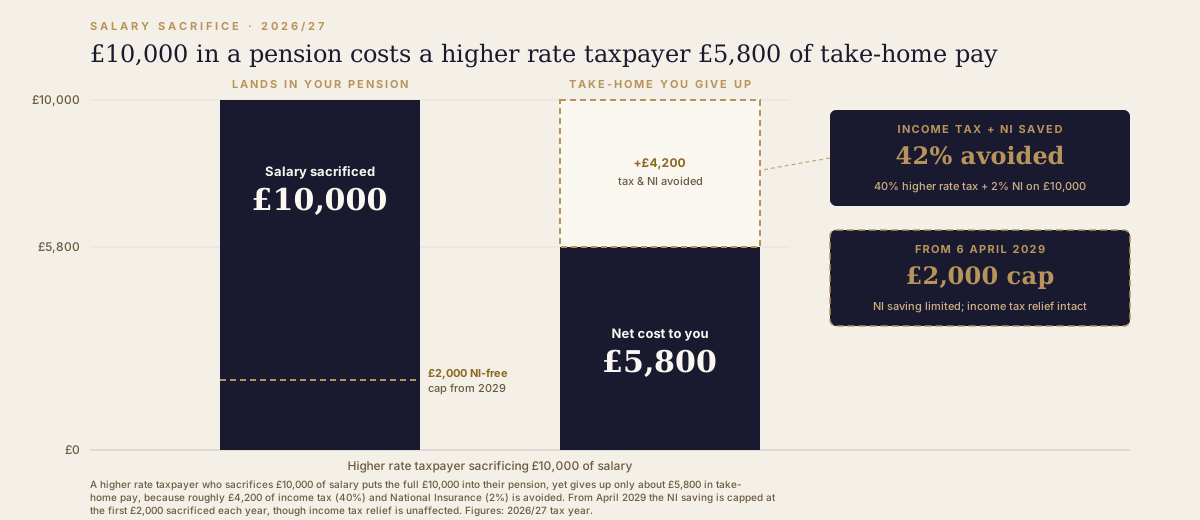
Salary sacrifice is a formal agreement between an employee and employer to exchange part of the employee's contractual gross salary for a non-cash benefit, most commonly an employer pension contribution. Salary sacrifice saves National Insurance as well as income tax, and by lowering your adjusted net income it can win back allowances too, usually making it the most efficient way to fund a pension. Your employer redirects part of your gross salary into your pension before tax is calculated, so both your income tax bill and National Insurance fall. The National Insurance saving will be capped at a sacrifice of £2,000 a year from 6 April 2029, though the income tax advantage remains intact.
Salary sacrifice is an agreement to give up part of your gross salary in exchange for a pension contribution paid by your employer. Because the money leaves your pay before income tax and National Insurance are calculated, you pay less of both, and so does your employer. That makes it one of the most tax-efficient ways to build a pension in the UK. All figures in this article reflect the 2026/27 tax year. What decides how valuable salary sacrifice actually is sits in two places that rarely make the headlines: a National Insurance change arriving in 2029, and the income thresholds your contribution quietly moves you past.
How does salary sacrifice work for pensions?
Salary sacrifice works by reducing your gross salary before income tax and National Insurance are calculated. The amount you give up goes into your pension as an employer contribution. Because you are taxed on a lower salary, a higher-rate taxpayer sacrificing £4,000 typically gives up around £2,320 in take-home pay while the full £4,000 lands in their pension.
Contents
- What is salary sacrifice?
- How does salary sacrifice work for pensions?
- What is changing for salary sacrifice from 2029?
- Why does salary sacrifice affect your adjusted net income?
- How does salary sacrifice change your wider financial plan?
- Does salary sacrifice affect a mortgage or other benefits?
- Is salary sacrifice worth it?
What is salary sacrifice?
Salary sacrifice is a formal agreement to exchange part of your gross salary for a non-cash benefit, most often a contribution your employer makes to your pension. You agree to a lower contractual salary, and your employer pays the difference into your pension on top of anything they already contribute. The arrangement is sometimes called salary exchange, which is the same thing under a different name.
The mechanism matters more than the label. Your salary is reduced before income tax and National Insurance are worked out, so both you and your employer pay those charges on a smaller figure. HMRC’s guidance on salary sacrifice and the effects on PAYE sets out the conditions that must be met for an arrangement to qualify, including that the contract of employment must reflect the reduced salary. A standard pension contribution taken from net pay does not reduce National Insurance at all, which is the single feature that has made salary sacrifice so widely used in workplace schemes.
Risk warnings
Pensions
Levels and bases of, and reliefs from, taxation are subject to change and their value will depend upon personal circumstances. Taxation and pension legislation may change in the future.
Salary sacrifice
Note that salary sacrifice arrangements should be appropriately documented with the employee signing an agreement letter unless it is written into the employment contract. In addition, you would need to ensure that your employee payslips can display the amount of the salary exchanged.
Tax, trusts and estate planning
The Financial Conduct Authority does not regulate Cashflow Planning.
HM Revenue and Customs practice and the law relating to taxation are complex and subject to individual circumstances and changes which cannot be foreseen.
How does salary sacrifice work for pensions?
Salary sacrifice works by reducing your gross salary, so it lowers both your income tax and your National Insurance at the same time. If you sacrifice £100 of salary, that £100 goes into your pension in full, but the take-home pay you give up is well under £100, because you would never have received the whole £100 after tax and National Insurance in the first place.
Many employers also pass on some or all of their own National Insurance saving as an extra pension contribution, which improves the deal further. There is no obligation for them to do so, so it is always worth checking what your scheme actually does with the employer saving. For a direct comparison of how salary sacrifice stacks up against other contribution methods, the guide to net pay vs salary sacrifice covers the differences in detail.
Two limits apply. You cannot sacrifice salary below the National Minimum Wage or National Living Wage, which restricts how much lower earners can give up. The money also counts towards your pension annual allowance, which is £60,000 a year for 2026/27 for most people. Because a sacrificed amount is paid as an employer contribution rather than a personal one, the rule that caps tax-relievable personal contributions at 100% of your earnings does not bite in the usual way; the annual allowance is the limit that matters, and unused allowance from the previous three tax years can often be carried forward to allow more than £60,000 in a single year.
Salary sacrifice is also not automatically the right choice for everyone. An employee who earns too little to pay income tax can end up worse off, because they give up the basic-rate tax relief a normal contribution would have received while saving National Insurance they may not have been paying anyway. The same mechanism still applies to a small set of benefits the government chose to keep, including ultra-low-emission company cars, the cycle-to-work scheme, and workplace nurseries; most other forms of salary sacrifice were closed in 2017.
Risk warning
Salary sacrifice cannot be used if it would reduce an employee’s earnings below the National Minimum Wage / National Living Wage.
What is changing for salary sacrifice from 2029?
From 6 April 2029, only the first £2,000 of pension salary sacrifice each year will be free of National Insurance. This was confirmed in the Autumn Budget 2025 and set out in HMRC’s published reform. Anything you sacrifice above that £2,000 will be treated as ordinary earnings for National Insurance, so both you and your employer will pay it on the excess.
Two points are widely misunderstood about this change. First, it does not touch income tax relief: pension contributions will still receive full income tax relief up to the annual allowance, exactly as they do now. Second, salary sacrifice does not stop being worthwhile. The first £2,000 a year from 6 April 2029 still avoids National Insurance entirely, and the income tax efficiency is unchanged, so the arrangement remains useful for most people even after the cap arrives.
What the change does shift is the maths for anyone sacrificing large amounts, particularly higher earners contributing well above £2,000 a year from 6 April 2029. For them, the part of the planning conversation that used to centre on National Insurance now moves elsewhere, towards the thresholds that follow.
What is the salary sacrifice National Insurance cap from 6 April 2029?
From 6 April 2029, only the first £2,000 of pension salary sacrifice each year will be exempt from National Insurance. Salary sacrificed above that £2,000 threshold will attract both employee and employer National Insurance at the prevailing rates. Income tax relief on pension contributions is not affected by the cap.
Why does salary sacrifice affect your adjusted net income?
Salary sacrifice reduces your adjusted net income because it lowers your gross salary at source, and adjusted net income is the figure the tax system uses to decide what else you qualify for. Adjusted net income is your total taxable income minus pension contributions and Gift Aid donations, calculated before the personal allowance is applied. Lowering it can restore things that are worth far more than the contribution itself.
Three thresholds turn on adjusted net income, all unchanged for 2026/27. Above £100,000, your personal allowance is withdrawn by £1 for every £2 of income, disappearing entirely at £125,140 and creating an effective tax rate of around 60% on income in that band. Also at £100,000, eligibility for funded childcare and Tax-Free Childcare stops completely, with no taper at all. The detail of exactly what that costs in real terms is explained in our article on the £100,000 childcare income limit. And from £60,000, the High Income Child Benefit Charge begins to claw back Child Benefit, removing it in full once income reaches £80,000.
A salary sacrifice contribution reduces adjusted net income directly, because it lowers your gross pay at source. A personal pension contribution paid from net pay also reduces adjusted net income, though through a different route, which is explained in our guide to relief at source and how higher-rate relief is claimed. The planning point is the same either way: the contribution is a lever on the threshold, not just a deposit into a pension.
The two examples below use the same arrangement and reach very different outcomes.
Daniel, 44, earning £62,000
Daniel pays the auto-enrolment minimum into his workplace pension and has £4,000 a year of spare capacity he wants to save. He decides to redirect it into his pension through salary sacrifice rather than leave it in a savings account.
The £4,000 he sacrifices sits in the higher-rate band, so it would otherwise have been taxed at 40% income tax and 2% National Insurance. Giving it up costs him about £2,320 in take-home pay, yet £4,000 lands in his pension. If his employer shares its National Insurance saving, the amount invested is higher still.
The effect is real but steady. Each year his pension grows by more than the take-home he gives up, and over the years to retirement that gap compounds. The benefit here is consistency and efficiency, not transformation.
The next example uses an identical arrangement, but the figures behave very differently.
Hannah, 36, earning £103,000 with two children in nursery
Hannah’s adjusted net income is £103,000, which is just enough to disqualify her household from funded childcare and Tax-Free Childcare, and to start withdrawing her personal allowance. She arranges to sacrifice £3,100 of salary into her pension, bringing her adjusted net income to £99,900.
Crossing back under £100,000 restores funded childcare hours for both children under the expanded scheme, worth several thousand pounds a year between them, plus Tax-Free Childcare of up to £2,000 a year for each child. It also restores the personal allowance she had begun to lose, and the slice of her contribution sitting in the taper band attracts effective tax relief of around 60%.
The redirected £3,100 costs her far less than £3,100 in take-home pay, and it is not spent: it is sitting in her pension. The combined childcare support and tax relief she recovers can run well into five figures, depending on how much childcare the family uses, all from a single change to where her salary is paid.
The value of salary sacrifice is not the amount you put in. It is the tax, National Insurance, and lost allowances you avoid on the way, and the years the money then stays invested.
Risk warnings
Pensions
A pension is a long-term investment, the value of your investment and the income from it may go down as well as up. Your eventual income may depend upon the size of the fund at retirement, future interest rates and tax legislation.
Advice on auto enrolment pensions is not regulated by the financial conduct authority.
Salary sacrifice
Employees earning more than £260,000 with a tapered annual allowance may incur additional annual allowance tax charges.
Cash and deposits
While cash provides security of capital, it may not keep pace with inflation. Over time, the real value of your savings could fall.
How does salary sacrifice change your wider financial plan?
Salary sacrifice changes your plan in two directions at once: it improves your retirement position while reducing the income and access you have today. Both sides need to be weighed, not just the headline tax saving.
The money you sacrifice is locked in a pension, which you cannot normally touch until age 55, rising to 57 from 6 April 2028. That is the central trade-off, and it is the reason a pension is not always the right home for every spare pound. Where money needs to stay reachable before then, a different investment wrapper may suit the goal better, even though it lacks the National Insurance advantage. Getting the balance right between pension contributions and accessible savings is central to any pensions and retirement planning review.
There is also a cashflow question. Sacrificing salary lowers your take-home pay, so the arrangement only works if you can comfortably live on what remains, a point that sits at the heart of any sensible approach to budgeting and saving. Pushing contributions too hard in a single year can solve a tax problem and create a cashflow one.
Over a long horizon, the compounding matters more than any single year’s tax saving. A few thousand pounds redirected each year, left invested for two decades, has a disproportionate effect on the eventual pot. Seeing that effect clearly, rather than guessing at it, is exactly what lifetime cashflow modelling is for.
Does salary sacrifice affect a mortgage or other benefits?
Salary sacrifice can affect a mortgage application, because it lowers the gross salary that some lenders use to assess how much you can borrow. Many lenders will add pension contributions back when calculating affordability, but not all do, and the treatment varies, so it is worth confirming the position before sacrificing heavily in the run-up to a mortgage.
The reduced salary can also touch other figures that are based on pay. Life cover and income protection offered as a salary multiple, redundancy pay, and some earnings-related statutory payments can all be calculated on the lower contractual salary unless the scheme specifically uses pre-sacrifice pay. These are usually small considerations next to the tax and National Insurance saving, but they are worth knowing about in advance rather than discovering later.
Risk warnings
Salary sacrifice
Mortgage lenders may calculate borrowing amounts in terms of the reduced salary.
Life cover or income protection policies may pay out on a multiple of salary. This may be less if salary is sacrificed.
Protection
Benefits of insurance products will be put at risk or cease altogether if premium payments are not maintained.
The definitions vary between product providers and will be described in the key features and policy document, if you go ahead with the plan.
Mortgages
Your home may be repossessed if you do not keep up repayments on your mortgage. Think carefully before securing debts against your home.
Not all mortgage contracts are regulated by the Financial Conduct Authority.
Is salary sacrifice worth it?
Salary sacrifice is worth it for most employees who pay income tax, because it converts taxable earnings into pension savings at a lower net cost than any other contribution method. Even after the National Insurance cap, the income tax efficiency is unchanged and the first £2,000 a year from 6 April 2029 still avoids National Insurance entirely. For the majority of people in workplace schemes, the arrangement improves quietly and consistently in the background.
The case is weaker in two situations. An employee who pays no income tax gives up the basic-rate tax credit a standard relief-at-source pension contribution would have received, while saving little or no National Insurance. And anyone whose contractual salary sits close to the National Minimum Wage has limited room to sacrifice before hitting the floor.
For higher earners, the question is not whether it is worth it but how much it is worth. A contribution sized to bring adjusted net income below £100,000 can recover childcare support, personal allowance, and effective 60% relief simultaneously. At that level, the arrangement can pay for itself several times over. The figure that matters most is not how much you sacrifice; it is where that amount leaves your income sitting.
Simple in mechanism, situational in value
Salary sacrifice is simple in mechanism and situational in value. For most people it quietly improves a pension at a lower cost than any other contribution method, and even after the National Insurance cap, the first £2,000 a year from 6 April 2029 and the full income tax relief remain. Its real power, though, shows up at the edges, where a contribution sized to an income threshold can recover allowances and support worth several times what went in. The number that matters is rarely the amount you sacrifice. It is where that amount leaves your income, and how long it then has to grow.
Frequently asked questions
What is salary sacrifice?
Salary sacrifice replaces part of your gross salary with an employer pension contribution, reducing income tax and National Insurance on the exchanged amount. Because the exchange happens before tax is calculated, the take-home pay you give up is smaller than the amount that reaches your pension. The exact saving depends on your income tax band and National Insurance position.
Does salary sacrifice reduce your take-home pay?
Yes, salary sacrifice reduces your take-home pay, but by less than the amount you sacrifice. The salary you give up would otherwise have been taxed and subject to National Insurance, so the net cost to you is lower than the gross amount that lands in your pension. A higher-rate taxpayer sacrificing £4,000 typically gives up around £2,320 in take-home pay.
Is salary sacrifice changing in 2029?
Yes. From 6 April 2029, only the first £2,000 of pension salary sacrifice each year will be free of National Insurance. Anything sacrificed above £2,000 will attract both employee and employer National Insurance at the prevailing rates. Income tax relief on pension contributions is unaffected by this change.
Does salary sacrifice reduce your adjusted net income?
Yes. Salary sacrifice reduces your adjusted net income because it lowers your gross salary at source. This can restore tapered personal allowance, Child Benefit, or funded childcare for people near the relevant thresholds. It is one of the most direct ways to bring adjusted net income below £100,000 a year for 2026/27.
Can salary sacrifice help you keep free childcare?
Salary sacrifice can help you retain funded childcare, because eligibility is based on adjusted net income rather than headline salary. If a pension contribution brings your adjusted net income below £100,000 a year for 2026/27, you can qualify for funded hours and Tax-Free Childcare even when your salary is higher.
Is salary sacrifice the same as relief at source?
No. Salary sacrifice reduces your gross pay before tax and National Insurance are calculated, so there is no relief to claim back afterwards. Relief at source involves a contribution from your net pay, with basic-rate tax added automatically and higher-rate relief claimed separately through a self-assessment return.
Is there a limit to how much salary you can sacrifice?
Yes. You cannot sacrifice salary below the National Minimum Wage, and contributions still count towards the annual allowance, which is £60,000 a year for 2026/27 for most people. Because sacrificed amounts are paid as employer contributions, unused allowance from the previous three tax years can often be carried forward to allow a higher total contribution in a single year.
Should I use salary sacrifice for my pension?
For most employees who pay income tax, salary sacrifice is worth using: the net cost of a contribution is lower than through any other method. The case is weaker for non-taxpayers, who give up the basic-rate tax credit that a relief-at-source contribution would have received, and for anyone earning close to the National Minimum Wage. For higher earners, sizing a contribution to bring adjusted net income below the £100,000 threshold can recover personal allowance and childcare support worth several times the amount contributed.