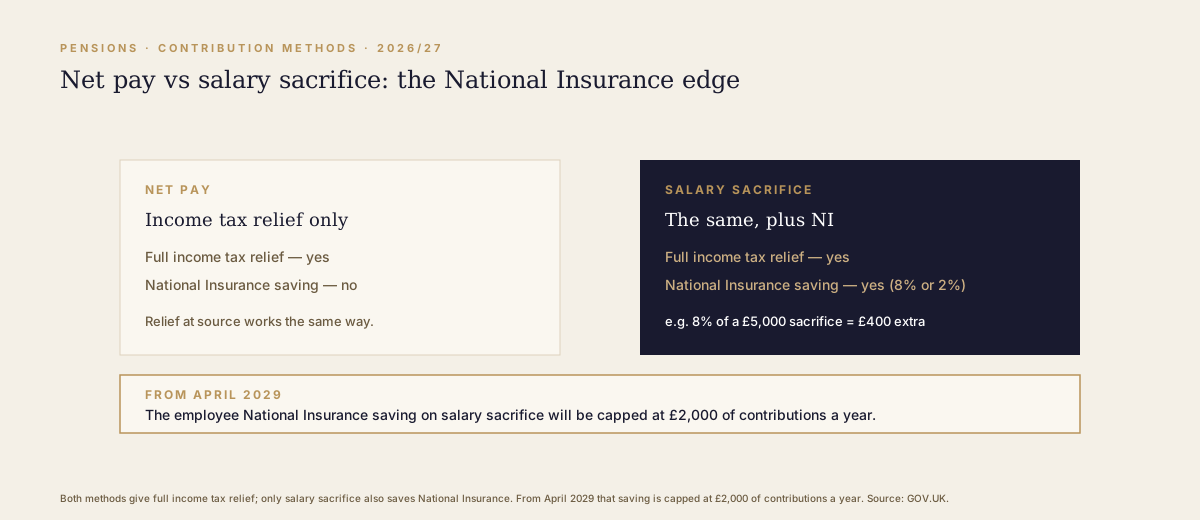
Salary sacrifice is a pension contribution method in which an employee formally reduces their contractual salary in exchange for an equivalent employer pension contribution, saving both income tax and National Insurance on the sacrificed amount. Salary sacrifice and net pay both deliver full income tax relief automatically, but salary sacrifice goes further by reducing the pay on which National Insurance is calculated. The size of that advantage depends on where your earnings sit relative to the upper earnings limit, and the employee National Insurance saving will be capped at contributions of £2,000 a year from 6 April 2029.
Net pay and salary sacrifice are the two most common ways money reaches a workplace pension, and the choice between them is really a question about National Insurance. Both give you full income tax relief at your marginal rate, so on the income tax side they are identical. The difference is that salary sacrifice also reduces the pay on which National Insurance is charged, which usually leaves you better off for the same contribution. All figures in this article reflect the 2026/27 tax year. How much better off depends on what you earn and whether your employer passes on its own saving, and from 6 April 2029 the advantage will be capped.
What is the difference between net pay and salary sacrifice for pensions?
Both methods deliver full income tax relief on pension contributions at your marginal rate. The difference is National Insurance: net pay saves income tax only, while salary sacrifice also reduces the earnings on which National Insurance is calculated, saving basic-rate earners an additional 8% for 2026/27.
Contents
- Where the two methods differ
- How a net pay arrangement works
- How salary sacrifice works
- Which saves you more?
- The 2029 change
- Is salary sacrifice worth it?
- Higher-rate tax relief
Net pay vs salary sacrifice: where the two methods differ
The core difference between net pay and salary sacrifice is National Insurance: both deliver the same income tax relief, but only salary sacrifice reduces the earnings your National Insurance is based on. Net pay is a method of giving pension tax relief, sitting alongside relief at source. Salary sacrifice is a different arrangement entirely: you give up part of your contractual salary, and your employer pays that amount into your pension as an employer contribution.
That structural difference is what creates the National Insurance saving. Because your salary is genuinely lower under salary sacrifice, both you and your employer pay less National Insurance. Under net pay, your full salary still counts for National Insurance even though your pension contribution has been taken from it.
Net pay vs salary sacrifice at a glance
| Feature | Net pay arrangement | Salary sacrifice |
|---|---|---|
| Income tax relief | Full, at marginal rate | Full, at marginal rate |
| How relief is given | Automatic via payroll | Automatic via lower salary |
| Employee National Insurance | No saving | Saved on the sacrificed amount |
| Employer National Insurance | No saving | Saved, and may be added to your pension |
| Higher-rate relief | Automatic | Automatic |
| From 6 April 2029 | Unchanged | NI saving capped at £2,000 a year |
Risk warning
Levels and bases of, and reliefs from, taxation are subject to change and their value will depend upon personal circumstances. Taxation and pension legislation may change in the future.
How does a net pay arrangement work?
A net pay arrangement takes your pension contribution from your gross salary before income tax is worked out, so you receive full tax relief at your highest rate automatically. A higher-rate taxpayer gets 40% relief immediately, with nothing to claim back from HMRC. This is the main practical advantage of net pay over relief at source, where higher-rate taxpayers have to reclaim the extra relief separately.
The limitation is National Insurance. Your contribution reduces your taxable pay, but National Insurance is still calculated on your earnings before the pension deduction. A net pay arrangement saves income tax but not National Insurance. There is also a long-standing quirk for the lowest earners: those earning below the personal allowance get no tax relief at all under net pay, because they have no income tax to relieve. If you want the mechanics on their own, our guide to how a net pay arrangement works goes deeper.
Risk warnings
The Financial Conduct Authority does not regulate Cashflow Planning.
HM Revenue and Customs practice and the law relating to taxation are complex and subject to individual circumstances and changes which cannot be foreseen.
How does salary sacrifice work?
Salary sacrifice works by lowering your contractual salary in return for your employer paying the same amount into your pension as an employer contribution. Because your salary is genuinely reduced, the contribution escapes both income tax and National Insurance, rather than income tax alone. Per HMRC’s employer guidance on salary sacrifice, the arrangement must involve a genuine change to the terms of employment, not just a bookkeeping adjustment.
The National Insurance saving comes in two parts. You save employee National Insurance on the sacrificed amount at the standard National Insurance rates: 8% in the main earnings band and 2% above the upper earnings limit, £50,270 a year for 2026/27. Your employer saves its own National Insurance at 15%, and many employers add some or all of that saving to your pension, though they are not obliged to. That employer top-up is money a net pay arrangement can never produce. The full mechanics, including the effect on your contract and pay reference, are covered in our explainer on how salary sacrifice works for pensions.
How does salary sacrifice reduce National Insurance?
Salary sacrifice reduces your contractual salary, so both you and your employer pay National Insurance on a smaller earnings figure. The employee saving is 8% on earnings up to the upper earnings limit, £50,270 a year for 2026/27, and 2% above it. Employer National Insurance of 15% is also saved on the sacrificed amount.
Which saves you more, and why?
Salary sacrifice saves you more, because it removes National Insurance from the contribution as well as income tax, while net pay removes only income tax. For a basic-rate taxpayer, that is an extra saving of 8% for 2026/27 on every pound contributed, before counting anything the employer passes on. The income tax relief itself is identical under both methods.
Priya, 34, earning £38,000
Priya pays 5% of her salary, £1,900 a year, into her workplace pension. Her employer offers both a net pay scheme and salary sacrifice, and she wants to know which leaves her better off.
Under net pay, the £1,900 comes out of her gross salary before income tax, giving 20% income tax relief worth £380. National Insurance is still charged on her full £38,000, so there is no further saving. The £1,900 contribution costs her £1,520 in take-home pay.
Under salary sacrifice, she gives up £1,900 of salary. She saves the same £380 in income tax and a further £152 in employee National Insurance, so the same £1,900 contribution costs her £1,368. If her employer adds its own 15% National Insurance saving, £2,185 reaches her pension for that lower cost.
The picture changes for higher earners, and not in the direction most people expect. Take Marcus, 52, earning £72,000, who sacrifices £6,000 a year. Because that £6,000 sits entirely above the upper earnings limit of £50,270, his employee National Insurance saving is only 2% for 2026/27, or £120, rather than the 8% Priya enjoys. He gains far more from income tax relief, at 40%, but the National Insurance advantage that distinguishes salary sacrifice from net pay is smaller for the slice of income above the upper earnings limit.
What decides the size of the National Insurance saving is therefore not the amount contributed but where that contribution sits relative to the upper earnings limit. For Priya, every pound sacrificed saves 8%; for Marcus, the same pounds save 2%. The contribution that ends up invested is what moves a retirement pot more than anything else, but the route it takes determines how much it costs to get there.
Salary sacrifice and net pay give identical income tax relief: the difference is National Insurance alone. For a basic-rate earner, that gap is worth 8% of every pound contributed.
Risk warning
A pension is a long-term investment, the value of your investment and the income from it may go down as well as up. Your eventual income may depend upon the size of the fund at retirement, future interest rates and tax legislation.
What is changing for salary sacrifice in 2029?
Salary sacrifice pension contributions will be subject to both employee and employer National Insurance above £2,000 a year from 6 April 2029. Contributions up to that cap keep their National Insurance exemption, and income tax relief is unaffected, so the change narrows rather than removes the advantage of salary sacrifice. Contributions above the cap will be treated like ordinary pension contributions for National Insurance purposes.
For someone like Priya, sacrificing £1,900, nothing changes: she stays under the cap. For Marcus, sacrificing £6,000, the £4,000 above the cap would attract employee National Insurance and, more significantly, 15% employer National Insurance from then on. The measure, set out in legislation now progressing through Parliament, is expected to raise around £4.7 billion in its first year and mainly affects middle and higher earners who sacrifice large amounts. It does not change the income tax case for pension contributions at all.
What is the salary sacrifice pension change from April 2029?
The National Insurance exemption on salary sacrifice pension contributions is capped at £2,000 a year from 6 April 2029. Contributions above that threshold will attract both employee and employer National Insurance at the standard rates. Income tax relief is unchanged. Everything sacrificed up to the cap each year remains fully National Insurance-exempt.
Is salary sacrifice worth it?
For most employees who can use it, salary sacrifice is worth it, because the National Insurance saving means an identical pension contribution costs less in take-home pay than under net pay. The advantage is largest for basic-rate earners, whose employee National Insurance saving is 8% rather than the 2% that applies above the upper earnings limit.
The trade-offs are real and worth weighing. Salary sacrifice lowers your headline salary, which is the figure lenders use for mortgage affordability, that some employers use for life cover and pension matching, and that determines statutory payments such as maternity pay. A lower salary can also, in some cases, take pay below the National Minimum Wage, which employers are not permitted to do. These effects sit downstream of the tax saving, and they are exactly the kind of interaction worth mapping out in lifetime cashflow modelling before committing to a large sacrifice.
Salary sacrifice is also a recognised way to manage income around tax thresholds. Reducing taxable income below £100,000 restores the personal allowance, which is withdrawn across £100,000 to £125,140 a year for 2026/27, and reducing it further can lower or remove the High Income Child Benefit Charge. Whether any of this helps depends on your whole position, which is the territory of pension and retirement planning rather than a single contribution decision.
Risk warnings
Mortgage lenders may calculate borrowing amounts in terms of the reduced salary.
Life cover or income protection policies may pay out on a multiple of salary. This may be less if salary is sacrificed.
Salary sacrifice cannot be used if it would reduce an employee’s earnings below the National Minimum Wage / National Living Wage.
What happens to higher-rate tax relief?
Under both net pay and salary sacrifice, higher-rate tax relief is given automatically, with nothing to claim. A higher-rate taxpayer receives 40% relief through payroll in real time, because the contribution either reduces taxable pay under net pay or reduces salary outright under salary sacrifice.
This is where both methods differ from relief at source, the system most personal pensions and some workplace schemes use. Under relief at source, the provider adds 20% basic-rate relief to your contribution, and higher and additional-rate taxpayers must claim the rest through self-assessment or by contacting HMRC. That extra relief is frequently left unclaimed. If your pension uses that system instead, our guide to claiming relief at source explains how to recover it, usually for up to four tax years.
It comes down to National Insurance
The income tax treatment of net pay and salary sacrifice is the same, so the decision rests almost entirely on National Insurance. Salary sacrifice usually wins, by 8% for basic-rate earners and by less higher up the income scale, with the possibility of an employer National Insurance top-up that net pay cannot match. That advantage will be capped at contributions of £2,000 a year from 6 April 2029, which sharpens the value of understanding where your contributions sit today and how they feed the rest of your plan.
Frequently asked questions
What is the difference between net pay and salary sacrifice?
The difference is National Insurance: both net pay and salary sacrifice give the same income tax relief, but only salary sacrifice also reduces your National Insurance. Net pay deducts your contribution from gross pay before income tax, while salary sacrifice lowers your contractual salary so the contribution escapes National Insurance too.
Does salary sacrifice or net pay save more tax?
Salary sacrifice usually saves more, because it cuts National Insurance as well as income tax. Under net pay, your contribution is taken before income tax but National Insurance is still charged on your full salary, so there is no NI saving. The income tax relief is identical under both methods.
Is salary sacrifice worth it for pension contributions?
For most employees, salary sacrifice is the more efficient option, because the National Insurance saving means the same contribution costs less in take-home pay. The trade-off is a lower headline salary, which can affect mortgage borrowing, salary-based life cover, and statutory payments. The National Insurance saving is capped at contributions of £2,000 a year from 6 April 2029.
Does a net pay arrangement save National Insurance?
No. A net pay arrangement saves income tax but not National Insurance. Your contribution is taken from gross pay before income tax, giving full income tax relief, but National Insurance is still calculated on your earnings before that deduction. Only salary sacrifice reduces the pay on which National Insurance is charged.
How is pension salary sacrifice changing in 2029?
Salary sacrifice pension contributions will be subject to both employee and employer National Insurance above £2,000 a year from 6 April 2029. Contributions up to that cap stay National Insurance-free, and income tax relief is unchanged. Amounts above it will be treated like ordinary pension contributions for National Insurance purposes.
Can you have both net pay and salary sacrifice?
Yes, in some situations. An employer might run salary sacrifice for the main workplace pension while a separate arrangement uses net pay, or you might pay into a personal pension alongside a salary sacrifice scheme. The methods are not mutually exclusive, though most workplace schemes use one approach for the main contribution.
How does salary sacrifice work for pension contributions?
Salary sacrifice works by reducing your contractual salary, with your employer paying the equivalent sum directly into your pension. Because your salary is genuinely lower, the contribution avoids both income tax and National Insurance, rather than income tax alone. A net pay arrangement gives the same income tax saving but leaves National Insurance charged on the full pre-sacrifice salary.