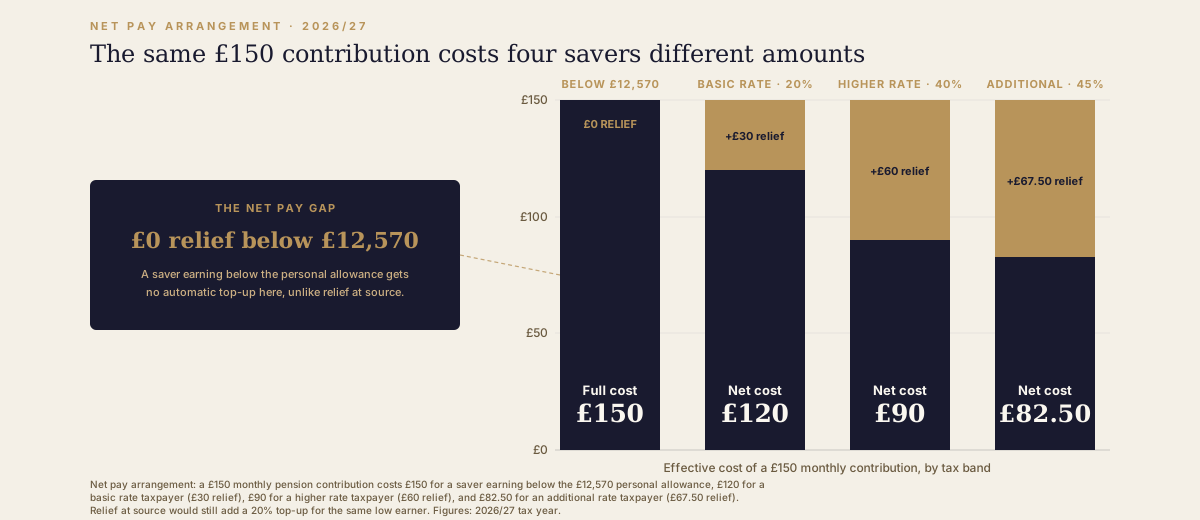
A net pay arrangement is a workplace pension method in which contributions leave your gross salary before income tax applies, so relief is given through payroll at your marginal rate. Which method your workplace pension uses to give tax relief quietly changes what you actually receive, and net pay hands you the relief automatically with nothing to reclaim. Higher earners do especially well from it, but some low earners below the personal allowance have historically received nothing, unlike under relief at source. The low earner's pension payment introduced for 2024/25 is designed to close that gap.
A net pay arrangement is one of the two main ways a workplace pension collects your tax relief, and the one most large employers use. With a net pay arrangement, your pension contribution is taken out of your salary before income tax is worked out, so the relief is built into your payslip automatically rather than claimed back later. For most employees this is efficient and almost invisible: the money goes in, your taxable pay falls, and there is nothing to reclaim. The mechanics only really matter at the edges, for higher earners who might be leaving relief unclaimed elsewhere, and for lower earners who can quietly end up worse off than they would under the alternative.
All figures and thresholds in this article reflect the 2026/27 tax year.
How does a net pay arrangement differ from relief at source?
Under a net pay arrangement, contributions are deducted from gross pay so relief arrives at your full marginal rate automatically, with nothing to claim. Under relief at source, the provider reclaims 20% basic rate relief from HMRC, but higher rate taxpayers must then claim the extra 20% through self assessment. Basic rate taxpayers end up with the same amount in their pension either way.
Contents
- What is a net pay arrangement?
- How it works
- Net pay vs relief at source
- The low earner anomaly
- Is net pay better?
- How to check your scheme
- What it means for your plan
What is a net pay arrangement?
A net pay arrangement is a method of giving pension tax relief in which your employer deducts your whole pension contribution from your gross salary before calculating the income tax due on your pay. Because your taxable pay is reduced by the full contribution, you automatically receive tax relief at your highest, or marginal, rate. There is no separate claim and nothing for the pension provider to reclaim from HMRC, because the relief has already been delivered through the payroll.
The name causes endless confusion. Despite the word “net”, contributions under a net pay arrangement come out of your gross pay, not your take-home pay. The “net” refers to the fact that you are then taxed on a salary that is net of, meaning reduced by, your pension contribution. It is the opposite of what most people assume when they first hear the term.
Net pay arrangements are common in larger occupational and trust-based workplace schemes. The alternative, relief at source, is used by all personal and stakeholder pensions and by many auto-enrolment schemes. Your employer chooses which one applies; as an employee, you do not get to pick. The GOV.UK guidance on workplace pensions sets out the general framework within which employers make this decision.
Risk warnings
Pensions
Levels and bases of, and reliefs from, taxation are subject to change and their value will depend upon personal circumstances. Taxation and pension legislation may change in the future.
Advice on auto enrolment pensions is not regulated by the financial conduct authority.
Tax, trusts and estate planning
HM Revenue and Customs practice and the law relating to taxation are complex and subject to individual circumstances and changes which cannot be foreseen.
How does a net pay arrangement work?
Under a net pay arrangement, the sequence on your payslip is simple: your employer takes your pension contribution from your gross pay first, then calculates income tax on what is left. Suppose you earn £3,000 a month and contribute 5%, or £150. Your employer deducts the £150, then works out income tax on £2,850 rather than £3,000. The full £150 still reaches your pension.
For a higher rate taxpayer the saving is larger. The same £150 contribution reduces taxable pay by £150, saving £60 of tax at the higher rate of 40% for 2026/27, so it costs £90 of take-home pay. That 40% relief arrives immediately, with no need to ask HMRC for anything.
Basic rate taxpayer: effective cost of a £150 monthly pension contribution
Employee earning £3,000 gross per month, contributing 5% under a net pay arrangement.
| Input | Value |
|---|---|
| Monthly gross salary | £3,000 |
| Contribution rate | 5% |
| Monthly contribution | £150 |
| Income tax rate | 20% |
- Pension contribution deducted from gross: £3,000 × 5% = £150
- Taxable pay after deduction: £3,000 − £150 = £2,850
- Income tax saving at 20%: £150 × 20% = £30
- Effective cost to take-home pay: £150 − £30 = £120
Result: A £150 pension contribution costs the basic rate taxpayer £120 of take-home pay, with £30 delivered immediately as tax relief through payroll. No claim is required.
One point often missed is that a net pay arrangement saves income tax but not National Insurance. Your NI is still calculated on your full salary, before the pension deduction. That is the key difference from salary sacrifice, where you give up gross salary altogether and save both income tax and NI. You can read the official summary of how relief is given on the government’s tax on private pension contributions guidance.
Risk warning
Note that salary sacrifice arrangements should be appropriately documented with the employee signing an agreement letter unless it is written into the employment contract. In addition, you would need to ensure that your employee payslips can display the amount of the salary exchanged.
How is a net pay arrangement different from relief at source?
The difference is when and how the relief reaches your pension. Under a net pay arrangement, the relief is given upfront through payroll at your full marginal rate. Under relief at source, your contribution is taken from your pay after tax, your provider adds 20% basic rate relief reclaimed from HMRC, and any higher or additional rate relief has to be claimed separately. For a basic rate taxpayer the end result is usually the same amount in the pension; only the route differs.
That separate claim is where relief at source quietly costs people money. A higher rate taxpayer in a relief at source scheme receives only 20% automatically and must claim the extra 20% through self assessment or by contacting HMRC. Many never do, leaving relief on the table year after year. A net pay arrangement removes that risk, because the full 40% or 45% relief is applied at the point of contribution. This is one reason it helps to understand how relief at source works, since the higher rate portion is the part most often left unclaimed.
There is also a small quirk for Scottish taxpayers. Relief at source pays a flat 20%, so a Scottish starter rate taxpayer (paying 19%) is effectively given slightly more relief than they paid, and does not have to repay the difference. Under a net pay arrangement they receive their actual 19%. This runs in the opposite direction to the problem low earners face elsewhere.
The net pay anomaly: why some low earners lose out
The flaw in net pay arrangements affects people who earn too little to pay income tax. If your earnings are below the personal allowance, £12,570 a year for 2026/27, you pay no income tax, so a net pay arrangement has no tax to relieve and your contribution gets no government top-up at all. Someone on identical earnings in a relief at source scheme would still receive the 20% basic rate boost, because relief at source adds it regardless of whether any tax was actually paid.
Do low earners lose out under a net pay arrangement?
Yes, historically. If you earn below the personal allowance, £12,570 a year for 2026/27, a net pay arrangement gives no relief because there is no income tax to relieve. Someone on the same earnings in a relief at source scheme still receives a 20% top-up. The low earner’s pension payment, introduced for contributions from 2024/25, is designed to close this gap.
Priya and Sam, both 24, both earning £11,500
Priya and Sam do similar jobs on the same salary, £11,500 a year, which sits below the personal allowance of £12,570, so neither of them pays any income tax. Each pays £500 into their workplace pension over the year. The only difference is the type of scheme their employer chose.
Sam’s scheme uses relief at source. He pays £400 from his wages and his provider reclaims £100 from HMRC, so £500 lands in his pension. Priya’s scheme uses a net pay arrangement. Her £500 is taken from gross pay before tax, but because she earns below the personal allowance there was no income tax to relieve, so the full £500 comes out of her own pocket.
Same £500 in the pension, but Sam paid £400 and Priya paid £500. The £100 gap exists purely because of the scheme type, something neither of them picked. The low earner’s pension payment, introduced for contributions from 2024/25, is designed to refund Priya that difference, with HMRC contacting eligible savers rather than requiring a claim.
This is a genuine design fault rather than a rounding issue, and it has been recognised as such. Following years of campaigning, the government introduced a remedy known as the low earner’s pension payment, which applies to contributions made from the 2024/25 tax year onwards. HMRC identifies affected net pay savers after the end of each tax year and pays them a top-up to bring them broadly into line with relief at source, without the saver needing to make a claim. People entitled for 2024/25 are expected to be contacted during 2026, although some operational details were still being finalised at the time of writing.
Is a net pay arrangement better than relief at source?
For most employees, neither arrangement is meaningfully better, because the amount that ends up in your pension is usually the same. The differences only bite at the two extremes of the income range. A net pay arrangement is better for higher and additional rate taxpayers, because it delivers their full relief automatically and removes the risk of unclaimed higher rate relief. Relief at source is better for low earners below the personal allowance, because it adds basic rate relief even when no tax was paid, which net pay cannot do until the low earner’s pension payment catches up.
Tax relief should not leak. A net pay arrangement closes the most common leak automatically; the risk with relief at source is that higher and additional rate taxpayers forget to claim the extra relief through self assessment, year after year, and the shortfall compounds silently over a career.
The trade-off, then, is not really about which scheme is superior in the abstract. It is about which quirk applies to you. A higher earner in relief at source has to be proactive to capture everything; a low earner in net pay has historically been short-changed by default. Because your employer decides the arrangement, the practical task is not choosing between them but knowing which one you are in and what it means for the relief you actually receive. Getting that right is part of broader pension and retirement planning rather than an isolated payroll detail.
How do I know which arrangement I’m in?
Check your payslip first. If your full pension contribution is deducted before income tax is calculated, and your taxable pay is reduced by the whole contribution, you are in a net pay arrangement. If instead you pay roughly 80% of the contribution from your wages and your provider reclaims the rest from HMRC, you are in a relief at source scheme.
If your payslip is not clear, your scheme paperwork or your provider’s online portal will usually state the method, and your employer’s HR or payroll team can confirm it. The distinction matters most if you are a higher earner, where you want to be sure all your relief is captured, or a lower earner, where you want to know whether the new top-up applies to you.
What net pay means for your wider plan
Tax relief is the government’s contribution to your pension, and the delivery method changes when, and sometimes whether, you actually receive it. Within a financial plan, the relief mechanism is one of several levers that determine how efficiently you are funding retirement, alongside how much you contribute, the wrappers you use, and your annual allowance. The planning point is straightforward: relief should not leak. Unclaimed higher rate relief in a relief at source scheme is the most common leak, and a net pay arrangement closes it automatically.
It is also worth seeing net pay in the context of the alternatives. Where an employer offers it, salary sacrifice goes a step further by saving National Insurance as well as income tax. For a side-by-side view of how the two methods compare across income levels and tax rates, net pay vs salary sacrifice sets out the full picture.
Relief is only one input, though. How much you put away, and over how long, moves the eventual outcome far more than the route the relief takes, a theme that runs through any honest discussion of what makes a good pension to retire on. A net pay arrangement is a quietly efficient way to receive relief; it is not, on its own, a retirement strategy.
The two situations where the method matters
A net pay arrangement does its job invisibly for most people, delivering pension tax relief through payroll at the right rate without anyone having to act. The reason to understand it is not to second-guess your employer’s choice, which you cannot change, but to recognise the two situations where the method genuinely matters: capturing full higher rate relief, and making sure a low income has not quietly cost you the basic rate boost. Knowing which arrangement you are in, and what it does for the relief you receive, turns a confusing piece of payroll jargon into something you can actually use.
Frequently asked questions
What is a net pay arrangement?
A net pay arrangement deducts your whole pension contribution from gross pay before income tax, so you get full marginal rate relief automatically. Because your taxable pay is reduced by the full contribution, you receive relief immediately through payroll. There is nothing to claim back from HMRC.
How does a net pay arrangement work?
Your employer deducts your full pension contribution from your gross pay, then calculates income tax on the reduced amount. If you earn £3,000 a month and contribute 5%, your taxable pay falls to £2,850 and the £30 tax saving goes straight to your pension. The full £150 contribution reaches the pension and no separate claim is needed.
Is a net pay arrangement the same as salary sacrifice?
No. A net pay arrangement saves income tax but not National Insurance, because NI is still charged on your full salary before the pension deduction. Salary sacrifice reduces your contractual gross pay instead, which saves both income tax and National Insurance. The two methods are often confused but work differently and have different effects on your payslip.
Do low earners lose out under a net pay arrangement?
Historically, yes. If you earn below the personal allowance, £12,570 a year for 2026/27, a net pay arrangement gives no relief on your contribution because there is no income tax to relieve. Someone on identical earnings in a relief at source scheme would still receive the 20% basic rate top-up. The low earner's pension payment, introduced for contributions from 2024/25, is intended to close this gap.
Should I worry about which arrangement my pension uses?
It matters most at two ends of the income range. Higher rate taxpayers benefit from a net pay arrangement because full relief arrives automatically with no self-assessment claim to remember. Low earners below the personal allowance have historically been disadvantaged by net pay. For basic rate taxpayers in the middle, the method makes little practical difference to how much reaches the pension.
How do I find out if I'm in a net pay arrangement?
Check your payslip. If your full pension contribution is deducted before income tax and lowers your taxable pay, you are in a net pay arrangement. If you pay roughly 80% of the contribution and your provider reclaims the rest from HMRC, you are in a relief at source scheme. If the payslip is unclear, your employer's payroll team or your provider's online portal can confirm.