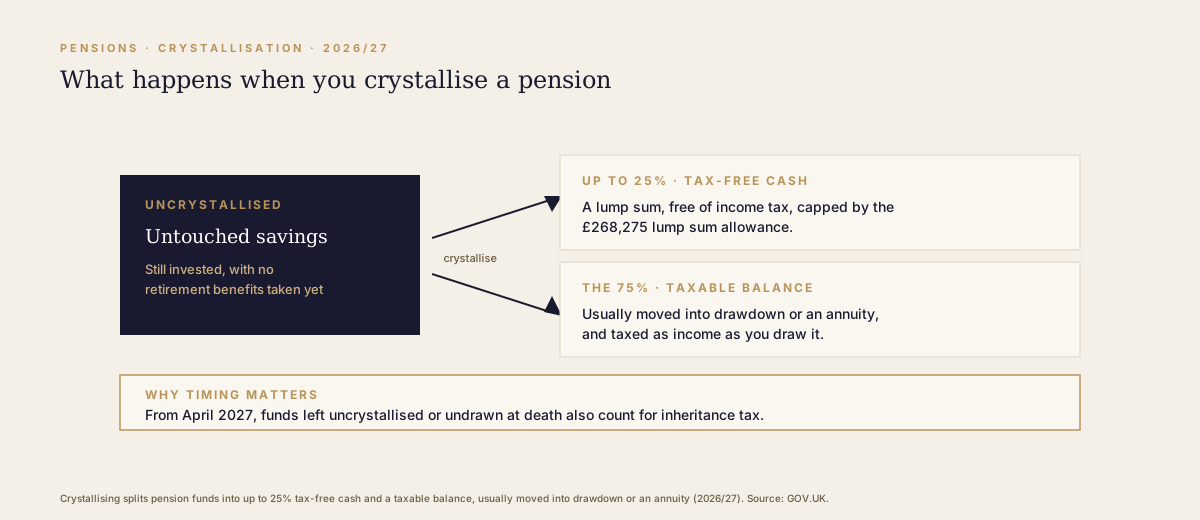
Pension crystallisation is the point at which uncrystallised pension savings are designated to provide retirement benefits, typically by taking a tax-free lump sum and moving the remainder into drawdown or an annuity. The decision controls when you take your 25% tax-free entitlement and how the remainder is taxed as you draw it, so it is as much about timing as amounts. Crystallising splits the chosen funds into tax-free cash and a taxable balance, usually moved into drawdown or an annuity. From April 2027, funds left uncrystallised or undrawn at death also count towards inheritance tax, so the timing carries more weight than before.
Pension crystallisation is the point at which you bring a pension into use: you take some or all of it, usually starting with up to 25% as tax-free cash, and turn the rest into retirement income. Crystallising a pension is not the same as spending it. The money can be set up to pay you and then left untouched and invested. Before you crystallise, your funds are described as uncrystallised; afterwards, the part you have accessed is crystallised, and it is taxed and treated differently from then on. The figures and thresholds in this article are correct for the 2026/27 tax year.
What happens when you crystallise a pension?
When you crystallise a pension you designate some or all of it for retirement benefits. You can normally take up to 25% as a tax-free lump sum, capped across all your pensions at £268,275 for 2026/27, with the balance moved into drawdown or used to buy an annuity and taxed as income when drawn.
Contents
- What is pension crystallisation?
- Crystallised vs uncrystallised funds: what is the difference?
- How does pension crystallisation work?
- Does crystallising a pension mean taking the money out?
- What happened to the lifetime allowance test?
- Should you crystallise your whole pension at once?
- How does crystallisation interact with the 2027 inheritance tax change?
What is pension crystallisation?
Pension crystallisation is the act of moving pension savings out of their accumulation stage and into a form that provides retirement benefits. In practice that almost always starts with a decision about your tax-free cash, followed by what happens to the rest: it either stays invested in a drawdown account you can draw from, or it buys a guaranteed income through an annuity. The word that matters is designate. When you crystallise, you are designating funds for the provision of benefits, which is a separate idea from physically taking money out.
This distinction sits at the heart of how pensions are taxed in retirement. Funds you have never touched are uncrystallised and still carry their full entitlement to 25% tax-free cash. The moment you crystallise a slice of your pension, that slice is treated as crystallised, the tax-free element is accounted for, and anything you later draw from it counts as taxable income. You do not have to crystallise everything in one go, and most people do not.
Risk warnings
A pension is a long-term investment, the value of your investment and the income from it may go down as well as up. Your eventual income may depend upon the size of the fund at retirement, future interest rates and tax legislation.
Your pension income could also be affected by the interest rates at the time you take your benefits. The tax implications of pension withdrawals will be based on your individual circumstances, tax legislation and regulation which are subject to change in the future.
Crystallised vs uncrystallised funds: what is the difference?
The difference between crystallised and uncrystallised funds comes down to whether you have accessed them yet. Uncrystallised funds are savings you have built up but not brought into payment. They sit in your pension, fully invested, with their 25% tax-free entitlement intact. Crystallised funds are the part you have accessed, where the tax-free cash has been taken or accounted for and the balance is earmarked for income.
A single pension can hold crystallised and uncrystallised funds at the same time. If you have a £400,000 pot and crystallise £200,000 of it, half your pension is crystallised and half remains uncrystallised, each with different tax treatment. This is what makes phased access possible: you can keep crystallising small amounts over many years, leaving the rest growing untouched.
The practical effect is on tax and on what your beneficiaries receive. Uncrystallised funds preserve flexibility, including the ability to take future tax-free cash. Crystallised funds in drawdown have already used their tax-free portion, so further withdrawals are fully taxable. Keeping track of which is which becomes part of managing income in retirement.
How does pension crystallisation work?
Pension crystallisation works by converting the funds you choose to access into a tax-free lump sum plus a taxable balance. The most common route starts with the pension commencement lump sum, the formal name for the 25% tax-free cash. You take up to a quarter of the amount being crystallised free of tax, and the remaining three quarters is designated for income.
Where that income comes from depends on the route you take. Most people move the balance into flexi-access drawdown, where it stays invested and you withdraw what you need, taxed as income each time. Others use it to buy an annuity, exchanging the fund for a guaranteed income for life. Both are crystallisation; they simply differ in how the income is delivered and how much risk you carry.
There is a third route that crystallises funds as you go. With an uncrystallised funds pension lump sum, each withdrawal takes 25% tax-free and 75% taxable directly from uncrystallised savings, crystallising only the amount you draw. It folds the lump sum and the income into a single payment rather than separating them.
Does crystallising a pension mean taking the money out?
No, crystallising a pension does not mean taking the money out. This is the single most common misunderstanding about the process. You can crystallise a fund, take your tax-free cash, move the balance into drawdown and then draw no income at all, leaving it fully invested. The funds are crystallised because you have set them up to provide benefits, not because you have spent them.
Why would anyone do that? Often to capture tax-free cash for a specific purpose, such as clearing a mortgage, while keeping the rest working. The drawdown fund continues to rise and fall with markets exactly as it did before.
There is, however, a consequence to drawing taxable income that catches people out. Taking any taxable income from a flexibly accessed pension can trigger the money purchase annual allowance, which sharply reduces how much you can still pay into pensions each year. Taking only your tax-free cash does not trigger it; drawing taxable income does. For anyone still working and contributing, that makes the order and timing of crystallisation a decision with lasting effects on how much they can rebuild.
Crystallising a pension sets up the tax treatment of that money for good; taking an income from it afterwards is a separate decision you can delay, change, or avoid altogether.
Risk warnings
Pensions
Levels and bases of, and reliefs from, taxation are subject to change and their value will depend upon personal circumstances. Taxation and pension legislation may change in the future.
Mortgages
Your home may be repossessed if you do not keep up repayments on your mortgage. Think carefully before securing debts against your home.
Not all mortgage contracts are regulated by the Financial Conduct Authority.
What happened to the lifetime allowance test?
The Lifetime Allowance was abolished on 6 April 2024, so crystallising a pension no longer tests its total value against a single lifetime cap. Under the old regime, every time you crystallised, the value was measured against the Lifetime Allowance at a benefit crystallisation event, and anything above the cap faced an extra charge. That cap is gone, and with it the idea that growing a large pension would be penalised on the way out.
What remains is a narrower set of limits on tax-free money. As set out in GOV.UK’s guidance on individual lump sum allowances, the Lump Sum Allowance caps the total tax-free cash you can take across all your pensions at £268,275 for 2026/27. A second limit, the Lump Sum and Death Benefit Allowance, caps tax-free lump sums paid in your lifetime plus those paid to beneficiaries on death at £1,073,100 for 2026/27. Income you draw is not tested against any lifetime cap; it is simply taxed at your marginal rate when you take it.
How much tax-free cash can you take when you crystallise a pension?
You can normally take up to 25% of the amount you crystallise as tax-free cash, capped across all your pensions by the Lump Sum Allowance of £268,275 for 2026/27. Anything above that allowance is taxed as income rather than paid tax-free, unless you hold an older HMRC protection.
The terminology survives in a reduced form. HMRC now tests tax-free lump sums at a relevant benefit crystallisation event, the moment you take the cash. For a pot where 25% would exceed the Lump Sum Allowance of £268,275 for 2026/27, the excess is taxed as income rather than paid tax-free, unless you hold one of the older HMRC protections. For most people, though, crystallisation is now simpler than it was: take your tax-free cash within the allowance, and pay income tax on the rest as you draw it.
Risk warning
HM Revenue and Customs practice and the law relating to taxation are complex and subject to individual circumstances and changes which cannot be foreseen.
Should you crystallise your whole pension at once?
Crystallising your whole pension at once is rarely the most efficient choice, even though it can feel like the simplest. Taking all your tax-free cash in one go hands you a large sum you may not need yet, moves it out of the tax-advantaged pension environment, and makes every subsequent withdrawal from the drawdown fund fully taxable. Crystallising gradually, by contrast, keeps more of your money invested and spreads your tax-free entitlement across the years you actually need it.
Diane, 62, with a £500,000 pension
Diane has stopped work and wants around £20,000 a year to bridge the gap until her state pension begins. She has no other taxable income yet and does not need a large lump sum.
She could crystallise the whole pot now, taking £125,000 of tax-free cash (25% of £500,000, comfortably within the lump sum allowance of £268,275 for 2026/27) and moving £375,000 into drawdown. Instead she crystallises only what she needs each year, drawing a mix of tax-free cash and taxable income that keeps the taxable slice inside her personal allowance of £12,570 a year for 2026/27.
By phasing, Diane pays little or no income tax in these early years and leaves most of her pot uncrystallised and invested. Crystallising everything at 62 would instead place £125,000 outside the pension earning taxable interest, with every later drawdown withdrawal fully taxable.
How much you can sensibly take, whatever your crystallisation strategy, is governed by a sustainable withdrawal rate rather than by how much tax-free cash happens to be available. Crystallising a large lump sum simply because you can, then leaving it in a low-interest account, can quietly erode its value while exposing it to tax it would have avoided inside the pension.
A second pitfall is recycling. If you take tax-free cash and then significantly increase your pension contributions, you can fall foul of the tax-free cash recycling rules, which exist to stop people generating fresh tax relief on cash they have just withdrawn tax-free. Being caught can trigger an unauthorised payment charge.
Deciding when and how much to crystallise is a question about the shape of your income over decades rather than a one-off event. Mapping that out is exactly what lifetime cashflow modelling is designed to do, testing how different crystallisation patterns play out against your spending, your other assets, and your tax position.
How does crystallisation interact with the 2027 inheritance tax change?
From 6 April 2027, most unused pension funds and death benefits will be counted as part of your estate for inheritance tax, and this changes the long-standing logic around crystallisation. For years the standard approach was to leave pensions untouched for as long as possible, spending other assets first, precisely because pension funds sat outside the estate. That advantage is being removed.
The change applies to funds that are uncrystallised and to crystallised funds left undrawn in a drawdown account: in both cases, what remains on death can fall within the inheritance tax net. According to GOV.UK guidance on inheritance tax for unused pension funds and death benefits, pensions passing to a spouse or civil partner remain exempt, as do those left to charity, and death-in-service benefits are excluded. Funds destined for children or other beneficiaries, however, can be added to the estate, where anything above the available inheritance tax thresholds may be taxed at up to 40% for 2026/27.
For someone who dies at or after 75, beneficiaries already pay income tax on inherited pension withdrawals at their own marginal rate. Layering inheritance tax on top from April 2027 creates a genuine double-tax exposure on the same pot. This is prompting many people to revisit whether the old instinct to preserve the pension still holds, and to weigh alternatives such as drawing income earlier or using lifetime gifting and the seven year rule to move wealth out of the estate during their lifetime.
None of this makes crystallising sooner automatically correct. Drawing pension funds faster can create an income tax bill now to avoid an inheritance tax bill later, and the balance depends entirely on your age, your health, your income needs, and the rest of your estate. It does mean the timing of crystallisation has become an inheritance tax planning question as much as a retirement income one, which was not really the case before.
Risk warning
The Financial Conduct Authority (FCA) does not regulate Inheritance Tax Planning or Trust Advice.
Crystallising is a choice, not an event
Crystallisation is one of those pieces of pension jargon that sounds more complicated than it is. Stripped back, it is simply the moment you turn savings into benefits, and the key insight is that the moment is a choice, not a single event you have to get over with. You can crystallise all at once or in slices, take income or leave it invested, and each decision sets the tax treatment for that part of your pension from then on.
What has changed is the weight that timing now carries. With the Lifetime Allowance gone, the tax-free cash limits fixed, and pensions moving into the inheritance tax net from 2027, the question is no longer just how to access your pension, but when, in what order, and against the backdrop of everything else you own. The mechanics are straightforward. The planning around them is where the value lies, which is exactly what pensions and retirement planning advice is for.
Frequently asked questions
What is pension crystallisation?
Pension crystallisation is the point at which you turn pension savings into retirement benefits, usually by taking tax-free cash and setting up an income through drawdown or an annuity. Until this happens the funds are 'uncrystallised'. Once you crystallise, that part of your pension is 'crystallised' and treated differently for tax and access.
What is the difference between crystallised and uncrystallised funds?
Uncrystallised funds are pension savings you have not yet accessed, and they still carry their full 25% tax-free entitlement. Crystallised funds are those you have brought into payment, where the tax-free cash has already been accounted for and further withdrawals are taxed as income. A single pension can hold both at the same time.
How does pension crystallisation work?
When you crystallise a pension you designate some or all of it for retirement benefits. You can normally take up to 25% as a tax-free lump sum, capped across all your pensions at £268,275 for 2026/27, and the remainder moves into drawdown or buys an annuity. You can crystallise the whole pot at once or in stages.
Does crystallising a pension mean you have to withdraw the money?
No. Crystallising a pension is not the same as spending it. You can crystallise funds, take your tax-free cash, move the rest into drawdown and leave it fully invested without drawing any income. Crystallisation sets the benefits up; withdrawing income from them is a separate decision.
Should you crystallise your whole pension at once?
Not necessarily. Crystallising everything in one go gives you all your tax-free cash immediately but makes every later withdrawal taxable and moves money out of the pension before you need it. Crystallising in stages can spread the tax-free entitlement and keep more invested. The right approach depends on your income needs and wider plan.
Is there still a lifetime allowance test when you crystallise a pension?
No. The Lifetime Allowance was abolished on 6 April 2024, so crystallising no longer tests the total value of your pension against a single cap. Instead, only tax-free lump sums are limited, to the Lump Sum Allowance of £268,275 for 2026/27. Income you draw is simply taxed at your marginal rate.