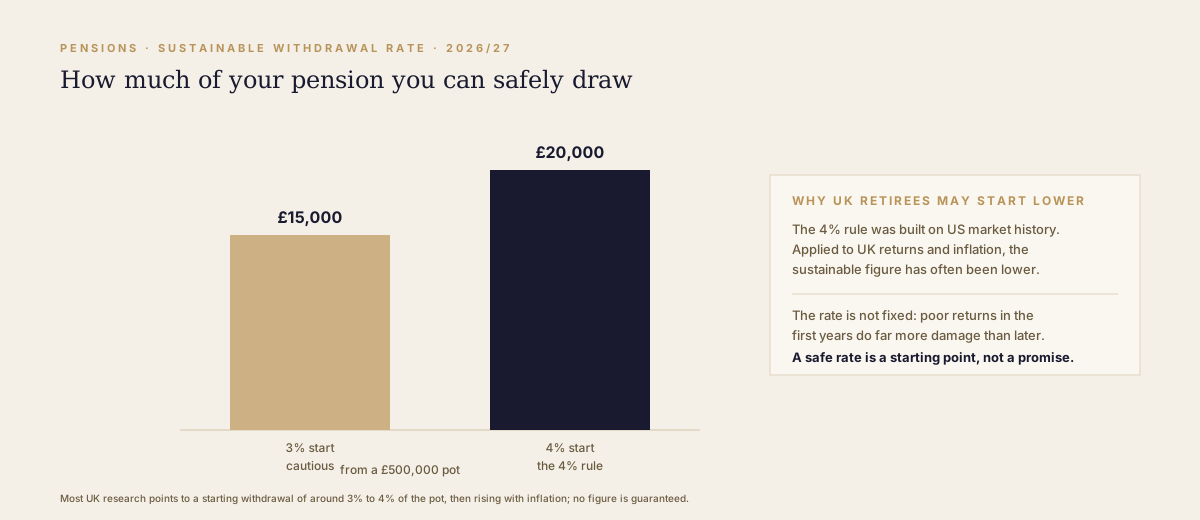
A sustainable withdrawal rate is the percentage of a retirement portfolio drawn in the first year, then increased each year for inflation, set so the money is unlikely to run out. Most UK research points to a starting withdrawal rate of around 3% to 4% of the pot in the first year, then rising with inflation, though no figure is guaranteed. The familiar 4% rule is a useful anchor, but it was built on US market history, and applied to UK returns and inflation the sustainable figure has often been lower. The rate is not fixed: a poor run of returns in the first few years of retirement does far more damage than the same returns later.
A sustainable withdrawal rate is the percentage of your pension you take as income in the first year of retirement, then increase each year for inflation, set at a level the pot is unlikely to run dry. It answers the question every drawdown retiree faces: how much can I spend each year without running out? The familiar reply is the 4% rule. In practice, UK evidence points to a starting figure somewhere between 3% and 4% for a typical balanced portfolio, because that rule carries assumptions that do not travel well across the Atlantic. The figures and thresholds in this article are correct for the 2026/27 tax year.
How does a sustainable withdrawal rate work?
A sustainable withdrawal rate sets your first year’s pension income as a percentage of the pot, often 3% to 4% in the UK. You then raise that pound amount each year in line with inflation, rather than recalculating the percentage. The aim is an income that lasts roughly 30 years across changing markets.
Contents
- What a sustainable withdrawal rate is
- Where the 4% rule comes from
- Is 4% safe for UK retirees?
- Why the order of returns matters
- What else changes the rate
- Fixed rate or flexible?
- Fitting it into your plan
What is a sustainable withdrawal rate?
A sustainable withdrawal rate is the income you can take from an invested pension each year, expressed as a percentage of the pot in year one and then increased with inflation, without a meaningful risk of exhausting the fund. The percentage only does its work once. You apply it to the starting value, fix the resulting pound figure, and from then on you uprate that figure for rising prices rather than recalculating against a pot that rises and falls.
That distinction matters more than it first appears. Drawing a flat 4% of whatever the pot is worth each year can never fully empty it, but it produces a wildly unstable income that collapses after a bad year. The sustainable-withdrawal approach does the opposite: it fixes a stable, inflation-linked income and asks whether the portfolio can support it for the long haul. Most of this income is taken through flexi-access drawdown, where the pot stays invested and you choose what to withdraw.
The standard test runs over a 30-year retirement, long enough to matter for someone retiring in their sixties. The headline question is simple to state and hard to answer: what starting percentage survives almost any market you might retire into?
Risk warning
Your pension income could also be affected by the interest rates at the time you take your benefits. The tax implications of pension withdrawals will be based on your individual circumstances, tax legislation and regulation which are subject to change in the future.
Where does the 4% rule come from?
The 4% rule comes from a 1994 study by the US financial planner William Bengen, who tested how much a retiree could have drawn from a portfolio across every 30-year period in modern American market history. He found that a starting withdrawal of about 4.15%, rounded down to 4%, then raised each year for inflation, would have survived even the worst-case retirement dates. The rule of thumb stuck, and a later study by academics at Trinity University reinforced it.
Two features of that research are easy to miss. First, 4% was never the typical outcome; it was close to the worst case. In most historical periods a US retiree could have drawn considerably more. Second, the work rested almost entirely on twentieth-century United States market data, and US markets were unusually generous by global standards.
Bengen himself has since revisited the figure. In his 2025 book he revised the safe starting rate up to 4.7%, after adding more asset classes and accounting for market valuations and inflation. That tells you something important: the 4% rule is not a law of nature. It is the output of a particular dataset. Change the dataset and you change the number.
Is a 4% withdrawal rate safe for UK retirees?
Not reliably. When researchers rerun the same analysis on UK market returns and inflation rather than US data, the sustainable starting rate has consistently come out lower. Studies using a century of UK data put the figure for a balanced portfolio at roughly 3.3% to 3.7%, and the single worst starting point in UK history would have supported only about 2.5%. The UK’s harsher inflation episodes, including the 1970s, are a large part of the reason.
Forward-looking research points the same way. Morningstar’s 2025 analysis, which uses projected returns rather than history, settled on a 3.9% starting rate for a balanced portfolio at a 90% success rate, down from the 4% that historical studies implied. None of these numbers includes the fees and taxes a real retiree pays, which pull the safe figure lower still.
The practical effect is sobering. At a 4% rate you need 25 times your target income as a pot (1 divided by 0.04). At 2.5% you need 40 times. That gap reshapes how large a pension you actually need to fund a given lifestyle, and it is why anchoring blindly to 4% can leave a UK retiree more exposed than the famous rule suggests.
Risk warnings
Investments
The taxation of the investment is dependent on the individual circumstance of each investor, and may be subject to change in the future.
Any rates of investment growth shown, are intended as a guide only, they are not guaranteed, nor are they intended to be either minimums or maximums.
Pensions
Levels and bases of, and reliefs from, taxation are subject to change and their value will depend upon personal circumstances. Taxation and pension legislation may change in the future.
Why does the order of investment returns matter?
The single biggest reason a safe rate has to be cautious is the order in which your returns arrive, known as sequence of returns risk. Two retirees can earn exactly the same average return over their retirement and end up in completely different places, purely because one met a market fall early and the other met it late.
The mechanism is simple. When you draw an income from an invested pot, you sell units to fund it. If prices are low because markets have just fallen, you sell more units to raise the same income, and those units are gone before the recovery arrives. Early losses are therefore baked in; later losses, after years of growth, do far less damage. This is also why the way shares and bonds usually move differently matters in retirement, because a smoother ride reduces the depth of those early falls.
Margaret and Eleanor, both 65 with £500,000
Both retire on the same day with identical £500,000 pension pots, both invested the same way. Each draws £20,000 in the first year, a 4% start, and raises that income by 2.5% a year for inflation. Over their retirements both portfolios earn the same average annual return. The only difference is the order in which those returns arrive.
Eleanor is unlucky: a sharp market fall lands in her first two years while she is still drawing income, so she sells investments at depressed prices and locks the losses in. Margaret meets the same fall, but two decades later, after years of growth have built her pot up first.
On these illustrative figures, Eleanor’s pot is exhausted in her early eighties. Margaret’s, having grown before the downturn hit, is still worth close to its original £500,000 at age 90. Same average return, same withdrawals, opposite outcomes.
A poor sequence of returns in the first five years of retirement can empty a pot that identical average returns, arriving later, would have left intact. No starting percentage can be called safe without accounting for this, which is why worst-case-based figures like the UK’s 2.5% exist at all.
Risk warning
Investing in shares should be regarded as a long-term investment and should fit in with your overall attitude to risk and financial circumstances.
What else changes your sustainable withdrawal rate?
Several factors move your sustainable withdrawal rate, sometimes by more than the choice between 3% and 4%. The four that matter most are your time horizon, your investment mix, your costs, and the income you already have guaranteed.
A longer retirement needs a lower rate, because the pot has to survive more years and more potential downturns. Someone retiring at the minimum pension access age, which rises to 57 from 6 April 2028, is planning for a span that could exceed 35 years, and a 30-year rule understates the risk for them.
How does retirement age affect your sustainable withdrawal rate?
Retiring earlier lowers your sustainable withdrawal rate because your pot must support more years of income. The minimum pension access age rises to 57 from 6 April 2028, so someone retiring then may need to plan for a 35-year-plus retirement rather than the 30 years most studies assume, pointing to a starting rate below the typical 3% to 4% range.
Costs work quietly against you. A starting rate is usually quoted before platform charges, fund fees and any adviser costs, which together can run to 1% or more a year. Every percentage point of charges comes straight off the rate you can sustain.
Your investment mix cuts both ways. Hold too little in equities and the pot cannot outpace inflation; hold too much and the early falls that drive sequence risk become deeper. How you draw across different pots also matters, because which wrapper your savings sit in changes the tax on each withdrawal and therefore how much you keep. The most powerful lever, though, is guaranteed income: the fuller your fixed income from the state pension and any defined benefit scheme, the less you depend on the invested pot, and the more risk that pot can safely take.
Important information
We do not currently provide advice on transferring out of defined benefit (final salary) pension schemes. If you require this advice, we will provide details of a suitably qualified adviser at a firm with the necessary regulatory permissions who can assist you.
Should you use a fixed rate or stay flexible?
For most retirees, some flexibility beats a rigidly fixed income, because it lets you start higher and respond to markets rather than locking in a cautious number for life. A fixed inflation-linked withdrawal is simple and predictable, but its safety comes from assuming the worst, which means in most markets you will under-spend and leave a large unspent pot.
The alternative is to flex withdrawals with the portfolio: trim spending after a bad year, take a little more after a good one. Morningstar’s research found that flexible “guardrails” approaches could support starting rates above 5% rather than under 4%, precisely because the retiree agrees to absorb some variability. The trade-off is real. A flexible strategy can mean cutting your income in a downturn, which is exactly when it feels hardest.
So the honest answer is that the right approach depends on how much variability your core spending can tolerate. If your fixed costs are covered by guaranteed income, you can afford to flex the rest and start higher. If the invested pot funds your essentials, a lower, steadier rate protects you from being forced to sell into a falling market. The number is not the strategy; the rule for changing the number is.
How does a withdrawal rate fit into your wider plan?
A sustainable withdrawal rate is not a standalone number; it is one input into a retirement income plan, and the rest of the plan changes what the number needs to be. The starting point is your guaranteed income. The full new state pension is worth about £12,548, and for many retirees it covers a meaningful slice of essential spending before the invested pot does anything at all.
That floor changes the maths. If the state pension and a defined benefit pension between them cover your non-negotiable bills, the drawdown pot is funding discretionary spending, and discretionary spending is exactly what you can safely flex. Some retirees deliberately widen that floor by using part of the pot to buy an annuity, and the gilt yields that drive annuity rates have made that option more attractive than it was for much of the past decade.
The withdrawal rate also interacts with tax and inheritance. Drawing income pushes you up the income tax bands, where the higher rate of 40% applies above £50,270 for 2026/27, while pension funds left untouched have their own treatment on death, which is changing from 2027. A rate set purely to make the pot last can miss these downstream effects entirely.
The useful way to hold all this is to stop hunting for the one true percentage. There is no single safe number, only a starting rate that has to flex with the markets, your time horizon and the income you already have guaranteed. A pensions and retirement planning review can bring your withdrawal rate, tax position and guaranteed income together into one plan. Get the plan around it right, and the rate tends to look after itself.
Risk warning
A pension is a long-term investment, the value of your investment and the income from it may go down as well as up. Your eventual income may depend upon the size of the fund at retirement, future interest rates and tax legislation.
Frequently asked questions
What is a sustainable withdrawal rate?
A sustainable withdrawal rate is the percentage of your pension you draw as income in the first year of retirement, then increase each year for inflation, set so the pot is unlikely to run out. In the UK, research points to a starting figure of roughly 3% to 4% for a balanced portfolio, rather than a single guaranteed number.
How does the 4% rule work?
The 4% rule means withdrawing 4% of your pension in the first year, then increasing that pound amount by inflation every year afterwards, regardless of how the pot performs. It was designed so the money would last at least 30 years. The percentage is only applied once, at the start; you do not recalculate it against the pot's changing value.
Is the 4% rule safe for UK retirees?
Not reliably. The 4% rule was built on US market history, and studies using UK returns and inflation have found a lower sustainable starting rate, closer to 3.3% to 3.7% for a balanced portfolio. The worst starting point in UK history would have supported only about 2.5%. Fees and taxes reduce the safe figure further.
How much income can I take from a £500,000 pension?
At a 3.5% starting rate, a £500,000 pension supports about £17,500 of income in the first year, rising with inflation; at 4% it is £20,000. Adding the full new state pension of about £12,548 lifts the total household income. Higher withdrawal rates increase the income but also the risk of running out.
What is sequence of returns risk?
Sequence of returns risk is the danger that poor investment returns early in retirement do lasting damage, because you sell units to fund income while prices are low. Two retirees with the same average return can end up very differently depending on whether losses arrive early or late. It is the main reason a safe withdrawal rate has to be cautious.
Can I withdraw more than 4% from my pension?
Yes, a drawdown pension lets you withdraw any amount, and the rule's creator now suggests up to 4.7% may be safe on US data. But the higher the rate, the greater the chance of exhausting the pot, especially in the UK where historical sustainable rates have been lower. Flexible withdrawals that fall in bad years can support a higher starting figure.