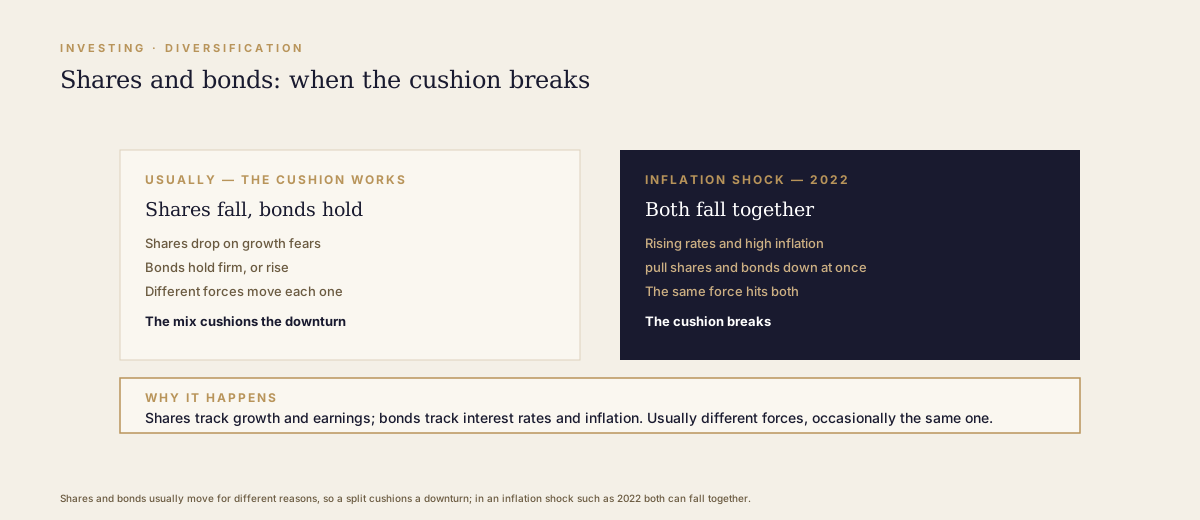
Stock-bond correlation is the statistical relationship between share price movements and bond price movements, measuring whether the two asset classes tend to rise and fall together or independently. Shares and bonds do not always move together: their relationship shifts with the economic backdrop, which is why a portfolio split between them usually, but not always, cushions a downturn. The diversification works when share prices fall on growth fears while bonds hold firm, but it breaks down when inflation and rising interest rates pull both down at once, as UK investors saw in 2022.
Shares and bonds do not always move in opposite directions, and the long-standing belief that one rises whenever the other falls is a tendency rather than a rule. The shares versus bonds relationship is usually loose: shares are driven mainly by company profits and economic growth, while bonds respond mainly to interest rates and inflation. Because those forces are often different, a portfolio holding both tends to ride out downturns more smoothly than one holding either alone. The important word, though, is usually. In some conditions, most painfully when inflation surges, the two fall together and the cushion disappears. This article explains why that happens, what UK investors learned in 2022, and what the relationship means for how a plan is built.
All market figures and yield data in this article are stated as at early 2026.
What is stock-bond correlation?
Stock-bond correlation measures whether share prices and bond prices tend to move together or independently. When correlation is negative, bonds often rise as shares fall, cushioning the portfolio. When it turns positive, as in 2022, both assets fall together and that cushion disappears.
Contents
- Shares vs bonds: what is the core difference?
- Why do shares and bonds usually move differently?
- So why do shares and bonds sometimes fall together?
- What did 2022 teach UK investors?
- Is a portfolio of shares and bonds still worth it?
- What does the shares vs bonds relationship mean for your plan?
- Can shares and bonds fall together again?
Shares vs bonds: what is the core difference?
The core difference is ownership versus lending: a share makes you a part-owner of a company, while a bond makes you a lender to a government or company that pays fixed interest in return. That single distinction drives almost everything else about how the two behave. As an owner, your return rises and falls with the fortunes of the business and the wider economy. As a lender, your return is largely fixed at the outset, so what moves the value of your bond is mainly the level of interest rates available elsewhere. These are two of the main types of investments, and each is asked to do a different job inside a portfolio: shares for long-term growth, bonds for stability and income.
Shares and bonds compared by what they are and what drives them
| Aspect | Shares | Bonds |
|---|---|---|
| What you own | Part-ownership of a company | A loan to a government or company |
| Main return driver | Company profits and economic growth | Interest rates and inflation |
| Typical role | Long-term growth, higher volatility | Steadier income, lower expected return |
Why do shares and bonds usually move differently?
Shares and bonds usually move differently because they are priced off different things. Share prices reflect expectations about future company earnings, which tend to rise when the economy is strong and fall when recession looms. Bond prices move in the opposite direction to interest rates: when rates rise, the fixed coupon on an existing bond looks less attractive, so its price falls, and when rates fall, that fixed income becomes more valuable and the price rises.
In a typical growth scare, these forces pull in opposite directions. Investors fear weaker company profits, so shares fall, while central banks cut interest rates to support the economy, so bond prices rise. The rising bonds offset some of the falling shares. This is the mechanism behind the classic balanced portfolio, and it is why government bonds earned their reputation as portfolio ballast. The way gilt yields move sits at the heart of this, because a UK government bond is only as steady as the interest rate environment around it.
So why do shares and bonds sometimes fall together?
Shares and bonds fall together when the problem facing markets is inflation rather than weak growth. Inflation is the one force that damages both at the same time. To bring inflation down, central banks raise interest rates, which directly pushes bond prices lower. The same rising rates make future company profits worth less in today’s money and raise borrowing costs, which pushes share prices lower too. There is no growth scare prompting rate cuts to rescue bonds, because the central bank is deliberately tightening.
The result is positive correlation: both assets move in the same downward direction. When the Bank of England raised interest rates rapidly to tackle inflation, the cushion that bonds normally provide simply was not there. Economists describe this as a regime shift: the shares versus bonds correlation is not a constant but flips with the macroeconomic backdrop, negative when growth shocks dominate and positive when inflation shocks dominate.
How does inflation cause shares and bonds to fall together?
Inflation forces central banks to raise interest rates. Rising rates push bond prices down directly, because fixed coupons become less attractive. The same rate rises reduce the present value of future company profits, pulling share prices lower too. In 2022, UK gilt funds fell around 20% and global shares fell around 8.5% in the same year.
What did 2022 teach UK investors?
2022 taught UK investors that the part of a portfolio meant to be safe can fall hard at exactly the moment shares do too. It was a textbook inflation shock. As prices surged and interest rates were pushed up sharply, the supposedly safe part of a balanced portfolio fell hard. UK gilt funds fell around 20% over the year, and index-linked gilt funds fell roughly 31%, while global equities fell around 8.5% in sterling terms, helped by a weak pound that softened overseas losses. For a UK investor, the uncomfortable lesson was that the defensive holding lost more than the risky one.
Margaret, 67, drawing income from a balanced portfolio
Margaret retired with £400,000 invested in a classic balanced split: £240,000 in global shares and £160,000 in UK gilts. The gilts were there to steady the portfolio and provide a safer source of income.
In 2022 the plan worked in reverse. Her gilts fell about 20%, a loss of roughly £32,000, while her global shares fell about 8.5% in sterling terms, a loss of roughly £20,000. The holding she thought of as safe lost more than the holding she thought of as risky.
Her portfolio fell by around £52,000 in total, close to 13%, in a year when the defensive ballast offered no protection at all. Selling gilts to fund her income that year meant crystallising losses on the very assets meant to cushion her.
Contrast that with a more familiar kind of downturn. In 2008, and again in early 2020, share prices collapsed on fears of recession, but government bonds rose as central banks slashed interest rates. A balanced investor in those episodes saw their bonds climb while their shares fell, exactly the offset the structure is designed to deliver. The portfolios looked similar on paper. What differed was the cause of the fall: a growth shock lets bonds do their job, while an inflation shock takes that job away. The outcome for the saver was materially different even though the allocation was identical.
Is a portfolio of shares and bonds still worth it?
Yes, a portfolio of shares and bonds is still worth holding, because the years when both fall together are the rare exception rather than the norm. In nearly a century of market history, the two have ended the year down together only a handful of times, and much the same force was behind each of them, a sharp repricing of interest rates: the mid-1970s, then 1994, then 2022. The 1994 episode is the closest parallel. The Bank of England traces the turn in bond markets to the monetary tightening the US Federal Reserve began on 4 February 1994, which ended the previous year’s rally and unsettled bond markets for months afterwards. UK share prices fell over the same year, with the FTSE 100 closing 1994 about 10% below where it began. For most downturns, which are driven by growth fears rather than inflation, bonds still cushion equity losses. The trade-off is that this protection is not guaranteed in every environment, and 2022 proved that an inflation shock can strip it away precisely when it is least convenient.
The diversification between shares and bonds does not disappear permanently in an inflation shock: it reverts. The lesson of 2022 is not that the structure failed, but that its one vulnerability is real, and a sensible plan accounts for it.
A balanced portfolio buys you smoother returns most of the time and the discipline to stay invested, at the cost of accepting that no single asset, including government bonds, is genuinely risk-free. The sensible conclusion is not to abandon the structure but to understand its one weakness, so that an inflationary spell does not come as a surprise. Where you hold each asset matters too: the investment wrapper around a holding shapes its tax treatment and how easily you can reach it without selling at the wrong moment.
Risk warning
The taxation of the investment is dependent on the individual circumstance of each investor, and may be subject to change in the future.
What does the shares vs bonds relationship mean for your plan?
The shares versus bonds relationship matters most for a financial plan at the moment you begin drawing on your money. While you are still saving, a year like 2022 is uncomfortable but recoverable, because you are not selling and markets eventually recover. In retirement it is different. If you are taking an income and both holdings fall at once, you may have to sell assets at depressed prices to fund withdrawals, locking in losses a recovering market would otherwise have repaired. This is why the sequence of returns, not merely the long-run average, shapes how long a pot lasts, and why deciding what makes a pension enough to retire on rests as much on timing as on the headline figure.
The practical response is not to forecast which kind of shock comes next, but to build a plan that survives either. Holding enough in cash or short-dated assets to cover a year or two of spending means you are rarely forced to sell long-term holdings in a falling year. Testing how a portfolio behaves across different return sequences, rather than assuming a smooth average, is exactly what lifetime cashflow modelling is designed to reveal, and it shows where a plan is most fragile.
There is also a more encouraging point as of 2026. With gilt yields meaningfully positive again, longer-dated gilts yielding around 5% in early 2026 against CPI inflation of around 3.2% (Office for National Statistics), bonds now offer a real income cushion they did not provide through the near-zero years of the 2010s. A higher starting yield gives bonds more room to rise if growth falters, restoring some of their traditional protective role.
Deciding how much to hold in each, and how that blend fits your specific situation and timeline, is the kind of judgement that personal investment advice exists to support.
Risk warnings
The value of pensions and any income from them can fall as well as rise. You may not get back the full amount invested.
A pension is a long-term investment and the value is not guaranteed. Any advice or considerations are personal to each individual’s circumstances.
A pension is a long-term investment, the value of your investment and the income from it may go down as well as up. Your eventual income may depend upon the size of the fund at retirement, future interest rates and tax legislation.
Can shares and bonds fall together again?
Yes, shares and bonds can fall together again, most likely if inflation becomes the market’s dominant concern once more. The 2022 episode was unusual but not unique, and a similar inflationary shock could pull both down in the same way. Understanding how sequence of returns risk works helps frame why timing matters: a bad year at the point of drawing income is far more damaging than the same percentage loss during accumulation. That is a risk worth planning for rather than a forecast of what comes next.
It does not mean diversification is broken: the relationship reverted to its normal, helpful pattern in 2023, with bonds once again cushioning equity weakness. The honest takeaway is that the shares and bonds partnership is reliable most of the time and exposed in one specific set of conditions, and a sensible plan keeps that exception in mind without trying to predict it.
Bringing it back to the plan
The reason shares and bonds usually move differently is the same reason they occasionally move together: each responds to its own set of forces, and now and then those forces align. For most of investing history, holding both has meant a smoother ride and fewer reasons to panic and sell. The lesson of 2022 is not that the approach failed, but that its one weak spot is real and worth respecting. A portfolio is not a machine that always behaves; it is a set of trade-offs, and understanding when the usual rules bend is what separates a plan that endures from one that surprises you at the worst possible moment.
Frequently asked questions
Do shares and bonds always move in opposite directions?
No. Shares and bonds do not move in fixed opposition; the relationship is usually loose, and occasionally they fall together, as UK investors saw in 2022. The cushion bonds provide is a strong tendency rather than a guarantee.
What is the difference between shares and bonds?
Shares make you a part-owner of a company, so your return rises and falls with its success. Bonds are loans to a government or company that pay fixed interest, so their value is driven mainly by interest rates rather than profits.
How does the relationship between shares and bonds work?
Shares respond mainly to economic growth and company earnings, while bonds respond mainly to interest rates and inflation. Because those forces usually differ, the two tend to move for different reasons, and bonds often rise when shares fall.
Is a 60/40 portfolio of shares and bonds still worth it?
Whether a 60/40 portfolio suits you depends on your spending needs relative to the size of your pot, not on the ratio itself, so it is better treated as a benchmark than a target. The split reflects a sound principle, with shares driving growth and bonds adding stability, but no fixed allocation removes the risk that both can fall together in an inflation shock, as 2022 showed. The right balance is the one a wider plan can realistically sustain.
Why did shares and bonds both fall in 2022?
Both fell in 2022 because high inflation forced central banks to raise interest rates sharply. Rising rates pushed bond prices down directly and weighed on share prices at the same time, removing the usual diversification benefit.
Shares vs bonds: which is safer?
Bonds are generally lower risk than shares over the short term, but they are not risk-free. UK gilts fell around 20% in 2022 when interest rates rose, so the safer label refers to relative volatility, not a guarantee against loss.