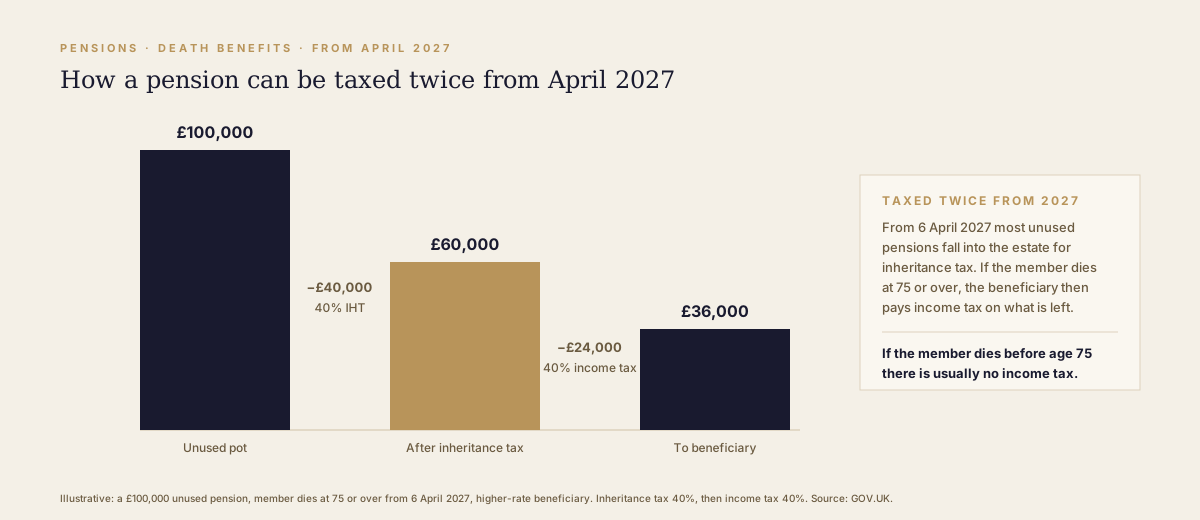
Pension death benefits are the lump sums or income paid from a registered pension scheme to a member's beneficiaries after the member dies. When you die, your pension can pass to your beneficiaries, but how much tax they pay depends on your age at death and, increasingly, on the size of your estate. Die before 75 and a defined contribution pension is usually free of income tax; die at 75 or over and your beneficiary pays income tax at their own marginal rate. From 6 April 2027 most unused pensions also fall within inheritance tax, so a single pot can be taxed twice before it reaches an adult child.
How pensions are taxed on death depends on two separate taxes, and from April 2027 both can land on the same pot. The first is income tax, which turns entirely on your age when you die: a defined contribution pension passed on before age 75 is usually free of income tax, while one passed on at 75 or over is taxed at whatever rate your beneficiary pays. The second is inheritance tax, which most pensions have escaped until now. Finance Act 2026 changed that. From 6 April 2027, most unused pension funds and death benefits are counted as part of your estate. The figures and thresholds in this article are correct for the 2026/27 tax year.
Do beneficiaries pay tax on an inherited pension?
Beneficiaries inheriting a UK pension pay no income tax if the member died before 75 and the funds are paid out or moved to drawdown within two years, unless a lump sum exceeds the £1,073,100 allowance. If the member died at 75 or over, withdrawals are taxed at the beneficiary’s marginal rate. From 6 April 2027, inheritance tax may also apply.
Contents
- How are pensions taxed on death?
- How does the age 75 rule affect pension income tax?
- How are defined benefit pensions and annuities taxed on death?
- How does inheritance tax on pensions change from April 2027?
- Can a pension be taxed twice on death?
- What is the lump sum and death benefit allowance?
- Should you change your plan before 2027?
How are pensions taxed on death?
A pension is taxed on death through up to two taxes: income tax on the money your beneficiaries receive, and, from 6 April 2027, inheritance tax on the value of your unused pension as part of your estate. Which of them apply, and at what rate, depends on your age when you die, who inherits, and the type of pension you hold.
The two taxes are answered as separate questions. Income tax has applied to inherited pensions for years and is not changing. Inheritance tax is the new layer, and for most people it is the bigger shift, because it overturns two decades of treating pensions as wealth that sits outside the estate.
Most of what follows applies to defined contribution pensions, the pots of money built up in a personal pension, a SIPP, or a workplace scheme. Defined benefit pensions and annuities work differently and are covered separately below. With a defined contribution pension, the scheme administrator usually has discretion over who receives any unused funds, guided by the expression of wishes or nomination form you complete. That discretion is the historical reason these pots have fallen outside your estate, and it is precisely what the 2027 reform removes.
The diagram shows that a defined contribution pension faces two separate tests on death: your age determines whether income tax applies, and from 6 April 2027 the identity of your beneficiary determines whether inheritance tax applies. Only a death at 75 or over, where the pension passes to someone other than a spouse, civil partner or charity, brings both taxes into play on the same pot.
Risk warnings
Pensions
Levels and bases of, and reliefs from, taxation are subject to change and their value will depend upon personal circumstances. Taxation and pension legislation may change in the future.
A pension is a long-term investment, the value of your investment and the income from it may go down as well as up. Your eventual income may depend upon the size of the fund at retirement, future interest rates and tax legislation.
Your pension income could also be affected by the interest rates at the time you take your benefits. The tax implications of pension withdrawals will be based on your individual circumstances, tax legislation and regulation which are subject to change in the future.
Defined benefit transfers
We do not currently provide advice on transferring out of defined benefit (final salary) pension schemes. If you require this advice, we will provide details of a suitably qualified adviser at a firm with the necessary regulatory permissions who can assist you.
How does the age 75 rule affect pension income tax?
If you die before age 75, your beneficiaries can usually take a defined contribution pension completely free of income tax; if you die at 75 or over, they pay income tax on it at their own marginal rate. This single age threshold has set the income tax treatment of inherited pensions since the 2015 pension freedoms, and it is unaffected by the inheritance tax changes coming in 2027.
For an under-75 death, the tax-free treatment is not automatic. The funds generally have to be paid out as a lump sum, or moved into flexi-access drawdown for the beneficiary, within two years of the date the scheme was told of your death (or could reasonably have known). Miss that two-year window and income tax can apply even though you died before 75. It is one of the most common ways a tax-free inheritance becomes a taxable one.
A second limit applies to larger pots. A lump sum death benefit is tax-free only up to the lump sum and death benefit allowance, £1,073,100 for 2026/27, with anything above it taxed at the beneficiary’s marginal rate. Moving the funds into beneficiary drawdown rather than taking a lump sum avoids that test, which is why the choice between a lump sum and drawdown matters for large pensions. The allowance is covered in more detail below.
Whether you had started drawing on the funds during your lifetime, which pension rules call crystallising them, makes little difference to this income tax outcome, though it affects the allowance test described later. Two cases are taxed regardless of age: a dependant’s scheme pension is always subject to income tax, and a beneficiary’s annuity is taxable if you died at 75 or over.
Where you die at 75 or over and a lump sum is paid, the provider deducts income tax under PAYE before the money reaches the beneficiary. Because the right tax code is often not in place, the first payment is frequently taxed on an emergency basis, leaving the beneficiary to reclaim the overpayment from HMRC.
Risk warning
HM Revenue and Customs practice and the law relating to taxation are complex and subject to individual circumstances and changes which cannot be foreseen.
How are defined benefit pensions and annuities taxed on death?
Defined benefit pensions and annuities follow their own rules on death, set mainly by the scheme or the contract rather than by a pot of money you can pass on. There is usually no fund to inherit in the way a defined contribution pot can be inherited.
A defined benefit scheme typically pays a reduced survivor’s pension, often around half of the member’s pension, to a spouse, civil partner, or dependent child. That income is taxed as the recipient’s earnings. Some schemes also pay a lump sum if you die in service or within a guaranteed period after retirement.
An annuity bought with a defined contribution pot stops on death unless you built in protection: a joint-life basis that continues paying a survivor, or a guarantee period that pays out for a set number of years. As with drawdown, payments to a beneficiary are tax-free if you died under 75 and taxable if you died at 75 or over. Death-in-service lump sums paid from a registered pension scheme are treated separately again, and the government has confirmed they stay outside the 2027 inheritance tax changes.
How does inheritance tax on pensions change from April 2027?
From 6 April 2027, most unused pension funds and death benefits are added to the value of your estate and can be taxed at 40% above your available nil-rate band. This is settled law rather than a proposal: the measure is set out in HM Treasury’s technical note on Inheritance Tax on pensions, implemented through Finance Act 2026, which received Royal Assent on 18 March 2026 and applies to deaths on or after 6 April 2027.
The change ends the long-standing position that pensions sit outside the estate, and it removes the role of scheme discretion in deciding the inheritance tax outcome. A pot the trustees pay out at their discretion will be treated the same as one paid under a binding direction. From that date, a pension is no longer a route to pass wealth outside the inheritance tax net.
Two exemptions survive. Death benefits passing to a surviving spouse or civil partner remain free of inheritance tax under the spousal exemption, as do gifts to a registered charity. The ordinary allowances also still apply: the nil-rate band of £325,000, frozen at that level since 2009 and set to remain frozen until April 2031, plus a residence nil-rate band of up to £175,000 where a home passes to direct descendants. Between them, a married couple can often pass on up to £1 million before inheritance tax applies, and the seven-year rule on lifetime gifts continues to sit alongside the new pension rules as part of wider inheritance tax planning.
Responsibility for the tax is shared. Your personal representatives, usually the executors, report and pay the inheritance tax, and the pension beneficiary is jointly liable for the share relating to their benefit. To help with the cash, the legislation lets personal representatives ask a scheme to hold back up to half of the taxable death benefits for up to 15 months, and a dedicated payment scheme will allow the pension provider to settle the inheritance tax directly on a beneficiary’s instruction.
Risk warning
The Financial Conduct Authority (FCA) does not regulate Inheritance Tax Planning or Trust Advice.
Can a pension be taxed twice on death?
Yes. From 6 April 2027, a pension left to anyone other than a spouse, civil partner, or charity can be hit by inheritance tax as part of your estate and then by income tax when your beneficiary draws it, provided you die at 75 or over. The two taxes stack: inheritance tax takes 40% of the pension above your available nil-rate band, and income tax then applies at the beneficiary’s marginal rate to whatever they withdraw from what remains.
A pension left to an adult child can therefore lose roughly two-thirds of its value to tax if death occurs at 75 or over. For a higher-rate beneficiary the combined effective rate is around 64%, and for an additional-rate beneficiary it reaches around 67%.
Margaret, 78, leaving a £500,000 pension to her son
Margaret dies in the 2027/28 tax year aged 78, with a £500,000 defined contribution pension she never drew. Her home and savings have already used up her nil-rate bands. Her son David, a higher-rate taxpayer, is her nominated beneficiary.
Because Margaret died at 75 or over and after 6 April 2027, and David is not a spouse, both taxes apply. The £500,000 falls into her estate, and inheritance tax at 40% takes £200,000, leaving £300,000 in the pension.
When David draws that £300,000, it is taxed as his income at his 40% rate, a further £120,000. He keeps £180,000 of the original £500,000, an effective tax rate of 64%. Had Margaret died at 74, no income tax would arise; had she left it to her husband, no inheritance tax would arise.
There is one piece of relief in the mechanics. Where the pension scheme pays the inheritance tax directly under the new payment scheme, that specific payment is not itself treated as taxable income. The residual fund the beneficiary keeps and draws, however, remains subject to income tax in the normal way.
What is the lump sum and death benefit allowance?
The lump sum and death benefit allowance is a separate cap on how much can be paid out as tax-free lump sums on death, set at £1,073,100 for 2026/27 and confirmed unchanged at the 2025 Budget. It limits the total tax-free lump sums payable across your lifetime and on your death.
The allowance bites on death where you die before 75 and a lump sum death benefit is paid. Anything above your remaining allowance is taxed at the beneficiary’s marginal rate, and the test itself counts as a relevant benefit crystallisation event. Importantly, the tax-free cash you take during your lifetime also uses up this allowance, so taking a large tax-free lump sum at retirement leaves less that can be paid tax-free to your beneficiaries.
How much pension can be paid out tax-free when someone dies?
If you die before 75, lump sum death benefits are tax-free up to the lump sum and death benefit allowance of £1,073,100 for 2026/27. Tax-free cash taken during your lifetime reduces this allowance. Regular drawdown income, scheme pensions and annuity payments are not tested against it, and if you die at 75 or over the allowance does not apply at all.
Two limits are worth keeping straight. Only lump sums are tested against the allowance; regular drawdown withdrawals, scheme pensions, and annuity payments are not. And where you die at 75 or over, lump sum death benefits are not tested against the allowance at all, because they are already taxed as the beneficiary’s income.
Should you change your plan before 2027?
There is no single answer, but the long-standing default of preserving pensions and spending everything else first is worth revisiting before April 2027, because the tax logic that made pensions the last thing you touched is changing. For years, the pension was the most tax-efficient asset to leave untouched and pass on; once it falls within inheritance tax, that is no longer automatically true.
For two decades the planning instinct was to leave the pension alone and spend other assets first. From April 2027, that logic no longer holds by default.
Several considerations come into play, and they interact rather than working in isolation. Drawing more pension income during retirement, so that less sits unused at death, can reduce the amount exposed to inheritance tax, though money taken out of a pension loses its sheltered, tax-efficient growth. Working out the order in which to spend different pots is exactly what a sustainable withdrawal strategy is for, and the trade-offs are easier to see when mapped against your wider pension and retirement planning.
Keeping your expression of wishes current matters more than ever, because routing death benefits to a spouse or civil partner keeps them outside inheritance tax, while leaving them to children does not. Modelling how these choices play out across a full retirement, using lifetime cashflow modelling, is often the clearest way to compare spending the pension down against preserving it. None of this is one-size-fits-all, the right balance is specific to each person’s circumstances, and it should not be read as advice.
Two taxes, one pot, from April 2027
Pensions are taxed on death through two distinct lenses, and from April 2027 both can apply to the same money. Income tax depends on whether you reached 75, and that rule is not changing. Inheritance tax is the new arrival: most unused pensions now count towards your estate, except where they pass to a spouse, civil partner, or charity. The combination matters most for pensions left to adult children after death at 75 or over, where the effective rate can approach two-thirds. The practical takeaway is that the pension can no longer be treated as a tax-free inheritance set aside and forgotten, and the order in which you spend your assets in retirement deserves a fresh look well before 2027.
Frequently asked questions
What happens to your pension when you die?
When you die, any unused money in a defined contribution pension can usually be passed to the people you have nominated. How much tax they pay depends on your age at death and, from April 2027, on the size of your estate. A defined benefit pension instead typically pays a reduced pension to a surviving spouse or dependant.
How are pensions taxed if you die before 75?
If you die before age 75, your beneficiaries can usually take a defined contribution pension free of income tax, as a lump sum or as drawdown income. The funds normally need to be paid out or moved into beneficiary drawdown within two years of the scheme being told of your death. A lump sum above your lump sum and death benefit allowance is the main exception, taxed at the beneficiary's marginal rate. After two years, income tax can also apply even for an under-75 death.
Do you pay both inheritance tax and income tax on an inherited pension?
From 6 April 2027 this is possible. If you die at 75 or over and leave your pension to someone other than a spouse, civil partner or charity, the fund can be subject to inheritance tax within your estate and then income tax when your beneficiary draws it. For a higher-rate beneficiary the combined effective rate can reach around 64%.
Should you spend your pension before your other savings?
There is no single right answer, but the long-standing default of spending other assets first and preserving pensions is being widely reconsidered ahead of April 2027. Once unused pensions count towards inheritance tax, drawing pension income in retirement or gifting from other assets may leave less exposed to tax. The trade-off is that money taken out of a pension loses its tax-sheltered growth, so the right order depends on your wider plan.
How are pensions taxed on death in the UK?
UK pensions face up to two taxes on death. Income tax depends on your age: usually none if you die before 75, and the beneficiary's marginal rate if you die at 75 or over. From 6 April 2027, inheritance tax can also apply to most unused pensions above your available nil-rate band, unless they pass to a spouse, civil partner or charity.
Is an inherited pension free of inheritance tax if it goes to my spouse?
Yes. Death benefits paid to a surviving spouse or civil partner are exempt from inheritance tax, both now and under the rules from April 2027. Your spouse may still pay income tax on what they withdraw if you died at 75 or over. Gifts of pension death benefits to a registered UK charity are also exempt.