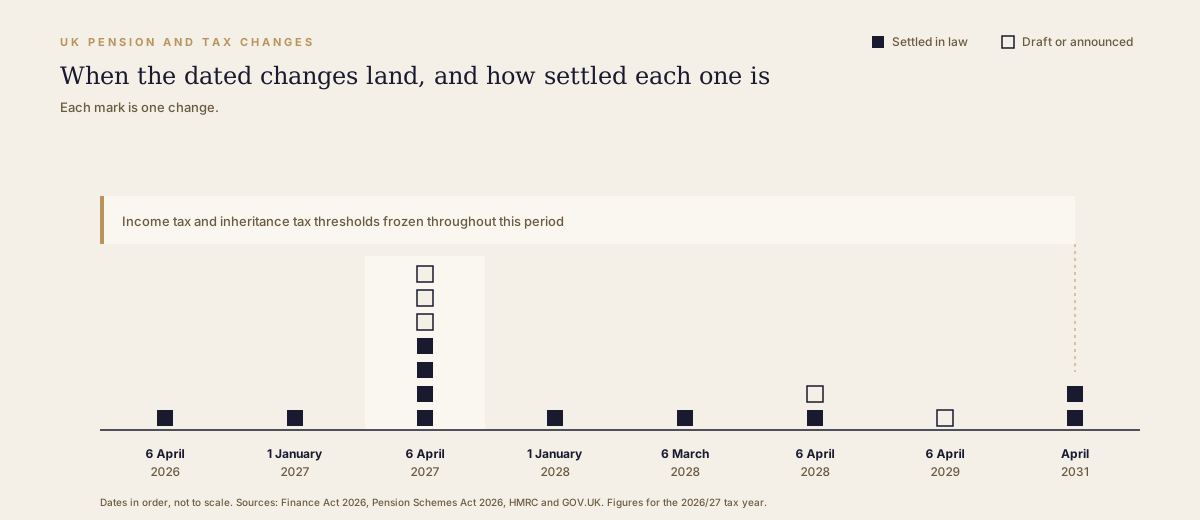
The UK pension and tax changes timetable is the sequence of statutory changes to pension, inheritance tax, ISA and income tax rules that already have a fixed date between 2026 and 2031. The changes cluster on 6 April 2027, and they interact: a plan built around leaving a pension untouched for inheritance runs into a lower cash ISA limit on the money you would spend instead. How settled each change is matters as much as its date, because the pension change is enacted while the ISA changes are still draft regulations that could move. The table below is kept current as dates are added, and each row links to the guide that covers it properly.
A dated change and a rumoured one need completely different responses, and most coverage runs the two together. Everything in the table below has a date already attached to it, set by legislation or by published draft regulations rather than by a decision nobody has taken yet. That is the whole selection rule for this page. All figures reflect the 2026/27 tax year, and every one of them is read from the rates and allowances page, which carries the source and the check date behind each one.
Which UK pension and tax changes are already law?
The April 2027 pension inheritance tax change and the income tax threshold freeze to 2031 are both enacted in the Finance Act 2026, and the rises in State Pension age and pension access age have been law for years. The cash ISA changes were published as draft regulations in June 2026 and have not yet been made.
Contents
- The dated changes
- What the status column means
- Which of these changes interact
- Should you act now or wait for the Budget?
- Where a dated timetable fits in your planning
The dated changes
This page is an index rather than an explanation. Each row links to the guide that covers that change in the detail it deserves, and the table is updated as dates are added, amended or reached. Where a row states a figure, the figure is read from the announced section of the rates and allowances page. What the rest of this page adds is the two things a list of dates cannot carry on its own: how much weight each date will bear, and which of these changes collide with each other.
Risk warnings
Investments
Investing in shares should be regarded as a long-term investment and should fit in with your overall attitude to risk and financial circumstances.
The taxation of the investment is dependent on the individual circumstance of each investor, and may be subject to change in the future.
ISAs
The favourable tax treatment of ISAs may be subject to changes in legislation in the future.
Salary sacrifice
Mortgage lenders may calculate borrowing amounts in terms of the reduced salary.
Mortgages
Your home may be repossessed if you do not keep up repayments on your mortgage. Think carefully before securing debts against your home.
Not all mortgage contracts are regulated by the Financial Conduct Authority.
Defined benefit transfers
We do not currently provide advice on transferring out of defined benefit (final salary) pension schemes. If you require this advice, we will provide details of a suitably qualified adviser at a firm with the necessary regulatory permissions who can assist you.
What the status column means
The words in that column are doing different jobs, and the difference decides how much of a plan should rest on any given row.
In force means the rule already applies and there is nothing to wait for. Enacted means Parliament has passed it and the start date sits in the future, which is the strongest position a future change can be in. Draft means the wording has been published and consulted on, but the regulations have not been made, so the detail can still move. Announced is the weakest of the four: a published figure and an effective date, which is more than a rumour and less than a statute.
Treat a draft as a strong signal about direction and a weak one about detail. The draft ISA regulations published for consultation in June 2026 are far enough advanced that ignoring them would be careless, and unmade enough that building something irreversible on their exact figures would be premature.
The two 2031 rows need a caveat of their own, because nothing actually happens that day. A freeze ending does not mean the thresholds rise. It means only that the freeze stops, and what replaces it is a decision nobody has taken. Until then the nil-rate band of £325,000, the residence nil-rate band of £175,000 and the £2 million taper threshold hold still, as do the personal allowance at £12,570 and the higher rate threshold at £50,270. Scotland sets its own income tax rates and bands, so a Scottish taxpayer is affected by the personal allowance half of that and not the rest.
Which of these changes interact
6 April 2027 is where the collisions are, and they hold more easily as two pairs.
The first pair concerns pensions. Unused funds and death benefits become part of your taxable estate for inheritance tax under the Finance Act 2026, reversing the position that has held since 2015, and alongside it scheme administrators pick up statutory deadlines for giving personal representatives what they need.
The second pair concerns cash. The annual cash ISA limit falls for under-65s while savers aged 65 and over keep the full £20,000, and a flat charge lands on interest from cash held inside a stocks and shares or innovative finance ISA, which closes the obvious route around the lower limit.
The pairing matters more than either change on its own. A great many retirement plans were built on a simple order: spend the ISA and the general investment account first, leave the pension alone, because the pension passed on free of inheritance tax. From 6 April 2027 the reason for that order disappears, and at the same moment the wrapper you were spending down becomes harder to refill in cash. If your income strategy was written under the old logic, this is the date it stops describing reality.
The second collision involves no new rule at all. A frozen threshold needs no announcement to bite: estates cross it through house prices and investment growth, not through anything the owner decided. Someone whose estate sits at £1.9 million today may find the £2 million taper reaching them well before 2031, and adding an unused pension from April 2027 accelerates it. The interaction between the bands is where most of the real movement happens, and none of it appears as a dated event.
The third is a trap of timing rather than of tax. The State Pension age finishes its rise to 67 on 6 March 2028, and the earliest age you can touch your own pension rises from 55 to 57 four weeks later. Two different ages, a month apart, under separate legislation, and anyone planning to stop work in that window needs both dates rather than whichever one they happened to read about first. A protected pension age can preserve earlier access to a private pension; nothing preserves an earlier State Pension age, which is set purely by your date of birth, and you can check yours on GOV.UK.
One row interacts with nothing, which is worth saying plainly. The 2029 cap on National Insurance relief for salary sacrifice leaves income tax relief on employee and employer contributions untouched. The arrangement still works; it just costs more above £2,000 of sacrifice a year, and the cost lands on the employer as much as on the employee.
Risk warnings
Pensions
Levels and bases of, and reliefs from, taxation are subject to change and their value will depend upon personal circumstances. Taxation and pension legislation may change in the future.
A pension is a long-term investment, the value of your investment and the income from it may go down as well as up. Your eventual income may depend upon the size of the fund at retirement, future interest rates and tax legislation.
Salary sacrifice
Employees earning more than £260,000 with a tapered annual allowance may incur additional annual allowance tax charges.
Tax, trusts and estate planning
HM Revenue and Customs practice and the law relating to taxation are complex and subject to individual circumstances and changes which cannot be foreseen.
Should you act now or wait for the Budget?
Act now where the action is right regardless of the Budget, and wait where it is not. That sounds evasive until you apply it, at which point it sorts almost everything.
Some of what sits on this timetable is worth work now, because it does not depend on a fiscal event. The withdrawal order in a retirement plan built around inheritance-free pensions needs revisiting, because the premise it rests on expires: 2026/27 is the last tax year in which a pension passes outside the estate. An estate approaching the £2 million taper wants modelling with the pension counted in. Unused pension annual allowance from three years back lapses on its own schedule, which is a genuine deadline that no Chancellor sets.
Revisiting is not the same as acting, and the first two of those carry a trap worth naming before anybody moves money. Drawing a pension down faster because it will sit inside the estate brings forward income tax at your marginal rate. Inside the pension the fund grows free of income tax and capital gains tax, and the tax on what you eventually draw is deferred rather than removed, so the real question is when you pay it and at what rate. Taking taxable income flexibly also triggers the money purchase annual allowance, which cuts what you can contribute from £60,000 to £10,000 a year for the rest of your life. Neither of those can be undone once the money is out.
Using carry forward has a quieter version of the same problem. A personal contribution needs relevant UK earnings at least equal to the amount paid in, and a tapered annual allowance can shrink what is genuinely available to as little as £10,000. The affordability question also comes before the tax one, because money going into a pension is not accessible again until 55, and until 57 once April 2028 arrives.
What does not deserve work is anything being considered only because of what a Budget might contain. Crystallising a gain, surrendering a relief or making a gift you cannot reverse, in order to get ahead of a measure that has not been proposed, is a real and permanent cost paid against a hypothetical one. Far more measures are speculated about than are ever enacted, which is what makes the trade a poor one. Waiting is not free of risk, because a Budget can change a rate from the day it is delivered and the window closes with the announcement. What separates acting early from waiting is certainty rather than size, and that does not change with the political weather.
The draft entries sit between the two, which is what the status column is for.
Risk warning
Your pension income could also be affected by the interest rates at the time you take your benefits. The tax implications of pension withdrawals will be based on your individual circumstances, tax legislation and regulation which are subject to change in the future.
Where a dated timetable fits in your planning
A timetable is a filter, not a plan. Its value is that it separates the handful of changes with a real date attached from the far larger volume of coverage that surrounds them, most of which describes things nobody has decided yet.
Almost everything on this page changes when or how a rule applies rather than whether the underlying planning still makes sense. Pension contributions still attract the same tax relief after April 2027, ISAs are still worth filling after the cash limit falls, and salary sacrifice still works after 2029. What moves is the order you do things in and the size of the advantage.
That is why a run of dated changes across five years produces so much less work than the volume of commentary suggests. Every row falls into one of two groups. A few of them, the pension inheritance tax charge and the residence nil-rate band taper above all, reshape a plan, and both reward the same response: knowing what your estate is actually worth with the pension counted in. The rest are adjustments you make once, when the date arrives.
Sorting the rows into those two groups is most of the value a timetable has, and which group a given change falls into depends entirely on the size and shape of what you hold. That is the part this page cannot do for you: the same row is a footnote for one household and the centre of the plan for another, and only your own numbers decide which. Anyone building a plan around pensions and retirement is really deciding the order of those two groups.
Frequently asked questions
What is the UK pension and tax changes timetable?
It is the sequence of statutory changes to pension, inheritance tax, ISA and income tax rules that already have a fixed date between 2026 and 2031. Each entry has a start date set by legislation or by published draft regulations rather than by a Budget decision, which is what separates the timetable from speculation about future tax policy.
Do the State Pension age and the pension access age change on the same date?
No, and they are a month apart, which catches people planning a retirement date. The State Pension age finishes its rise to 67 on 6 March 2028, while the age at which you can touch your own private pension rises from 55 to 57 on 6 April 2028. They are separate ages under separate legislation, and only the second one is affected by a protected pension age.
How does the April 2027 pension change interact with the residence nil-rate band?
Adding an unused pension to your estate can push the total past £2 million, and above that figure the residence nil-rate band tapers away by £1 for every £2 of excess. An estate at £1.9 million today with a £400,000 pension therefore loses relief it currently keeps, on top of the inheritance tax on the pension itself. This interaction catches estates that were comfortably clear of the taper before the pension was counted.
Does the cash ISA change affect money already in a cash ISA?
No. The limit of £12,000 a year from 6 April 2027 applies to new subscriptions in a tax year, not to balances already built up, so an existing cash ISA can stay where it is and keep its tax treatment. What changes is how much new money an under-65 can add each year, and the ability to transfer from a stocks and shares ISA into a cash ISA. Balances transferred between cash ISAs are unaffected.
What happens to unused pension annual allowance after 5 April 2027?
Carry forward reaches back three tax years, so unused allowance from 2023/24 can be used in 2026/27 and then lapses. This is an existing rule rather than one of the scheduled changes, and it repeats every year: 2024/25 allowance lapses after 5 April 2028. It is unaffected by anything on this timetable or by a Budget.
Should I make a large pension contribution before the carry-forward window closes?
Only if you have the earnings and the liquidity to support it. A personal contribution is capped at your relevant UK earnings for the year, so a retired reader with no earned income cannot use carry forward at all regardless of unused allowance. A tapered annual allowance can also cut what is available to as little as £10,000. The money is then locked until 55, rising to 57 from 6 April 2028, which makes affordability the first question rather than the tax saving.
What happens if the draft ISA regulations are not made in time?
The current rules continue. A draft statutory instrument has no effect until it is made, so if the regulations are not in place by 6 April 2027 the cash ISA limit stays at £20,000 for all ages until they are. The consultation on the draft closed on 2 August 2026 and HMRC is considering responses. This is the practical reason to treat the ISA entries on this timetable as a direction rather than a date to plan around precisely.
Does the 2029 salary sacrifice cap affect income tax relief?
No. The cap of £2,000 a year from 6 April 2029 applies to the National Insurance exemption only, and income tax relief on both employee and employer pension contributions is unchanged. An arrangement sacrificing more than that keeps its income tax advantage and loses the National Insurance saving above it. The change is to the cost of the arrangement, not to whether it works.
Risk warning
The Financial Conduct Authority (FCA) does not regulate Inheritance Tax Planning or Trust Advice.