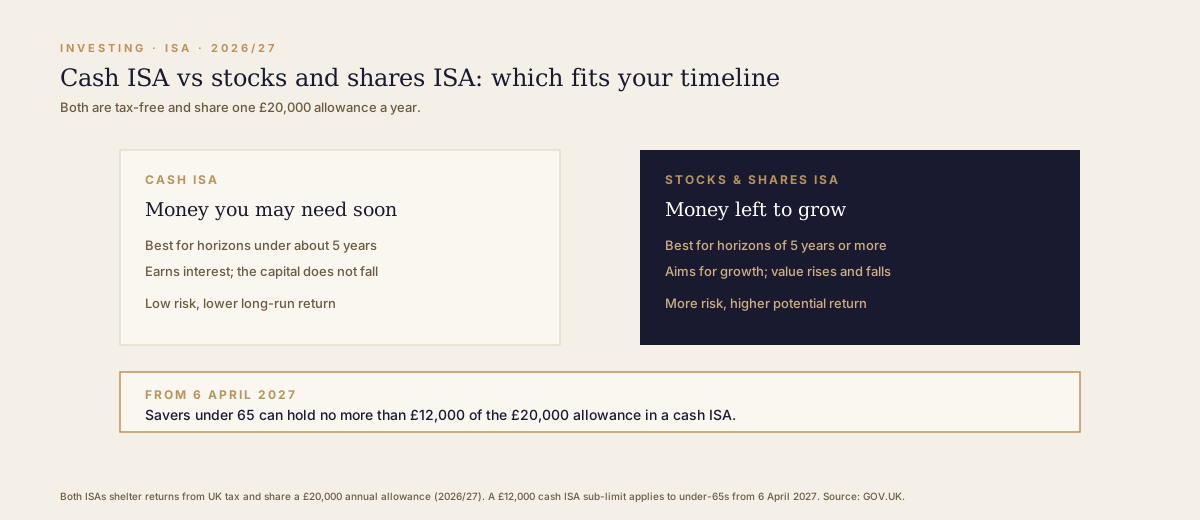
A cash ISA and a stocks and shares ISA are tax-free savings accounts; a cash ISA holds cash deposits that earn interest, while a stocks and shares ISA holds investments such as funds and shares. A cash ISA suits money you may need within about five years; a stocks and shares ISA suits money you can leave invested for longer, where growth outweighs short-term risk. Both shelter your returns from UK tax, but one holds interest-bearing cash and the other holds investments that rise and fall in value. Savers under 65 will be limited to £12,000 a year from 6 April 2027 in a cash ISA, within the same £20,000 overall allowance.
Cash ISA vs stocks and shares ISA is a choice between certainty and growth. Both are tax-free wrappers, so neither charges you UK tax on the interest, dividends, or gains earned inside them. The difference is what they hold: a cash ISA holds deposits that earn a set rate of interest, while a stocks and shares ISA holds investments whose value can rise and fall. That single difference, capital protected versus capital at risk, drives almost every other decision about which to use and when. All figures and thresholds in this article reflect the 2026/27 tax year.
What is the difference between a cash ISA and a stocks and shares ISA?
A cash ISA holds deposits that earn interest and never falls in value, so your capital is protected. A stocks and shares ISA holds investments such as funds and shares, which can grow faster over time but can also drop. Both shelter returns from UK tax within the same £20,000 annual ISA allowance in 2026/27.
Contents
- What is the difference between a cash ISA and a stocks and shares ISA?
- How does a cash ISA work?
- How does a stocks and shares ISA work?
- Cash ISA vs stocks and shares ISA: how do they compare?
- Does the personal savings allowance make a cash ISA pointless?
- How do the 2027 cash ISA changes affect the choice?
- Should you choose a cash ISA or a stocks and shares ISA?
- Can you have both a cash ISA and a stocks and shares ISA?
What is the difference between a cash ISA and a stocks and shares ISA?
The difference between a cash ISA and a stocks and shares ISA is risk and return: a cash ISA keeps your capital safe and pays interest, while a stocks and shares ISA puts your capital to work in investments that can grow more but can also fall. The tax treatment is identical. What differs is the trade you are making with your money.
A cash ISA behaves like a tax-free savings account. You deposit money, it earns interest at a stated rate, and the balance only ever goes up. A stocks and shares ISA behaves like a tax-free investment account. You buy funds, shares, or bonds inside it, and the value tracks those holdings up and down. Over a year or two, cash is steadier; over a decade or two, investments have historically delivered more, though never with any guarantee.
This is why the comparison is rarely about which product is “best”. It is about matching the wrapper to the job. Money for a wedding next summer and money for retirement in twenty years are different problems, and they call for different answers even though both can sit inside an ISA.
Risk warning
The favourable tax treatment of ISAs may be subject to changes in legislation in the future.
How does a cash ISA work?
A cash ISA works like an ordinary savings account, except the interest is free of UK tax for as long as the money stays inside the wrapper. You can pay in up to the £20,000 overall ISA allowance for 2026/27, choose between easy-access and fixed-rate versions, and the balance is protected: it cannot fall in nominal value. Interest is added at the rate your provider offers, and you never report it to HMRC.
The strength of a cash ISA is certainty. You know what you will have, which makes it well suited to an emergency fund or a near-term goal where a fall in value would be unacceptable. The weakness is the flip side of that certainty. If the interest rate is lower than inflation, the real spending power of the money shrinks over time even as the number on the statement rises. Cash protects the pounds, not what those pounds can buy.
Easy-access cash ISAs let you withdraw whenever you need to, while fixed-rate versions pay more in exchange for locking the money away for a set term. Some are “flexible”, meaning you can withdraw and replace money in the same tax year without losing allowance, but not all are, so it is worth checking the specific account terms.
Risk warning
HM Revenue and Customs practice and the law relating to taxation are complex and subject to individual circumstances and changes which cannot be foreseen.
How does a stocks and shares ISA work?
A stocks and shares ISA holds investments rather than cash, and shelters all the growth, dividends, and gains from UK tax. You fund it from income you have already paid tax on, then invest in funds, individual shares, investment trusts, or bonds. There is no tax on dividends, no tax on growth, and no capital gains tax on shares when you sell inside the wrapper, however large the gain. Withdrawals are tax-free and never appear on a tax return.
The defining feature is investment risk. The value of a stocks and shares ISA moves with the markets it is invested in, so it can be worth less than you paid in, particularly over short periods. That is precisely why it suits long horizons: time gives markets the chance to recover from falls and for returns to compound. As a general guide, money you might need within five years is usually better in cash, while money you can leave for longer has more scope to benefit from being invested.
Compounding is what does the work over those longer periods. Compound growth applies each year’s return to the returns already earned as well as to the original capital, so where investments do outgrow cash, the gap between the two wrappers tends to widen with every year the money stays invested rather than opening in a straight line. That is also why the choice carries more weight than it appears to at the point of making it: any difference between the two wrappers is built out of time in the market, and time is the one input a later decision cannot add back.
The tax-free shelter matters more the larger your investments become. Outside an ISA, dividends and gains can be taxed once they exceed the relevant allowances, and those allowances have been cut sharply in recent years. Holding the same investments inside a stocks and shares ISA removes that drag entirely, which is one reason it sits at the heart of most long-term investment wrappers.
Risk warnings
The value of investments and any income from them can fall as well as rise. You may not get back the full amount invested.
The taxation of the investment is dependent on the individual circumstance of each investor, and may be subject to change in the future.
Cash ISA vs stocks and shares ISA: how do they compare?
The cash ISA vs stocks and shares ISA comparison comes down to four things: whether your capital is safe, how your money grows, how long you should hold it, and what it costs to run. The table sets them side by side.
How a cash ISA and a stocks and shares ISA compare across the features that matter most
| Feature | Cash ISA | Stocks and Shares ISA |
|---|---|---|
| Capital risk | Protected, cannot fall | At risk, can fall in value |
| Return | Fixed or variable interest | Growth and dividends, not guaranteed |
| Tax on returns | None | None |
| Best time horizon | Up to about 5 years | 5 years or more |
| Typical use | Emergency fund, near-term goals | Long-term and retirement savings |
| Charges | Usually none | Platform and fund charges apply |
No column wins outright. The cash ISA dominates on safety and simplicity; the stocks and shares ISA dominates on long-term growth potential and tax-sheltered compounding. A saver building a house deposit for next year values the certainty on the left, while someone investing for a retirement decades away values the growth on the right. The feature that looks like a weakness from one seat is a strength from the other.
The real risk in a cash ISA is not losing money on paper but losing spending power to inflation, which is why cash is a poor home for money you will not touch for ten or twenty years.
Does the personal savings allowance make a cash ISA pointless?
The personal savings allowance does narrow the case for a cash ISA, but it does not remove it. The allowance lets you earn a set amount of savings interest tax-free in an ordinary account: £1,000 for basic rate taxpayers and £500 for higher rate taxpayers in 2026/27, and £0 for additional rate taxpayers. There is also a separate starting rate for savings of up to £5,000 in 2026/27 for people with low non-savings income. For many savers, that means modest interest is already tax-free without using an ISA at all.
Where the cash ISA still earns its place is at higher balances, for higher earners, and as protection against future change. A higher rate taxpayer with a large cash holding can breach the £500 allowance quickly, and an additional rate taxpayer has £0. The personal savings allowance is also not guaranteed to stay where it is, whereas interest inside a cash ISA is sheltered permanently. The ISA wrapper is most valuable precisely for the people the personal savings allowance helps least.
How much can you pay into a cash ISA?
In 2026/27 you can pay up to £20,000 into a cash ISA, the full annual ISA allowance, as long as you do not exceed that across all your ISAs combined. The cash ISA limit falls to £12,000 a year from 6 April 2027 for savers under 65, while those aged 65 and over keep the full allowance.
How do the 2027 cash ISA changes affect the choice?
The amount under-65s can pay into a cash ISA falls from £20,000 to £12,000 a year from 6 April 2027, while the overall ISA allowance stays the same. Savers aged 65 and over keep the full allowance as their cash ISA limit. In practice, a younger saver who wants to use their whole allowance from that date will have to put at least £8,000 into a stocks and shares ISA or another ISA type rather than cash.
Alongside the lower cash limit, a new anti-avoidance rule closes the obvious workaround. Interest paid on cash held inside a non-cash ISA, such as money left uninvested in a stocks and shares ISA, faces a charge of 22% from 6 April 2027, and transfers from a non-cash ISA into a cash ISA are blocked from the same date, as confirmed in the GOV.UK ISA reform anti-circumvention factsheet. Only the transfer block lifts at 65. The charge on cash interest inside a non-cash ISA applies whatever your age, as does the bar on holding nothing but cash-like assets. The practical message is that parking a large cash balance inside a stocks and shares ISA is not a route around the cash limit.
That is not the same as barring near-cash investments, and the distinction is worth holding onto. The factsheet defines cash-like assets as money market funds only, and they remain eligible inside a stocks and shares ISA as a partial holding; a 100% allocation to them makes the account non-qualifying. The charge falls on interest and alternative finance return paid on cash, so it still catches money left uninvested in the account, but it is not aimed at what a money market fund earns. An under-65 who wants the extra £8,000 sheltered without much volatility has somewhere to put it from 6 April 2027, so long as it is not the entire account. It is an investment rather than cash, though: the value is not fixed and there is no deposit protection.
The change is designed to nudge long-term savers from cash towards investing, and it sharpens a decision many people were avoiding. It does not affect the current tax year: for 2026/27 the full £20,000 can still go into cash. It also leaves the stocks and shares ISA allowance untouched. If you are weighing where to direct money you will not need for years, the reform is a reason to look seriously at investing through a stocks and shares ISA, or at the wider stocks and shares ISA versus pension question, rather than defaulting to cash out of habit.
For younger savers with a specific goal, a Lifetime ISA can also be worth weighing alongside the two, since its 25% government bonus serves a particular job that neither a plain cash nor stocks and shares ISA matches.
Risk warnings
Pensions
The value of pensions and any income from them can fall as well as rise. You may not get back the full amount invested.
Levels and bases of, and reliefs from, taxation are subject to change and their value will depend upon personal circumstances. Taxation and pension legislation may change in the future.
A pension is a long-term investment and the value is not guaranteed. Any advice or considerations are personal to each individual’s circumstances.
A pension is a long-term investment, the value of your investment and the income from it may go down as well as up. Your eventual income may depend upon the size of the fund at retirement, future interest rates and tax legislation.
Cash and deposits
The Financial Services Compensation Scheme (FSCS) protects eligible deposits up to £120,000 per person, per banking licence.
Some banking brands share a single licence, so spreading funds across them may not increase protection.
If total deposits with one banking group exceed the FSCS limit, amounts above this may not be covered in the event of default.
Should you choose a cash ISA or a stocks and shares ISA?
Choose a cash ISA for money you will need within about five years, and a stocks and shares ISA for money you can leave invested for longer. The deciding factor is your time horizon, not which account looks more attractive in a given month. A cash ISA removes the risk of a fall when you can least afford it; a stocks and shares ISA accepts that risk in exchange for a chance of growth that keeps ahead of inflation over time.
The trade-off is worth stating plainly. Cash gives you certainty and instant peace of mind but tends to lose real value over long periods. Investments give you growth potential but can fall, sometimes sharply, in the years you hold them. The mistake is using the wrong one for the job: holding a house deposit in shares risks a market dip just before completion, while holding a twenty-year retirement pot in cash quietly erodes it. Understanding why shares and bonds behave differently helps explain why long-term investors have historically been rewarded for accepting that volatility, though not over every period.
- Cash ISA if the money is an emergency fund, or earmarked for a goal within roughly five years.
- Stocks and Shares ISA if the money is for the long term and you can tolerate ups and downs along the way.
- A split of both if you have separate pots for separate goals, which is how most savers actually use their allowance.
Rebecca and Hannah, both 41, both with £20,000 to set aside for retirement
Rebecca puts her £20,000 into a stocks and shares ISA, accepting that the value will rise and fall over the years before she retires at 61. Hannah, the same age and saving for the same retirement, keeps her £20,000 in a cash ISA because it feels safer.
Over the twenty years, Rebecca’s invested ISA grows at an assumed 6% a year to around £64,000, while Hannah’s cash ISA earning around 3% reaches roughly £36,000. Both balances are tax-free; the gap is driven entirely by where the money was held.
The choice that looks like caution is the one that costs Hannah the most. For money she did not need to touch for two decades, the steadier account left close to £28,000 of potential growth on the table, while the risk she avoided was the very volatility that long horizons are built to absorb.
Returns are not guaranteed and the figures above are illustrative assumptions, not forecasts. Testing the choice against your actual goals and timeline, through investment advice or lifetime cashflow modelling, turns it from a general rule into a decision grounded in your own numbers.
Can you have both a cash ISA and a stocks and shares ISA?
Yes, and most people with more than one savings goal should. Since 6 April 2024 you can pay into more than one ISA of different types in the same tax year, so you can fund a cash ISA and a stocks and shares ISA together. The only constraint is the overall allowance: you can split your £20,000 allowance across your ISAs however you like in 2026/27, putting more into cash for a near-term goal and more into investments for a distant one.
Used together, the two wrappers cover different jobs cleanly. The cash ISA holds the money you might need at short notice or cannot afford to see fall, while the stocks and shares ISA holds the money you are growing for the long term. You can also transfer between them later: moving cash ISA money into a stocks and shares ISA through the official transfer process does not use up fresh allowance, which matters once you have built up balances from earlier years. From 6 April 2027 that road runs one way for under-65s. Cash into investments still works, but transferring back from a stocks and shares ISA into a cash ISA is closed off until you reach 65.
The lesson from putting a cash ISA and a stocks and shares ISA side by side is that they are not really rivals. They are tools for different time horizons, and the question is not which is better but which deserves each pound you are setting aside, given when you expect to spend it.
Frequently asked questions
What is a cash ISA?
A cash ISA is a savings account that holds cash deposits and pays interest free of UK tax. Your capital is protected, so the balance cannot fall in value, and you do not declare the interest on a tax return. In 2026/27 cash ISAs share the overall £20,000 annual ISA allowance with other ISA types.
How does a stocks and shares ISA work?
A stocks and shares ISA holds investments such as funds, shares, and bonds, sheltering all growth, dividends, and gains from UK tax. You fund it from money you have already been taxed on, and there is no tax to pay on withdrawals. The value rises and falls with markets, so you can get back less than you put in.
Is a cash ISA or a stocks and shares ISA better?
Neither is better in the abstract; it depends on when you need the money. A cash ISA is better for goals within about five years because the capital is safe. A stocks and shares ISA is usually better for money left invested for longer, where growth potential outweighs the risk of short-term falls.
Can you transfer a cash ISA to a stocks and shares ISA?
Yes. You can transfer money from a cash ISA to a stocks and shares ISA at any time without it counting against your annual allowance, provided you use the provider's official ISA transfer process. Withdrawing the cash and re-paying it yourself instead uses up fresh allowance and can lose the tax-free status.
Can you pay into a cash ISA and a stocks and shares ISA in the same year?
Yes. Since 6 April 2024 you can pay into multiple ISAs of different types in the same tax year. The only limit is the overall £20,000 ISA allowance for 2026/27, which you can split across a cash ISA and a stocks and shares ISA however you choose.
Do you pay tax when you withdraw from a stocks and shares ISA?
No. Withdrawals from a stocks and shares ISA are completely free of UK income tax and capital gains tax, however much the investments have grown. This is one of the wrapper's main advantages, because the same gains held outside an ISA could be subject to capital gains tax above the annual exempt amount.