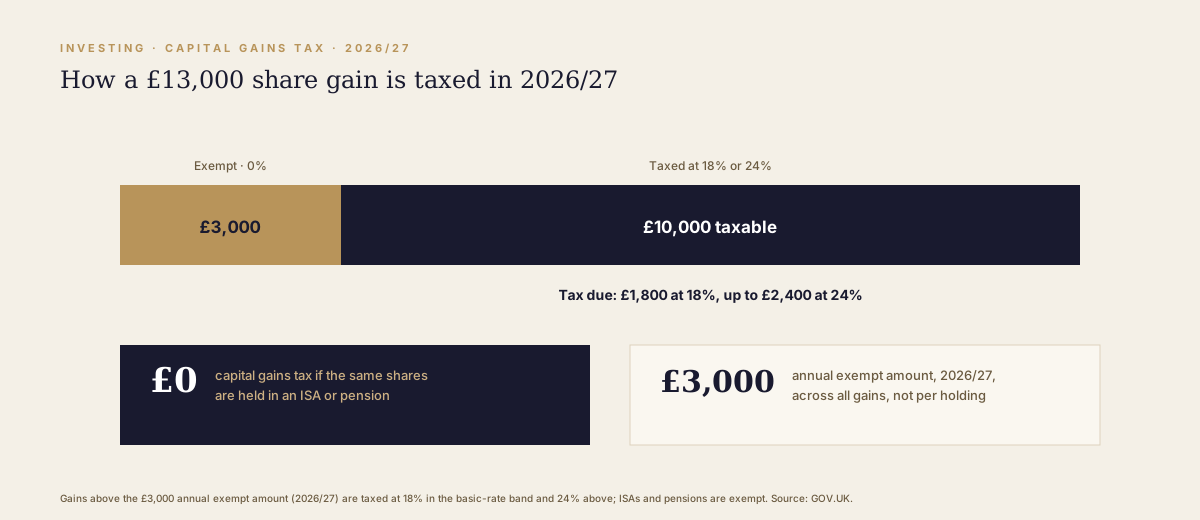
Capital gains tax on shares is a tax on the profit you make when you sell or dispose of shares that are held outside a tax-free wrapper such as an ISA or pension. You pay capital gains tax on shares held outside an ISA or pension once your gains for the year exceed the £3,000 annual exempt amount. The rate depends on your income: 18% within the basic-rate band and 24% above it for 2026/27. Shares held inside a stocks and shares ISA or a pension are entirely free of the charge, which is why the wrapper often matters more than the holding itself.
Capital gains tax on shares is the tax charged on the profit when you sell shares held outside a tax-free wrapper, and for most investors it only bites on holdings in a general investment account rather than an ISA or pension. The profit, not the sale price, is what is taxed, and only the part above the £3,000 annual exempt amount is chargeable for the year. The rate then depends on your income: 18% on gains within your remaining basic-rate band and 24% above it. All figures in this article reflect the 2026/27 tax year. Understanding how the gain is calculated, and where the wrapper sits, is the difference between a needless tax bill and a gain that is sheltered in full.
Do you pay capital gains tax on shares held in an ISA?
No. Shares held inside a stocks and shares ISA or a pension are free of capital gains tax, however large the gain. The charge only applies to shares held in a general investment account, and only once your total gains for the year exceed the £3,000 annual exempt amount for 2026/27.
Contents
- What is capital gains tax on shares?
- How is capital gains tax on shares calculated?
- What is the capital gains tax allowance?
- How does your income tax band affect the rate?
- Can you use your personal allowance against capital gains?
- How can you reduce capital gains tax on shares?
- Should you worry about capital gains tax on shares?
What is capital gains tax on shares?
Capital gains tax on shares is the tax on the profit when you sell shares for more than they cost you. The taxable event is the disposal, not the purchase, and it is the gain that is taxed, not the amount you receive. If you bought a holding for £20,000 and sold it for £33,000, the £13,000 increase is the chargeable gain.
The charge depends almost entirely on where the shares are held. Inside a stocks and shares ISA or a pension, gains are sheltered completely and never enter the calculation. Outside those wrappers, in a general investment account, gains above the annual exempt amount are taxable. This is why two investors holding the identical fund can face very different tax outcomes, and why the wrapper is a decision in its own right rather than an afterthought to picking the investment.
Shares are only one type of chargeable asset. The same tax applies to disposals of funds, investment trusts, and most other investments. Since October 2024 the rates on shares and other assets have matched those on residential property, at 18% and 24% for 2026/27, so the rate is no longer what sets the two apart. Residential property still differs in two ways: your main home is usually exempt, and a taxable property gain must be reported and the tax paid within 60 days of completion rather than through Self Assessment.
Risk warnings
Investments
The value of investments and any income from them can fall as well as rise. You may not get back the full amount invested.
The taxation of the investment is dependent on the individual circumstance of each investor, and may be subject to change in the future.
ISAs
The favourable tax treatment of ISAs may be subject to changes in legislation in the future.
Pensions
Levels and bases of, and reliefs from, taxation are subject to change and their value will depend upon personal circumstances. Taxation and pension legislation may change in the future.
A pension is a long-term investment, the value of your investment and the income from it may go down as well as up. Your eventual income may depend upon the size of the fund at retirement, future interest rates and tax legislation.
How is capital gains tax on shares calculated?
You calculate capital gains tax on shares by taking the gain, subtracting the £3,000 annual exempt amount and any losses, then applying the rate that matches your income. For 2026/27 that rate is 18% on gains within your remaining basic-rate band and 24% on anything above it. Allowable costs, such as dealing charges, reduce the gain before the allowance is applied.
How capital gains tax on a £15,000 share gain is worked out for a higher-rate taxpayer
Marcus, 60, a higher-rate taxpayer, sells a fund in his general investment account with a £15,000 gain in 2026/27.
| Input | Value |
|---|---|
| Total gain on the shares | £15,000 |
| Annual exempt amount | £3,000 |
| Taxable gain | £12,000 |
- Deduct the annual exempt amount: £15,000 minus £3,000 = £12,000.
- Marcus is a higher-rate taxpayer, so the 24% rate applies for 2026/27: £12,000 × 24% = £2,880.
- Report and pay the £2,880 through Self Assessment or HMRC’s real-time Capital Gains Tax service.
Result: Marcus pays £2,880 in capital gains tax, leaving £12,120 of the £15,000 gain after tax.
Where a holding has been built up through several purchases, the cost is averaged using share pooling, so you cannot simply match a sale to the cheapest or most expensive lots. The pool combines all shares of the same class in the same company into a single average cost, and HMRC’s guidance on selling shares sets out how the pooling and same-day rules work in practice.
Risk warning
HM Revenue and Customs practice and the law relating to taxation are complex and subject to individual circumstances and changes which cannot be foreseen.
What is the capital gains tax allowance?
The capital gains tax allowance, formally the annual exempt amount, is £3,000 a year for 2026/27. It is the total gains you can realise across all your assets in the tax year before any tax is due, not a separate allowance for each holding. The allowance was £12,300 as recently as 2022/23 before being cut in stages, so far more modest gains are now taxable than a few years ago.
Can you carry forward an unused capital gains tax allowance?
No. The annual exempt amount, £3,000 a year for 2026/27, cannot be carried forward and is lost if you do not use it by the end of the tax year. Capital losses are different: they can be carried forward indefinitely once reported to HMRC, provided you claim them within four years of the end of the tax year they arose.
Because the allowance resets every 6 April and cannot be banked, realising modest gains each year to use it is one of the few genuinely free tax savings available to investors. The allowance applies to gains, not proceeds, so you can sell far more than £3,000 of shares without a tax bill, provided the profit element stays within the limit.
How does your income tax band affect the rate?
Your income decides whether a share gain is taxed at 18% or 24%, because gains stack on top of your taxable income. HMRC counts your income first, fills up your basic-rate band, and then taxes the gain on whatever band space remains. For 2026/27, the basic-rate band runs to £37,700 of taxable income, so a gain that pushes you past that ceiling is taxed partly at 18% and partly at 24%.
This stacking effect means the same gain costs different amounts for different people. A basic-rate taxpayer with spare band space pays 18% on the gain, while a higher-rate taxpayer pays the upper rate of 24% on most or all of it. A large gain can also straddle the boundary, taxed at 18% up to the threshold and 24% beyond, which is one reason spreading disposals across tax years can change the outcome.
The interaction with dividends matters too, because both come from the same holdings. We cover how the dividend allowance and dividend tax work separately, but the principle is the same: income and gains from an unwrapped portfolio are taxed in layers, and the order in which they fall determines the rate.
Can you use your personal allowance against capital gains?
No. Your personal allowance applies only to income, so it cannot be set against a capital gain; gains have their own separate allowance, the £3,000 annual exempt amount for 2026/27. A common and costly assumption is that someone with little or no income can realise a gain up to the £12,570 personal allowance tax-free. Only the £3,000 exempt amount shelters a gain, and any unused personal allowance is simply lost for capital gains purposes.
What a low-income year does change is the rate, not the allowance. Because gains stack on top of taxable income, little income leaves most or all of the basic-rate band free, so more of the gain is taxed at 18% rather than 24%. The personal allowance and the annual exempt amount sit in separate systems: one shelters income, the other shelters gains, and neither spills over into the other.
Take Naomi, 47, who is on a career break and earns £5,000 from part-time work in 2026/27 while selling a fund in her general investment account at a £20,000 gain. Her £5,000 income sits within her personal allowance, so she pays no income tax, but that unused allowance does nothing for the gain. She deducts only the £3,000 annual exempt amount, leaving £17,000 taxable, and with no taxable income using up her basic-rate band the whole £17,000 falls within it and is taxed at 18%, a bill of £3,060. Someone expecting the personal allowance to cover the first slice of the gain would have braced for a far smaller bill.
How can you reduce capital gains tax on shares?
You reduce capital gains tax on shares mainly by using allowances, losses, a spouse’s tax position, and tax-free wrappers, rather than by avoiding selling. Four levers do most of the work, and they combine.
- Use the annual exempt amount every year. Realising up to £3,000 of gains each tax year keeps them permanently out of charge, and the allowance is lost if unused.
- Offset and carry forward losses. Capital losses reduce gains in the same year, and unused losses carry forward indefinitely once reported to HMRC within four years.
- Use a spouse or civil partner’s allowance. Transfers between spouses are no gain, no loss, so a couple can apply two £3,000 allowances and two sets of tax bands.
- Move holdings into an ISA. Selling in a general investment account and repurchasing inside an ISA, known as Bed and ISA, shelters all future growth.
The single most effective move is usually to involve a spouse, because it multiplies both the allowance and the lower-rate band. Transfers of assets between spouses are exempt, so the only cost is the paperwork to retitle the holding before sale.
Sofia and Liam, both sitting on a £24,000 share gain
Sofia, 52, is a higher-rate taxpayer with a £24,000 gain on a fund in her general investment account. She sells the whole holding in her own name in 2026/27. After her £3,000 allowance, £21,000 is taxable at 24%, a bill of £5,040.
Liam, 53, has an identical £24,000 gain and is also a higher-rate taxpayer, but he transfers half the holding to his wife Hannah, a basic-rate taxpayer, before selling. The transfer is no gain, no loss, so nothing is taxed on it. They then each realise £12,000.
Liam deducts his £3,000 allowance and pays 24% on £9,000, which is £2,160. Hannah deducts her own £3,000 allowance and, with her gain sitting inside the basic-rate band, pays 18% on £9,000, which is £1,620. Their combined bill is £3,780, against Sofia’s £5,040, a difference of £1,260 from one transfer form.
The wrapper, not the share, is where most capital gains tax is won or lost. The same holding that triggers a four-figure bill in a general investment account produces nothing at all once it sits inside an ISA or pension.
For larger or more complex portfolios, the order in which gains, dividends, and income are realised across several years is itself a planning exercise, and one that tailored investment advice is built to handle. The aim is not to dodge a single year’s tax but to position the whole portfolio so that growth lands in the most efficient place over time.
Should you worry about capital gains tax on shares?
For most investors, capital gains tax on shares is a manageable cost rather than a reason to avoid selling, and it should rarely drive the decision on its own. If your shares are held in an ISA or pension, there is nothing to worry about, because gains there are tax-free. The charge only becomes material when you hold significant unwrapped investments and need to realise large gains in a single year.
The real trade-off is between paying a modest tax now and leaving gains to build unchecked. Holding a winning share purely to defer the tax can concentrate risk in a single position, which sits awkwardly with how a balanced mix of the main types of investment is meant to behave, and it can store up a far larger bill later. Realising gains gradually and recycling them into an ISA spreads the tax and removes future growth from charge, so deferral is not the same as avoidance, and an unrealised gain is still a tax liability in waiting.
Where it pays to act is at the margins: using the £3,000 allowance before 5 April, harvesting losses to offset gains, and moving holdings into a tax-free wrapper over successive years. Weighing how aggressively to do this across a multi-year horizon is exactly the question a lifetime cashflow plan is built to answer, and none of it requires timing the market.
Where you hold shares is the part you can decide in advance
What a holding goes on to return is unknowable on the day you buy it. Whether the gain it produces is taxable at all is settled that same day, by the account you put it in. The same gain can be fully taxable or entirely sheltered depending on that one choice, which is why the decisions worth most here are usually made long before a sale. For anyone building wealth outside pensions, the question is less how to escape the tax on a single disposal and more how to route growth into ISAs and use allowances steadily, so that the unwrapped, taxable portion of a portfolio stays as small as it sensibly can.
Frequently asked questions
What is capital gains tax on shares?
Capital gains tax on shares is the tax you pay on the profit when you sell shares held outside a tax-free wrapper such as an ISA or pension. For 2026/27 it applies only once your total gains for the year exceed the £3,000 annual exempt amount, at 18% or 24% depending on your income.
How much can you gain before paying capital gains tax on shares?
You can make £3,000 of gains in the 2026/27 tax year before any capital gains tax is due. This annual exempt amount applies across all your chargeable assets combined, not per holding, and it cannot be carried forward if unused.
What is the capital gains tax rate on shares in 2026/27?
For 2026/27 the rate is 18% on gains that fall within your remaining basic-rate band and 24% on gains above it. Your taxable income is counted first, then your gains stack on top, so a higher earner pays 24% on most or all of a share gain.
Can you use your personal allowance against capital gains?
No. The personal allowance only reduces income tax, not capital gains tax. Gains have a separate £3,000 annual exempt amount for 2026/27, and any unused personal allowance cannot be set against a gain. A low income does, however, leave more of the basic-rate band free, so more of a gain is taxed at 18% rather than 24%.
How do you report and pay capital gains tax on shares?
You report gains on shares through a Self Assessment tax return after the end of the tax year, or through HMRC's real-time Capital Gains Tax service. The deadline to report and pay through Self Assessment is 31 January following the tax year in which you sold.
Should you sell shares just to use your capital gains tax allowance?
Using the £3,000 allowance each year can be worthwhile because it is lost if unused, but selling purely to crystallise a gain only helps if it fits your wider plan. Reinvesting the same shares inside an ISA, known as Bed and ISA, locks in future tax-free growth.
Can you transfer shares to your spouse to save capital gains tax?
Yes. Transfers of shares between spouses or civil partners are treated as no gain, no loss, so no tax arises on the transfer itself. This lets a couple use two £3,000 allowances and two sets of tax bands, which can materially cut the combined bill on a large gain.