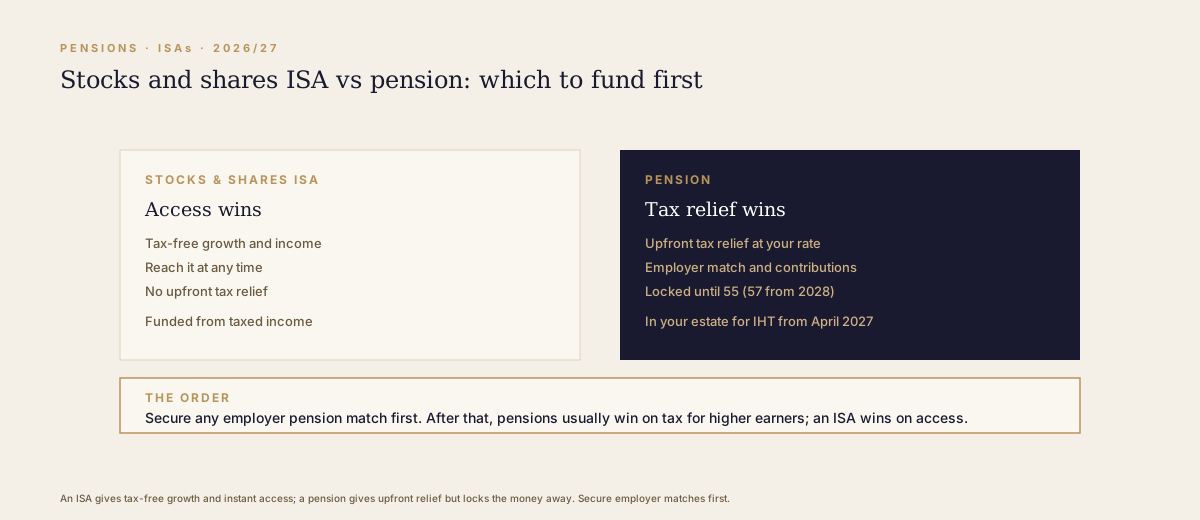
A Stocks and Shares ISA is a tax-free investment account with no access restrictions, while a pension is a tax-relieved retirement account that cannot normally be accessed until age 55. There is no single right order: securing any employer pension match usually comes first, then whether to favour an ISA or pension depends on your tax rate and timeline. An ISA offers tax-free growth with instant access, while a pension adds upfront tax relief in exchange for locking the money away until age 55, rising to 57 from 6 April 2028. Pensions usually win on tax for higher earners and matched contributions, but from 6 April 2027 unused pension funds fall within your estate for inheritance tax.
Stocks and Shares ISA vs pension is the question that decides where your next pound of long-term savings should go. Both wrap your investments so they grow free of capital gains and dividend tax, but they solve different problems. A pension pays you upfront, through tax relief, to lock money away until retirement. A Stocks and Shares ISA gives up that upfront break in return for tax-free access whenever you want it. The right order is rarely all of one and none of the other, and for most people it is not a permanent choice. All figures and thresholds in this article reflect the 2026/27 tax year.
How is a Stocks and Shares ISA taxed compared with a pension?
A Stocks and Shares ISA is funded from money you have already paid tax on, then grows and pays out completely tax free. A pension gives tax relief on the way in, lets you take 25% tax free at retirement, and taxes the rest as income. The ISA wins on access; the pension wins on upfront tax.
Contents
- Which should you use first?
- How does a Stocks and Shares ISA work?
- How does a pension work?
- How do they compare?
- What about the Lifetime ISA?
- How do the 2027 changes affect the choice?
- Should you use an ISA or pension first?
Stocks and Shares ISA vs pension: which should you use first?
Which to use first depends on your own circumstances rather than a fixed rule, though one starting point is close to universal: if your employer matches pension contributions, securing that match usually comes before anything else, because it is an immediate return that neither wrapper can match on tax alone. Beyond that, the right answer is shaped by three things: your tax rate, whether you might need the money before retirement, and how much you can realistically afford to save.
Those factors can point different people in opposite directions. A higher earner with a healthy emergency reserve and no near-term spending plans may sensibly lean towards the pension for its relief, while someone who might need the money for a house deposit or a career break may put a Stocks and Shares ISA first for its access, even though that means giving up the upfront tax break. Neither is following a better rule; they are weighing the same trade-offs against different lives. Choosing the right investment wrapper for your situation often matters more to the final outcome than choosing the investments held inside it.
The question is rarely whether you can use both, because few people fill either limit. The ISA allowance is £20,000 a year for 2026/27 and the pension annual allowance is £60,000, so for most savers the practical decision is which wrapper deserves the money they actually have to save this year.
Risk warnings
ISAs
The favourable tax treatment of ISAs may be subject to changes in legislation in the future.
Pensions
Levels and bases of, and reliefs from, taxation are subject to change and their value will depend upon personal circumstances. Taxation and pension legislation may change in the future.
How does a Stocks and Shares ISA work?
A Stocks and Shares ISA is an account that holds investments, such as funds, shares, and bonds, and shelters them entirely from UK tax on growth, dividends, and withdrawals. You fund it from income you have already paid tax on, so there is no relief going in, but there is also no tax to pay coming out, and no need to declare it on a tax return. You can subscribe up to £20,000 a year for 2026/27 across all your ISAs, and you can withdraw at any time without penalty.
The defining feature is access. Because the money is never locked away, a Stocks and Shares ISA doubles as both a long-term investment vehicle and a large, flexible reserve. That flexibility is exactly why it sits ahead of extra pension contributions for anyone who might need the capital before retirement age. It is worth remembering that the wrapper removes tax, not investment risk: the value still rises and falls with markets, so an ISA suits money you can leave invested for at least five years.
The trade-off is that you receive no upfront boost. Every £100 you invest costs you £100, whereas the same £100 into a pension costs a higher rate taxpayer far less after relief. For a long-term retirement pound, that missing relief is a real cost, which is why the ISA is rarely the most tax-efficient home for money you are certain you will not touch until you are older.
Risk warnings
Investments
The taxation of the investment is dependent on the individual circumstance of each investor, and may be subject to change in the future.
Pensions
Your pension income could also be affected by the interest rates at the time you take your benefits. The tax implications of pension withdrawals will be based on your individual circumstances, tax legislation and regulation which are subject to change in the future.
How does a pension work?
A pension works in the opposite direction: it rewards you upfront with tax relief, then restricts when you can take the money out. Contributions receive tax relief at your marginal rate, within a £60,000 annual allowance or 100% of your earnings if lower. Basic rate relief lifts a £80 net payment to £100 in the pension automatically; higher and additional rate taxpayers claim the rest from HMRC, an extra step explained in the article on how to claim higher rate pension tax relief.
The catch is access and eventual taxation. You cannot normally touch a pension until age 55, rising to 57 from 6 April 2028. When you do, up to 25% is tax free and the remainder is taxed as income at your marginal rate in retirement. The pension’s edge therefore depends on relief being given at a higher rate than the rate you eventually pay on withdrawal, which is common: many higher rate taxpayers during their careers become basic rate taxpayers in retirement. The size of the pot you can build is also shaped by the pension annual allowance and, for very high earners, a tapered version of it.
A pension is best understood as a deferral, not a giveaway: it lets you contribute before tax and pay tax later, usually at a lower rate, in exchange for accepting that the money is genuinely out of reach until your late fifties.
Risk warning
HM Revenue and Customs practice and the law relating to taxation are complex and subject to individual circumstances and changes which cannot be foreseen.
Stocks and Shares ISA vs pension: how do they compare?
The Stocks and Shares ISA vs pension comparison comes down to four levers that pull in opposite directions: the upfront tax break, when you can access the money, how withdrawals are taxed, and what happens on death. The table sets them side by side.
How a Stocks and Shares ISA and a pension compare across the features that matter most
| Feature | Stocks and Shares ISA | Pension |
|---|---|---|
| Tax relief on contributions | None | At your marginal rate (20%, 40%, 45%) |
| Annual limit (2026/27) | £20,000 | £60,000 or 100% of earnings |
| Access | Any time | Age 55, rising to 57 from 6 April 2028 |
| Tax on withdrawal | None | 25% tax free, rest taxed as income |
| Employer contributions | No | Yes, often matched |
| On death (from April 2027) | In your estate for IHT | In your estate for IHT |
No column wins outright, which is the point. The pension dominates on the way in, thanks to relief and employer contributions; the ISA dominates on flexibility and on the simplicity of tax-free withdrawals. A 30-year-old saving for a possible house move values the ISA’s flexibility, while a 50-year-old higher earner saving purely for retirement values the pension’s relief. The features that look like weaknesses from one seat are strengths from the other.
How much can you pay into an ISA and a pension each year?
In 2026/27 you can subscribe up to £20,000 across all ISAs and contribute up to £60,000 to pensions, or 100% of your earnings if lower, with tax relief. The two limits are separate, so funding one does not reduce the other. Unused pension allowance can sometimes be carried forward from the previous three tax years.
What about the Lifetime ISA?
The Lifetime ISA sits between the two and can beat both for a specific job. It adds a 25% government bonus on up to £4,000 a year, so £4,000 becomes £5,000, and that payment counts towards your overall £20,000 ISA allowance. You can only open one between the ages of 18 and 39, and the money is intended for a first home worth up to £450,000 or for retirement from age 60.
For a first-time buyer, the Lifetime ISA bonus often outranks both an ordinary Stocks and Shares ISA and a pension, because the 25% uplift matches basic rate pension relief but the money can be used for a property years before pension age. The limitation is the 25% withdrawal charge if you take the money out for any other reason before 60, which can return less than you put in. It is a powerful but narrow tool, best slotted into a plan rather than treated as a general-purpose account.
How do the 2027 changes affect the choice?
Two confirmed changes from April 2027 nudge the balance, though neither overturns the basic logic. The first is the inheritance tax change: from 6 April 2027, most unused pension funds will be brought within your estate for inheritance tax on unused pension funds and death benefits. This removes a long-standing advantage of using pensions to pass wealth on, and it matters most for larger estates. The wider implications are set out in the article on pensions and inheritance tax from April 2027.
The second change is to the ISA itself. The amount under-65s can subscribe to a cash ISA falls to £12,000 a year from 6 April 2027, but the overall £20,000 ISA limit is unchanged and the Stocks and Shares ISA allowance is unaffected. In practice that pushes more savers towards investing rather than holding cash, which suits the long horizons an ISA is built for. Neither change alters the day-to-day ranking of employer match, then ISA, then pension, but both are reasons to revisit the plan rather than set it once and forget it.
Risk warning
While cash provides security of capital, it may not keep pace with inflation. Over time, the real value of your savings could fall.
Should you use a Stocks and Shares ISA or pension first?
Which to prioritise depends on your tax rate and when you will need the money, with one near-universal exception: an employer pension match is usually worth securing first. Beyond that match there is a genuine trade-off rather than a single right answer, and for many people the sensible response is to run both wrappers in parallel rather than exhaust one before starting the other.
The trade-off is worth stating plainly. The pension gives more tax-efficient pounds but they are locked away and taxed on withdrawal, while the ISA gives fewer pounds upfront but total freedom over when and how you spend them. A useful test is your own tax rate: relief given at 40% or 45% and later taxed at 20% is a clear win for the pension, whereas a basic rate taxpayer who values flexibility loses far less by leaning on an ISA.
- Pension first if your employer matches contributions, you are a higher or additional rate taxpayer, or the money is firmly for retirement.
- Stocks and Shares ISA first if you may need the money before age 55, you have used your match, or you want simple tax-free access.
- Lifetime ISA if you are within the 18 to 39 opening window and saving for a first home or for retirement from 60, where the 25% bonus does specific work.
Maya, 34, basic rate, and Daniel, 52, higher rate, both with £6,000 to invest
Maya earns £38,000 and hopes to buy a first home within five years. She has already captured her employer match. She puts her £6,000 into a Stocks and Shares ISA, keeping it within reach for the deposit, accepting no upfront relief in exchange for the freedom to use it before retirement.
Daniel earns £72,000, owns his home, and is saving purely for retirement. He pays the same £6,000 into his pension. Basic rate relief is added by the provider, so £7,500 lands in the pension, and because he is a higher rate taxpayer he claims a further £1,500 through his tax return. Once that refund reaches him, the £7,500 has cost him £4,500.
The decision that looks like a detail is Daniel’s tax rate. The same £6,000 leaves both their hands, and it buys Maya £6,000 she can reach and Daniel £7,500 he cannot, with £1,500 of his own tax coming back on top. Maya is not making a mistake: she is buying access she will use soon. Daniel is not being clever: he simply has no need to touch the money early, so the locked-away pound is the cheaper one for him.
Modelling both routes against your real spending and timeline, through lifetime cashflow modelling, turns this from a general preference into a decision grounded in your own numbers.
Can you use both an ISA and a pension?
Yes, and most people building serious long-term savings should. The £20,000 ISA allowance and the £60,000 pension annual allowance are separate, so there is no need to choose one wrapper exclusively. A common pattern is to secure the employer match, build an ISA large enough to cover access needs and emergencies, then direct surplus income into the pension for the relief.
Used together, the two wrappers create a useful structure in retirement as well. Drawing tax-free ISA money alongside taxable pension income lets you manage which tax band you fall into year by year, a flexibility that a pension alone cannot provide. Coordinating contributions and withdrawals across both is where joined-up investment advice and pension and retirement planning earn their place, because the right split depends on your whole financial picture rather than either account in isolation.
The lesson from putting a Stocks and Shares ISA and a pension side by side is that they are not rivals so much as tools for different jobs. The question is not which is better in the abstract, but which deserves your next pound given your tax rate, your employer, and how soon you will need the money.
Frequently asked questions
What is the difference between a Stocks and Shares ISA and a pension?
A Stocks and Shares ISA is a tax-free investment account you can access at any time, funded from money you have already been taxed on. A pension is a retirement account that adds tax relief to your contributions but cannot normally be touched until age 55, rising to 57 from 6 April 2028. The ISA trades the upfront tax break for flexibility; the pension does the reverse.
How does pension tax relief make a difference?
Pension tax relief refunds the income tax you paid on a contribution, so a £100 pension payment costs a basic rate taxpayer £80 and a higher rate taxpayer £60 after relief. A Stocks and Shares ISA receives no relief, so £100 invested costs the full £100. That upfront boost is the pension's main mathematical advantage, partly clawed back because withdrawals above the 25% tax-free portion are taxed as income.
Should you use a Stocks and Shares ISA or a pension first?
Fund enough pension to capture any employer match first, because matched contributions are an immediate return no ISA can beat. Beyond that, a Stocks and Shares ISA suits money you may need before age 55, while extra pension contributions suit higher earners and money firmly earmarked for retirement. Many people use both rather than choosing one.
Can you lose money in a Stocks and Shares ISA?
Yes. A Stocks and Shares ISA holds investments whose value rises and falls, so you can get back less than you put in. The same investment risk applies inside a pension. The ISA and pension wrappers change the tax treatment, not the underlying market risk, which is why both suit long-term horizons rather than money needed within a few years.
Does a Stocks and Shares ISA use up your pension annual allowance?
No. The £20,000 ISA allowance and the £60,000 pension annual allowance for 2026/27 are entirely separate, so paying into one does not reduce the other. A couple could in principle shelter £160,000 across both wrappers in a single tax year, subject to having the earnings to support the pension contributions.
What happens to a Stocks and Shares ISA and a pension when you die?
A Stocks and Shares ISA forms part of your estate and can be subject to inheritance tax, though a surviving spouse can inherit the ISA tax wrapper. Pensions have historically sat outside the estate, but from 6 April 2027 most unused pension funds will be brought within it for inheritance tax. This change narrows one of the pension's long-standing advantages.