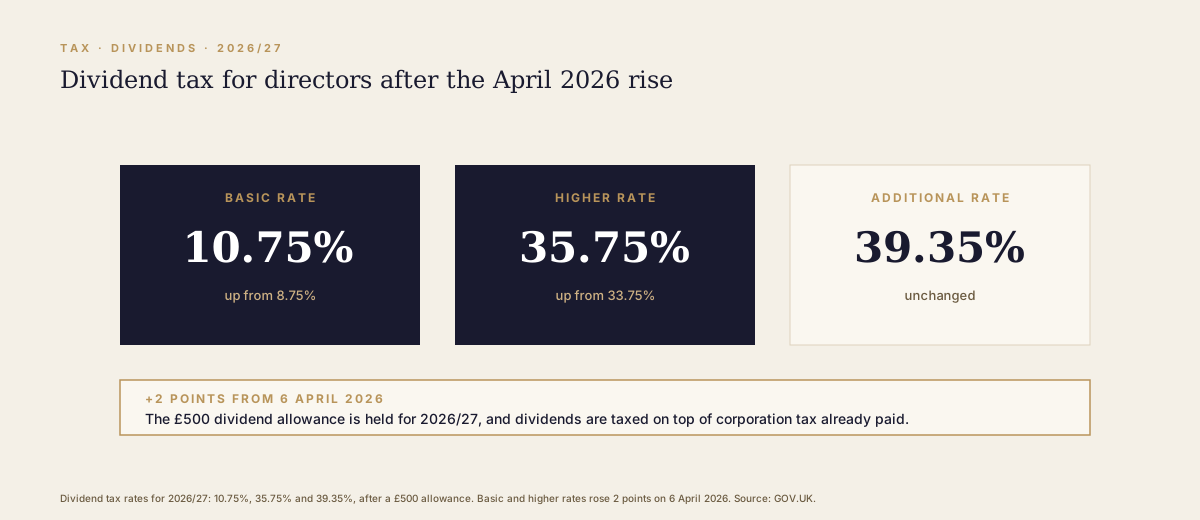
Dividend tax is the personal income tax a shareholder pays on dividends received from a company, charged at rates determined by their overall income tax band. Company directors pay dividend tax on profits drawn from their company as dividends, on top of the corporation tax the company has already paid. From 6 April 2026 the basic and higher rates rose by two percentage points, to 10.75% and 35.75%, raising the cost of taking profit this way. Because dividends stack on top of salary, a modest salary can still push dividend income into the higher-rate band.
Dividend tax for company directors changed on 6 April 2026. The basic and higher rates each rose by two percentage points, to 10.75% and 35.75%, while the additional rate held at 39.35% and the tax-free dividend allowance stayed at £500. For anyone drawing profit from their own limited company as dividends, that shift quietly raised the cost of every pound taken above the allowance. The rates and thresholds in this article are correct for the 2026/27 tax year. What follows is how dividends are taxed once they land on top of a director’s salary, how corporation tax compounds the bill, and where the decision sits within a wider remuneration plan.
How is dividend tax calculated for a company director?
Add the director’s salary and dividends together to find the tax band. Salary uses the personal allowance and basic-rate band first, and dividends stack on top. After the £500 dividend allowance, dividends within the basic-rate band, up to £50,270 of total income, are taxed at 10.75%, and those above at 35.75%.
Contents
- How are dividends taxed for company directors?
- What is the dividend allowance, and how has it changed?
- How does corporation tax affect the real cost of director dividends?
- Are dividends still the most tax-efficient way to pay yourself?
- Can you split dividends with your spouse?
- How is dividend income reported to HMRC?
How are dividends taxed for company directors?
A company director pays dividend tax personally on the dividends they receive as a shareholder, at 10.75%, 35.75% or 39.35% for 2026/27, depending on which income tax band the dividends fall into. Dividends are not earnings: they are a distribution of company profit, paid in proportion to shareholdings, and they do not attract National Insurance for either the company or the director. The increase took effect on 6 April 2026, announced in the Autumn 2025 Budget and legislated by the Finance Act 2026.
Dividends are treated as the top slice of your income. HMRC adds your salary and any other income first, then stacks dividends on top to decide the rate. The first £500 is covered by the dividend allowance and taxed at 0%, but that allowance is a 0% band rather than a deduction, so it still uses up part of whichever band it sits in.
The diagram shows why the order matters. Salary is taxed first and fills the personal allowance and basic-rate band from the bottom, and dividends then sit on top. A director on a £12,570 salary keeps the basic-rate dividend rate of 10.75% only until total income reaches £50,270, after which each further pound of dividend is taxed at 35.75%.
Because dividends sit on top, push total income beyond £100,000 and the personal allowance begins to taper away, creating the 60% tax trap on the slice between £100,000 and £125,140, even when the income causing it is dividends. One more point on geography: dividend tax rates and thresholds are set UK-wide, so they apply at the same levels in Scotland even though Scotland sets its own rates for salary.
Risk warnings
Investments
The taxation of the investment is dependent on the individual circumstance of each investor, and may be subject to change in the future.
Tax, trusts and estate planning
The Financial Conduct Authority does not regulate Cashflow Planning.
HM Revenue and Customs practice and the law relating to taxation are complex and subject to individual circumstances and changes which cannot be foreseen.
What is the dividend allowance, and how has it changed?
The dividend allowance is £500 a year for 2026/27, unchanged from 2025/26. It is the amount of dividend income you can receive each year before any dividend tax applies, it covers dividends from any source, and it sits on top of the £12,570 personal allowance.
The allowance has shrunk sharply. It was introduced at £5,000 in 2016, fell to £2,000 in 2018/19, dropped to £1,000 in 2023/24, and halved again to £500 from April 2024. At £500, almost any meaningful dividend income is now taxable, and the allowance does far less to shelter a director on a normal income than it once did.
A point that catches people out: the allowance is tax-free, but that does not make dividends tax-free. The £500 is a 0% band that still occupies space in your basic or higher-rate band. Dividends held inside a stocks and shares ISA are different, because they sit entirely outside the dividend tax system, which is why the choice of investment wrapper matters for dividends from listed shares, though not for dividends from your own trading company.
Risk warnings
Investments
The value of investments and any income from them can fall as well as rise. You may not get back the full amount invested.
Investing in shares should be regarded as a long-term investment and should fit in with your overall attitude to risk and financial circumstances.
ISAs
The favourable tax treatment of ISAs may be subject to changes in legislation in the future.
An investment in a Stocks & Shares ISA will not provide the same security of capital associated with a Cash ISA.
How does corporation tax affect the real cost of director dividends?
Dividends are paid out of profit the company has already paid corporation tax on, so the same money is taxed twice: once in the company, once in the director’s hands. That is why the headline dividend rate understates the true cost of taking profit out as dividends.
Corporation tax is 19% for 2026/27 on profits up to £50,000, 25% on profits above £250,000, and an effective 26.5% on profits in between under marginal relief. Stack the personal dividend tax on top and the combined rate climbs.
How corporation tax and dividend tax combine on £10,000 of company profit
Priya, 47, a higher-rate taxpayer, draws £10,000 of company profit as a dividend in 2026/27.
| Input | Value |
|---|---|
| Company profit drawn | £10,000 |
| Corporation tax (small profits rate) | 19% |
| Dividend tax rate (higher rate) | 35.75% |
- Corporation tax on the profit: £10,000 × 19% = £1,900
- Profit left to pay as a dividend: £10,000 less £1,900 is £8,100
- Dividend tax, with the allowance already used: £8,100 × 35.75% = £2,896
- Total tax: £1,900 plus £2,896 is £4,796
Result: Of £10,000 in company profit, Priya keeps about £5,200, a combined corporation tax and dividend tax rate close to 48%.
A company in the marginal-relief band fares worse still. At an effective 26.5% corporation tax, a higher-rate director keeps roughly £4,720 of every £10,000 of profit, a combined rate of about 53%. The April 2026 increase added two pence of dividend tax to each pound of dividend above the allowance, which compounds for directors taking substantial dividends year after year.
Are dividends still the most tax-efficient way to pay yourself?
For most directors, dividends remain a more lightly taxed way to draw profit than an equivalent salary, because dividends carry no National Insurance. But the margin has narrowed. The April 2026 dividend rate rise, on top of the April 2025 increase in employer National Insurance to 15% and the cut in the secondary threshold to £5,000, has eroded part of the advantage that made the salary-plus-dividends model so efficient.
Net retained by director from company profit in 2026/27
| Company profit | Salary only | Salary + dividends | Saving |
|---|---|---|---|
| £30,000 | ~£22,800 | ~£24,400 | +£1,600 |
| £50,000 | ~£35,300 | ~£38,900 | +£3,600 |
Dividend route: £12,570 salary plus remaining profit distributed as dividend after 19% corporation tax. Salary route: all profit paid as salary, which is corporation-tax deductible but attracts employer National Insurance at 15% on earnings above £5,000. No Employment Allowance assumed. Director has no other income. 2026/27 rates. Figures rounded to nearest £100.
The common structure is a modest salary topped up with dividends. A salary at the personal allowance of £12,570 a year for 2026/27 sits above the lower earnings limit, so it secures a qualifying year towards the state pension while keeping income tax and employee National Insurance at nil, and it is deductible against corporation tax. Whether a lower salary near the £5,000 secondary threshold is preferable often turns on the Employment Allowance: a single director with no other employees cannot claim it, so salary above £5,000 attracts 15% employer National Insurance, whereas a company with two or more directors paid above the threshold can usually claim the £10,500 a year for 2026/27 Employment Allowance and absorb that cost. A salary as low as £5,000 also falls below the lower earnings limit, so on its own it may not secure a state pension qualifying year.
The salary-and-dividends model still works, but the question has shifted. It is no longer only how to extract profit most cheaply, but whether to extract it at all this year rather than leave it to fund a pension.
Dividends are not the only route out of a company. Paying profit into a pension through the company, as an employer pension contribution for the director, avoids the double layer of tax entirely, because the contribution is deductible for the company and is not a distribution of profit that has already been taxed.
For higher earners the picture is more complex. Large dividends count towards adjusted income and can trigger the tapered annual allowance, which reduces how much can be paid into a pension in the first place, so the two decisions cannot be taken separately.
None of this is settled in isolation. How profit is drawn interacts with pension funding, state pension entitlement, and future income needs, which is where lifetime cashflow modelling earns its place.
Risk warnings
The value of pensions and any income from them can fall as well as rise. You may not get back the full amount invested.
Levels and bases of, and reliefs from, taxation are subject to change and their value will depend upon personal circumstances. Taxation and pension legislation may change in the future.
A pension is a long-term investment and the value is not guaranteed. Any advice or considerations are personal to each individual’s circumstances.
Can you split dividends with your spouse?
Yes. Where a spouse or civil partner genuinely owns shares in the company, dividends paid to them are taxed as their income, using their own personal allowance, £500 dividend allowance, and tax bands. For a couple where one is a higher-rate taxpayer and the other has little income, splitting dividends across two people can lower the household’s overall dividend tax.
The rules that police this are the settlements legislation, which lets HMRC tax income back on the person who really generated it where income has been diverted artificially. There is an important exemption for spouses: an outright gift of shares between spouses or civil partners is not caught, provided the shares are a genuine gift carrying full rights, not merely a right to dividends. This was the central issue in the long-running Arctic Systems case, which the couple ultimately won.
Does giving shares to a spouse to split dividends trigger HMRC’s settlements rules?
Not automatically. The settlements legislation includes a specific exemption for outright gifts of shares between spouses or civil partners, confirmed in the Arctic Systems case. The risk arises where share classes are designed purely to direct dividends to a lower earner, or where the arrangement can be unwound at will, rather than representing a genuine transfer of ownership.
The practical conditions matter. The shares should be ordinary shares with full voting and capital rights, given outright rather than with strings attached. Share classes engineered purely to route dividends to a lower earner, or arrangements that can be unwound at will, are far more vulnerable to challenge. This is company law and tax planning combined, and it is worth taking advice before restructuring ownership.
How is dividend income reported to HMRC?
Dividends are reported through Self Assessment, and the threshold depends on the amount. Dividend income above £10,000 must be reported on a Self Assessment tax return; between £500 and £10,000 it can be reported by contacting HMRC or through an adjustment to your tax code; below £500 there is nothing to report unless you already file a return. In practice, most director-shareholders file a return anyway.
When do company directors need to report dividend income to HMRC?
Dividend income above £10,000 must be declared on a Self Assessment return. Between £500 and £10,000, the income can be reported by contacting HMRC directly or through a PAYE tax code adjustment. Below £500, there is nothing to report unless the director already files a return, which most director-shareholders do.
Before any dividend is paid, it has to be lawful. A dividend can only come from distributable profits, meaning accumulated profit after corporation tax. Paying a dividend the company cannot support creates an unlawful dividend that may have to be repaid, and HMRC can treat it as salary or a loan, with PAYE, National Insurance, or a charge on the director’s loan account following. Good practice is to minute the decision and issue a dividend voucher each time.
From the 2025/26 tax year, directors of close companies face extra disclosure on their return. A close company is broadly a UK company controlled by five or fewer participators, or by its director-shareholders, which covers most owner-managed businesses. Affected directors must now report dividends from their own company separately from other dividends, give the company name and registration number, and state their highest shareholding percentage during the year. The box confirming you were a director of a close company is now mandatory, and a £60 penalty can apply for each missing item. The first returns affected are due by 31 January 2027.
The direction of travel for dividends
The mechanics of dividend tax have not changed, but the numbers have, and the direction of travel is clear. Successive cuts to the dividend allowance and the April 2026 rate rise have steadily narrowed the gap between drawing profit as dividends and other ways of taking money out of a company. Dividends still avoid National Insurance and still do useful work in a director’s remuneration, but the case for taking every spare pound as a dividend, rather than leaving profit to fund a pension or drawing it more gradually, is weaker than it was. The right answer depends on the plan the income is meant to serve, not on the dividend rate alone.
Frequently asked questions
What is dividend tax for company directors?
Dividend tax is the personal income tax a director pays as a shareholder on dividends drawn from their company. For 2026/27 the rates are 10.75%, 35.75% and 39.35%, depending on income band, after a £500 tax-free allowance.
Did dividend tax go up in April 2026?
Yes. From 6 April 2026 the basic rate rose from 8.75% to 10.75% and the higher rate from 33.75% to 35.75%. The additional rate was unchanged at 39.35%. The change was announced in the Autumn 2025 Budget and legislated in the Finance Act 2026.
Do company directors pay National Insurance on dividends?
No. Dividends are not subject to National Insurance for the company or the director. This is a key reason the salary-and-dividends mix has been popular, though dividends are paid only after the company has paid corporation tax on the profit.
Are dividends more tax-efficient than salary for directors?
Usually, because dividends avoid National Insurance, but the gap is narrower than it looks. The company pays corporation tax on the profit first, so the combined tax on a dividend is higher than the headline dividend rate. The best mix depends on the company's profit and the director's other income.
How much can a director take in dividends tax-free?
For 2026/27, £500 through the dividend allowance, plus any unused personal allowance up to £12,570. A director already taking a £12,570 salary has used the personal allowance, so only the £500 dividend allowance remains.
Can dividends push a director into a higher tax band?
Yes. Dividends sit on top of salary and other income. A director on a £12,570 salary moves into the higher-rate band once total income passes £50,270, so dividends above roughly £37,700 are taxed at 35.75% rather than 10.75%.