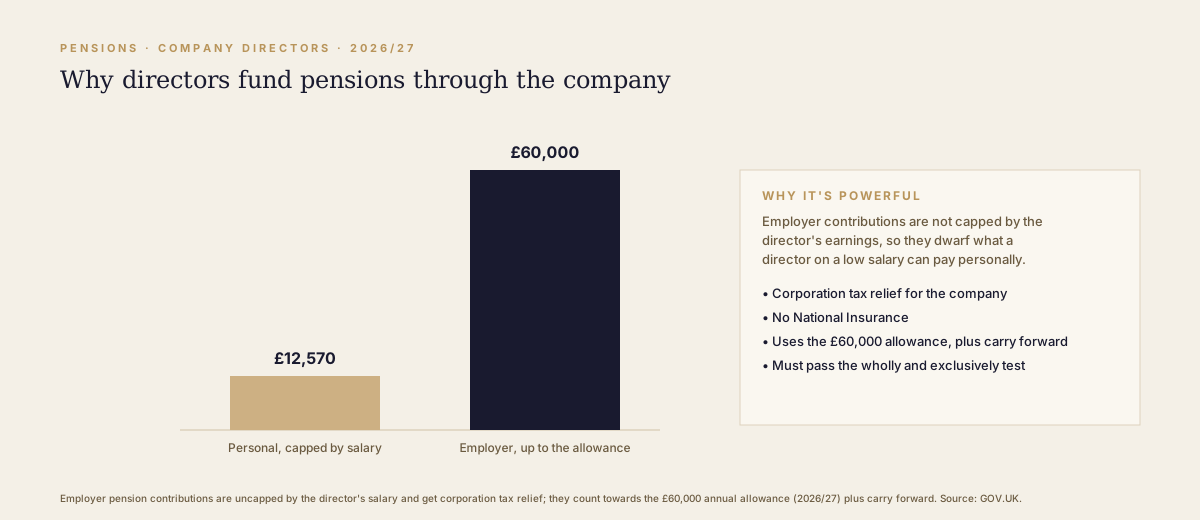
Employer pension contributions for company directors are payments a limited company makes directly into a director's pension, treated as a deductible business cost rather than the director's taxable income. A company can fund a director's pension far beyond what the director could pay personally, because employer contributions are not capped by their earnings. Since dividends do not count as earnings, employer contributions are usually the only way a director on a low salary can fund a pension at a meaningful level. Relief depends on the contribution passing HMRC's wholly and exclusively test, and the total still counts towards the annual allowance, £60,000 a year for 2026/27.
Employer pension contributions for directors let a limited company pay money straight into a director’s pension, where it counts as a business cost rather than personal income. Employer contributions are not limited by a director’s salary, unlike personal contributions, which are capped at the director’s relevant earnings. For someone who takes a small salary topped up with dividends, that distinction matters enormously: dividends do not count as earnings, so they do nothing to lift the personal contribution limit. The company claims the contribution against its profits, pays no National Insurance, and the director pays no income tax on the way in. All figures in this article reflect the 2026/27 tax year, and it is written for directors of their own owner-managed companies, where this route carries the most planning weight.
How are employer pension contributions for a director treated for tax?
Employer pension contributions are deducted from company profits as a business expense, reducing the corporation tax bill. The director pays no income tax or National Insurance on the contribution, and it does not count as relevant UK earnings. It still counts towards the director’s annual allowance, £60,000 a year for 2026/27.
Contents
- How do employer pension contributions for directors work?
- Why do employer contributions beat personal contributions for directors?
- How much can a director pay into a pension through their company?
- Do employer pension contributions reduce corporation tax?
- The wholly and exclusively rule: when can HMRC object?
- The tapered annual allowance and high-earning directors
- Are employer pension contributions for directors worth it?
- Can a company pay pension contributions for a director’s spouse?
How do employer pension contributions for directors work?
An employer pension contribution is a payment your limited company makes directly to your pension scheme, claimed as an allowable business expense rather than paid to you as income. The money never passes through your hands as salary or dividends, so there is no income tax, no employee National Insurance, and no employer National Insurance to account for. The company simply pays the chosen amount to the pension provider and deducts it from its taxable profits.
This is structurally different from a personal contribution. When you pay into a pension yourself, you use money that has already been taxed and the scheme reclaims basic-rate relief on top. An employer contribution skips that loop entirely: the company gets its relief by reducing profits, and nothing is taxed on the individual at the point the money goes in.
For most owner-directors, the practical effect is that the company becomes the natural place from which to fund retirement saving. Whatever the company pays still counts towards your pension annual allowance, so the contribution is not unlimited, but the route is far more flexible than paying personally. It is also a board decision: the company is choosing to reward a director, which is why the size of the contribution has to be justifiable as a genuine business cost rather than simply a way to move money.
Risk warning
Levels and bases of, and reliefs from, taxation are subject to change and their value will depend upon personal circumstances. Taxation and pension legislation may change in the future.
Why do employer contributions beat personal contributions for directors?
Employer contributions beat personal contributions because they are not capped by the director’s relevant UK earnings, while personal contributions only attract tax relief up to 100% of those earnings, or £3,600 a year for 2026/27 if that figure is higher. Relevant earnings means employment income and salary, not dividends, not rental income, and not pension income. When you contribute personally, basic-rate relief is added under relief at source, with any higher-rate relief claimed separately.
Most company directors deliberately take a low salary and draw the rest of their income as dividends, because that is the more tax-efficient way to extract profit. The unintended consequence is that their relevant earnings, and therefore the amount they can pay into a pension personally, is small. A director on a £12,570 salary can personally contribute only £12,570 gross with relief, however large their dividend income.
Employer contributions cut straight through this. There is no relevant-earnings test on what a company can contribute, because there is no personal tax relief being claimed. The only ceilings are the annual allowance and the company’s ability to justify and afford the payment. For a director whose income is mostly dividends, the employer route is usually the only way to fund a pension at a level that matches what they actually earn.
Priya and Sophie, both 53, same income, different route
Priya and Sophie each run their own limited company. Both take a £12,570 salary and draw a further £80,000 in dividends, and both want to add £40,000 to their pension this year.
Priya decides to contribute personally. Her relevant earnings are just her £12,570 salary, because dividends do not count. She can get tax relief on a personal contribution of only £12,570; anything above that earns no relief at all.
Sophie has her company make the £40,000 as an employer contribution. No relevant-earnings test applies, so the full £40,000 goes into her pension, is deducted from company profits, and attracts no income tax or National Insurance. Both are well inside the annual allowance of £60,000, the circumstances are identical, yet Sophie funds more than three times what Priya could.
How much can a director pay into a pension through their company?
A company can pay up to the director’s available annual allowance, which is £60,000 a year for 2026/27, plus any unused allowance carried forward from the previous three tax years. Employer and personal contributions are added together when measured against this allowance, so a £40,000 employer contribution leaves only £20,000 of standard allowance for any personal top-up in the same year. The official limits are set out in GOV.UK’s annual allowance guidance.
Where a company has had a profitable year, pension carry forward can allow a much larger one-off contribution. Provided the director was a member of a registered pension scheme in each of the three prior tax years, unused allowance from those years can be added to the current year, potentially supporting a contribution well above £60,000. The earliest year’s unused allowance is used first.
Two limits are worth watching closely. First, the company must genuinely have the profits or reserves to make the contribution: HMRC can challenge a contribution that pushes the company into a loss, and relief on a very large one-off contribution may be spread across more than one accounting period. Second, if the director has already started drawing flexibly from a defined contribution pension, the money purchase annual allowance usually caps total contributions at £10,000 a year for 2026/27 and removes access to carry forward altogether.
Risk warning
HM Revenue and Customs practice and the law relating to taxation are complex and subject to individual circumstances and changes which cannot be foreseen.
Do employer pension contributions reduce corporation tax?
Yes. An employer pension contribution is an allowable business expense, so it reduces the company’s taxable profits and therefore its corporation tax bill, provided it meets the wholly and exclusively test. The size of the saving depends on the company’s profit level.
Companies pay corporation tax at 19% on profits up to £50,000 and 25% on profits above £250,000, with a marginal band in between where the effective rate on each extra pound of profit reaches 26.5%. A company sitting in that marginal band therefore saves tax at that rate on the profits a contribution removes, which is a higher rate of relief than a company paying the headline 25%. The current rates are explained in GOV.UK’s corporation tax guidance.
How corporation tax relief cuts the net cost of a £40,000 employer pension contribution
Marcus runs a limited company with taxable profits of £120,000 and makes a £40,000 employer pension contribution.
| Input | Value |
|---|---|
| Employer contribution | £40,000 |
| Company profit band | £50,000 to £250,000 (marginal relief) |
| Effective corporation tax rate in band | 26.5% |
- The £40,000 contribution is deducted from taxable profits as an allowable expense
- Corporation tax saved: £40,000 at 26.5% = £10,600
- Net cost to the company: £40,000 less £10,600 = £29,400
Result: A £40,000 contribution into the director’s pension costs the company £29,400 after corporation tax relief, with no income tax or National Insurance on top.
This is what makes the company such an efficient place to fund a pension. The same money taken as salary would attract employer National Insurance at 15% before the director had paid a penny of their own tax. Routed as an employer pension contribution, it avoids that charge entirely and reduces corporation tax on top, so the company parts with noticeably less to put a given sum into the director’s pension than it would to deliver the equivalent as pay.
The wholly and exclusively rule: when can HMRC object?
HMRC will only allow corporation tax relief on an employer pension contribution if it is made wholly and exclusively for the purposes of the business. In practice this rarely causes a problem for a director who is the driving force behind their own company. HMRC’s own guidance accepts that, for a controlling director whose work generates the company’s income, the level of the overall remuneration package is a commercial decision and it is unlikely there is a non-trade purpose for it. The detailed position is set out in HMRC’s Business Income Manual at BIM46035.
The test looks at the whole remuneration package, combining salary, bonuses, benefits and pension, rather than the pension contribution in isolation. For a sole director-shareholder, that package is whatever they decide to pay themselves, so a large contribution is hard to challenge.
Where the rule does bite is contributions for a spouse or family member who works in the business. Here HMRC compares the total package against what an unconnected employee doing the same job would receive. A £40,000 pension contribution for a spouse who does a few hours of admin a week would look excessive, and the excess could be disallowed. Good practice is to record the contribution in a board minute setting out the commercial rationale, and to avoid contributions large enough to create a trading loss.
The tapered annual allowance and high-earning directors
Directors with high incomes can see their allowance reduced by the tapered annual allowance, but the way directors are usually paid often keeps them clear of it. The taper only applies if both your threshold income exceeds £200,000 and your adjusted income exceeds £260,000 a year for 2026/27. For every £2 of adjusted income above that, the allowance falls by £1, down to a floor of £10,000.
The detail that matters for directors is what goes into each measure. Adjusted income includes employer pension contributions; threshold income does not. Because a low-salary, dividend-based director often has total income comfortably below £200,000, their threshold income stays under that trigger even when a sizeable employer contribution lifts their adjusted income higher. In that situation the taper does not apply, and the full £60,000 allowance survives.
Does an employer pension contribution count towards the tapered annual allowance?
They count towards adjusted income, not threshold income. Those are the two separate measures the taper uses. Adjusted income includes employer contributions and triggers the taper once it clears £260,000 a year for 2026/27; threshold income excludes them and has its own trigger at £200,000. A director above the adjusted-income trigger but below the threshold-income one keeps the full annual allowance, £60,000.
A director who draws a large salary or very large dividends is more exposed. If threshold income clears £200,000 and adjusted income clears £260,000, the tapered annual allowance begins to erode how much the company can contribute with relief. Carry forward can still be used to make a contribution above the tapered figure, which is one reason higher earners often combine the two.
Are employer pension contributions for directors worth it?
For most owner-directors, employer pension contributions are one of the most tax-efficient ways to extract value from a company, but they come with a real trade-off: the money is locked away. Once inside a pension it cannot be touched until minimum pension age, currently 55 and rising to 57 from 6 April 2028, and is then reached through options such as flexi-access drawdown or lump sums. For a director who may need the cash sooner, that illiquidity is the main reason to think carefully before diverting too much.
For most owner-directors, the company, not the individual, is the most tax-efficient source of retirement funding, provided the cash genuinely is not needed before pension age.
Set against that, the combined saving is substantial. The company avoids 15% employer National Insurance, claims corporation tax relief of up to 26.5%, and the director pays no income tax on the contribution. Compared with extracting the same sum as salary, or even as dividends and then trying to contribute personally, the employer route is usually far ahead, which is why it sits at the centre of so much retirement planning for business owners.
There is also a change on the horizon worth holding in view. From 6 April 2027, unused pension funds will fall within the scope of inheritance tax, under the Finance Act 2026, which alters the long-standing logic of using a pension as a wealth-transfer vehicle. It does not undermine the income-tax and corporation-tax case for contributing, but it is a reason to keep the wider estate in mind rather than defaulting to the maximum contribution every year.
Risk warnings
Pensions
Your pension income could also be affected by the interest rates at the time you take your benefits. The tax implications of pension withdrawals will be based on your individual circumstances, tax legislation and regulation which are subject to change in the future.
Pension drawdown
Drawdown pension plans (unsecured income) are complex and are not suitable for everyone. Pension decisions can affect your income for the rest of your life (and that of any partner and other dependants). Where benefits are accessed on a flexible basis, these are not fixed or safeguarded for life. If security of income is important to you then you should consider purchasing an annuity or taking a scheme pension to provide a secured level of income.
Can a company pay pension contributions for a director’s spouse?
Yes, a company can make employer pension contributions for a spouse, but only if the spouse is a genuine employee or director and the contribution is justifiable as part of a commercial remuneration package. This is the same wholly and exclusively test, applied more strictly. HMRC will look at whether the spouse’s total pay, including the pension contribution, is reasonable for the work they actually do, comparing it to what an unconnected employee in the same role would be paid.
A spouse who is a full working director of the business can usually receive employer contributions on the same footing as any other director. A spouse listed on the payroll for a nominal role, who contributes little real work, is where contributions are most likely to be challenged and partly disallowed. The safest approach is to align the contribution with a defensible job and a commercial salary, and to document the decision in a board minute.
The company is usually the right payer
For company directors, the pension question is rarely about whether the rules allow a contribution. It is about recognising that the company, not the individual, is usually the efficient place for that money to come from. A director who understands this can fund retirement at a level their salary alone would never permit, taking corporation tax relief and sidestepping National Insurance, for as long as the contribution stays commercially justifiable and the cash is genuinely not needed before pension age.
Frequently asked questions
What are employer pension contributions for company directors?
Employer pension contributions for company directors are payments a limited company makes into a director's pension scheme as a business expense. They reduce the company's corporation tax bill, carry no National Insurance, and are not limited by the director's salary, unlike personal contributions.
How does an employer pension contribution work for a director?
The company pays the contribution directly to the director's pension provider and claims it as an allowable expense against profits, provided it passes the wholly and exclusively test. The director pays no income tax or National Insurance on it, and it counts towards their annual allowance, £60,000 a year for 2026/27.
How much can a company pay into a director's pension?
A company can contribute up to the director's available annual allowance, which is £60,000 a year for 2026/27, plus any unused allowance carried forward from the previous three tax years. Unlike personal contributions, there is no cap based on the director's earnings, though the company must have the profits to support it.
Are employer pension contributions tax deductible?
Usually yes, but not automatically. The contribution is deductible against corporation tax only if it is made wholly and exclusively for the purposes of the business. For a controlling director who drives the company's income, HMRC generally accepts this; for contributions to a spouse or family member, the total package must be commercially justifiable.
Should a director take dividends or make pension contributions?
It is not strictly either or. Dividends provide accessible income now, while employer pension contributions defer income tax-efficiently into a pension that cannot be touched until at least age 55, rising to 57 from 6 April 2028. The right balance depends on how much income is needed now versus how much can be locked away for retirement.
Do employer pension contributions count towards the annual allowance?
Yes. Employer and personal contributions both count towards the annual allowance, £60,000 a year for 2026/27. If the total exceeds the available allowance, including any carry forward, an annual allowance charge applies to the excess at the director's marginal income tax rate.