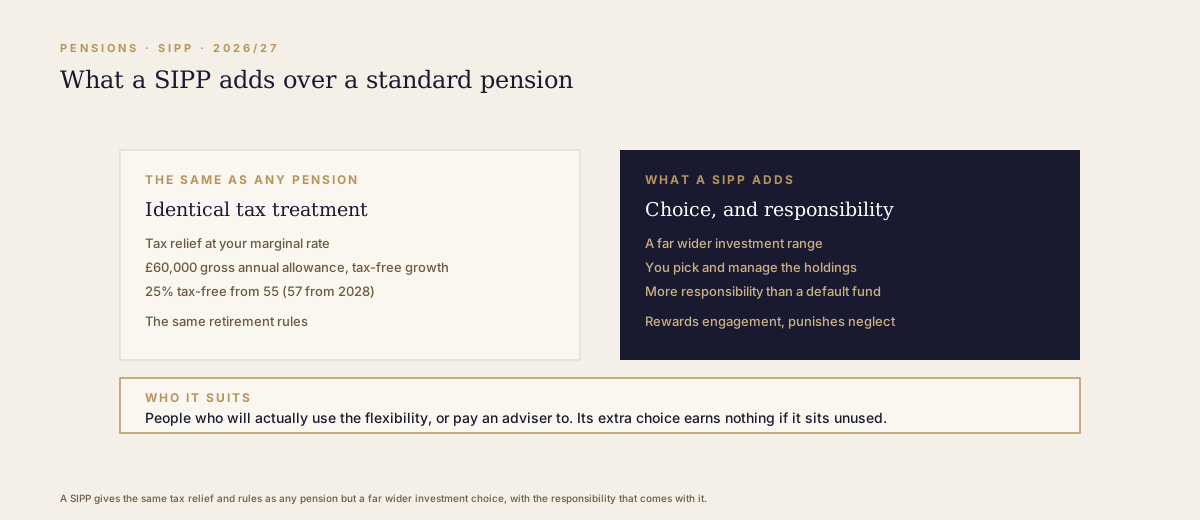
A self-invested personal pension (SIPP) is a type of personal pension that lets the holder choose and manage the investments held within it, inside a tax-advantaged wrapper. If you want to choose the investments inside your pension rather than accept a provider's default fund, a SIPP is the wrapper for it. It offers a far wider investment range than most workplace or personal pensions, alongside identical tax relief and the same retirement rules. That control brings real responsibility, so a SIPP suits people who will actually use the flexibility or pay an adviser to.
A SIPP, or self-invested personal pension, is a personal pension that hands you control of the investments inside it. Where a workplace pension or a standard personal pension usually places your money in a provider’s default fund, a SIPP opens up a far wider menu: individual shares, funds, investment trusts, exchange-traded funds, and commercial property among them. The tax treatment is identical to any other registered pension. What differs is the breadth of choice, and the responsibility that comes with it. The figures and thresholds in this article are correct for the 2026/27 tax year. What follows is how a SIPP works, what you can hold, how it is taxed, and where its flexibility earns its keep rather than sitting unused.
How much can you pay into a SIPP?
In 2026/27 the annual allowance is £60,000 gross, covering your contributions, the tax relief added to them, and anything an employer pays in. In a SIPP you reach it by paying in £48,000, which the provider grosses up to £60,000. Your own contributions are separately capped at 100% of your relevant UK earnings.
Contents
- What is a SIPP, and how is it different from other pensions?
- How does a SIPP work?
- What can you hold in a SIPP?
- How is a SIPP taxed?
- SIPP vs personal pension vs workplace pension
- How do you open a SIPP?
- Is a SIPP worth it?
- Who is a SIPP not suitable for?
What is a SIPP, and how is it different from other pensions?
A SIPP is a personal pension that you, rather than a provider, decide how to invest. The “self-invested” part is the whole point: instead of a short list of provider-run funds, you get access to a broad investment universe and you make the choices. Legally it is still a registered pension scheme, so it sits under the same rules on contributions, tax relief and access as any other pension. The difference is control, not tax.
That control is the dividing line between the three common pension types. A workplace pension is set up by your employer and usually defaults your money into a single fund. A standard personal pension, which you arrange yourself, gives you a moderate range of the provider’s own funds. A SIPP, which GOV.UK groups under personal pensions, widens that range dramatically. Because a SIPP is one wrapper among several, it helps to understand how it sits alongside ISAs and other structures, which is the subject of the main types of investment wrapper in the UK.
A SIPP does not give you a better pension. It gives you a wider set of choices and the job of making them, which is an advantage only if you actually want it.
Risk warnings
ISAs
The favourable tax treatment of ISAs may be subject to changes in legislation in the future.
Pensions
Levels and bases of, and reliefs from, taxation are subject to change and their value will depend upon personal circumstances. Taxation and pension legislation may change in the future.
How does a SIPP work?
A SIPP works in three stages: money goes in, it grows inside a tax-advantaged wrapper, and it can come out from age 55, the normal minimum pension age. You fund it with personal contributions, employer contributions, or transfers from other pensions. The provider adds basic-rate tax relief to your personal contributions, the investments grow free of UK income tax and capital gains tax, and you choose when and how to draw the money in retirement.
The contribution limits are the same as for any pension, and they are two separate tests rather than one. The annual allowance of £60,000 a year for 2026/27 caps the total going in from every source, and it is a gross figure: your own contributions, the basic-rate relief added to them, and anything an employer pays in all count towards it. Because a SIPP operates relief at source, you reach it by paying in £48,000 and the provider reclaiming £12,000 from HMRC.
The second test caps your own contributions at 100% of your relevant UK earnings, or £3,600 gross if you earn less than that, and it does not apply to employer contributions at all. That distinction matters for a company director paying themselves mostly in dividends: their own relievable contribution is small, while the company can still pay in up to the annual allowance.
Unused allowance from the previous three tax years can sometimes be carried forward. High earners may have a reduced allowance under the taper, and anyone who has already flexibly accessed a pension may be limited to the lower money purchase annual allowance. The contribution rules are explained in full in what the pension annual allowance is.
Risk warnings
Investments
The taxation of the investment is dependent on the individual circumstance of each investor, and may be subject to change in the future.
Tax, trusts and estate planning
HM Revenue and Customs practice and the law relating to taxation are complex and subject to individual circumstances and changes which cannot be foreseen.
What can you hold in a SIPP?
A SIPP can hold a far wider range of investments than a standard pension, which is its defining feature. The typical menu includes funds and unit trusts, investment trusts, exchange-traded funds, individual company shares, corporate and government bonds, and cash. Some SIPPs also allow commercial property, which is why business owners sometimes use one to hold their trading premises.
The point of the wide menu is the freedom to build a portfolio that matches your plan rather than accept a one-size default. That freedom only matters if you understand what you are choosing, and the building blocks are worth knowing before you start: the main types of investments sets out what each asset class is actually for.
Constructing and maintaining a portfolio you are comfortable holding through a downturn is the harder part. It is where many people decide to take professional investment advice rather than go it alone, particularly once the pot is large enough that mistakes are expensive.
How is a SIPP taxed?
A SIPP is taxed the same way as every other registered pension: relief on the way in, tax-free growth inside, and income tax on most of what comes out. Personal contributions receive tax relief at your marginal rate, with 20% added automatically in 2026/27 and higher or additional-rate taxpayers claiming the extra back from HMRC, through Self Assessment if they file a return and through HMRC’s online service or by post if they do not. Inside the wrapper, there is no UK income tax or capital gains tax on the investments.
When you come to take the money, up to 25% is normally tax-free, capped by the Lump Sum Allowance of £268,275 for 2026/27, and the rest is taxed as income when withdrawn. The mechanics of that tax-free element are covered in the pension commencement lump sum.
The fund you do not take as cash stays invested and is usually drawn as income through flexi-access drawdown, which keeps the money working while you take what you need rather than committing it to a fixed annuity.
Higher earners who pay personal contributions should not assume the extra relief is added for them, which is why it pays to understand how to claim higher-rate pension tax relief.
When can you take money out of a SIPP?
You can normally access a SIPP from age 55, rising to 57 from 6 April 2028. Up to 25% is usually tax-free, capped by the £268,275 Lump Sum Allowance in 2026/27, and the remainder is taxed as income when withdrawn. Taking money before the normal minimum age is only possible in rare cases such as serious ill health.
One change ahead matters for anyone using a SIPP as a way to pass wealth on. From April 2027, most unused pension funds will count as part of your estate for inheritance tax, reversing years of pensions sitting outside it. What that means in practice is set out in pensions and inheritance tax from April 2027.
Risk warnings
A pension is a long-term investment, the value of your investment and the income from it may go down as well as up. Your eventual income may depend upon the size of the fund at retirement, future interest rates and tax legislation.
Your pension income could also be affected by the interest rates at the time you take your benefits. The tax implications of pension withdrawals will be based on your individual circumstances, tax legislation and regulation which are subject to change in the future.
SIPP vs personal pension vs workplace pension
The practical difference between the three comes down to choice, charges, and who sets them up. A SIPP gives the widest investment range and the most control. A workplace pension is the most hands-off, and the narrowest. A standard personal pension sits in between.
How the three pension types compare
| Feature | Workplace pension | Personal pension | SIPP |
|---|---|---|---|
| Investment choice | Default fund or short list | Provider’s fund range | Very wide |
| Who chooses | Scheme or default | You, from a menu | You |
| How you are charged | Scheme charge, capped at 0.75% in the default fund | Provider’s charge, built into its funds | Platform or admin fee, plus the cost of what you hold |
| Set up by | Employer | You | You |
| Employer contributions | Automatic under auto-enrolment | Accepted if your employer will pay in | Accepted if your employer will pay in |
The 0.75% figure is the charge cap on the default fund of a qualifying auto-enrolment workplace scheme, so it is a ceiling rather than a going rate. Cost is not reliably what separates the three, and a SIPP holding low-cost funds can sit well inside that cap. People often open a SIPP to bring several old pots together, a process explained in pension consolidation, though consolidating is not always the right move.
Risk warning
Pensions
Advice on auto enrolment pensions is not regulated by the financial conduct authority.
Defined benefit transfers
We do not currently provide advice on transferring out of defined benefit (final salary) pension schemes. If you require this advice, we will provide details of a suitably qualified adviser at a firm with the necessary regulatory permissions who can assist you.
How do you open a SIPP?
You open a SIPP by choosing a provider, completing an application, and then funding it. It is a short process, but each step carries a decision that affects what the SIPP costs and how well it works for you.
- Choose a provider and check the charges. Compare providers on charging structure, investment range, and dealing costs. Percentage-based platform fees tend to suit smaller pots; flat fees often work out cheaper on larger ones. Confirm the provider is authorised by the Financial Conduct Authority.
- Open the account and fund it. Apply, then pay in by personal or employer contribution, or by transferring an existing pension. Basic-rate relief is added to personal contributions automatically. Check any pension you transfer for exit penalties or valuable guarantees first.
- Choose and manage the investments. Select investments in line with your time horizon and risk tolerance, then review them periodically. A SIPP only adds value if the money is genuinely invested rather than left in cash.
Transferring a defined benefit, or final salary, pension into a SIPP is a different matter entirely. It is rarely advisable, it means giving up a guaranteed income for life, and it requires regulated advice where the transfer value exceeds £30,000.
Is a SIPP worth it?
A SIPP is worth it when you want investment choice beyond a default fund and will actually use it, or when you pay an adviser to manage it for you. It is rarely worth it for a pot that ends up sitting in cash or a single basic fund, because the one thing a SIPP offers over a simpler pension then goes unused. The honest test is whether the control changes what you do, not whether it sounds appealing.
Naomi, 58, with three old workplace pensions
Naomi’s three pots hold £84,000, £31,500 and £126,000. Two of them are still in the fund each employer defaulted her into, both shifting steadily into bonds ahead of a retirement date of 65 that she no longer intends to use. She wants to start drawing an income at 62.
Brought into one SIPP, the £241,500 can be run as a single portfolio built around the date she actually plans to stop, rather than around three schemes’ separate assumptions. She holds about £21,000, roughly two years of the income she expects to take from this pot, in cash and short-dated bonds, so an early market fall does not force her to sell equities to fund the first years of retirement. The rest stays invested for the decades that follow.
That is the choice doing real work, and it shows up in the shape of the portfolio rather than in the wrapper itself. Had she moved all three into the SIPP and then left the whole £241,500 in one balanced fund, she would have swapped three ready-made allocations for a fourth: tidier, no better aimed at the date she plans to stop, and inside a wrapper whose defining feature she never uses.
Cost is worth checking before you open anything, and it is not what settles this. What settles it is whether the wider choice changes how the money is actually invested. Because that answer depends on how and when you will draw income, the decision rarely stands alone, which is where pensions and retirement planning brings the parts together.
A SIPP is not the only tax-efficient home for long-term money, either. The wider question of whether a pension or an ISA should hold your next contribution is weighed up in stocks and shares ISA versus pension.
Risk warning
An investment in a Stocks & Shares ISA will not provide the same security of capital associated with a Cash ISA.
Who is a SIPP not suitable for?
A SIPP is not suitable for someone who does not want to make investment decisions and will not pay anyone to make them. If the money will sit untouched in a default fund, a SIPP’s wider choice simply goes to waste.
It is also a poor fit for anyone tempted by exotic or unregulated investments wrapped inside a SIPP, which have been at the centre of repeated pension scams. Protections such as the Financial Services Compensation Scheme can apply if a regulated provider fails, but they do not cover ordinary investment losses, and the wrapper being regulated does not make a bad investment good. A SIPP rewards engagement; it punishes neglect.
Risk warning
The Financial Services Compensation Scheme (FSCS) protects eligible deposits up to £120,000 per person, per banking licence.
A SIPP is a tool, not an upgrade
The tax treatment is the same as any pension. What a SIPP adds is a far wider set of investment choices, and their value depends entirely on whether they get used well. For an engaged investor, or for someone whose adviser is running the portfolio, a well-chosen SIPP can be an excellent home for retirement money. Where it earns nothing is where nobody is directing it, neither you nor anyone you have appointed, and the money sits wherever it landed. The question is never whether a SIPP is good in the abstract, but whether its control gets used, by you or by someone you pay to do it.
Frequently asked questions
What is a SIPP?
A SIPP, or self-invested personal pension, is a personal pension that lets you choose and manage the investments held inside it. It carries the same tax relief, contribution limits and access rules as any other registered pension, but offers a much wider investment range than a default workplace or personal pension.
How does a SIPP work?
You open a SIPP with a provider, pay in contributions or transfer existing pensions, and choose investments from a wide menu. Basic-rate tax relief is added to personal contributions, the money grows free of UK income and capital gains tax, and from age 55 (57 from 6 April 2028) you can take up to 25% tax-free and draw the rest as taxable income.
Is a SIPP worth it?
A SIPP is worth it if you want investment choice beyond a default fund and will use it, or you pay an adviser to manage it. It is rarely worth it for a small pot left sitting in cash or a basic fund, where the flexibility goes unused. The trade-off is responsibility and engagement against control.
Are SIPPs safe?
SIPPs from FCA-regulated providers carry the same investor protections as other UK pensions, including FSCS cover that can apply if the provider fails. The investments inside a SIPP still rise and fall in value, so the wrapper being regulated does not remove investment risk. Higher-risk or unregulated investments held in a SIPP carry their own dangers.
Can I transfer my existing pensions into a SIPP?
Yes, most defined contribution pensions can be transferred into a SIPP, which is a common reason people open one. Defined benefit (final salary) pensions are different: transferring one out is rarely advisable and requires regulated advice if the value exceeds £30,000. Always check for exit penalties or valuable guarantees before transferring.
What is the difference between a SIPP and a personal pension?
Both are personal pensions with the same tax rules, but a standard personal pension offers a limited range of provider-run funds, while a SIPP offers a far wider choice including individual shares, investment trusts and commercial property. A SIPP gives more control, and the responsibility for using it well.
Risk warnings
Some banking brands share a single licence, so spreading funds across them may not increase protection.
If total deposits with one banking group exceed the FSCS limit, amounts above this may not be covered in the event of default.