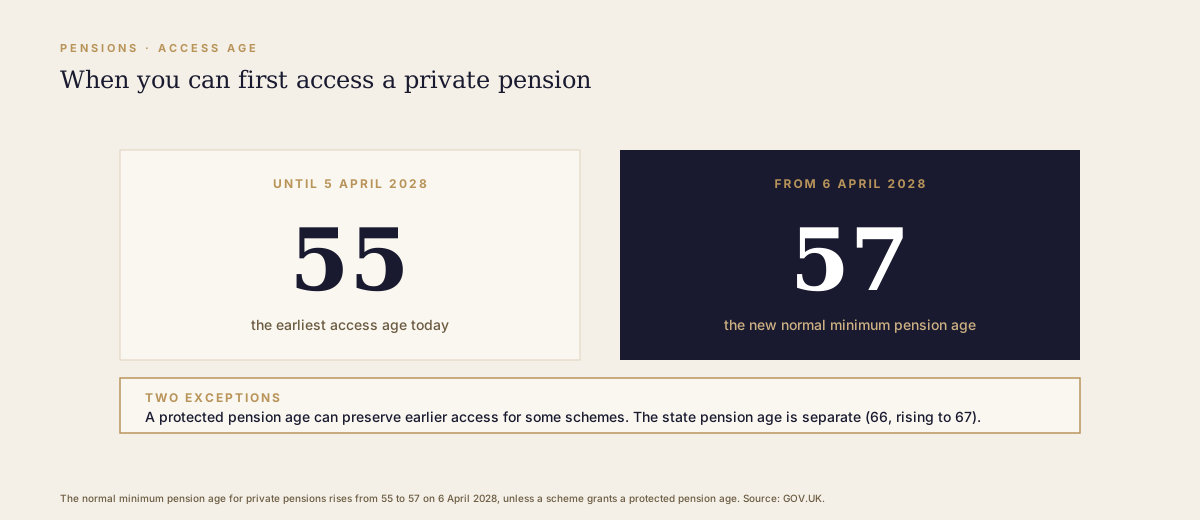
The pension access age, or normal minimum pension age, is the earliest age at which you can normally take money from a private pension without an unauthorised payment tax charge. For now you can take a private pension from age 55, but the earliest age rises to 57 from 6 April 2028. The increase catches anyone who reaches 55 on or after that date, so a two-year age gap between partners can mean one waits years longer to draw their pot. A protected pension age or serious ill health are the main routes to taking benefits earlier.
The pension access age is the earliest point at which you can normally start taking money from a private pension, and for most people that age is about to move. Today you can usually reach a defined contribution pension from 55, but the minimum rises to 57 from 6 April 2028. The shift sounds small, yet for anyone planning to stop work in their mid-fifties it can push a carefully timed retirement back by up to two years. The figures and thresholds in this article are correct for the 2026/27 tax year.
Who is affected by the pension access age rising to 57?
The rise to 57 from 6 April 2028 affects most people who reach age 55 on or after that date. Members with a protected pension age, and those in the firefighters, police and armed forces schemes, keep their earlier access. Serious ill health is a separate exception.
Contents
- What is the pension access age?
- When does the pension access age rise to 57?
- Who keeps a protected pension age?
- Can you take your pension early due to ill health?
- Pension access age vs State Pension age
- Should you take your pension as soon as you can?
- Where it fits in your retirement plan
What is the pension access age?
The pension access age is the earliest age at which you can take benefits from a private or workplace pension without HMRC treating the payment as unauthorised. Its formal name is the normal minimum pension age, and it currently sits at 55. Below that age, a pension is not allowed to pay you a lump sum or income except in narrow circumstances such as ill health.
The normal minimum pension age is the threshold below which any pension payment is treated as unauthorised and taxed accordingly. Reaching it is what lets you do anything with the pot: take your tax-free cash, formally the pension commencement lump sum, move funds into drawdown, or buy an annuity. The act of bringing benefits into payment is known as crystallising your pension, and the access age is simply the gate that has to open first.
It matters that this age is a minimum, not a target. Nothing forces you to take anything at 55, or at 57 once the rise lands on 6 April 2028, and for most people leaving the money invested for longer is the more powerful option. The access age only sets the earliest moment the door is unlocked.
Risk warnings
Pensions
A pension is a long-term investment, the value of your investment and the income from it may go down as well as up. Your eventual income may depend upon the size of the fund at retirement, future interest rates and tax legislation.
Your pension income could also be affected by the interest rates at the time you take your benefits. The tax implications of pension withdrawals will be based on your individual circumstances, tax legislation and regulation which are subject to change in the future.
Pension drawdown
Drawdown pension plans (unsecured income) are complex and are not suitable for everyone. Pension decisions can affect your income for the rest of your life (and that of any partner and other dependants). Where benefits are accessed on a flexible basis, these are not fixed or safeguarded for life. If security of income is important to you then you should consider purchasing an annuity or taking a scheme pension to provide a secured level of income.
Tax, trusts and estate planning
HM Revenue and Customs practice and the law relating to taxation are complex and subject to individual circumstances and changes which cannot be foreseen.
When does the pension access age rise to 57?
The pension access age rises from 55 to 57 on 6 April 2028. The change was legislated some years ago and applies to almost all registered pension schemes, so it will affect the large majority of savers approaching their mid-fifties at the end of this decade. GOV.UK’s guidance on increasing the normal minimum pension age confirms the date and the scope.
The practical catch is the cliff edge around the change. If you reach 55 and take your benefits before 6 April 2028, you can still use the current age of 55. But once the minimum becomes 57 on that date, simply having turned 55 no longer grants access on its own. Anyone who reaches 55 on or after 6 April 2028, without a protected pension age, has to wait until 57.
That turns a difference of a couple of birthdays into a difference of two whole years of access, which is where retirement plans built around a shared timetable can come unstuck.
Rachel and Sam, planning to retire together
Rachel and Sam are a couple with a two-year age gap who intend to wind down work at the same time. Rachel reaches 55 in early 2027 and takes some tax-free cash from her pension to fund the transition, under the current age of 55.
Sam reaches 55 in 2029, the year after the access age rises on 6 April 2028. Despite turning 55, he cannot touch his pension: the minimum age is now 57, so he must wait until 2031.
The same plan, made by two people born two years apart, produces a two-year gap in when each can draw on their pension. For a couple relying on both pots to retire together, that is the difference between the plan working and needing a rethink of how the early years are funded.
Who keeps a protected pension age?
Some people keep the right to take their pension before 57, even after the rise on 6 April 2028, through a protected pension age. This protection generally applies where a member had an unqualified right, under the scheme’s rules before 4 November 2021, to take benefits at an earlier age. HMRC’s protected pension age guidance sets out the detailed conditions, including how the protection can survive a block transfer between schemes.
Three groups of public service workers are exempt from the increase entirely. Members of the firefighters, police and armed forces schemes keep their existing arrangements and are not pushed to 57 from 6 April 2028. These are typically defined benefit pensions with their own normal retirement ages, reflecting the nature of those careers.
If you think you might hold a protected pension age, the only reliable way to confirm it is to ask your scheme administrator. A protected age is specific to the scheme that grants it, and it can be lost or preserved depending on how any transfer is carried out, so it is worth checking before you move a pension.
Important information
We do not currently provide advice on transferring out of defined benefit (final salary) pension schemes. If you require this advice, we will provide details of a suitably qualified adviser at a firm with the necessary regulatory permissions who can assist you.
Can you take your pension early due to ill health?
You can take a pension before the minimum age if you meet the ill-health condition. This requires a registered medical practitioner to confirm that you are, and will continue to be, medically incapable of carrying on your current occupation, and that you have actually stopped doing it. HMRC’s guidance on taking benefits before pension age sets out the test and the requirement for the scheme to keep the medical evidence on file.
The ill-health route is the main legitimate way to access a pension early, and individual schemes can apply stricter rules than the HMRC minimum, for example requiring that you are unable to do any work rather than just your current job. Outside ill health and a protected pension age, there is no general way to unlock a pension before the access age.
What happens if you take your pension before the minimum age?
Taking money from a pension before the normal minimum pension age, unless you qualify for ill health or a protected pension age, is an unauthorised payment. HMRC can apply tax charges of up to 55% of the amount withdrawn. Schemes that promise early cash access before 55 are almost always scams.
This is why offers to release pension cash early should be treated with suspicion. Beyond the tax charges, so-called pension liberation arrangements frequently turn out to be fraud, and the saver can lose both the tax and much of the pot. If an arrangement sounds like a way around the access age, it usually carries the unauthorised payment charge or worse.
How is the pension access age different from the State Pension age?
The pension access age and the State Pension age are two separate ages governed by different rules. The pension access age applies to your own private and workplace pensions and is 55, rising to 57 from 6 April 2028. The State Pension age is when you can claim the State Pension from the government. It is 66 now, rising to 67 in monthly steps that finish on 6 March 2028, and the Pensions Act 2007 already legislates a further rise to 68 between 2044 and 2046, on a timetable the government reviews roughly every six years. You can check your own State Pension age on GOV.UK.
The gap between the two ages is deliberate. The normal minimum pension age is intended to track at roughly ten years below the State Pension age, which is part of the reason it is moving to 57 from 6 April 2028. In practice this means most people can draw on their own pensions for around a decade before the State Pension starts, a stretch often called the bridge period.
Planning the bridge is one of the more important parts of retirement timing. Knowing your State Pension forecast tells you when guaranteed income arrives, and the private pension access age tells you how early you can fund the years before it. The two together frame how much your own savings need to cover and for how long.
Should you take your pension as soon as you can?
Reaching the pension access age is rarely a reason to take money straight away. The age is a permission, not a prompt, and drawing benefits early carries real costs: the pot spends less time invested, and any taxable withdrawal beyond your tax-free cash can trigger the money purchase annual allowance, permanently cutting how much you can pay back in to £10,000 a year for 2026/27.
There are sound reasons to access a pension at the earliest age, such as funding a phased move out of full-time work, clearing a mortgage, or bridging to the State Pension. The point is that the decision should follow a plan, not the calendar. Taking the 25% tax-free cash with no income, for instance, avoids the money purchase trap but still removes money from a tax-sheltered environment.
The pension access age tells you the earliest you can draw on a pension, not the best time to do it. For most savers, the bigger risk is taking money too soon, not waiting too long.
Working out the right time turns on the same question that drives every retirement plan: how much sustainable income the pot can support, and for how long. That is the territory of what makes a good pension to retire on rather than the access age itself.
Risk warnings
Pensions
Levels and bases of, and reliefs from, taxation are subject to change and their value will depend upon personal circumstances. Taxation and pension legislation may change in the future.
Mortgages
Your home may be repossessed if you do not keep up repayments on your mortgage. Think carefully before securing debts against your home.
Not all mortgage contracts are regulated by the Financial Conduct Authority.
Where the pension access age fits in your retirement plan
The pension access age sets the floor for retirement timing, but it should rarely be the thing that decides your start date. It tells you the earliest you can act, while the size of your pot, your other income, and your spending needs decide whether acting then is wise. The rise to 57 from 6 April 2028 simply moves that floor upward for most people approaching their mid-fifties.
For anyone planning to retire around the change, the sensible response is to check three things: when you personally reach the access age under the new rules, whether you hold any protected pension age, and how the years before the State Pension will be funded. Mapping that out is exactly what lifetime cashflow modelling is for, and it is the foundation of any pensions and retirement planning conversation. The access age is the gate; the plan is what tells you when to walk through it.
Frequently asked questions
What age can you take your pension in the UK?
You can normally take money from a private pension from age 55, rising to 57 from 6 April 2028. This is the normal minimum pension age set by HMRC. The State Pension is separate and is paid from State Pension age, currently 66. Defined benefit schemes may set their own normal retirement age.
Why is the pension access age rising to 57 from 6 April 2028?
The pension access age is rising to 57 to keep it roughly ten years below the State Pension age, which is itself increasing. The government legislated the change so that pension savings stay focused on later-life income rather than being drawn too early. The rise takes effect on 6 April 2028.
Can I take my pension at 55 if I reach 55 before 6 April 2028?
If you reach 55 and take your benefits before 6 April 2028, you can access your pension at 55 under the current rules. The complication is for those who turn 55 close to the change: once the minimum age becomes 57 on that date, reaching 55 alone no longer grants access unless you have a protected pension age.
Should I take my tax-free cash as soon as I reach pension access age?
Reaching the pension access age does not mean you should take money straight away. Drawing benefits early shortens the time your pot stays invested and can trigger the money purchase annual allowance if you take taxable income. Taking only tax-free cash with no income avoids that trap, but the money still leaves a tax-sheltered environment.
Does the pension access age apply to defined benefit pensions?
The normal minimum pension age applies to defined benefit pensions too, so the rise to 57 from 6 April 2028 affects final salary schemes as well as pots. Many defined benefit schemes set a normal retirement age of 60 or 65 in any case, and taking benefits earlier usually means an actuarial reduction. Public service schemes for firefighters, police and the armed forces are exempt from the increase.
Can I access my pension early due to ill health?
You can take a pension before the minimum age if you meet the ill-health condition: a registered medical practitioner confirms you are permanently unable to carry on your occupation, and you stop doing it. The scheme must hold the medical evidence. Individual schemes can set stricter rules, so check your own scheme's terms.
Is the pension access age the same as the State Pension age?
No. The pension access age applies to private and workplace pensions and is 55, rising to 57 from 6 April 2028. The State Pension age is when you can claim the State Pension and is currently 66, rising to 67 and later 68. They are different ages governed by different rules.