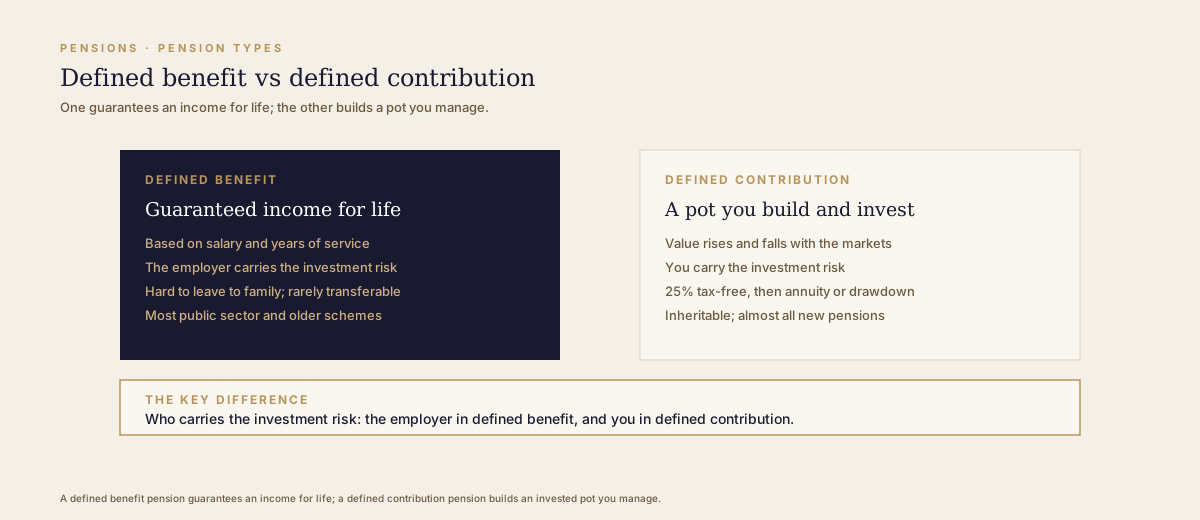
Defined benefit and defined contribution are the two main types of pension: a defined benefit pension provides an income fixed by a formula, while a defined contribution pension provides a pot built from invested contributions. A defined benefit pension is usually more valuable because the employer guarantees the income for life, while a defined contribution pension gives you control and inheritability but leaves the investment risk with you. It also shapes how secure your income is and what passes to your family when you die. Almost all new pensions today are defined contribution, and a defined benefit pension can rarely be replaced once given up, which is why transfers out are tightly regulated.
The difference between a defined benefit and a defined contribution pension comes down to a single question: does someone promise you an income, or do you build a pot and turn it into income yourself? A defined benefit pension guarantees a set income for life, calculated from your salary and years of service, with your employer responsible for funding it. A defined contribution pension builds an invested pot whose final value, and the risk of it falling short, sit with you. That one distinction shapes how secure your retirement income is, how much flexibility you have, and what your family inherits. All figures and thresholds in this article reflect the 2026/27 tax year.
How can you tell if you have a defined benefit or defined contribution pension?
Check your annual statement. A defined contribution pension shows a pot or fund value that rises and falls with investments. A defined benefit pension shows a projected yearly income instead. Public sector schemes, such as the NHS, teachers and civil service, are almost always defined benefit; most other workplace and personal pensions are defined contribution.
Contents
- What is the difference between a defined benefit and defined contribution pension?
- How does a defined benefit pension work?
- How does a defined contribution pension work?
- Defined benefit vs defined contribution: how do they compare?
- Who carries the investment risk in each pension?
- What happens to each pension when you die?
- Should you transfer a defined benefit pension to a defined contribution scheme?
What is the difference between a defined benefit and defined contribution pension?
The core difference is who bears the risk. A defined benefit pension places the investment and longevity risk on your employer, which must pay the promised income however markets perform and however long you live. A defined contribution pension places that risk on you: your contributions are invested, and what you eventually receive depends on how those investments grow and how you choose to draw on them.
This is why the two are sometimes called final salary (defined benefit) and money purchase (defined contribution) pensions. Defined benefit schemes were once the norm across UK employment, but their cost and unpredictability led most private employers to close them to new members. Today, almost all new workplace pensions, set up through automatic enrolment, are defined contribution.
The label is not a technicality. It determines every downstream decision: how your pension grows, what you can do with it at retirement, and how it is treated for tax and inheritance.
Risk warnings
A pension is a long-term investment, the value of your investment and the income from it may go down as well as up. Your eventual income may depend upon the size of the fund at retirement, future interest rates and tax legislation.
Advice on auto enrolment pensions is not regulated by the financial conduct authority.
How does a defined benefit pension work?
A defined benefit pension pays an income calculated from a formula, not from an investment pot. The formula multiplies your pensionable salary by your years of membership and an accrual rate, often 1/60th or 1/80th for each year of service. A defined benefit scheme can be final-salary, using your salary near retirement, or career-average, using your earnings across the whole of your membership. The State Pension works on the same broad principle, paying an amount set by your National Insurance record rather than by an invested fund.
Thirty years in a final-salary scheme with a 1/60th accrual rate and a pensionable salary of £40,000 at retirement would produce a pension of £20,000 a year, which is 30/60 of £40,000, payable for life and usually rising each year with inflation. Your employer, or the scheme behind it, must hold enough money to pay that income and top up any shortfall from its own resources.
That arithmetic only works this cleanly where the pension is based on your final salary. A career-average scheme builds and revalues a separate slice of pension each year, and a scheme averaging your last three or five years of earnings works from a figure that is rarely your salary at retirement, so neither lands on a tidy fraction of a single number.
Because the income is fixed by rules rather than markets, the annual allowance is measured differently for a defined benefit pension. No contribution figure is tested at all. The scheme values the pension you had built up at the start of the year at 16 times its yearly amount, uprates that opening value in line with inflation, then values what you had built up at the end of the year the same way; the difference between the two is the pension input amount that counts against your allowance. Because the opening value is inflation-proofed before the comparison is made, a year in which your pension only keeps pace with prices uses almost none of your allowance, while a promotion or a large jump in pensionable pay can consume a great deal of it at once.
Risk warning
Levels and bases of, and reliefs from, taxation are subject to change and their value will depend upon personal circumstances. Taxation and pension legislation may change in the future.
How does a defined contribution pension work?
A defined contribution pension builds a pot of money from your contributions, your employer’s contributions and tax relief, all invested to grow over time. The pot’s value rises and falls with the markets, and there is no promised income: what you end up with depends entirely on how much goes in and how the investments perform.
At retirement, that pot becomes income through the choices you make. You can normally take up to 25% as tax-free cash, then buy an annuity, take lump sums as you need them, or move the rest into flexi-access drawdown and leave it invested while you draw on it.
Each route trades certainty against flexibility in a different way, which is the heart of the annuity versus drawdown decision. An annuity hands the longevity risk back to an insurer; drawdown keeps it with you in exchange for control and the chance of growth.
Because you control the pot, you also carry the risks a defined benefit scheme would have absorbed for you. A poor run of returns in your first years of retirement, known as sequence of returns risk, can permanently shrink the income a pot will sustain, which is why how much you draw each year matters as much as how much you saved.
Risk warnings
Pensions
Your pension income could also be affected by the interest rates at the time you take your benefits. The tax implications of pension withdrawals will be based on your individual circumstances, tax legislation and regulation which are subject to change in the future.
Pension drawdown
Drawdown pension plans (unsecured income) are complex and are not suitable for everyone. Pension decisions can affect your income for the rest of your life (and that of any partner and other dependants). Where benefits are accessed on a flexible basis, these are not fixed or safeguarded for life. If security of income is important to you then you should consider purchasing an annuity or taking a scheme pension to provide a secured level of income.
Defined benefit vs defined contribution: how do they compare?
Set side by side, the two pension types differ on almost every dimension that matters in retirement. The table below summarises where they diverge.
How defined benefit and defined contribution pensions compare
| Feature | Defined benefit | Defined contribution |
|---|---|---|
| What you get | Guaranteed income, set by formula | A pot you invest and draw |
| Who bears the risk | The employer or scheme | You |
| Income certainty | Fixed and usually inflation-linked | Depends on investment returns |
| Flexibility at retirement | Limited, set by scheme rules | High: drawdown, annuity, lump sums |
| On death | Reduced pension to a spouse | Remaining pot to your beneficiaries |
| Typical holders | Public sector, older schemes | Most private sector, almost all new schemes |
No single column makes one type better outright. A defined benefit pension wins on certainty and security; a defined contribution pension wins on flexibility and on what it can leave behind. Which matters more depends on your other income, your health, and your plans for the money, the same factors that decide how much pension is enough to retire on.
Risk warning
Past performance is used as a guide only; it is no guarantee of future performance.
Who carries the investment risk in each pension?
In a defined benefit pension the employer carries the investment risk; in a defined contribution pension you carry it yourself. If a defined benefit scheme’s investments underperform, the employer must make up the difference to pay your promised income. If a defined contribution pot underperforms, your income simply falls, because no one stands behind it.
Even when the employer fails, a defined benefit member is not left with nothing. The Pension Protection Fund steps in and pays broadly 90% of the promised pension to members below their scheme’s normal pension age when it enters assessment, and 100% of it to those already at or past it. The compensation cap that used to reduce this for higher earners was removed in 2021, after the courts found it discriminated by age. Increases in payment are capped at 2.5% a year, so the compensation is a floor rather than a full replacement, but the promise does not disappear with the employer.
The flip side is that flexibility and control sit with the defined contribution saver. You decide how the pot is invested, when to draw it, and how much to take, which is why getting your sustainable withdrawal rate right is so important. A defined benefit member trades that control for the certainty of an income that arrives whatever happens to markets.
Marcus and Elena, both 60 and retiring
Marcus spent his career in the NHS and retires on a defined benefit pension of £20,000 a year, rising with inflation. Almost all of it was built in the 1995 Section, which pays a surviving spouse 50% of the member’s pension, so his wife would receive around £10,000 a year if he dies first. The rate is not the same across the scheme: the 2008 Section pays 37.5% and the 2015 scheme 33.75%, so where the service sits changes what a survivor gets.
Elena earned a similar salary in the private sector and built a defined contribution pot of £400,000. To match Marcus, she would need to buy an inflation-linked annuity paying £20,000 a year with the same spouse’s benefit.
At 2026 rates, that annuity would cost roughly £450,000 to £550,000, more than her entire pot. Elena’s £400,000 looks the larger number, yet it buys less guaranteed income than Marcus receives for life. The gap is the value of the guarantee his employer funds, and hers does not.
What happens to each pension when you die?
Defined benefit and defined contribution pensions pass on very differently. A defined benefit pension typically pays a reduced pension to a surviving spouse or civil partner, and sometimes to dependent children, but there is rarely a capital sum your family can inherit outright. The survivor rate is set by the scheme rules and varies widely, so it is worth checking yours rather than assuming a standard fraction. A defined contribution pot, by contrast, can usually be passed in full to whomever you nominate.
That inherited-pot advantage is narrowing. From April 2027, most unused defined contribution pension funds will count towards your estate for inheritance tax, reducing an advantage they have held for years. Many defined benefit death benefits, paid as a survivor’s pension rather than a lump sum, fall outside this change.
How each is taxed in the beneficiary’s hands also depends on your age at death, a distinction that decides whether the income is tax-free or taxed as the recipient’s earnings, which we cover in how pensions are taxed on death.
Should you transfer a defined benefit pension to a defined contribution scheme?
For most people, transferring a defined benefit pension to a defined contribution scheme is the wrong move, and the regulator, the Financial Conduct Authority, starts from the position that it is unlikely to be in your interest. You would be giving up a guaranteed, inflation-protected income for life in exchange for a pot whose value and longevity you must then manage yourself.
The trade-off is not always one-sided. A transfer can suit someone in poor health who is unlikely to draw a pension for long, or someone with ample other guaranteed income who values flexibility and the ability to leave the whole pot to their family. But these are exceptions, and they turn on circumstances a guaranteed income cannot easily flex around.
A defined benefit pension is worth far more than its transfer value suggests. The headline figure is what it would cost to replace a lifetime of guaranteed, inflation-linked income, not a windfall waiting to be spent.
Can you transfer a defined benefit pension into a defined contribution pension?
Yes, but if the transfer value is more than £30,000 you must take advice from an FCA-authorised pension transfer specialist first. Most advisers and regulators start from the view that staying in the defined benefit scheme is the right choice, because the guaranteed income it provides cannot be bought back once given up.
Because the stakes are so high, transferring a defined benefit pension worth more than £30,000 legally requires advice from a regulated specialist. The cash equivalent transfer value you are offered can look large, but it is the price of replacing a lifetime guarantee, not free money. A high number on the letter is a measure of how much you would be giving up.
Important information
We do not currently provide advice on transferring out of defined benefit (final salary) pension schemes. If you require this advice, we will provide details of a suitably qualified adviser at a firm with the necessary regulatory permissions who can assist you.
The choice is rarely yours, but the use of it is
The choice between defined benefit and defined contribution is usually not yours to make: it depends on the schemes you have been enrolled in across your career. What you can control is how you use each one. A defined benefit pension is a foundation of guaranteed income to build the rest of a plan around. A defined contribution pension is a flexible asset that rewards good decisions about investment, withdrawal and timing, and punishes poor ones. Knowing which you hold, and treating each according to its nature, is where a sound retirement plan begins.
Frequently asked questions
What is the difference between a defined benefit and defined contribution pension?
A defined benefit pension pays a guaranteed income worked out from your salary and years of service, funded by your employer. A defined contribution pension builds an invested pot whose value can rise or fall, and which you turn into income yourself. The key difference is who carries the investment risk: the employer in a defined benefit scheme, and you in a defined contribution one.
Is a defined benefit pension better than a defined contribution pension?
For most people a defined benefit pension is more valuable, because it guarantees an inflation-linked income for life that you cannot outlive. A defined contribution pension offers more flexibility and can be passed to your family in full, but it carries investment risk and no income guarantee. Better depends on what you value: certainty or control.
How does a defined contribution pension work?
A defined contribution pension invests your contributions, your employer's contributions and tax relief to build a pot of money. The pot grows or shrinks with the markets. At retirement you can take up to 25% tax-free, then buy an annuity, move into drawdown, or take lump sums, with the income depending entirely on the pot's value.
Can you have both a defined benefit and defined contribution pension?
Yes. Many people build up a defined benefit pension early in their career, then a defined contribution pension later, or hold both at once. Public sector workers with a defined benefit pension often also pay into a separate defined contribution scheme to add flexible savings on top of their guaranteed income.
Are public sector pensions defined benefit?
Most are. NHS, teachers, civil service, police, firefighters and armed forces pensions are defined benefit schemes, paying an income based on salary and service rather than an invested pot. Most are now career-average rather than final-salary, but they remain defined benefit and carry the same guarantees.
What happens to a defined benefit pension if my employer goes bust?
The Pension Protection Fund steps in. It broadly pays 90% of your promised pension if you were below your scheme's normal pension age when the scheme entered assessment, and 100% if you were already at or past it. That level is fixed on the assessment date and does not rise when you later reach normal pension age. The compensation cap that once cut payments for higher earners was removed in 2021, so a defined benefit pension is not simply lost, or heavily truncated, when an employer becomes insolvent.