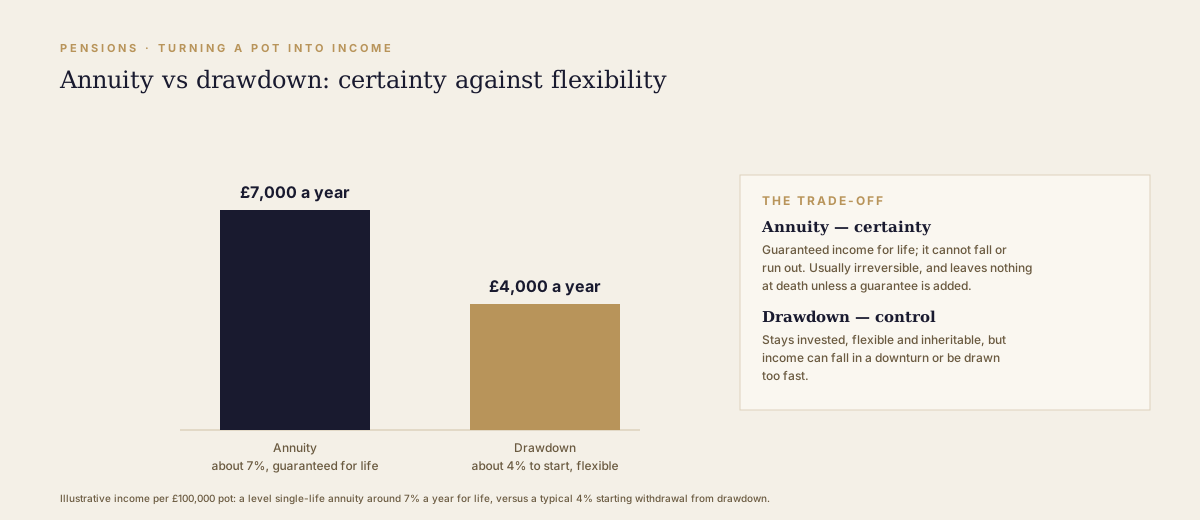
An annuity is an insurance contract that converts a pension pot into a guaranteed income, while drawdown is a method of taking variable income from a pension that remains invested. Choose an annuity if a secure income for life matters most, or drawdown if you want flexibility and to leave a pot to your family; the trade-off is certainty versus control. An annuity removes investment and longevity risk but is usually irreversible and leaves nothing once payments stop, unless you add a guarantee. Drawdown keeps control and inheritability but exposes your income to market falls and the risk of withdrawing too much too soon.
Annuity vs drawdown is the central decision most people face when turning a defined contribution pension into a retirement income. An annuity hands your pot to an insurer in exchange for a guaranteed income that lasts as long as you do. Drawdown keeps the pot invested in your own name and lets you take money out as you choose, leaving the investment risk, and the rewards, with you. One removes uncertainty; the other keeps control. Neither is inherently better, because they solve different problems, and many retirees end up using both. All figures and thresholds in this article reflect the 2026/27 tax year.
How is pension drawdown different from an annuity?
An annuity converts your pension pot into a guaranteed income paid for life by an insurer, with no investment risk to you but no remaining fund, and a level annuity loses value to inflation. Drawdown keeps the pot invested in your name, lets you vary withdrawals, and can be passed on, but the income is not guaranteed and can run out if markets fall or you withdraw too much.
Contents
- The difference between annuity and drawdown
- How an annuity works
- How pension drawdown works
- Annuity vs drawdown compared
- How each is taxed
- What happens when you die
- Should you choose an annuity or drawdown?
What is the difference between an annuity and drawdown?
The difference between an annuity and drawdown is who carries the risk. With an annuity, an insurance company takes on the investment and longevity risk and pays you a set income whatever happens to markets or however long you live. With drawdown, you keep the pot, you keep the risk, and your income depends on how your investments perform and how much you withdraw.
Both start from the same place: a defined contribution pension that you can normally access from age 55, rising to 57 from 6 April 2028. Both also let you take up to 25% of the pot as tax-free cash first, subject to the lump sum allowance. What changes is what happens to the remaining 75%. With an annuity, that money buys a guaranteed income and you never see the capital again. With drawdown, it stays invested and remains yours to spend, leave, or eventually use to buy an annuity later.
This is why the choice is rarely about which product is superior. It is about which risk you would rather hold: the risk that markets fall and your income suffers, or the risk that you trade away a large sum for an income that looks low if you do not live long. Understanding how flexi-access drawdown works alongside the annuity option is the foundation of the decision.
Risk warnings
A pension is a long-term investment, the value of your investment and the income from it may go down as well as up. Your eventual income may depend upon the size of the fund at retirement, future interest rates and tax legislation.
Your pension income could also be affected by the interest rates at the time you take your benefits. The tax implications of pension withdrawals will be based on your individual circumstances, tax legislation and regulation which are subject to change in the future.
How does an annuity work?
An annuity works by exchanging some or all of your pension pot for a guaranteed income, paid by an insurer for the rest of your life. You hand over a lump sum, the insurer applies an annuity rate, and that rate fixes your income. A higher rate means more income for every pound of pot, and rates rise with your age and with gilt yields, because insurers back annuities largely with government bonds.
The income is only as good as the options you attach to it, and those options cost income up front. A level single-life annuity pays the most at outset but never increases, so inflation erodes it every year. Adding inflation protection, a spouse’s pension, or a guarantee period all reduce the starting figure, sometimes sharply. An enhanced annuity, by contrast, pays more if you have health conditions or lifestyle factors that shorten life expectancy.
The defining feature is permanence. Once the short cooling-off period ends, a standard lifetime annuity cannot be undone. That permanence is exactly what delivers the security: you cannot outlive the income, and no market crash can reduce it. Whether that certainty justifies the cost is the question the article on whether annuities are worth it examines in detail.
How does pension drawdown work?
Pension drawdown works by leaving your pot invested while you withdraw income from it directly, so you keep control of the capital and the investment decisions. In its modern form, flexi-access drawdown, there is no cap on how much you can take. You decide the amount and the timing, and you can turn the income up, down, or off as your circumstances change.
That flexibility is also the risk. Because the pot stays invested, a run of poor returns early in retirement can do lasting damage, especially if you are still withdrawing income through the fall. This is known as sequence of returns risk, and it is the single biggest threat to a drawdown plan. Withdraw too much, too early, into a falling market, and the pot may never recover enough to last.
How much can you safely take from pension drawdown?
There is no fixed safe figure, but many UK planners use around 4% of the pot a year as a starting point for income expected to last 30 years or more. The sustainable rate depends on your age, investment mix, and willingness to cut back after poor years. Drawing a flat 6% or 7% with no flexibility materially raises the risk of running out.
Managing that risk is what makes drawdown a plan rather than a product. Setting a sustainable withdrawal rate, holding a cash buffer to avoid selling investments in a downturn, and reviewing the pot regularly are all part of running drawdown well. Done carelessly, it is the riskier of the two routes.
Annuity vs drawdown: how do they compare?
Annuity vs drawdown comes down to a handful of features that pull in opposite directions: certainty, flexibility, investment risk, and what is left for your family. The table below sets them side by side.
How an annuity and drawdown compare across the features that matter most
| Feature | Annuity | Drawdown |
|---|---|---|
| Income | Guaranteed for life | Variable, not guaranteed |
| Investment risk | Carried by the insurer | Carried by you |
| Flexibility | Fixed once set | Adjust any time |
| Reversibility | Usually irreversible | Can switch to annuity later |
| Death benefits | Stop unless guarantee added | Pot passes to beneficiaries |
| Best for | Certainty and simplicity | Control and inheritance |
No single column wins outright, which is the point. An annuity dominates on certainty and simplicity; drawdown dominates on flexibility and inheritance. A retiree who would lose sleep over a falling pot values the left column, while one who wants to leave money to children and keep their options open values the right. The features that look like weaknesses from one seat look like strengths from the other.
The annuity decision is the most final one in retirement planning: it trades a sum you can see for an income you cannot outlive, and it cannot usually be reversed once made.
How are an annuity and drawdown taxed?
Annuity and drawdown income are taxed the same way: as ordinary income through PAYE, after any tax-free cash. Whichever route you take, you can normally take up to 25% of the pot tax free first, capped by the lump sum allowance of £268,275 for 2026/27, and the income that follows is added to your other earnings and taxed at your marginal rate.
The important tax difference is not the rate but the effect on future contributions. Taking taxable income through flexi-access drawdown triggers the money purchase annual allowance, which cuts how much you can still pay into defined contribution pensions to £10,000 a year for 2026/27. Taking only your tax-free cash and leaving the rest untouched does not trigger it, and buying a lifetime annuity does not trigger it either.
This matters for anyone still working. If you intend to keep contributing meaningfully, taking flexible income early can quietly close that door, while an annuity bought with the same pot leaves your annual allowance intact. The tax treatment of the income is identical; the side effect on your contributions is not.
Risk warning
Levels and bases of, and reliefs from, taxation are subject to change and their value will depend upon personal circumstances. Taxation and pension legislation may change in the future.
What happens to an annuity or drawdown when you die?
What happens on death is one of the sharpest contrasts between the two. A standard single-life annuity stops paying the moment you die, and the money you used to buy it is gone, unless you chose to add a guarantee period or a joint-life option that continues paying a spouse. Those features protect your family, but you pay for them with a lower income from day one.
A drawdown pot behaves very differently. Whatever remains passes to the beneficiaries you nominate, who can usually take it as a lump sum or continue to draw an income from it, an arrangement explained in the article on beneficiary drawdown. For many people this inheritability is the strongest argument for staying in drawdown rather than annuitising.
That advantage is narrowing. From 6 April 2027, most unused pension funds and death benefits, including drawdown pots, will be brought within your estate for inheritance tax, a change confirmed in GOV.UK guidance on inheritance tax and unused pension funds. The pension freedom to pass wealth on tax-efficiently is being reduced, which changes the calculation for larger pots in particular. The wider pension and inheritance tax changes from April 2027 are worth understanding before relying on drawdown as an estate planning tool.
Risk warnings
The Financial Conduct Authority does not regulate Cashflow Planning.
The Financial Conduct Authority does not regulate some aspects of Trust, Tax and Estate Planning.
HM Revenue and Customs practice and the law relating to taxation are complex and subject to individual circumstances and changes which cannot be foreseen.
Should you choose an annuity or drawdown?
Choose an annuity if your priority is a guaranteed income you cannot outlive, and choose drawdown if your priority is flexibility and control over the pot. The honest answer for many people is a mix of the two, and the decision should follow your other income and your tolerance for risk rather than a general preference for one product.
The trade-off is real and worth stating plainly. An annuity removes the risk of running out of money but locks away your capital and pays a low headline figure if you live only a few years. Drawdown keeps your capital working and inheritable but exposes your income to markets and to your own withdrawal discipline. A useful test is to cover your non-negotiable spending first.
- An annuity if you want certainty, have little appetite for investment risk, or need to guarantee that core bills are always covered.
- Drawdown if you value flexibility, want to leave the pot to family, and can tolerate income that varies with markets.
- A combination if you want guaranteed income for the essentials and a flexible pot for everything else.
Edward and Marian, both 67, both with £320,000 left after tax-free cash
Edward has no other pension beyond the state pension and cannot face the thought of his income falling. He uses his £320,000 to buy a level single-life annuity at a rate of around 7%, giving roughly £22,400 a year, guaranteed for life and unaffected by any market crash.
Marian has a small defined benefit pension that already covers her basic bills. She keeps her £320,000 in drawdown, withdrawing around £16,000 a year to start, with the pot staying invested and inheritable by her children.
The decision that looks like a detail is Edward’s choice of a level annuity over an inflation-linked one. An escalating annuity would have started at closer to £15,000 a year. The level option pays far more now, but after twenty years of inflation its buying power could be roughly halved, while Marian retains the ability to increase her income and adapt. Edward bought certainty; Marian kept control. Neither is wrong, because their circumstances are not the same.
For anyone weighing this up, modelling the two paths against your real spending, using lifetime cashflow modelling, turns an abstract preference into a decision grounded in numbers.
Important information
We do not currently provide advice on transferring out of defined benefit (final salary) pension schemes. If you require this advice, we will provide details of a suitably qualified adviser at a firm with the necessary regulatory permissions who can assist you.
Can you combine an annuity and drawdown?
Yes, you can use part of your pot to buy an annuity and leave the rest in drawdown, and for many retirees this blend works better than an all-or-nothing choice. A common approach is to annuitise enough to cover essential spending, so that bills are always met whatever markets do, and keep the balance in drawdown for flexibility and to pass on.
You can also stagger the timing. Because drawdown is not permanent, you can start there and buy an annuity later, often at a higher rate as you age or if your health declines. This lets you keep flexibility while younger and lock in guaranteed income when certainty matters more. Coordinating these moves with your other assets is where joined-up pension and retirement planning earns its keep, because the right split depends on your whole financial picture, not the pension alone.
The lesson from putting annuity and drawdown side by side is that they are not rivals so much as tools for different jobs. The question is not which one is best, but how much guaranteed income you need before flexibility becomes the priority.
Frequently asked questions
What is the difference between an annuity and drawdown?
An annuity converts your pension pot into a guaranteed income paid for life by an insurer, removing investment and longevity risk. Drawdown keeps the pot invested in your name and lets you take variable withdrawals, but the income is not guaranteed and can fall or run out. The core trade-off is certainty versus flexibility.
Is drawdown better than an annuity?
Neither is better in isolation; they manage different risks. Drawdown suits people who value flexibility, want to leave the pot to family, and can tolerate income that varies with markets. An annuity suits people who want a guaranteed income they cannot outlive and prefer certainty over control. The right answer depends on your other income and your appetite for risk.
Can you change from drawdown to an annuity later?
Yes. Drawdown is not permanent, so you can use the remaining fund to buy an annuity at any later age, and annuity rates often improve as you get older. The reverse is rarely possible: a standard lifetime annuity cannot usually be cancelled once the cooling-off period ends, which makes it the more final of the two decisions.
How much income will an annuity or drawdown pay?
An annuity rate sets your income as a percentage of the pot, varying with your age, health, and gilt yields; a healthy 66-year-old might secure roughly 7% a year for a level single-life annuity in 2026. Drawdown income is whatever you choose to withdraw, though many planners treat around 4% a year as a starting point for a pot that needs to last.
Does taking drawdown affect how much I can pay into a pension?
Yes. Taking taxable income through flexi-access drawdown triggers the money purchase annual allowance, which caps future defined contribution contributions at £10,000 a year for 2026/27. Taking only your 25% tax-free cash does not trigger it. Buying a lifetime annuity does not trigger the allowance either.
What happens to an annuity or drawdown pot when I die?
A standard single-life annuity stops paying when you die unless you added a guarantee period or a spouse's pension. A drawdown pot passes to your nominated beneficiaries, who can usually inherit it as a lump sum or continue drawing from it. From 6 April 2027, most unused pension funds, including drawdown, fall within your estate for inheritance tax.