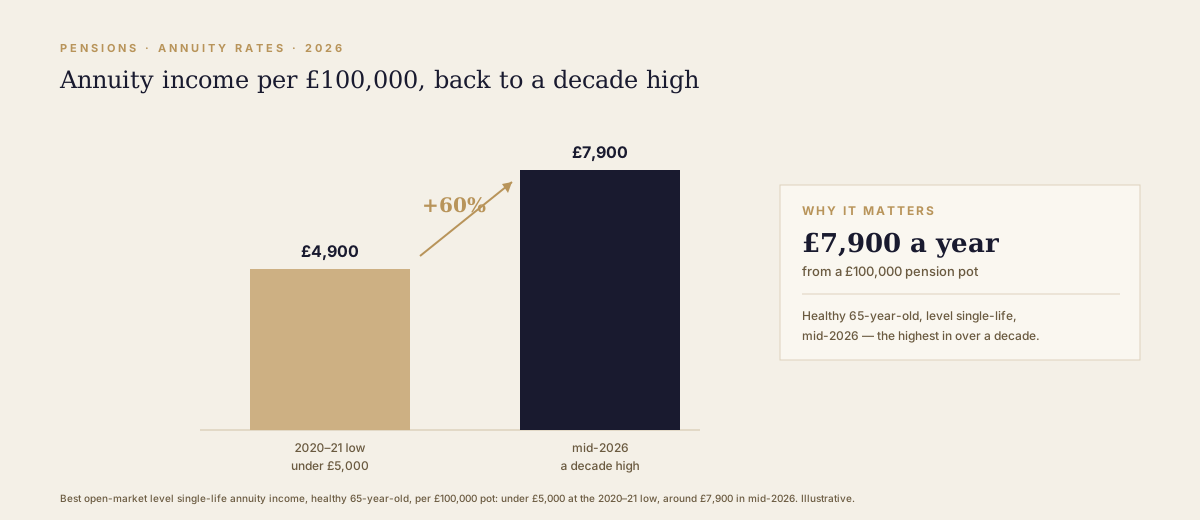
An annuity is an insurance contract that converts a pension pot into a guaranteed income, paid either for the rest of your life or for a fixed term. Annuities are worth it for retirees who value a guaranteed income over flexibility and access. After interest rates rose from 2022, annuity income reached its highest level in well over a decade, reviving a product the pension freedoms had pushed to the margins. The catch is permanence: a conventional annuity cannot be unwound, so it rewards certainty over flexibility and suits part, rather than all, of most retirement plans.
Whether annuities are worth it comes down to a single trade-off: a guaranteed income you cannot outlive, in exchange for giving up access to your capital and the prospect of investment growth. For most of the decade after the 2015 pension freedoms, that trade looked poor, and annuities fell out of fashion. Higher interest rates have changed the arithmetic. A healthy 65-year-old can now secure around £7,900 a year for life from a £100,000 pension pot, the highest annuity income on offer in well over a decade. This article explains how annuities work, what drives the income on offer, how they are taxed, and where guaranteed income earns its place in a retirement plan. All figures reflect the 2026/27 tax year.
How much income does an annuity pay in 2026?
In mid-2026, the best open-market rate for a healthy 65-year-old buying a single-life, level annuity is around £7,900 a year for every £100,000 of pension pot. Older buyers, smokers and those in poor health are offered more; inflation-linked and joint-life annuities start lower.
Contents
- What is an annuity, and how does it work?
- How much income does an annuity pay?
- What types of annuity can you choose?
- Why do annuity rates change?
- Are annuities worth it?
- How is annuity income taxed?
- What happens to an annuity when you die?
- Should you buy an annuity now or wait?
What is an annuity, and how does it work?
An annuity is an insurance contract that turns a pension pot into a guaranteed income, paid by an insurer for the rest of your life or for a fixed term. You hand over a lump sum, usually from a defined contribution pension, and in return the provider promises a set income, however long you live and whatever happens to investment markets. Before buying, you can normally take up to 25% of the pot as a tax-free pension commencement lump sum, with the balance used to purchase the annuity.
The income offered, known as the annuity rate, reflects how long the insurer expects to pay you. It depends on your age, your health and lifestyle, the size of your pot, and the options you build in. You do not have to buy your annuity from your existing pension provider, and you do not have to annuitise everything: many people secure an income with part of their pot and leave the rest invested. Shopping the whole market matters more than any other single step, because the open market option, your right to buy your annuity from any provider rather than your current one, can add up to around 20% to the income you receive.
Risk warnings
A pension is a long-term investment, the value of your investment and the income from it may go down as well as up. Your eventual income may depend upon the size of the fund at retirement, future interest rates and tax legislation.
Your pension income could also be affected by the interest rates at the time you take your benefits. The tax implications of pension withdrawals will be based on your individual circumstances, tax legislation and regulation which are subject to change in the future.
How much income does an annuity pay?
In mid-2026, a healthy 65-year-old buying a single-life, level annuity with no other features can expect around £7,900 a year for every £100,000 of pension pot from the most competitive providers. That is the highest annuity income has been in well over a decade, and roughly 60% more than the same pot would have bought at the lows of 2020 and 2021, when rates fell below £5,000.
The headline figure is only a starting point, because the income changes sharply with the options you choose. The chart below compares the annual income a 65-year-old might secure from a £100,000 pot across the main annuity types.
The pattern is consistent: every feature that makes an annuity more valuable lowers the starting income. A level single-life annuity pays around £7,900 a year, while the protections that matter most in a real plan, rising income and a continuing payment to a spouse, reduce the starting figure by several hundred to over two thousand pounds. An enhanced annuity moves the other way, paying more to those whose health is expected to shorten how long the income is paid.
Two things lift the rate further. Age is one: a 70-year-old is offered more than a 65-year-old, and a 75-year-old more again, because the income is expected to be paid for fewer years. Health is the other. Anyone with a medical condition or lifestyle factor, such as smoking, high blood pressure or a history of serious illness, may qualify for an enhanced annuity, which can pay materially more for the same pot.
What types of annuity can you choose?
The main choices are between an income that stays flat and one that rises, between cover for one life and two, and between standard and enhanced rates. Each is a separate decision, and you can combine them, for example a joint-life income that also rises with inflation.
A level annuity pays the same amount every year for life. It has the highest starting income, but its real value falls as prices rise. An escalating annuity increases each year, either by a fixed percentage such as 3% or in line with an inflation index; it starts lower but protects your purchasing power. A joint-life annuity continues paying a set proportion, often 50% or 100%, to a surviving spouse or partner after you die, whereas a single-life annuity stops on your death. An enhanced annuity pays more to people whose health or lifestyle reduces their life expectancy.
Margaret, 66, choosing between a level and an escalating income
Margaret has a £200,000 pension pot and wants a secure income to sit alongside her state pension. She is weighing a level annuity against one that rises by 3% each year.
The level annuity offers around £15,800 a year, fixed for life. The 3% escalating annuity starts at around £12,600, about £3,200 a year less at the outset. On the face of it the level income looks far more attractive.
But the escalating income overtakes the level one when Margaret is in her mid-70s, and by her early 80s it has paid more in total. Meanwhile, at 3% inflation the level annuity’s spending power roughly halves over a 24-year retirement. The higher headline figure buys less and less each year, exactly when later-life costs such as care tend to rise.
Two features protect against dying early. A guarantee period keeps the income paid for a minimum term, say five or ten years, even if you die within it. Value protection can return the balance of your original pot, less income already paid, as a lump sum to your beneficiaries.
A fixed-term annuity, by contrast, pays a guaranteed income for a set number of years, often three to twenty-five, and then a maturity lump sum, which keeps your options open rather than committing you for life. A short-term annuity is a briefer version, lasting no more than five years and bought from funds already moved into drawdown rather than from the part of your pension you have not yet started drawing on.
One further category sits apart from these. An investment-linked annuity, sometimes called a flexible annuity, keeps part of the income tied to investment performance, so it can rise or fall rather than staying fixed. It reintroduces some of the investment risk a conventional annuity is bought to remove, which is why it remains a niche choice for those willing to trade certainty for the chance of a higher income.
Risk warnings
Investments
Past performance is used as a guide only; it is no guarantee of future performance.
Pension drawdown
Drawdown pension plans (unsecured income) are complex and are not suitable for everyone. Pension decisions can affect your income for the rest of your life (and that of any partner and other dependants). Where benefits are accessed on a flexible basis, these are not fixed or safeguarded for life. If security of income is important to you then you should consider purchasing an annuity or taking a scheme pension to provide a secured level of income.
Why do annuity rates change?
Annuity rates move with the yield on long-dated UK government bonds, or gilts. Insurers back the guaranteed income they sell by buying these bonds, so when gilt yields rise, providers can offer more income for the same pot, and when yields fall, rates follow them down. This is why the same £100,000 bought less than £5,000 of income in 2021 and close to £7,900 today: the difference is largely the change in gilt yields since interest rates began rising in late 2021.
Two practical points follow. First, annuity rates are not set by any single provider’s generosity; they reflect market conditions that move daily, which is why a quote may only be held open for a week or two. Second, no one can reliably predict where rates go next, because gilt yields respond to inflation, interest rate expectations and government borrowing, none of which is forecastable with confidence.
Are annuities worth it?
An annuity is worth it when the certainty of a guaranteed retirement income you cannot outlive is worth more to you than flexibility and the chance of growth. For someone who wants to know their essential bills are covered for life, regardless of how markets or their own lifespan behave, that certainty is valuable, and today’s rates make it easier to justify than at any point in well over a decade.
The case rests on two risks an annuity removes. One is investment risk. The other is sequence of returns risk, the danger that poor returns early in retirement, combined with withdrawals, permanently shrink a pot you are drawing on. An annuity transfers both risks to the insurer.
The alternative is flexi-access drawdown, which keeps your money invested with full access and the prospect of growth, but the income is not guaranteed and a bad run of markets can force you to cut back.
Strengths
- Income guaranteed for life, however long you live
- No exposure to falling markets or poor return sequencing
- Simple to run, with nothing to manage or review
- Higher starting rates than at any time in well over a decade
Trade-offs
- The capital is gone and cannot be reached for emergencies
- A conventional annuity cannot be reversed if circumstances change
- A level income loses real value to inflation every year
- Die early without protection, and the income simply stops
This is rarely an all-or-nothing choice. Many retirees cover their non-negotiable costs with a guaranteed income and keep a separate invested pot for flexibility, which is also where a sustainable withdrawal rate does its work. The right balance depends on how much guaranteed income you already have, including the state pension, and how much of your spending you are unwilling to leave exposed to markets, a question that sits at the heart of pensions and retirement planning.
A guaranteed income is most valuable for the spending you cannot afford to cut. Covering non-negotiable bills with an annuity, and leaving discretionary spending to a flexible pot, often matters more than choosing between an annuity and drawdown outright.
How is annuity income taxed?
Annuity income is taxed as pension income at your marginal rate, in the same way as a salary or the state pension, as set out in HMRC’s Pensions Tax Manual guidance on lifetime annuities. The provider deducts tax through PAYE before paying you, so the figures quoted by providers are gross, before tax.
The tax-free element comes earlier. Up to 25% of the pot can be taken as a tax-free lump sum before the annuity is bought, capped by the Lump Sum Allowance of £268,275 for 2026/27. The income from the annuity itself is then fully taxable. Regular annuity income is not tested against the Lump Sum Allowance; only lump sums are, so the size of the income you secure does not use up that allowance.
How much tax-free cash can you take before buying an annuity?
Before buying an annuity, you can normally take up to 25% of your pension pot as a tax-free pension commencement lump sum, capped by the Lump Sum Allowance of £268,275 for 2026/27. The remaining amount used to buy the annuity then produces fully taxable income.
One useful quirk: buying a conventional lifetime annuity, one whose income cannot fall, does not trigger the money purchase annual allowance, whereas taking flexible income from drawdown does. So someone who annuitises part of their pension and keeps working can still contribute up to the full annual allowance, where drawing income another way might have cut it to £10,000. There are two exceptions: a flexible or investment-linked annuity whose income can decrease, and a short-term annuity bought from funds already in drawdown. Both count as flexibly accessing your pension, so they trigger the allowance in the same way drawdown does.
Risk warnings
Pensions
Levels and bases of, and reliefs from, taxation are subject to change and their value will depend upon personal circumstances. Taxation and pension legislation may change in the future.
Tax, trusts and estate planning
The Financial Conduct Authority does not regulate Cashflow Planning.
HM Revenue and Customs practice and the law relating to taxation are complex and subject to individual circumstances and changes which cannot be foreseen.
What happens to an annuity when you die?
What happens depends entirely on the options you chose when you set the annuity up. A single-life annuity with no guarantee stops paying the moment you die. A joint-life annuity continues paying a chosen percentage to your spouse or partner, a guarantee period keeps the income running for the rest of a fixed term, and value protection can return part of the original pot as a lump sum.
For the income tax treatment, the rule turns on your age at death. If you die before 75, income paid to a beneficiary under a joint-life or guaranteed annuity is income-tax-free. If you die at 75 or over, that income is taxable at the beneficiary’s marginal rate. This mirrors the wider rules on how pensions are taxed on death.
Inheritance tax is where annuities have an unusual advantage. From 6 April 2027, most unused pension funds and many death benefits are brought into the estate for inheritance tax, a significant change covered in our guide to pensions and inheritance tax from April 2027. The continuing income from a joint-life annuity is specifically left outside that net, and anything paid to a spouse or civil partner remains exempt in any case. Value protection lump sums and discretionary guarantee payments, however, can fall within it.
Should you buy an annuity now or wait?
There is no reliable way to time annuity rates, so the decision is better framed around your need for income than around forecasting gilt yields. If a guaranteed income would let you stop worrying about markets and you are at or near the age you want it, securing today’s rates removes a risk rather than taking one.
Waiting has a cost. Every year you delay is a year of guaranteed income you do not receive, and rates may be lower, not higher, when you return to the question. Working out how much guaranteed income you actually need, and when, is the kind of question lifetime cashflow modelling is built to answer.
Two patterns are common among those who do annuitise. Some buy in stages, converting tranches of their pot at 65, 70 and 75, which spreads the risk of buying everything at one rate and takes advantage of the higher income offered at older ages. Others delay annuitising until their 70s, keeping the pot flexible while they are active and likely to want access, then locking in a guaranteed income as longevity risk and the appeal of simplicity grow. Neither is right for everyone, but both beat assuming the choice has to be made once, in full, on the day you retire.
How much of your income should be guaranteed?
Annuities are no longer the poor-value option they seemed for much of the last decade. Higher rates have restored a genuine choice between certainty and flexibility, and for many retirees the answer is not one or the other but a deliberate mix of both. The question worth asking is not simply whether annuities are worth it, but how much of your retirement income you want guaranteed, and which spending you are unwilling to leave at the mercy of markets. Get that balance right, and the decision about whether, when and how much to annuitise tends to answer itself.
Frequently asked questions
What is an annuity?
An annuity is an insurance contract that pays a guaranteed income in exchange for some or all of your pension pot. The income can be paid for the rest of your life, called a lifetime annuity, or for a fixed term. Most lifetime annuities cannot be changed or cashed in once they start.
Can you cash in an annuity once you have bought it?
No. A conventional lifetime annuity normally has a 30-day cooling-off period, after which it cannot be cancelled, sold, or converted back into a pot of money. This permanence is the main reason to compare the whole market and weigh the options carefully before buying.
Is an annuity better than drawdown?
Neither is universally better; they answer different needs. An annuity gives a guaranteed income that cannot fall or run out, while flexi-access drawdown keeps your pot invested with full access and growth potential, but no guarantees. Many retirees use both, annuitising enough to cover their essential bills.
Do annuity payments stop when you die?
It depends on the options you choose. A single-life annuity with no guarantee stops on death, even if that is soon after it starts. A joint-life annuity continues paying a chosen percentage to your spouse or partner, and a guarantee period or value protection can return more to your beneficiaries.
How does buying an annuity affect the rest of my pension?
You do not have to annuitise everything. You can buy an annuity with part of your pot and leave the rest invested in drawdown. Buying a conventional lifetime annuity does not trigger the money purchase annual allowance, so it does not by itself reduce how much you can keep contributing. The exceptions are a flexible or investment-linked annuity whose income can fall and a short-term annuity bought from drawdown, both of which trigger the allowance and cap further contributions at £10,000.
Are annuity rates likely to fall?
Annuity rates move with long-dated gilt yields, which no one can reliably predict, so rates could rise or fall from here. Waiting risks giving up income you could have received, though buying at an older age usually secures a higher rate because the income is expected to be paid for fewer years.