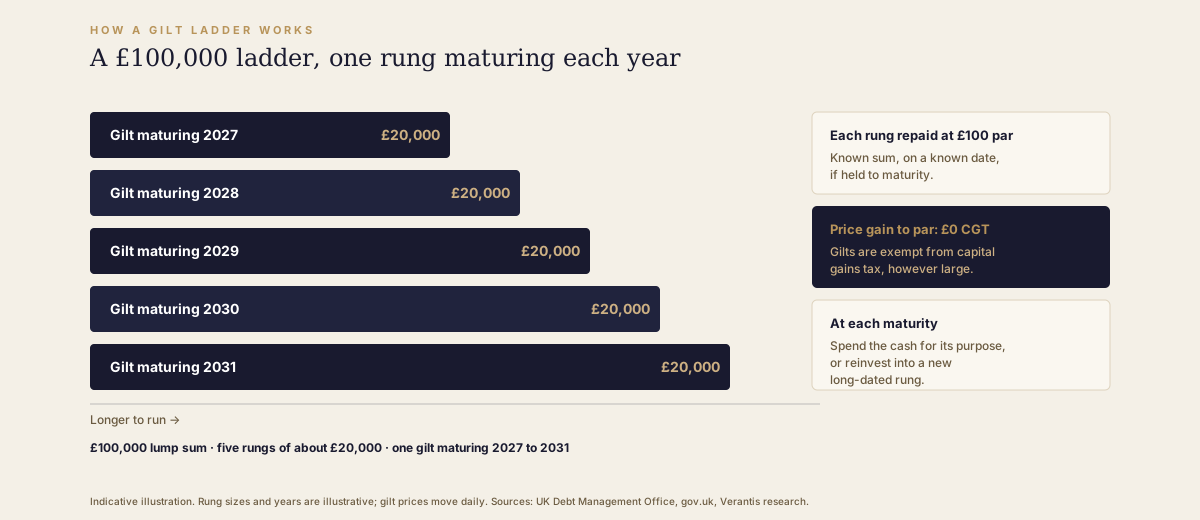
Gilt laddering is an investment strategy that holds several individual UK government bonds with staggered maturity dates, so that one gilt matures and returns its capital at each planned interval. Held to maturity, each rung of a gilt ladder returns a known sum on a known date, locking in a defined, largely tax-free return. It suits money earmarked for a future date, a retirement income floor, or a higher-rate taxpayer holding low-risk money outside an ISA or pension. The main limitations are reinvestment risk when rungs mature and the sizeable lump sum needed to spread across enough gilts.
Gilt laddering is a way of holding several individual UK government bonds that mature one after another, so a known sum of capital returns to you on a schedule you choose rather than being left to the mercy of the market. Each bond, or rung, is bought to be held to its maturity date, when the government repays it in full at £100 par value. Held outside an ISA or pension, a gilt ladder is one of the most tax-efficient ways for a UK investor to hold low-risk money, because gilts are exempt from capital gains tax. This article explains how a gilt ladder works, why the tax treatment is so favourable, how to build one, and where it earns its place in a plan.
All figures and yield levels in this article reflect the 2026/27 tax year and market conditions in mid-2026.
How does a gilt ladder work?
A gilt ladder holds several UK government bonds with maturity dates spread across successive years, so one gilt matures and repays its capital at each interval. Each gilt is held to its maturity date, when it is repaid at £100 par value. The returned cash is then spent or reinvested into a new long-dated rung.
Contents
- What is gilt laddering?
- How does a gilt ladder work?
- Why are gilts so tax-efficient in a ladder?
- How do you build a gilt ladder?
- What is a gilt ladder used for?
- Gilt ladder vs bond fund: what is the difference?
- What are the drawbacks of gilt laddering?
- Is gilt laddering worth it?
What is gilt laddering?
Gilt laddering is the practice of buying several gilts with different maturity dates and holding each one until it matures. A gilt is a bond issued by the UK government: it pays a fixed coupon and, at a set future date, repays a fixed amount, conventionally £100 for every £100 of nominal value. Buy gilts maturing in 2027, 2028, 2029 and so on, and you have built a ladder whose rungs redeem one at a time.
The point of the structure is certainty of outcome. A single gilt held to maturity has a known redemption value on a known date, so the return you lock in when you buy is the return you get, whatever the price does in between. Spreading maturities across several years turns that single certain event into a steady, scheduled release of capital. You decide, at the outset, roughly when your money comes back.
This is quite different from owning a bond fund, which never matures and whose value simply floats with the market. A ladder is a set of fixed appointments; a fund is an open-ended relationship. That distinction is the source of almost every advantage and drawback that follows.
How does a gilt ladder work?
A gilt ladder works by holding each rung to its maturity date, at which point the UK Debt Management Office, which issues gilts on the government’s behalf, repays the gilt at £100 par plus its final coupon. Because that repayment amount and date are fixed in advance, the maturing rung is immune to the price swings that affect a gilt sold early.
Between purchase and maturity, the market price of each gilt still moves, mostly with changes in gilt yields. If yields rise, the market price of your existing gilts falls, and vice versa. For a ladder, that mid-life price movement is noise: you are not planning to sell. What you have fixed is the redemption value, and that does not change.
Ladders come in two broad shapes. A rolling ladder reinvests each maturing rung into a new long-dated gilt, keeping the structure going indefinitely and smoothing your exposure to different yield environments over time. A defined-maturity ladder is built to run down, with each rung timed to fund a specific future cost, and is not replaced when it matures. The mechanics are identical; only what you do with the returned cash differs.
Why are gilts so tax-efficient in a ladder?
Gilts are tax-efficient because they are exempt from capital gains tax, and their coupon income is usually modest. Gov.uk confirms that UK government gilts are among the assets you do not pay capital gains tax on, whatever the size of the gain. That single fact reshapes the maths for anyone holding low-risk money outside an ISA or pension.
Here is why it matters. A gilt’s total return, its gross redemption yield, comes from two sources: the coupon it pays each year, and the difference between the price you pay and the £100 you get back at maturity. Many gilts issued in the ultra-low-rate years carry tiny coupons and now trade well below £100, so most of their return arrives as a capital gain to par. For a gilt, that gain is entirely free of capital gains tax, unlike a gain on shares held in a taxable account.
The coupon is not tax-free. HMRC taxes it as savings income, sheltered by the personal savings allowance of £1,000 for basic-rate, £500 for higher-rate and £0 for additional-rate taxpayers in 2026/27, with any excess taxed at your marginal rate. Because a low-coupon gilt pays very little coupon, most of its return escapes tax entirely. The gov.uk guidance on tax on savings interest sets out how that allowance works.
Nadia, 55, higher-rate taxpayer with £50,000 outside her ISA and pension
Nadia has £50,000 sitting in cash that she will not need for about two years. Her choice is between a fixed-rate savings account paying around 4.2% before tax, and a low-coupon gilt maturing in early 2028.
The savings account is fully taxable. Her £500 personal savings allowance covers the first slice of the interest and the rest is taxed at 40%, leaving her a net return of roughly 2.9% a year. The gilt she is looking at has a 0.5% coupon and trades at about £93 per £100 nominal.
Held to maturity, the gilt repays £100, a capital gain of about £7 per £100 that is free of capital gains tax. Its coupon is small enough to sit inside the same allowance the savings interest overshoots, so in practice none of the gilt’s return is taxed. Her after-tax return works out at roughly 4.3% a year. Same risk, same horizon, but the gilt keeps about £700 a year more of her return, purely because of how it is taxed. (Illustrative figures; gilt prices move daily.)
Risk warnings
Investments
Investing in shares should be regarded as a long-term investment and should fit in with your overall attitude to risk and financial circumstances.
The taxation of the investment is dependent on the individual circumstance of each investor, and may be subject to change in the future.
ISAs
The favourable tax treatment of ISAs may be subject to changes in legislation in the future.
Pensions
Levels and bases of, and reliefs from, taxation are subject to change and their value will depend upon personal circumstances. Taxation and pension legislation may change in the future.
Tax, trusts and estate planning
The Financial Conduct Authority does not regulate Cashflow Planning.
HM Revenue and Customs practice and the law relating to taxation are complex and subject to individual circumstances and changes which cannot be foreseen.
Cash and deposits
While cash provides security of capital, it may not keep pace with inflation. Over time, the real value of your savings could fall.
How do you build a gilt ladder?
You build a gilt ladder by dividing a lump sum into rungs, choosing a gilt to mature in each target year, and holding each one to maturity. The process is more methodical than complicated, and follows five steps.
- Set the horizon and the amount. Decide how many years the ladder should span and the total to invest, then split it into roughly equal rungs, one per year. A five-year ladder of £100,000 means about £20,000 per rung.
- Choose a maturity for each rung. Pick a gilt maturing in each target year, so one bond redeems every year across the span. The Debt Management Office publishes every gilt in issue and its maturity date.
- Favour low-coupon gilts outside a wrapper. If the ladder sits in a general investment account rather than an ISA or SIPP, prefer low-coupon gilts trading below £100, so most of the return comes as tax-free capital growth.
- Buy and hold each gilt to maturity. Buy each rung intending to keep it to its redemption date. Holding to maturity is what locks in the known outcome and removes price risk.
- Reinvest or spend at each maturity. When a rung matures at par, spend the cash for its earmarked purpose or roll it into a new long-dated rung to keep the ladder running.
What is a gilt ladder used for?
A gilt ladder is used to make a slice of your money behave predictably, in three main situations. Each relies on the same feature: a known sum arriving on a known date.
- A defined income floor in retirement. Rungs maturing over the next few years can cover essential spending with money that does not depend on share prices, easing the pressure to sell growth assets after a fall. This directly softens sequence of returns risk, the danger of poor early returns in drawdown.
- Meeting a known future cost. School fees, a house deposit, or a large tax bill on a set date can each be matched by a rung timed to mature just before the money is needed.
- A tax-efficient home for low-risk money. For higher and additional-rate taxpayers who have used their ISA and pension allowances, gilts held in a taxable account can beat savings accounts and bond funds after tax.
A gilt ladder is not trying to beat the market. Its job is to make one part of your money boringly predictable: a known sum, on a known date, taxed as lightly as the rules allow.
Used as a retirement income tool, a ladder complements rather than replaces the wider question of how much you can sustainably draw. It secures the near-term, letting the rest of the portfolio stay invested for growth.
Risk warnings
Pensions
A pension is a long-term investment, the value of your investment and the income from it may go down as well as up. Your eventual income may depend upon the size of the fund at retirement, future interest rates and tax legislation.
Pension drawdown
Drawdown pension plans (unsecured income) are complex and are not suitable for everyone. Pension decisions can affect your income for the rest of your life (and that of any partner and other dependants). Where benefits are accessed on a flexible basis, these are not fixed or safeguarded for life. If security of income is important to you then you should consider purchasing an annuity or taking a scheme pension to provide a secured level of income.
Gilt ladder vs bond fund: what is the difference?
The core difference is maturity: every gilt in a ladder has a fixed redemption date, whereas a bond fund never matures and simply tracks the market value of the bonds it holds. That one distinction drives the rest of the comparison.
Gilt ladder vs a bond fund at a glance
| Feature | Gilt ladder | Bond fund |
|---|---|---|
| Maturity | Each gilt has a fixed date | None; runs perpetually |
| Return | Known if held to maturity | Depends on price when you sell |
| Price risk | Removed if held to maturity | Always present |
| Diversification | You build it, gilt by gilt | Instant, across many bonds |
| Ongoing cost | One-off dealing, no fund fee | Annual fund charge |
A fund is simpler and diversified from day one, but it can never promise you a specific sum on a specific date, and its value can be down when you need to sell, as many holders found when bond prices fell sharply in 2022. A ladder demands more setup and a larger pot, and in exchange gives you defined outcomes. The right choice depends on whether you value certainty of maturity or hands-off diversification more.
What are the drawbacks of gilt laddering?
The main drawbacks are reinvestment risk, inflation, and the effort and scale a ladder requires. None is fatal, but each shapes who a ladder suits.
Are gilts free from capital gains tax?
Yes. UK government gilts are exempt from capital gains tax, so the gain between the price you pay and the £100 repaid at maturity is tax-free, however large. The coupon a gilt pays is still taxed as savings income, but many gilts pay only a small coupon, so most of the return escapes tax.
Strengths
- Defined return and maturity date if each rung is held to term
- Gains are free of capital gains tax, whatever their size
- Very low default risk on UK government debt
- No annual fund charge; only one-off dealing costs
Trade-offs
- Reinvestment risk: maturing cash may only be reinvested at lower yields
- Inflation erodes fixed returns unless you use index-linked gilts
- Needs a lump sum large enough to spread across several gilts
- More admin than a single fund, and rungs must actually be held to maturity
Reinvestment risk is the one most people underestimate. A ladder locks in today’s yields only for the rungs you hold; when each matures, the cash is reinvested at whatever yields prevail then, which may be lower. Index-linked gilts can address inflation, but they behave differently and add complexity.
Is gilt laddering worth it?
Gilt laddering is worth it when you need defined amounts of low-risk money on defined dates, and especially when that money sits outside an ISA or pension where the capital gains tax exemption does real work. For a higher-rate taxpayer holding cash they cannot shelter, a ladder of low-coupon gilts can quietly out-earn a savings account after tax, at a similar level of risk.
It is less compelling in other cases. If your low-risk money is already inside an ISA or SIPP, the tax advantage falls away and a simple gilt fund may serve just as well with less effort. If your pot is small, the cost and admin of assembling individual gilts can outweigh the benefit. And if your real problem is long-term growth rather than near-term certainty, gilts are the wrong tool: their job is stability, not return.
The honest summary is that a gilt ladder is a precision instrument. It does one thing, certainty of outcome on a schedule, better than almost anything else, and it does nothing at all for growth. Whether that trade is worth making depends on what the rest of your plan already covers, which is exactly the kind of question that investment advice and a lifetime cashflow plan are built to answer.
Frequently asked questions
What is a gilt ladder?
A gilt ladder is a set of individual UK government bonds bought so that they mature in different, successive years. As each gilt reaches maturity it repays its capital at £100 par, giving you a predictable series of cash returns you can spend or reinvest. It is the fixed-income version of not putting all your money on one date.
What happens when a gilt in your ladder matures?
When a gilt matures, the government repays its full £100 par value per unit of nominal, plus the final coupon. That cash lands in your account on the known maturity date. You then choose whether to spend it for the goal it was earmarked for, or reinvest it into a new longer-dated gilt to extend the ladder.
How much money do you need to build a gilt ladder?
There is no legal minimum, but spreading money across enough separate gilts to make a ladder worthwhile usually calls for a lump sum in the tens of thousands of pounds. With less than that, a low-cost gilt fund or a fixed-term savings product is often simpler, even though it does not give the same defined maturity dates.
Can you hold a gilt ladder in an ISA or SIPP?
Yes. Gilts can be held inside a Stocks and Shares ISA or a SIPP, where all returns are already sheltered from tax. The distinctive tax advantage of gilts, their exemption from capital gains tax, matters most outside a wrapper, so a ladder is often built in a general investment account once ISA and pension allowances are used up.
Is a gilt ladder better than a bond fund?
Neither is simply better. A gilt ladder gives you fixed maturity dates and a known return if every rung is held to maturity, which a bond fund cannot, because a fund never matures. A fund gives instant diversification and no dealing effort. A ladder suits defined future needs; a fund suits hands-off, long-term bond exposure.
Should you use a gilt ladder for retirement income?
A gilt ladder can form a dependable income floor in retirement, covering essential spending for the next few years with money that does not depend on markets. This reduces the pressure to sell shares after a fall. It is rarely the whole plan, though: inflation and reinvestment risk mean a ladder usually sits alongside growth assets rather than replacing them.
Risk warnings
ISAs
An investment in a Stocks & Shares ISA will not provide the same security of capital associated with a Cash ISA.
Cash and deposits
Interest rates are not guaranteed to remain at current levels. Rates available when your fixed/notice account matures may be lower, and any reinvestment could earn less.
If your circumstances change, breaking a fixed-term arrangement early may reduce the interest you receive.
Some accounts have notice periods or fixed terms. During these periods, you may not be able to access your funds, or may incur penalties for early withdrawal.