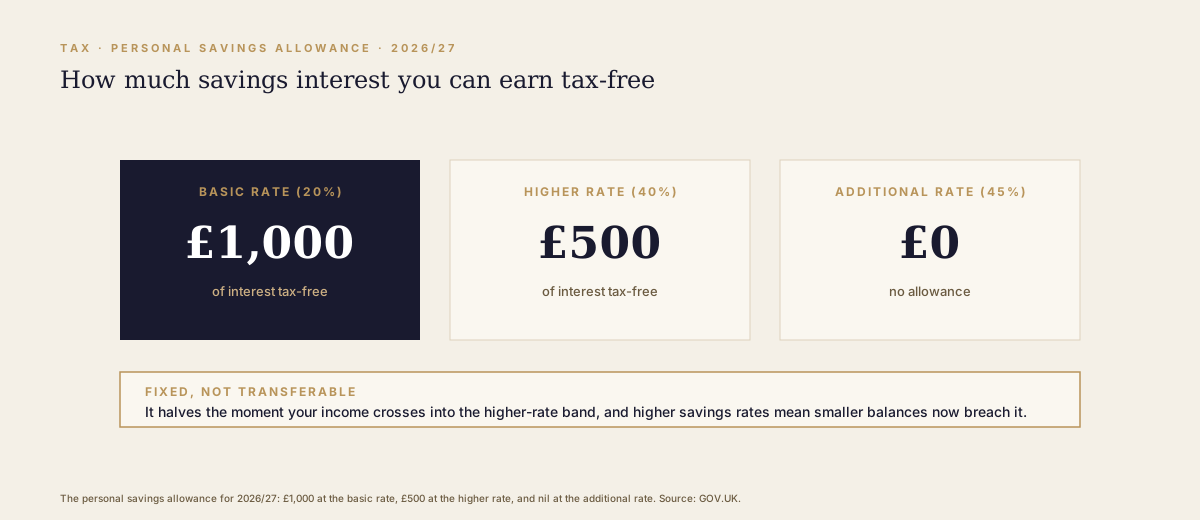
The personal savings allowance is the amount of interest a UK taxpayer can earn each year without paying income tax on it, set by income tax band. The personal savings allowance takes the first slice of your interest out of income tax: £1,000 a year for 2026/27 at the basic rate, £500 at the higher rate and £0 at the additional rate. It matters more now that higher savings rates take a far smaller balance past the limit than a few years ago. The allowance is fixed, cannot be carried forward, and changes the moment your total income crosses into a higher band, which the interest itself counts towards.
The personal savings allowance lets most people earn a set amount of interest each year without paying income tax on it: £1,000 for basic-rate taxpayers, £500 for higher-rate taxpayers, and £0 for additional-rate taxpayers. It is not a pot you claim or an account you open; it works automatically against the interest your savings pay. With savings rates far higher than they were a few years ago, the allowance now bites on much smaller balances, which is why more people are paying tax on interest for the first time. All figures in this article reflect the 2026/27 tax year.
How is tax on savings interest calculated?
Savings interest is added on top of your other income for 2026/27. Your personal allowance and any unused starting rate for savings are applied first, then your personal savings allowance covers £1,000 of interest at the basic rate or £500 at the higher rate. Interest above those limits is taxed at 20%, 40% or 45%, and each of those rises two percentage points on 6 April 2027.
Contents
- How the allowance works
- How tax on interest is calculated
- The starting rate for savings
- How ISAs change the picture
- The knock-on effects
- Should you move savings into an ISA?
How does the personal savings allowance work?
The personal savings allowance works as a tax-free band that sits on top of your other income and applies only to interest. For the 2026/27 tax year it is £1,000 for basic-rate taxpayers, £500 for higher-rate taxpayers, and £0 for additional-rate taxpayers whose income exceeds £125,140. You do not apply for it and it does not appear on a statement: HMRC simply does not tax the first slice of interest your savings pay, up to your band limit.
The allowance is set by the tax band you are in, not by the size of your savings. What decides that band is your total taxable income, and a pay rise is only the most visible way it moves. Rental profit, self-employment, dividends, a bonus, a pension drawn for the first time and the savings interest itself all count towards the £50,270 threshold.
That last one is the trap. A saver sitting just below the higher-rate band can be carried over it by their own interest, which halves the allowance that was meant to shelter that interest in the first place. The allowance cannot be carried forward either, so unused headroom in one tax year is simply lost.
Why this matters more now is arithmetic. When savings rates were close to zero, a £1,000 allowance covered a very large balance. With rates much higher, the same allowance is used up far sooner, a shift driven by the same forces that move gilt yields and the wider cost of money. At a 4.5% rate, £1,000 of interest is reached on a balance of around £22,000, and £500 on around £11,000.
Risk warnings
Pensions
The value of pensions and any income from them can fall as well as rise. You may not get back the full amount invested.
Levels and bases of, and reliefs from, taxation are subject to change and their value will depend upon personal circumstances. Taxation and pension legislation may change in the future.
A pension is a long-term investment and the value is not guaranteed. Any advice or considerations are personal to each individual’s circumstances.
Tax, trusts and estate planning
The Financial Conduct Authority does not regulate Cashflow Planning.
HM Revenue and Customs practice and the law relating to taxation are complex and subject to individual circumstances and changes which cannot be foreseen.
How is tax on savings interest calculated?
Tax on savings interest is calculated by stacking your interest on top of your other income, then applying your allowances in a set order before any tax is charged. The order is what makes the system feel opaque, so it is worth seeing the steps. First your personal allowance of £12,570 covers your earned income. Next, if you qualify, the starting rate for savings can cover up to £5,000 of interest at 0%. Then your personal savings allowance covers the next £1,000 or £500. Only interest above all of that is taxed, at the same 20%, 40% or 45% rate that applies to the band it falls in. The mechanics are set out in GOV.UK’s guidance on tax on savings interest.
Those three rates change on 6 April 2027. Savings income will then be taxed at 22%, 42% and 47%, two percentage points above the equivalent rates on earnings, confirmed in HMRC’s measure on tax rates for property, savings and dividend income. The allowances themselves are untouched: the personal savings allowance stays at £1,000 and £500, and the starting rate for savings stays a 0% band on up to £5,000. So nothing changes about how much interest is tax-free. What changes is the price of the interest above it, and for a higher-rate taxpayer with £850 of taxable interest that is £340 this year against £357 on the same interest in 2027/28.
This is the same design used for dividends, where a separate dividend allowance taxes income above the threshold at its own rates. The two allowances are distinct: interest uses the savings allowance, dividends use the dividend allowance, and one cannot soak up the other.
The effect of the band rule is sharpest when a person’s earnings and their interest sit either side of the higher-rate threshold. Two savers with identical balances can pay very different amounts of tax purely because of where their salary lands.
Two savers, the same £30,000 put away
Devan and Sofia each hold £30,000 in a savings account outside an ISA paying 4.5%, so each earns £1,350 of interest this year. Devan earns a salary of £48,000; Sofia earns £52,000.
Devan is a basic-rate taxpayer. His salary plus interest stays under £50,270, so his personal savings allowance is the full £1,000. That covers most of the interest, leaving £350 taxed at 20%, a bill of £70.
Sofia is a higher-rate taxpayer, so her allowance is only £500, and all her interest falls in the 40% band. After the £500 allowance, £850 is taxed at 40%, a bill of £340.
The same £1,350 of interest costs Devan £70 and Sofia £340. A difference of £4,000 in salary produces a tax bill on identical savings that is almost five times larger, because crossing into the higher-rate band both halved the allowance and lifted the rate on every pound of interest.
Risk warnings
Investments
The taxation of the investment is dependent on the individual circumstance of each investor, and may be subject to change in the future.
ISAs
The favourable tax treatment of ISAs may be subject to changes in legislation in the future.
What is the starting rate for savings?
The starting rate for savings is a separate 0% band that can shelter up to £5,000 of interest for people whose non-savings income is low. It sits beneath the personal savings allowance and is aimed at those living mainly off savings or a small pension. For the 2026/27 tax year the full £5,000 is available only if your non-savings income, such as salary or pension, is no more than your £12,570 personal allowance. Above that, it reduces by £1 for every £1 of other income, and it disappears entirely once non-savings income reaches £17,570.
For most working savers the starting rate is irrelevant, because a normal salary uses it up. But for a recently retired person drawing a modest pension, or someone taking a career break, it can combine with the personal savings allowance to make a substantial amount of interest tax-free. A person with £12,570 of pension income could, in principle, receive £5,000 under the starting rate plus £1,000 under the personal savings allowance, sheltering £6,000 of interest in the year.
It helps to see the starting rate as one of several allowances that do similar jobs across different income types, much as the capital gains tax allowance shelters investment gains before any tax applies. Knowing which allowance covers which kind of income is the difference between an efficient plan and an accidental tax bill.
Risk warning
A pension is a long-term investment, the value of your investment and the income from it may go down as well as up. Your eventual income may depend upon the size of the fund at retirement, future interest rates and tax legislation.
How do ISAs change the savings allowance equation?
ISAs change the equation by taking interest outside UK income tax, so it never uses your personal savings allowance in the first place. Interest earned inside a cash ISA is free of income tax, with no reporting and no band limit, up to the £20,000 you can pay into ISAs across the 2026/27 tax year. That makes an ISA the natural home for savings once your taxable interest is heading past your allowance. The rules for each type are summarised in GOV.UK’s overview of Individual Savings Accounts.
Two changes are coming and they pull in opposite directions. The cash ISA limit for savers under 65 becomes £12,000 a year from 6 April 2027, out of an overall allowance of £20,000, so less cash can be sheltered each year, while savers aged 65 and over keep the full £20,000. Cash left uninvested inside a stocks and shares ISA will carry a charge on its interest of 22% from 6 April 2027, which closes the obvious way round the first change. Both are covered in detail in our guide to how the ISA allowance works. The practical reading is that ISA shelter for cash still works from April 2027, but it has to be a cash ISA or money genuinely invested, not cash parked in an investment wrapper.
Those reforms are also the reason to be careful about how permanent any of this sounds. ISA tax treatment is set by legislation and has been changed before, most recently by these very rules. An ISA is the strongest shelter available for cash interest today, which is a narrower claim than saying it will still be untouched in twenty years, and worth holding in mind for money you expect to leave there for decades.
Because ISA interest is invisible to the savings allowance, the two work best together: hold enough outside an ISA to use your £1,000 or £500 of tax-free headroom, and shelter the rest inside one. Choosing between the different types of investment wrapper is really a question of which income each one protects, and an ISA is the only wrapper that removes both income tax and capital gains tax on the assets it holds.
Not every ISA suits cash savings, though. A Lifetime ISA carries its own bonus and withdrawal rules that make it a poor fit for short-term money, and a stocks and shares ISA exposes capital to market falls. The savings allowance question is about cash interest; the wrapper you choose still has to match what the money is for.
Why does savings interest affect more than your tax bill?
Savings interest matters beyond the tax on the interest itself because it counts as taxable income, and several important thresholds are tested on total income. The figure that decides those thresholds is your adjusted net income, and savings interest forms part of it. A large amount of interest can therefore push you over a line that has nothing to do with savings.
Does savings interest count towards your adjusted net income?
Yes. Savings interest is taxable income and forms part of your adjusted net income for 2026/27. A large amount can therefore start withdrawing your personal allowance, which tapers across £100,000 to £125,140, trigger the High Income Child Benefit Charge, which runs from £60,000 to £80,000, or tip you into the higher-rate band where your personal savings allowance halves to £500.
The clearest example is the taper band, £100,000 to £125,140, across which the personal allowance is withdrawn. Interest that lifts your income across it drags you into the 60% effective tax trap, where each extra pound is taxed at an unusually high marginal rate. Interest can also count towards the income test for the High Income Child Benefit Charge. None of these effects appear on a savings statement, which is why a year of strong interest can produce a tax outcome that feels out of proportion to the sums involved.
Should you move savings into an ISA to avoid tax?
For most savers earning interest above their personal savings allowance, moving cash into an ISA is worth it, because the interest sits outside UK income tax and your allowance is freed up for savings held elsewhere. The benefit grows with your tax rate: a higher-rate taxpayer saves the 40% that would otherwise fall on every pound of sheltered interest, and protects an allowance that is already only £500. That saving becomes 42% from 6 April 2027, so the decision gets slightly more valuable at the same moment the cash ISA limit tightens for the under-65s.
The trade-offs are genuine. ISA contributions are capped at £20,000 across the 2026/27 tax year, and from 6 April 2027 a saver under 65 can put no more than £12,000 of that into a cash ISA, so very large cash holdings cannot all be sheltered at once. The best headline savings rate is sometimes on a non-ISA account, which can outweigh the tax saving for a basic-rate taxpayer still inside their allowance. There is also the discipline of acting before the tax year ends, since unused ISA allowance cannot be carried forward.
Savings interest is the one form of income most people forget is taxed at all. The personal savings allowance hides that fact until rates rise, and then it surfaces as a tax bill nobody planned for.
Where this sits in a wider plan is the real question. Deciding how much cash to keep accessible, how much to shelter, and how much to invest is exactly the ground investment advice covers, and it often runs alongside the choice of whether to weigh an ISA against a pension for longer-term money.
Do you have to declare savings interest to HMRC?
Most people do not have to declare savings interest, because banks and building societies report the interest they pay directly to HMRC each year. Where tax is due and you are not in Self Assessment, HMRC normally collects it by adjusting your tax code the following year, so the process is automatic. You only need to report interest yourself if you complete a Self Assessment return, if your interest is large enough that HMRC asks you to, or if some of it comes from sources not reported automatically, such as certain peer-to-peer lending. It is still worth checking the figure HMRC uses, because a coding adjustment based on an unusually high year can carry forward into a year when your interest is lower.
Does the personal savings allowance apply in Scotland?
The personal savings allowance applies in Scotland in exactly the same way as in the rest of the UK. Both the allowance and the starting rate for savings are reserved to the UK government rather than devolved, so a Scottish taxpayer receives the same £1,000 or £500 for the 2026/27 tax year. The one wrinkle is that the band you fall into for savings purposes is measured against the UK higher-rate threshold of £50,270, set out in GOV.UK’s income tax rates, not the separate Scottish income tax bands that apply to your earnings. A Scottish taxpayer can therefore pay one set of rates on salary and be judged against a different threshold for their savings allowance.
Your band, not your balance, decides the allowance
The personal savings allowance is easy to overlook precisely because it works silently, until higher rates turn a once-generous band into a limit you can cross on a modest balance. The amount that is tax-free depends on the band your whole income puts you in rather than on the size of your savings, so anything that lifts that income can change it, the interest itself included. For most people with cash beyond their allowance, the practical response is straightforward: use the £1,000 or £500 of headroom, shelter the rest in a cash ISA, and check where your income sits before 6 April 2027, when the rate on everything above the allowance rises to 22%, 42% and 47%.
Frequently asked questions
What is the personal savings allowance?
The personal savings allowance is the amount of interest you can earn each tax year without paying income tax on it. For 2026/27 it is £1,000 for basic-rate taxpayers, £500 for higher-rate taxpayers, and £0 for additional-rate taxpayers. The allowance applies automatically and you do not have to claim it.
How much savings interest can I earn before paying tax?
A basic-rate taxpayer can receive £1,000 a year (2026/27) in interest without tax, and a higher-rate taxpayer £500. The test is on all your interest together, across every account outside an ISA, rather than on each account separately, so several modest balances can breach the limit while none of them looks large on its own.
Does the personal savings allowance cover ISA interest?
No, and it does not need to. Interest earned inside a cash ISA is free of income tax, so it never touches your personal savings allowance. One exception is coming: cash left uninvested inside a stocks and shares ISA carries a charge on its interest of 22% from 6 April 2027, so the shelter covers cash ISAs and money genuinely invested, not cash parked in an investment wrapper.
Do you have to declare savings interest to HMRC?
Usually not. Banks and building societies report the interest they pay you to HMRC automatically, and any tax due is normally collected through a change to your tax code. You only need to report it yourself if you complete a Self Assessment return or HMRC asks you to.
Should you move savings into an ISA to avoid tax on interest?
For most people earning interest above their personal savings allowance, yes, and the case strengthens on 6 April 2027 when savings tax rates rise two percentage points. A cash ISA keeps the interest outside UK income tax under current rules and frees your allowance for savings held elsewhere. The trade-offs are the £20,000 annual ISA limit, a cash ISA limit of £12,000 a year from 6 April 2027 for savers under 65, and the discipline of moving money across before a tax year ends.
What happens to your allowance when you become a higher-rate taxpayer?
Your personal savings allowance halves from £1,000 to £500 the moment your income crosses into the higher-rate band, which starts at £50,270 for 2026/27. Every source counts towards that test, including the savings interest itself, so a rise in pay, a first year of rental profit or simply a strong year of interest can each cut the allowance and tax the interest at 40% rather than 20%.
Does the personal savings allowance apply in Scotland?
Yes. The personal savings allowance and the starting rate for savings are set on a UK-wide basis, so Scottish taxpayers receive the same £1,000 or £500 allowance for 2026/27. Which band you fall into is measured against the UK higher-rate threshold of £50,270, not the Scottish income tax bands.