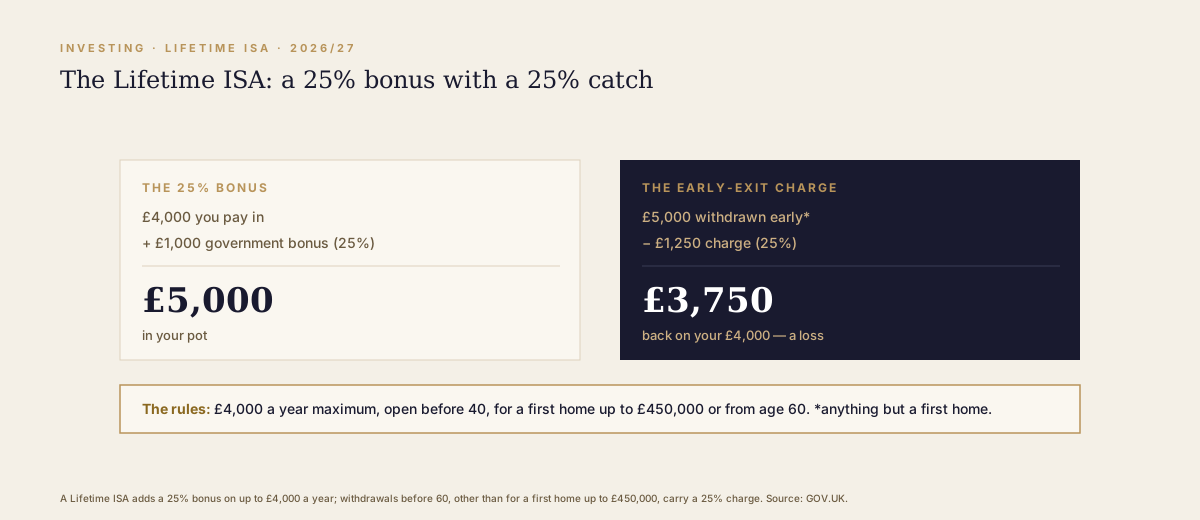
A Lifetime ISA is a tax-free UK savings account for adults aged 18 to 39 that attracts a 25% government bonus on annual contributions of up to £4,000. Save up to £4,000 a year for 2026/27 in a Lifetime ISA and the government adds a 25% bonus, up to £1,000, toward a first home or retirement from age 60. It is one of the few ways to get free top-ups on savings outside a pension, but only people who open it in the 18 to 39 age window can use it. Money taken out before age 60 for anything other than a first home carries a 25% charge that can return less than you paid in.
A Lifetime ISA is a UK savings account that hands you a 25% government bonus on what you put in, up to £1,000 a year, to help buy a first home or build a pot for later life. You can open one between the ages of 18 and 39, pay in up to £4,000 each year, and keep contributing until you turn 50. The catch sits in the access rules: take the money out before age 60 for any reason other than a first home and a 25% charge applies, which can leave you with less than you saved. The figures in this article are correct for the 2026/27 tax year. What follows is how the bonus works, where the withdrawal charge bites, how a Lifetime ISA compares with a pension, and why the government plans to replace it.
How does a Lifetime ISA work?
A Lifetime ISA lets UK residents aged 18 to 39 save up to £4,000 a year for 2026/27, with the government adding a 25% bonus worth up to £1,000 a year, paid monthly. The money can be withdrawn with no charge to buy a first home costing £450,000 or less, or from age 60. Contributions can continue until age 50.
Contents
- How does a Lifetime ISA work?
- How much is the Lifetime ISA bonus worth?
- What is the Lifetime ISA withdrawal charge?
- Lifetime ISA vs pension: which wins for retirement?
- Is the Lifetime ISA being scrapped?
- Is a Lifetime ISA worth it?
How does a Lifetime ISA work?
A Lifetime ISA works by topping up your own savings with a 25% government bonus, in return for keeping the money locked to one of two goals: a first home or later life. To open one you must be a UK resident aged between 18 and 39. Once it is open you can pay in up to £4,000 a year for 2026/27, and the government pays in a further £1 for every £4 you save, up to £1,000 a year, paid automatically each month based on the previous month’s contributions.
That payment limit is not an extra allowance on top of everything else. It sits inside your overall ISA allowance, £20,000 a year for 2026/27, so paying the full £4,000 into a Lifetime ISA leaves £16,000 for other ISAs. You can hold your Lifetime ISA in cash or in stocks and shares, and the choice matters: a cash Lifetime ISA suits a house deposit you expect to use within a few years, while an invested one suits a longer retirement horizon. The same logic that governs any choice of investment wrapper applies here.
Contributions, and the bonus, continue only until you turn 50. After that the account stays open and keeps growing, but you can no longer pay in or earn the bonus. Anyone who opened a Help to Buy ISA in the past can transfer it into a Lifetime ISA, though the £4,000 annual limit still applies to the transferred amount.
Risk warning
Investing in shares should be regarded as a long-term investment and should fit in with your overall attitude to risk and financial circumstances.
How much is the Lifetime ISA bonus worth?
The Lifetime ISA bonus is worth 25% of everything you pay in, which means up to £1,000 each year and as much as £32,000 over a lifetime of maximum contributions from 18 to 49. On a single £4,000 contribution the government adds £1,000, and that £1,000 then earns interest or investment growth alongside your own money, so the real value compounds over time. How that pot is invested, rather than left in cash, is where tailored investment advice can change the long-term outcome.
The bonus is genuinely free money, not a tax rebate, and no ordinary savings account comes close to matching a guaranteed 25% uplift. For a first-time buyer saving steadily, that uplift can bring a deposit years closer. Building the habit of paying in the full £4,000 each year, in the way a structured budgeting approach such as the 50/30/20 rule encourages, is what turns the bonus into a meaningful sum.
Aisha, 27, saving for a first flat
Aisha opens a cash Lifetime ISA and pays in the full £4,000 every year for five years, a total of £20,000 of her own money.
Over those five years the government adds £1,000 a year, so £5,000 in bonuses lands in her account on top of her contributions and any interest earned.
By the time she buys a £300,000 first flat, she has £25,000 from contributions and bonus alone toward her deposit. The £5,000 bonus is money she would never have had in a standard savings account, and it costs her nothing as long as the home qualifies.
The catch is the ceiling. Because the maximum bonus is £1,000 a year, a Lifetime ISA rewards consistency over lump sums: someone who can only spare £2,000 in a year gets £500, and there is no way to carry forward an unused allowance to a later year.
Risk warning
The favourable tax treatment of ISAs may be subject to changes in legislation in the future.
What is the Lifetime ISA withdrawal charge?
The Lifetime ISA withdrawal charge is a penalty of 25% for 2026/27, applied to any money you take out before age 60 for a reason other than buying a qualifying first home. A withdrawal charge is the government’s way of recovering its bonus, plus a little more, when the money is not used for its intended purpose. There are only three charge-free routes out: buying a first home costing £450,000 or less, reaching age 60, or being terminally ill with less than 12 months to live. To use it for a first home, the account must also have been open for at least 12 months.
The arithmetic of the charge surprises people, because 25% out is not the mirror image of 25% in. The bonus is added to your contribution, then the charge is taken from the larger total, so you lose part of your own capital as well as the bonus.
How the withdrawal charge can leave you with less than you paid in
Daniel, 32, saved £4,000 into his Lifetime ISA and needs to take it out for an emergency, not a first home.
| Input | Value |
|---|---|
| Daniel’s own contribution | £4,000 |
| Government bonus added | £1,000 |
| Account balance | £5,000 |
- Balance including the bonus: £4,000 + £1,000 = £5,000
- Withdrawal charge on the full balance: £5,000 at 25% = £1,250
- Amount returned to Daniel: £5,000 less £1,250 = £3,750
Result: Daniel gets back £3,750, which is £250 less than the £4,000 he paid in. The charge takes back more than the bonus ever added.
What is the Lifetime ISA withdrawal charge?
The Lifetime ISA withdrawal charge is 25% of the amount taken out before age 60 for any reason other than a qualifying first home or terminal illness. Because the charge applies to your contribution plus the bonus, it returns about 6.25% less than you originally paid in, so it removes more than the bonus added.
This is why the Lifetime ISA suits money tied to a fixed plan, not a general rainy-day fund. If there is any real chance you will need the cash before age 60 for something other than a first home, the charge turns a generous account into an expensive one.
Lifetime ISA vs pension: which wins for retirement?
For retirement saving, a pension is usually the first place to look, especially if you are employed. Employer contributions are effectively free money, and a Lifetime ISA cannot compete with them. Pensions are also more attractive for higher-rate and additional-rate taxpayers, because the tax relief available can be worth far more than the Lifetime ISA’s 25% government bonus.
But once those advantages have been used, the Lifetime ISA can become very compelling for a specific group of savers: basic-rate taxpayers who have already secured their full employer pension match and do not expect to need the money before age 60.
For a basic-rate taxpayer, the upfront maths can look similar. Paying £80 into a pension can become £100 after basic-rate tax relief. Paying £80 into a Lifetime ISA can also become £100 after the 25% government bonus. The difference comes later. Pension withdrawals are usually taxable, apart from the tax-free lump sum, whereas Lifetime ISA withdrawals from age 60 are completely tax-free. For someone who expects to pay tax on their pension income in retirement, that can make the Lifetime ISA a more efficient home for extra long-term savings.
The Lifetime ISA also offers a form of backup access that pensions do not. Pension money is generally locked away until minimum pension age, while Lifetime ISA money can technically be withdrawn earlier. However, this flexibility should not be overstated. Unless the withdrawal is for a qualifying first-home purchase, terminal illness, or made from age 60, a 25% withdrawal charge normally applies. That charge more than removes the government bonus, so a Lifetime ISA should still be treated as long-term money.
The practical order for many employed savers is therefore:
- Contribute enough to your workplace pension to get the full employer match.
- Use extra pension contributions where higher-rate tax relief or large contribution limits make them attractive.
- Consider a Lifetime ISA for additional retirement savings if you are a basic-rate taxpayer, have already secured your employer match, and are comfortable leaving the money until at least 60.
The Lifetime ISA is not usually better than a workplace pension overall. It has a £4,000 annual contribution limit, bonuses stop at age 50, and early withdrawals can be costly. But it does earn a clear place in retirement planning for basic-rate taxpayers who want tax-free income from age 60 alongside a taxable pension. For those savers, it can be more than a niche product, it can be a genuinely useful second retirement wrapper.
Risk warnings
Pensions
Levels and bases of, and reliefs from, taxation are subject to change and their value will depend upon personal circumstances. Taxation and pension legislation may change in the future.
A pension is a long-term investment, the value of your investment and the income from it may go down as well as up. Your eventual income may depend upon the size of the fund at retirement, future interest rates and tax legislation.
Your pension income could also be affected by the interest rates at the time you take your benefits. The tax implications of pension withdrawals will be based on your individual circumstances, tax legislation and regulation which are subject to change in the future.
Cash and deposits
Some accounts have notice periods or fixed terms. During these periods, you may not be able to access your funds, or may incur penalties for early withdrawal.
Is the Lifetime ISA being scrapped?
Not immediately, but the government has confirmed it intends to replace the Lifetime ISA. After first flagging the change in the Autumn 2025 Budget, the Treasury published a consultation on a new First Time Buyer ISA on 23 June 2026, which would be offered in place of the Lifetime ISA. The consultation closes on 18 August 2026. The Treasury’s stated reasoning is that trying to serve two goals, a first home and retirement, made the product unnecessarily complex.
The proposed First Time Buyer ISA would focus only on first-time buyers and drop the retirement option. Crucially, it would pay the government bonus at the point you buy your home rather than as you save, which removes the withdrawal penalty that catches out savers whose circumstances change. The subscription limit, the qualifying property price cap, and the bonus rate have not yet been set, and will follow at a future fiscal event. The new product is expected to launch from around April 2028.
For now, nothing has changed. You can still open a Lifetime ISA, still receive the bonus, and existing accounts will continue under current rules until any replacement is in place. Anyone weighing one up should treat the looming reform as a reason to understand the exit rules clearly, not as a reason to rush in or stay out.
Is a Lifetime ISA worth it?
A Lifetime ISA is worth it for many first-time buyers aged under 40 who are buying a home costing £450,000 or less. The 25% government bonus is a powerful boost that ordinary savings accounts cannot match. The main trade-off is flexibility: the money is intended for either a first-home purchase or later-life savings, and withdrawing it outside the permitted rules usually triggers a 25% charge that can leave you with less than you put in.
For retirement, the answer depends on your employment status, tax position and access to a workplace pension. A pension should usually come first if it includes employer contributions, because that is money a Lifetime ISA cannot replace. Pensions are also normally stronger for higher-rate taxpayers, who can receive more valuable tax relief.
But a Lifetime ISA can be very worthwhile once those pension advantages have been used. It is particularly useful for the self-employed, who do not receive employer pension contributions, and for basic-rate taxpayers who have already secured their full workplace pension match. In that case, the Lifetime ISA’s 25% bonus can broadly match basic-rate pension relief on the way in, while withdrawals from age 60 are tax-free. That can make it a useful source of tax-free income alongside a taxable pension.
The limits still matter. You can only pay in up to £4,000 a year for 2026/27, bonuses stop at age 50, and early withdrawals can be costly. A Lifetime ISA is therefore unlikely to do all the heavy lifting for retirement on its own.
The deciding question is whether your goal matches the account’s rules. Use a Lifetime ISA for a definite first home purchase or long-term savings you can leave until 60, and it can be hard to beat. Use it as a flexible savings pot, and the withdrawal charge can quickly undo the benefit. As with most tax wrappers, the account should follow the plan, not the other way round.
Risk warning
The taxation of the investment is dependent on the individual circumstance of each investor, and may be subject to change in the future.
Does your goal fit the Lifetime ISA rules?
The Lifetime ISA pairs an unusually generous 25% bonus with unusually strict access rules, and the value you get from it depends entirely on whether your goal fits those rules. For a first-time buyer under 40 with a target under £450,000, it is one of the most rewarding accounts available. For flexible savings, the 25% withdrawal charge makes it a poor fit. With a replacement product on the horizon for around 2028, the sensible approach is to understand exactly what you are committing the money to before you pay in, and to let the wider plan, not the headline bonus, make the call.
Frequently asked questions
What is a Lifetime ISA?
A Lifetime ISA is a tax-free UK savings account for adults aged 18 to 39 that adds a 25% government bonus to contributions of up to £4,000 a year for 2026/27. The money is meant for buying a first home costing £450,000 or less, or for use from age 60.
How does the Lifetime ISA bonus get paid?
The government pays the 25% bonus automatically each month, based on what you paid in the previous month. You do not claim it yourself: your Lifetime ISA provider claims it from HMRC and adds it to your account, where it earns interest or investment growth like the rest of the pot.
Can you have a Lifetime ISA and a pension?
Yes. A Lifetime ISA and a pension are separate products and you can pay into both in the same tax year. The £4,000 Lifetime ISA limit sits inside your overall ISA allowance of £20,000 a year for 2026/27 and is entirely separate from your pension annual allowance.
Is a Lifetime ISA worth it for the self-employed?
Often yes, because the self-employed get no employer pension contributions, so the 25% Lifetime ISA bonus is a rare source of free top-ups. The trade-off is the £4,000 annual cap and the loss of higher-rate tax relief that a pension can give, so many self-employed savers use both.
Will the Lifetime ISA be scrapped?
Not immediately. The government published a consultation on 23 June 2026 on replacing the Lifetime ISA with a First Time Buyer ISA that pays its bonus at purchase and carries no withdrawal penalty. The consultation closes on 18 August 2026 and the new product is expected from around April 2028, with existing Lifetime ISAs continuing under current rules until then.
Can you open a Lifetime ISA after age 40?
No. The account has to be opened while you are 18 to 39. If you opened one earlier, you can keep paying in and receiving the bonus until you turn 50, but you cannot open a new Lifetime ISA once that window has passed.
Risk warnings
The Financial Conduct Authority does not regulate Cashflow Planning.
HM Revenue and Customs practice and the law relating to taxation are complex and subject to individual circumstances and changes which cannot be foreseen.