Adjusted net income is total taxable income from all sources, calculated before the personal allowance is deducted and after grossed-up pension contributions and Gift Aid donations are subtracted. Your adjusted net income decides whether you keep allowances such as the personal allowance and Child Benefit, and pension contributions and Gift Aid reduce it. It is your total taxable income after those deductions, and the personal allowance, the High Income Child Benefit Charge, and Tax-Free Childcare are all tested against it rather than your gross salary. Salary sacrifice lowers it before it is ever counted, while personal pension payments reduce it through grossing up.
Your adjusted net income, not the salary on your payslip, is the number that decides whether you keep the personal allowance, Child Benefit, and government childcare support. It is your total taxable income from every source, reduced by the grossed-up value of your pension contributions and Gift Aid donations. The distinction matters because a six-figure earner and a six-figure adjusted net income are not the same thing, and the gap between them is where almost all of the planning happens. All figures and thresholds in this article are correct for the 2026/27 tax year.
How is adjusted net income calculated?
Start with your total taxable income from all sources for the tax year. Take off any reliefs such as trading losses, then deduct your grossed-up Gift Aid donations and grossed-up personal pension contributions. The result is your adjusted net income for 2026/27, the figure HMRC uses to taper allowances above £100,000.
Contents
- What is adjusted net income?
- How is adjusted net income calculated?
- Why does adjusted net income matter?
- Is it the same as adjusted income for the taper?
- How can you reduce your adjusted net income?
- Should you manage your adjusted net income?
What is adjusted net income?
Adjusted net income is your total taxable income from all sources, calculated before the personal allowance is applied and after grossed-up pension contributions and Gift Aid donations are removed. It is not a figure that appears on your payslip or your P60, and for many people it is meaningfully lower than their gross pay. HMRC uses it as the income measure for a cluster of allowance thresholds, which is why two people on identical salaries can face very different tax outcomes.
The phrase to understand first is net income. Net income is your total taxable income for the year after deducting reliefs such as trading losses, but before the adjustments for pensions and charity. Adjusted net income then takes that net income and subtracts two specific items: grossed-up Gift Aid donations and grossed-up personal pension contributions.
Income from every taxable source counts towards the starting figure, not just the salary on your payslip. The full list includes:
- Employment income: salary, wages, bonuses, overtime, and commission
- Taxable benefits in kind reported on a P11D, such as a company car, private medical insurance, or a low-interest loan
- Profits from self-employment or a partnership
- Most pension income, including the State Pension and income from workplace and personal pensions
- Other taxable state benefits, such as Carer’s Allowance
- Rental profit from property
- Savings and investment interest, including amounts covered by the personal savings allowance
- Dividends, including those covered by the dividend allowance
- Income from trusts, foreign income, and chargeable event gains on investment bonds
Benefits in kind are the item people most often overlook. A company car or private medical cover never arrives as cash, but its taxable value still counts towards adjusted net income, and can be enough to push you over a threshold on its own. Genuinely tax-free income does not count, so ISA returns, the 25% tax-free cash from a pension, and Premium Bond prizes are all left out.
Risk warnings
Investments
The value of investments and any income from them can fall as well as rise. You may not get back the full amount invested.
The taxation of the investment is dependent on the individual circumstance of each investor, and may be subject to change in the future.
ISAs
The favourable tax treatment of ISAs may be subject to changes in legislation in the future.
Pensions
A pension is a long-term investment, the value of your investment and the income from it may go down as well as up. Your eventual income may depend upon the size of the fund at retirement, future interest rates and tax legislation.
Your pension income could also be affected by the interest rates at the time you take your benefits. The tax implications of pension withdrawals will be based on your individual circumstances, tax legislation and regulation which are subject to change in the future.
Tax, trusts and estate planning
HM Revenue and Customs practice and the law relating to taxation are complex and subject to individual circumstances and changes which cannot be foreseen.
How is adjusted net income calculated?
You calculate adjusted net income in a short sequence of steps set out in HMRC’s guidance on adjusted net income. First, total your taxable income and take off reliefs such as trading losses to reach net income. Second, deduct your grossed-up Gift Aid donations. Third, deduct your grossed-up personal pension contributions. Finally, add back any tax relief claimed on certain trade union or police organisation payments.
The grossing-up step is where most errors happen. Grossing up means adding back the basic-rate tax relief already given on a payment, so an £80 contribution counts as £100. Because basic-rate relief is 20% for 2026/27, you gross up by dividing the net amount by 0.8. An £800 Gift Aid donation therefore reduces adjusted net income by £1,000, not £800.
The diagram shows that adjusted net income is total taxable income with two deductions stacked underneath it: grossed-up Gift Aid and grossed-up personal pension contributions. Each grossed-up deduction is larger than the cash you actually paid, because it includes the basic-rate relief already claimed. Salary sacrifice contributions reduce the figure at the very top, before any income is counted, so they never appear in this stack at all.
How grossed-up contributions bring adjusted net income to £100,000
Marcus, 45, has a £110,000 salary plus £6,000 of rental profit for 2026/27.
| Input | Value |
|---|---|
| Total taxable income | £116,000 |
| Grossed-up Gift Aid donation | £1,000 |
| Grossed-up pension contribution | £15,000 |
- Net income before adjustments: £110,000 salary plus £6,000 rental profit = £116,000.
- Deduct grossed-up Gift Aid (£800 paid net, grossed up at 100/80 to £1,000): £115,000.
- Deduct grossed-up pension contribution (£12,000 paid net, grossed up to £15,000): £100,000.
Result: Marcus’s adjusted net income is £100,000, so he keeps his full £12,570 personal allowance for 2026/27.
Risk warning
Levels and bases of, and reliefs from, taxation are subject to change and their value will depend upon personal circumstances. Taxation and pension legislation may change in the future.
Why does adjusted net income matter?
Adjusted net income matters because it is the income measure behind several of the most expensive thresholds in the tax system, and all of them use it instead of gross salary. The personal allowance, the High Income Child Benefit Charge, and Tax-Free Childcare are each tested against adjusted net income, so reducing that one figure can unlock more than one benefit at the same time.
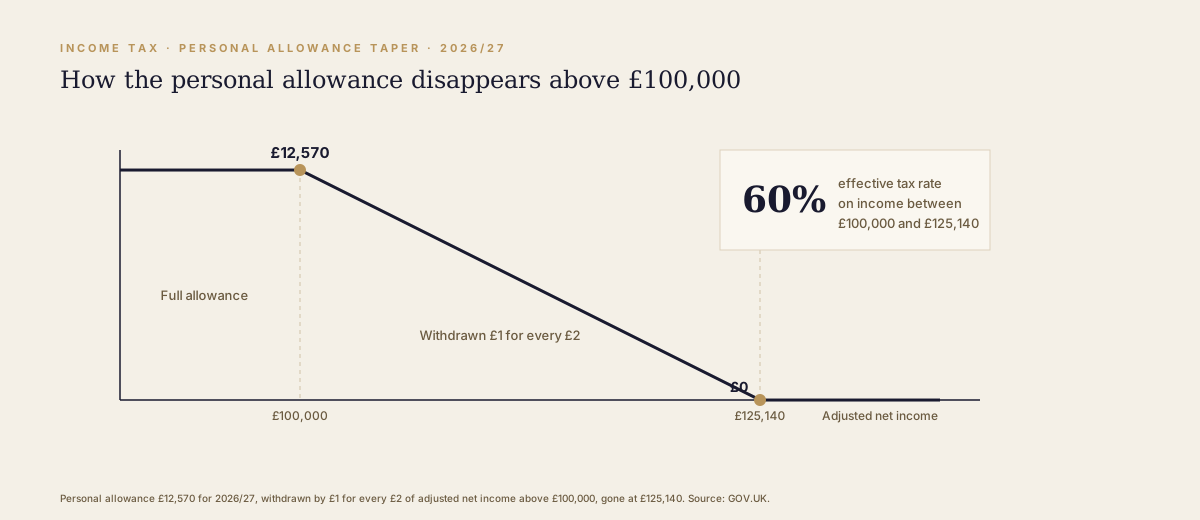
The personal allowance is the clearest example. It is set at £12,570 a year for 2026/27 and withdrawn by £1 for every £2 of income above £100,000, reaching zero at £125,140. Because the test is on adjusted net income, the slice of income between £100,000 and £125,140 carries an effective tax rate of around 60%, the mechanism we set out in full in our guide to the 60% tax trap.
For families the stakes are often higher. Crossing £100,000 of adjusted net income removes Tax-Free Childcare and the funded childcare hours entirely, which can cost more than the pay rise that triggered it, an interaction we explore in our explainer on the £100,000 childcare limit. The High Income Child Benefit Charge uses the same measure, beginning at £60,000 a year for 2026/27 of adjusted net income and clawing back all Child Benefit by £80,000.
Unlike the flat 60% at £100,000, the effective rate the Child Benefit charge creates in the £60,000 to £80,000 band depends on how many children you have, because a fixed amount of benefit is withdrawn across that range. On top of the 40% higher rate, the clawback pushes the combined effective rate to around 47% with one child and roughly 56% with three. At four children it passes 60%, so a large family in this band faces a steeper rate than the personal allowance taper produces. The more children you have, the steeper the rate, and the more a pension contribution in this band is worth.
Does salary sacrifice reduce your adjusted net income?
Yes, but indirectly. With salary sacrifice you give up gross salary before it is paid, so the sacrificed amount never counts as taxable income and never enters the adjusted net income calculation. A personal pension contribution works differently: it is taxable income first, then deducted as a grossed-up figure when adjusted net income is worked out.
Adjusted net income is the single figure that ties the personal allowance, Child Benefit, and childcare support together. Move it below a threshold and you can recover all three at once.
Risk warning
Employees earning more than £260,000 with a tapered annual allowance may incur additional annual allowance tax charges.
Is it the same as adjusted income for the taper?
No, and this is one of the most common and costly confusions in pension planning. Adjusted net income governs the personal allowance and child-related thresholds. The tapered annual allowance for high earners uses two completely different measures, threshold income and adjusted income, which are defined separately and sit at far higher levels.
These are two different calculations, not two names for one figure. Adjusted income for the tapered annual allowance adds employer pension contributions back in, whereas adjusted net income deducts your own contributions. A director who reduces adjusted net income with a large employer contribution can still find that the same contribution pushes their adjusted income towards the taper threshold of £260,000 a year for 2026/27. The two figures move in opposite directions for the same payment, which is exactly why they should never be treated as interchangeable.
How can you reduce your adjusted net income?
The most reliable way to reduce adjusted net income is to make a pension contribution or a Gift Aid donation, because both are deducted from the figure on a grossed-up basis. A gross pension contribution reduces adjusted net income pound for pound, so contributing enough to drop below a threshold can restore an allowance worth far more than the cash you part with.
There are two routes for a pension contribution and they are not equivalent. With salary sacrifice, you give up gross salary before it is paid, so it never counts as income and your adjusted net income is lower from the start. With a personal contribution paid under relief at source, you pay from net income, the provider adds basic-rate relief, and the grossed-up amount is then deducted when adjusted net income is calculated.
The size of contribution is capped. Pension contributions are limited by the annual allowance, set at £60,000 a year for 2026/27 for most people, and by your relevant UK earnings. If a bonus or one-off gain has pushed your income up sharply, carry forward of unused allowance from the previous three years can make a larger contribution possible. Gift Aid donations carry no such cap, and reduce adjusted net income in the same way while removing the money from your estate rather than saving it for later.
Should you manage your adjusted net income?
For anyone whose income sits just above £100,000 or £60,000, actively managing adjusted net income is usually worthwhile, because the relief on bringing it back under the line is unusually high. At £100,000 a pension contribution earns roughly 60% effective relief as the personal allowance is restored, among the highest returns available anywhere in the tax system. At £60,000 the relief reverses the Child Benefit charge instead, so it depends on family size: comfortably above the 40% higher rate for a parent of two or three children, and higher still for larger families. In both cases the arithmetic is certain, even if future rules can change.
The trade-off is access. Reducing adjusted net income through a pension means locking the money away until at least age 55, rising to 57 from 6 April 2028, so the right answer depends on whether that income is needed sooner. Someone clearing a mortgage or building a cash reserve may rationally accept the higher tax and keep the flexibility, which is the kind of decision pension and retirement planning exists to weigh. Company directors, who control the mix of salary, dividends, and employer contributions, have the most room to keep adjusted net income below a threshold by design rather than correction.
Risk warnings
Your home may be repossessed if you do not keep up repayments on your mortgage. Think carefully before securing debts against your home.
Not all mortgage contracts are regulated by the Financial Conduct Authority.
The figure the tax system actually reacts to
Adjusted net income is best understood as the real income figure the tax system reacts to, the one sitting behind the salary on the payslip. It rewards looking at total income across the whole year, including dividends and bonuses, rather than the monthly headline. For anyone hovering near £60,000 or £100,000, mapping adjusted net income as part of a lifetime cashflow plan shows whether a contribution now buys back more than it costs, or whether the threshold is one to simply ride out for a year.
Frequently asked questions
What is adjusted net income?
Adjusted net income is your total taxable income from all sources, less grossed-up pension contributions and Gift Aid donations, calculated before the personal allowance is deducted. It is the figure HMRC uses to means-test the personal allowance, Child Benefit, and childcare support, rather than your gross salary.
How does adjusted net income affect my personal allowance?
The personal allowance falls by £1 for every £2 of adjusted net income above £100,000. With an allowance of £12,570 a year for 2026/27, it disappears entirely once adjusted net income reaches £125,140. The reduction is tested on adjusted net income, so pension contributions and Gift Aid can preserve it.
Should I reduce my adjusted net income?
Often, yes, if you are just above £100,000 or £60,000. At £100,000 a pension contribution earns around 60% effective relief by restoring the personal allowance. At £60,000 it reverses the High Income Child Benefit Charge, so the relief depends on how many children you have, typically 47% to around 60%. The trade-off is access: pension money is locked away until at least age 55, rising to 57 from 6 April 2028.
Do pension contributions reduce adjusted net income?
Yes. A personal pension contribution is deducted as a grossed-up figure when adjusted net income is worked out, so an £80 net payment reduces it by £100. Salary sacrifice contributions reduce it too, but indirectly, because the sacrificed salary is never counted as income in the first place.
Is adjusted net income the same as taxable income?
No. Taxable income is your income before the deductions for grossed-up pension contributions and Gift Aid donations. Adjusted net income takes that figure and removes those reliefs, which is why it can be considerably lower than the salary shown on your payslip or P60.
Does adjusted net income include dividends and savings interest?
Yes. Adjusted net income includes income from all taxable sources, so dividends, savings interest, rental profit, and most pension income all count towards it. This is why a large dividend or one-off gain can push you over a threshold even if your salary sits comfortably below it.
Risk warning
Note that salary sacrifice arrangements should be appropriately documented with the employee signing an agreement letter unless it is written into the employment contract. In addition, you would need to ensure that your employee payslips can display the amount of the salary exchanged.